Last updated 2026-07-25
TL;DR
You can plant a good food plot with a hand spreader, a backpack sprayer, a rake or hand tiller, and a lawn mower or ATV. Kill existing vegetation, broadcast seed at the right depth (or none, for clover and brassicas), and time it to your zone's frost dates. No tractor needed for plots under an acre or two.
what is a food plot, exactly
A food plot is a planted patch of forage on hunting land meant to feed deer and other wildlife, usually somewhere between a quarter acre and a few acres. It's not a garden and it's not a lawn. Most plots run a mix of legumes (clover, soybeans), brassicas (turnips, radishes), cereal grains (oats, wheat, rye), or straight corn and sorghum, depending on the season and what the landowner wants out of it: early season attraction, late season groceries, or just better deer health going into winter. You do not need a tractor to make one. Small plots, generally under an acre, are actually easier to manage by hand or with a UTV/ATV than people assume. The USDA's NRCS technical guidance on wildlife food plots treats them as a habitat management practice, not a farming operation, and plenty of the guidance applies just as well to a half-acre hand-planted patch as a 10-acre disked field [1]. What you actually need is four things: a way to kill or knock back existing vegetation, a way to get seed into contact with soil, a way to pack it down, and a way to keep weeds from choking it out early. A tractor does all four faster. A hand sprayer, a hand seeder, some boots, and a mower can do all four too, just slower and on a smaller scale.
what equipment do you actually need without a tractor
The realistic no-tractor kit costs somewhere between $150 and $500 depending on what you already own, and most of it does double duty for other property chores. A backpack sprayer (2 to 4 gallon) or a pull-behind ATV sprayer handles herbicide application, generally the single most important step for a clean plot. A hand-crank broadcast seeder (the kind you wear on a shoulder strap) throws seed evenly over up to about a half acre per fill and costs $20 to $40. For seed-to-soil contact, a garden rake, a hand tiller, or a drag made from a chunk of chain-link fence or a section of cattle panel works fine on small ground. A push mower or brush mower knocks down existing growth before you spray, and later keeps weeds from overtopping new seedlings. If you have a four-wheeler, a small tow-behind disc, drag harrow, or cultipacker (often called a "plot roller") turns a half-day of hand labor into an hour, and these attachments run $300 to $900 used. That's the single best upgrade if you're doing more than one plot a year. But plenty of hunters plant good clover and brassica plots with nothing but a sprayer, a rake, and their own legs, especially on plots under a half acre. A soil test kit or mail-in test from your state land-grant extension office is worth doing before you buy a bag of anything. Lime and fertilizer decisions should follow your specific soil test results, not a generic recommendation. Your test report is the real authority here, follow what it says over any blanket advice, including this article.
when to plant food plots for deer
Timing depends on species and your zone, but the two big windows are late summer to early fall for annual brassicas and cereal grains, and spring through early summer for clover and other perennials. Most of the Midwest and Upper South plant fall brassica and grain plots between mid-August and mid-September, aiming for 60 to 90 days of growth before a hard frost locks things down. Spring plots (clover, chicory, soybeans as a summer annual) generally go in April through June once soil temps warm and frost risk has passed, timing that follows your local extension office's last-frost-date guidance rather than a fixed calendar date, since a last frost in coastal Alabama and one in northern Minnesota can be six or seven weeks apart. Check your state extension's planting date tables for your specific county; Penn State Extension, for example, publishes zone-specific windows for both spring and fall wildlife plantings that split Pennsylvania into three separate planting zones alone. That kind of local nuance matters more than any single national date.
when to plant oats for deer
Oats for deer are almost always planted as a fall annual, generally 6 to 8 weeks before your area's first expected hard frost, so the plants get real growth in before cold shuts them down. For most of the whitetail range that lands somewhere between late August and mid-September. Oats germinate fast, often within 5 to 10 days in warm, moist soil, and deer will hit young oat shoots hard, sometimes within days of emergence. That fast green-up is exactly why oats are a staple in fall food plot blends: they give you visible growth and early attraction while slower brassicas and clover are still establishing roots. Spring oat plantings exist too (as a nurse crop for clover, for example) but for pure deer attraction, fall is the standard play across almost the entire whitetail range.
when to plant turnips for deer
Turnips go in mid to late summer, generally 90 to 100 days before your first expected frost, because they need that long a runway to bulb out and reach peak palatability. Plant too late and you get leafy tops with no bulb development; plant too early in hot, dry conditions and germination suffers. For most of the whitetail range this means a planting window of late July through late August. Turnips actually taste better to deer after a hard frost or two, because the cold converts stored starches to sugars, sweetening both the tops and the bulbs. That's why turnip plots often see their heaviest use in late November and December rather than right after planting, a pattern well documented in university brassica forage trials [2]. Mix turnips with a cereal grain like oats or wheat for a blend that gives you both early green attraction and a late-season bulb crop from the same planting date.
do deer eat clover and do deer like clover
Yes, clover is one of the most consistently used food plot forages across the whitetail range, and deer show strong preference for it through spring, summer, and fall. White clover varieties (Ladino, Durana, and similar) are the standard perennial plot choice because they tolerate grazing pressure well and can produce usable forage for three to five years from a single planting if maintained. Clover's appeal comes down to protein content, typically running 25 to 30 percent crude protein in vegetative growth, which matters most in spring and summer when does are lactating and bucks are growing antlers [3]. It's also one of the most forgiving plots for a no-tractor setup: clover seed is tiny, needs only light soil contact (a quarter inch of coverage or less), and can be broadcast by hand and cultipacked or even just walked over and rained in. The tradeoff is that clover plots need mowing two to four times a season to control weed competition and keep the clover from getting stemmy, plus an annual mowing or light disking in early spring to knock back old growth. That maintenance is easy without a tractor. A brush mower or even a heavy-duty push mower on a half-acre clover plot is a manageable weekend chore, not a machinery problem.
do deer eat sorghum
Yes, deer eat sorghum, both the leaves and developing grain heads, though it's generally considered a secondary or supporting food plot species rather than a primary draw compared to corn, soybeans, or brassicas. Sorghum shows up most often in food plots as a standing-grain option for late fall and winter, since the seed heads hold up well and provide calories after softer forages have been grazed out or gone dormant. Sorghum is drought tolerant and grows well in poorer, sandier soils where corn struggles, which makes it a practical choice for hunters without irrigation or premium ground. It's a warm-season annual, planted after soil temps hit around 60 degrees Fahrenheit, generally late spring into early summer depending on region. For a no-tractor plot, sorghum is plantable by hand broadcast, but because it's a bigger seed that wants roughly half an inch to an inch of soil coverage, you'll get better stands if you can drag or lightly till it in rather than just broadcasting on bare, unworked ground.
what are deer's favorite foods
There's no single ranked list backed by rigorous science, deer preference shifts by season, region, and what's available, but extension research and browse studies consistently put a handful of foods at the top: soybeans and clover for protein-rich forage, acorns (especially white oak acorns) for fall fat reserves, and brassicas like turnips and radishes for late-season energy after frost sweetens them [2]. Native and agricultural food preference studies, including long-running work from Mississippi State University's deer lab, generally rank soybeans and cowpeas among the highest-preference food plot plantings when available, with deer selecting them over most other planted forages during the growing season [4]. But acorn availability in a given fall often outweighs any planted plot; in a heavy mast year, deer will largely ignore food plots in favor of oak flats. The honest answer is that "favorite food" is a moving target tied to protein needs, energy needs, and what's actually on the landscape that month. That's part of why most solid plot plans mix a legume, a brassica, and a grain rather than betting on one species.
do deer like honey
There's no credible wildlife research showing honey as a meaningful deer food or attractant, and it's not something you'll find in any university food plot or forage guidance. Deer are not physiologically drawn to honey the way, say, a bear is. Some commercial deer attractant sprays include sugar-based or molasses-based scents marketed for attraction, but that's a different product category from a food plot planting. More importantly: using bait or scent attractants at or near a food plot is regulated differently state to state, and in a lot of states, spreading feed, minerals, or scent-based attractants to draw deer for hunting purposes counts as baiting and is illegal or restricted. Check your state wildlife agency's baiting and feeding regulations before using any attractant product, since a legitimate food plot planting and an illegal bait pile can be closer in legal definition than people expect depending on your state's rules [5].
how do you kill existing weeds and grass without a tractor
Herbicide, mostly. A backpack or ATV sprayer with a glyphosate product (following label rates, generally 1 to 2 quarts per acre for a 41 percent glyphosate concentrate, though you should always follow the specific product label) knocks back existing grass and weeds two to three weeks before planting, giving you clean, mostly bare ground to work with . That's the step most no-tractor plotters skip, and it's the single biggest reason DIY plots fail. Broadcasting seed onto a thick sod of fescue or ragweed without killing it first means your new seedlings are competing against established root systems from day one, and they almost always lose. If you'd rather not spray, repeated mowing plus hand tilling or a heavy rake can work on small plots, but it takes more passes and more patience, and grass species like fescue will often just regrow from the roots. For anyone planting more than a quarter acre, a sprayer is the cheapest, most reliable tool in the whole kit.
how do you plant seed without a drill or planter
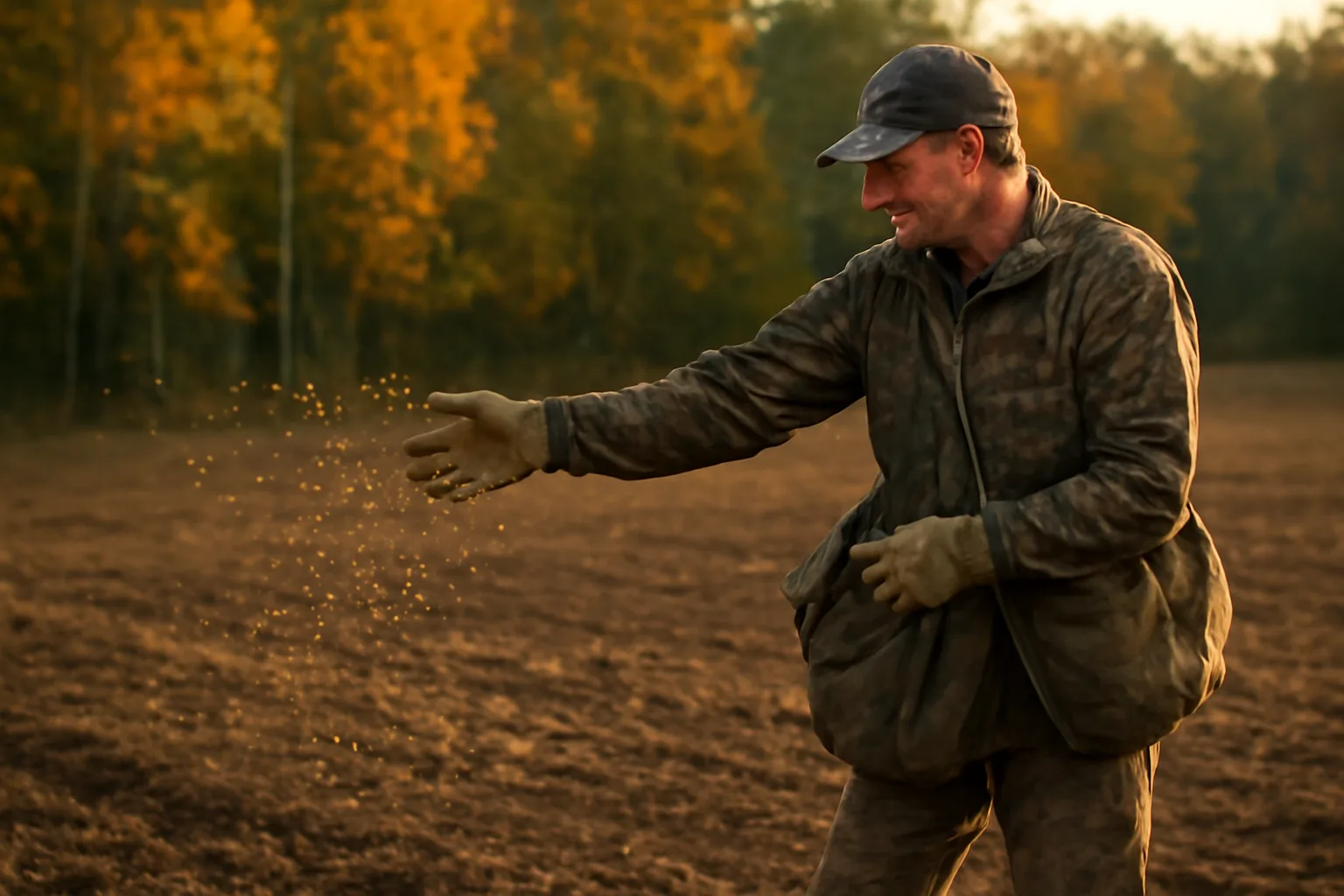
Broadcast it by hand or hand-crank spreader, then get seed-to-soil contact by dragging, raking, or rolling. Different seeds want different depths, and getting this wrong is the second most common reason plots fail. Small seeds like clover, chicory, and brassicas (turnips, radishes) want to sit right on the surface or under just a light dusting of soil, no more than a quarter inch. These can be broadcast onto worked ground and then lightly dragged with a chain-link section, a section of cattle panel, or even a piece of carpet pulled behind an ATV, or in a pinch just cultipacked by walking or driving over the area. Medium and large seeds like oats, wheat, soybeans, and sorghum want a half inch to an inch and a half of coverage, so broadcasting alone on undisturbed ground gives a poor stand. Better approach: broadcast onto worked, loose soil, then rake, drag, or lightly till to bury the seed, then pack it down with a roller, a four-wheeler tire, or by walking it in if the plot is small enough. A rough rule that extension agronomists use across small grains: seed planted too deep either fails to emerge or emerges weak, while seed left on the surface with no coverage dries out before it can germinate. Getting depth close to right matters more than getting the seeding rate exactly right.
do you need lime and fertilizer if you're planting by hand
Yes, and this is one place where planting by hand doesn't change anything. Soil pH and nutrient levels drive plot success more than almost any other factor, and a $15 to $20 soil test through your state land-grant extension office tells you exactly what your specific ground needs . Most food plot species, especially clover and brassicas, want soil pH in the 6.0 to 7.0 range, and a lot of hunting-land soil, particularly in the Southeast and parts of the upper Midwest, runs more acidic than that without lime applied. Lime takes months to fully react with soil, so if your test calls for it, get it down as early in the season as you can, even a season ahead of planting if you can manage it. Bagged pelletized lime and fertilizer can both be spread by hand or with a hand-crank spreader on small plots. It's slower than a tractor-pulled spreader, but the chemistry doesn't care how the product got onto the ground. Follow your soil test's specific lime and fertilizer recommendations over any generic rate you read online, your test results are the actual authority on your dirt, not this article or any seed bag's back-panel suggestion. If you want a starting point pulled together for your specific property, soil type, and region rather than piecing together generic advice from six different sources, that's exactly the gap a Custom Food Plot Plan is built to fill for $99, a one-time, site-specific plan based on your soil test and location rather than a one-size-fits-all seed bag recommendation.
which food plot species work best with hand tools
| White clover | Very small | Surface to 1/4 in | Easy | |
|---|---|---|---|---|
| Brassicas (turnips, radishes) | Small | Surface to 1/4 in | Easy | |
| Oats | Medium | 1/2 to 1 in | Moderate | |
| Wheat/rye | Medium | 1/2 to 1 in | Moderate | |
| Soybeans | Large | 1 to 1.5 in | Moderate to hard | |
| Sorghum | Small-medium | 1/2 to 1 in | Moderate | |
| Corn | Large | 1.5 to 2 in | Hard without a planter | Clover and brassicas are the easiest entry point for a first no-tractor plot because they tolerate surface broadcasting and light coverage. Corn is genuinely difficult without some kind of planter or precise hand-tool method, since depth and spacing both matter a lot for stand establishment; most hunters without equipment skip corn entirely and lean on soybeans, brassicas, and grains instead. |
Some species are just more forgiving of a no-tractor setup than others. Here's how the common options stack up. | Species | Seed size | Depth needed | Hand-plot difficulty |
what's a realistic plot size and layout without machinery
Somewhere between a quarter acre and one acre is the realistic ceiling for a fully hand-planted plot, and honestly a quarter to half acre is where most people should start. Beyond an acre, the labor of spraying, dragging, and packing by hand starts eating whole weekends instead of a half day. Shape matters too. Long, narrow plots (say 60 feet wide by a few hundred feet long) following a field edge or a natural opening are easier to spray and drag evenly by hand than a wide, blocky plot, since you can work in consistent passes. They also tend to draw deer better for bowhunting setups because they create more usable edge relative to open space. If you've got an ATV or UTV, adding a small tow-behind implement (a disc, a drag harrow, or a cultipacker) extends what's realistic up to a couple acres without ever needing a tractor. That's the natural next step once you've proven out a smaller plot works and you want to expand.
Frequently asked questions
Can you really plant a food plot without a tractor?
Yes. Plots under an acre, especially clover and brassica plots, are commonly planted with just a backpack sprayer, a hand-crank seeder, a rake or drag, and a mower. Many hunters manage several small plots this way every year without ever renting or owning a tractor.
Do deer eat sorghum in food plots?
Yes, deer eat both sorghum leaves and grain heads, though it's usually a secondary species behind corn, soybeans, and brassicas. It's most valuable as a standing late-season grain source and does well in drought-prone or sandy soil where corn struggles.
Do deer like clover?
Yes, clover is one of the most consistently preferred food plot forages, with crude protein often running 25 to 30 percent in vegetative growth. Deer use clover heavily spring through fall, and it's an easy species for hand-planting since the seed needs only light soil contact.
When should I plant food plots for deer?
Fall annuals (oats, wheat, brassicas) generally go in 60 to 100 days before your first hard frost, often mid-August through mid-September across most of the whitetail range. Spring plantings (clover, soybeans) go in after last frost, typically April through June. Exact dates depend on your zone, check your state land-grant extension's planting calendar.
When should I plant oats for deer?
Plant oats 6 to 8 weeks before your area's first expected hard frost, generally late August to mid-September for most of the whitetail range. Oats germinate fast, often in 5 to 10 days, and deer will hit young shoots almost immediately.
When should I plant turnips for deer?
Plant turnips 90 to 100 days before your first expected frost, typically late July through late August. Turnips need that full runway to bulb out, and they actually get sweeter and more attractive to deer after a frost or two converts starches to sugar.
What is a food plot?
A food plot is a planted area, usually a quarter acre to a few acres, established on hunting or wildlife land to provide forage for deer and other game. Common plantings include clover, brassicas, cereal grains, soybeans, and corn, chosen by season and region.
What do deer like to eat most?
It varies by season and availability, but soybeans, clover, and acorns consistently rank high in preference studies, with brassicas like turnips gaining favor after frost. In a heavy acorn year, deer often prefer mast over any planted food plot.
Do deer like honey?
There's no wildlife research supporting honey as a deer attractant or meaningful food source. Some commercial attractant products use sugar or molasses scents, but that's separate from planted food plots, and using bait-style attractants may be restricted under your state's baiting laws.
What's the cheapest way to plant a food plot without equipment?
A backpack sprayer ($40 to $80), a hand-crank seeder ($20 to $40), and a soil test ($15 to $20) covers the essentials for under $150. Add a push or brush mower if you don't already own one for weed control between plantings.
Do I still need to soil test if I'm hand-planting?
Yes. Soil pH and nutrient levels matter regardless of how the seed goes in the ground. A land-grant extension soil test tells you exactly how much lime and fertilizer your plot needs, and that recommendation should override any generic rate found online.
How big a food plot can I plant by hand?
A quarter acre to one acre is realistic for a fully hand-planted plot. Beyond that, spraying, dragging, and packing by hand becomes a serious time investment; adding a small ATV-towed implement extends that range to a couple acres.
What's the easiest food plot species for a beginner without a tractor?
White clover and brassicas like turnips are the most forgiving. Both use small seed that needs little to no soil coverage, so broadcasting by hand followed by a light drag or cultipacking gets a workable stand without precision equipment.
Sources
- USDA NRCS, Wildlife Habitat Management practice guidance: Food plots are treated as a wildlife habitat management practice applicable at small and large scale
- University of Tennessee Extension, forage crude protein data for clover: Clover crude protein commonly runs 25-30 percent in vegetative growth
- example state wildlife agency baiting and feeding regulation page (verify per state): Baiting and feeding regulations for deer vary by state and can restrict scent or feed attractants
- University of Georgia Extension, Glyphosate herbicide use in food plot establishment: Glyphosate application rates for site preparation typically run 1-2 quarts per acre of 41 percent concentrate depending on label
- Purdue University Extension, soil testing recommendations for food plots: Soil testing through a land-grant extension office guides specific lime and fertilizer recommendations for plot soil