Last updated 2026-07-25
TL;DR
Plant chicory in a firm, weed-free seedbed at 1/4 inch depth when soil hits 50-60 F, usually spring (April-May) or late summer (August). Seed at 4-6 lbs/acre alone or 2-4 lbs/acre in a clover mix, lime to pH 6.0-7.0 based on your soil test, and mow every 4-6 weeks to keep it leafy and palatable through summer.
What is chicory and why do food plotters plant it
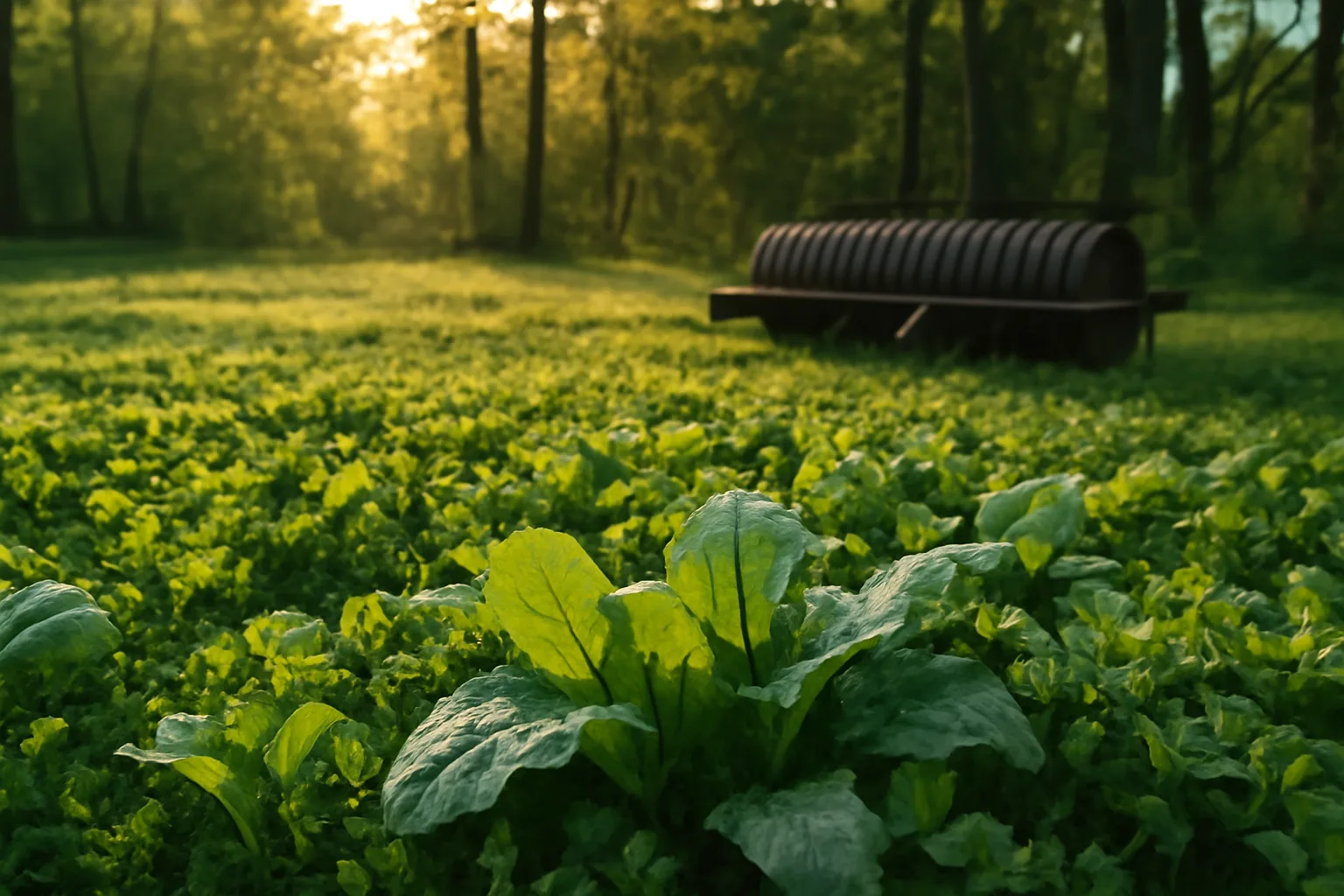
Chicory (Cichorium intybus) is a perennial broadleaf forb, not a grass or a legume, that grows a deep taproot and a rosette of dandelion-like leaves. Deer hunters plant it because it stays green and palatable through the heat of summer when clover often gets tough and beat down by grazing pressure. It's also drought tolerant once established, thanks to a taproot that can run 8 to 10 feet deep in loose soil, pulling moisture and nutrients that shallow-rooted plants can't reach. Forage chicory varieties like 'Puna II' were actually developed for livestock pasture in New Zealand and adapted for U.S. forage systems long before the food plot industry picked them up. Land-grant extension programs still evaluate it primarily as a grazing crop for cattle and sheep, and that research base is where most of the agronomic data on chicory comes from [1]. For deer, chicory offers crude protein commonly tested in the 20 to 32 percent range in young leaf tissue, which rivals or beats most clovers [2]. It's a workhorse plant. It's not flashy, and it won't win a beauty contest sitting next to a blooming clover plot, but it just keeps producing leaf tissue from May through the first hard frosts. If you're building out a broader plan and want to see where chicory fits against other perennials, the food plot whitetail overview breaks down species by season and soil type.
When to plant food plots for deer, and where chicory fits
| Zone 3-4 (Northern Midwest, New England) | Mid-May to early June | Not recommended (frost risk) | |
|---|---|---|---|
| Zone 5-6 (Central Midwest, Mid-Atlantic) | Late April to mid-May | Early-mid August | |
| Zone 7-8 (Southeast, mid-South) | Early-mid April | Late August to early September | If you're planting a mixed perennial plot, chicory is almost always seeded alongside clover rather than alone. That combination smooths out the summer slump when clover slows down and gives deer two forage types in one plot. For a broader look at how chicory stacks up against other perennial and annual options, see deer food plots. |
Timing for any food plot comes down to soil temperature and your region's frost dates, not the calendar date alone. Chicory germinates best when soil temps sit between 50 and 60 F, which typically lines up with mid-spring (April into May in the Midwest and Northeast) or a late-summer window in August for fall establishment in warmer zones. Most food plot species split into two camps: spring/summer plantings (chicory, clover, soybeans, sunflowers) and fall plantings (brassicas, cereal grains, winter wheat). Chicory is unusual in that it can go in either window, but spring establishment gives it a full growing season to build that deep taproot before winter, which matters a lot for long-term stand survival. Here's a rough planting window by region, based on USDA Plant Hardiness Zones and typical last-frost dates: | Region (USDA Zone) | Spring planting window | Fall planting window |
How do you prepare the soil and seedbed for chicory
Chicory wants a firm, fine, weed-free seedbed and a soil pH between 6.0 and 7.0. Below pH 5.5, chicory struggles to take up phosphorus and potassium even if they're in the soil, so lime is the first move if your test comes back low. Start with a real soil test, not a guess. A $15 to $20 soil test through your county extension office or a private ag lab tells you your current pH, phosphorus, potassium, and organic matter. Your lab's recommendation is the actual authority here on how much lime and fertilizer to apply; a general article like this one can only give you ranges. Follow what your specific test says over any blanket number online. General starting points extension programs cite for chicory establishment run something like 300 to 400 lbs/acre of a balanced fertilizer (such as 19-19-19) or an equivalent based on soil test phosphorus and potassium levels, plus lime if pH is below 6.0. Some sandy or acidic ground in the Southeast needs a full ton or two of ag lime per acre to correct pH; that's not unusual and it's why the soil test matters so much before you spend money on seed. Work the ground to a fine, firm seedbed. Chicory seed is small, similar in size to clover seed, and it can't push up through clods or heavy residue. A cultipacker before and after seeding helps a lot. If you're planting into an existing field with sod or heavy weed pressure, spray with glyphosate 2 to 3 weeks ahead of planting to knock back competition, then till or drill.
What seeding rate and planting depth does chicory need
Chicory seed is tiny, so depth control matters more than almost any other step. Plant at 1/4 inch depth, no deeper. Seed planted too deep simply won't emerge; it doesn't have the energy reserves to push through more than half an inch of soil. Seeding rates run 4 to 6 lbs/acre if you're planting chicory alone (broadcast, since drilling small seed alone is tricky), or 2 to 4 lbs/acre if it's mixed with clover, which is the more common approach among food plotters [2]. A typical mix might run 4 lbs of chicory with 6 to 8 lbs of a ladino or red clover blend per acre. Broadcasting works fine for chicory as long as you follow it with a cultipacker or light drag to press seed into firm contact with soil. A no-till drill set at its shallowest depth setting also works, but many drills struggle to meter such small, fluffy seed evenly; mixing the seed with a carrier like cracked corn or pelletized lime helps spread it evenly across the hopper. Don't cover it with a disc or heavy harrow after broadcasting. That's the single most common mistake, burying chicory seed 2 or 3 inches deep where it never breaks the surface. If you want help picking the right seed blend for your specific soil and region before you buy, the Custom Food Plot Plan runs $99 one-time and gives you a species and seeding plan based on your soil test and zone.
How do you maintain a chicory plot through the season
Chicory needs mowing to stay in its vegetative, leafy stage. Left alone, it bolts, sending up a tall flower stalk that gets woody and far less palatable to deer. Mow every 4 to 6 weeks during the growing season, cutting to about 6 to 8 inches, which knocks back the seed stalks and forces new leaf growth. Weed pressure is the other ongoing battle, especially in year one before chicory and clover fill in. Grass-selective herbicides like clethodim (Select Max, generic clethodim products) can be used over the top of established chicory-clover mixes to control grasses without harming the broadleaf forage; always check the specific product label for chicory or forb-safe use rates, since labels vary by state and formulation [3]. A well-maintained chicory-clover plot can hold up for 3 to 5 years before you need to rotate it out and start over, longer than most pure clover stands, which often decline after 3 years from grass encroachment and soil compaction. Topdressing with nitrogen isn't usually necessary since clover in the mix fixes its own nitrogen, but a maintenance application of potassium and phosphorus based on a follow-up soil test every 2 years keeps production up.
Do deer actually like chicory, and what are deer's favorite foods overall
Yes, deer readily eat chicory, and it's consistently rated as a preferred forage in university deer forage studies, often ranking alongside clover and soybeans in preference trials [2]. That said, no plant is a guaranteed magnet; deer preference shifts by region, season, and what native forage is available nearby. Deer's actual diet is dominated by native browse, forbs, and mast, not food plot species. Studies on whitetail diet composition, including long-running work from state wildlife agencies and universities, consistently show acorns and other hard mast, along with a wide variety of native forbs and woody browse, make up the bulk of a deer's annual diet by volume, with agricultural crops and food plots supplementing rather than replacing that base [4]. Within food plot species specifically, deer show strong preference for high-protein, tender forage: clover, chicory, soybeans (especially in the vegetative stage before pods harden), and brassicas after a frost sweetens the leaves through starch conversion. Preference isn't static though. A plot deer ignore in September might get hammered in November once acorns run out. If you're trying to decide between chicory and other species for a specific field, food plot seed and deer food plot seed cover how to match species to your soil type and hunting goals.
Do deer eat clover, and how does it compare to chicory
Yes, deer eat clover heavily, and ladino and red clover are two of the most planted perennial food plot species in the country for good reason: they're palatable, high in protein (typically 25 to 30 percent crude protein in vegetative growth), and relatively cheap per acre compared to annual grain crops [5]. The main difference between clover and chicory is heat and drought tolerance. Clover slows down hard in July and August heat, especially in the South and lower Midwest, while chicory's deep taproot keeps pulling water and keeps producing leaf through that stretch. That's exactly why the two are so often planted together; clover carries spring and fall production, chicory covers the summer gap. Clover also handles closer, more frequent grazing pressure than chicory does in year one, since established clover spreads by stolons and can recover from heavy browsing faster than young chicory plants can regrow a damaged crown. On new plots under heavy deer pressure, chicory can actually get overgrazed before it establishes a strong root system, so some food plotters cage a portion of a new planting for the first year to let it get established. Cost-wise, clover seed generally runs cheaper per acre than chicory, though most retail chicory-clover blends price the mix as a package rather than separately.
When should you plant turnips, oats, and other fall species alongside or instead of chicory
Turnips are a fall-planted brassica, seeded roughly 60 to 90 days before your first expected hard frost, which usually lands them in a July to early September window depending on region [6]. They're a completely different plant family and growing season than chicory, so they're typically planted in a separate plot or rotation rather than mixed in, since turnips are annuals that die out each winter while chicory persists as a perennial. Oats follow a similar fall-focused calendar in most of the whitetail range: plant 6 to 8 weeks before your average first frost date, which for much of the Midwest and Northeast lands in late August to mid-September [6]. Oats are a cool-season annual grain that deer hit hard in fall and early winter, especially after a frost boosts sugar content, but they winterkill in most zones colder than about Zone 6, so they don't carry into spring. If you're running a full-property plan, a common rotation looks like: chicory-clover perennial plots for spring through fall forage in your best, most fertile ground, paired with annual brassica/oat plots planted in July-September for a fall and early-winter food source in a separate field. This gives you season-long coverage rather than betting everything on one species and one planting window.
Do deer eat sorghum, and does it belong in a chicory rotation
Deer will eat sorghum, particularly grain sorghum heads and the seed once it matures, and it's more commonly used as a standing corn-alternative for winter cover and a late-season food source than as a primary summer forage crop [7]. It's a warm-season annual grass, planted in late spring once soil temps hit around 65 F, and it matures over a full growing season much like corn does. Sorghum isn't a direct substitute or companion for chicory in the same plot; they serve different purposes. Chicory is a perennial leafy forage grazed continuously through the season, while sorghum is usually left standing to provide grain and cover into late winter, often used in northern climates as a substitute for corn on ground where corn doesn't pencil out cost-wise. Some food plotters do plant sorghum-sudangrass hybrids as a summer annual for tonnage and cover, but that's a different use case than the leafy, continuous grazing chicory provides. If sorghum is part of your plan, it typically goes in its own block, planted in late May or June depending on region, rather than mixed with a chicory-clover perennial stand.
Do deer like honey, and does that matter for food plots
What is a food plot, in plain terms
A food plot is a planted area, usually somewhere between a quarter acre and several acres, seeded with forage crops specifically to feed and attract deer or other wildlife on hunted land. It's a wildlife management tool used by private landowners, lease holders, and public agencies to supplement natural forage, particularly during stress periods like late winter or summer drought when native browse is thin. Food plots range from simple annual clover patches to full rotational systems mixing perennials, brassicas, and grain crops across a property. State wildlife agencies generally treat food plots as a form of habitat management distinct from baiting, though the legal line between the two varies significantly by state, and hunters need to check their own state's regulations before planting anything they intend to hunt over, since some states restrict hunting over any planted food source within certain distances or require the plot to be established well ahead of season [8]. Chicory fits into this picture as a perennial forage component, usually mixed with clover, chosen specifically because it extends the productive season of a plot into the hottest, driest part of summer when annual crops and pure clover stands often struggle.
Frequently asked questions
Do deer eat sorghum?
Yes. Deer eat grain sorghum heads and seed, especially in late summer through winter once the grain matures. It's more often used as a standing winter food and cover crop, similar to corn, than as a grazed summer forage like chicory or clover. It's planted as a warm-season annual once soil hits around 65 F.
Do deer eat clover?
Yes, clover is one of the most heavily grazed food plot species available, with crude protein commonly in the 25-30% range in vegetative growth. Deer prefer clover in spring and fall when it's actively growing; it slows down in summer heat, which is why many plotters pair it with heat-tolerant chicory.
When to plant deer food plots?
Timing depends on species and region. Perennials like chicory and clover generally go in spring (April-May in most zones) once soil hits 50-60 F, or in a late-summer window in warmer zones. Annuals like brassicas and oats go in 6-12 weeks before your area's first fall frost. Check your USDA hardiness zone for exact windows.
Do deer like clover?
Yes, clover ranks among deer's most preferred food plot forages, particularly ladino and red clover varieties. Preference studies and decades of food plot use consistently show deer favor clover over many other planted forages when it's actively growing, though preference shifts seasonally and with what native food is available nearby.
When to plant oats for deer?
Plant oats 6 to 8 weeks before your area's average first fall frost date. For most of the Midwest and Northeast, that lands in late August to mid-September. Oats are a cool-season annual grain that deer hit hard in fall, especially after a frost sweetens the leaves, but the plant winterkills in colder zones.
When to plant food plots for deer?
Spring plots (chicory, clover, soybeans) go in once soil temps hit 50-60 F, typically April-May depending on region. Fall plots (brassicas, oats, winter wheat) go in 6-12 weeks ahead of first frost, usually late July through September. Always base timing on your local frost dates and soil temperature, not a fixed calendar date.
When to plant turnips for deer?
Plant turnips 60 to 90 days before your area's expected first hard frost, which typically falls in a July to early-September window depending on region. Turnips are cool-season annual brassicas; deer often ignore the leaves early on and hit them hard after frost converts starches to sugars in the bulb and foliage.
What is a food plot?
A food plot is a planted patch of forage crops, typically a quarter acre to several acres, seeded specifically to feed and attract deer or other wildlife on hunted or managed land. It supplements natural browse, especially during stress periods, and ranges from simple clover patches to full rotational systems of perennials and annuals.
What are deer's favorite foods?
Native mast (especially acorns) and native forbs and browse make up the bulk of a whitetail's diet by volume, per long-running state and university diet studies. Among planted food plot species, deer strongly prefer clover, chicory, soybeans in vegetative stage, and brassicas after a frost. Preference always shifts with season and what's locally available.
Do deer like honey?
There's no real research or established use of honey as a deer attractant; it's not a recognized food plot input or forage additive in any extension or wildlife agency literature. Deer occasionally raid beehives for the wax and larvae protein, not the honey itself, but this isn't a practical food plot strategy and isn't something serious plot managers use.
Can you plant chicory alone or does it need clover?
Chicory can be planted alone at 4-6 lbs/acre, but most food plotters mix it with clover at 2-4 lbs/acre chicory plus 6-8 lbs/acre clover. The mix works better long-term because clover fills in early and in cooler months while chicory's deep root carries the plot through summer heat and drought stress.
How long does a chicory food plot last before you need to replant?
A well-maintained chicory-clover plot commonly lasts 3 to 5 years before grass encroachment, soil compaction, or plant decline force a replant. That's longer than most pure clover stands, which often need renovation after 3 years. Regular mowing, weed control, and a maintenance fertilizer program based on periodic soil tests extend stand life.
Is chicory a good food plot for hot, dry climates?
Yes. Chicory's taproot can reach 8 to 10 feet into loose soil, letting it pull moisture and stay green through summer drought stress better than clover or most annuals. It's a strong pick for southern and mid-South food plots where summer heat shuts down cooler-season forages.
Sources
- Oregon State University Extension, Forage Chicory: Chicory was developed and researched primarily as a livestock forage crop before wide food plot adoption
- University of Tennessee Extension, Forages for Wildlife: Chicory crude protein content and deer preference ranking among food plot forages
- Clemson Cooperative Extension, Weed Control in Forage Legumes: Grass-selective herbicides like clethodim used over broadleaf forage mixes for weed control
- Mississippi State University Extension, White-tailed Deer Food Habits: Native mast and forbs make up the majority of whitetail deer diet by volume compared to food plots
- University of Georgia Extension, Clover for Wildlife Food Plots: Clover crude protein range in vegetative growth stage
- University of Tennessee Extension, Establishing Wildlife Food Plots: Planting windows for fall brassicas and oats relative to first frost date
- Mississippi State University Extension, Wildlife Food Plot Planting Guide: Use of grain sorghum as a standing winter food and cover crop for deer
- Michigan Department of Natural Resources, Baiting and Feeding Regulations: State wildlife agencies distinguish food plots from baiting under specific state regulations