Last updated 2026-07-25
TL;DR
Fertilize food plots based on a soil test, not a guess. Most plots need lime to hit pH 6.0-6.5, plus nitrogen, phosphorus, and potassium matched to the crop (clover needs less N, brassicas and grains need more). Apply lime months ahead if possible, and split nitrogen on grains to avoid burn and runoff.
What is a food plot and why does fertilizing it matter
A food plot is a planted opening on hunting land, usually a half-acre to a few acres, seeded with forage that deer and other wildlife will eat. It's more than a mowed field. It's a managed crop, and like any crop it pulls nutrients out of the soil every season. Fertilizing matters because most hunting ground was never farmed well, or it was farmed hard for decades and stripped of nutrients, or it's timber soil that's naturally acidic and low in phosphorus. Throw seed on ground like that with no fertilizer and no lime, and you'll get a thin, stressed stand that deer will hammer for two weeks and then ignore once the tonnage runs out. The fix isn't complicated, but it does take a plan. You need to know your starting pH, your phosphorus and potassium levels, and what the specific crop actually needs. A soil test from your local cooperative extension office is the cheapest insurance you'll buy all year, usually $10 to $20 per sample [1]. Skip it and you're fertilizing blind, which means you're either wasting money on nutrients the soil already has, or starving a crop that needed more.
How do I know what fertilizer rate to use
Pull a soil test before you buy a bag of anything. Extension labs report results in pounds per acre needed for nitrogen (N), phosphorus as P2O5, and potassium as K2O, along with a lime recommendation in tons per acre. That report is the actual answer to your fertilizer question, because soil chemistry varies field to field and even corner to corner in a irregular-shaped plot. As a rough baseline when you don't have a test in hand yet (get one before next season), clover and other legumes need very little nitrogen since they fix their own from the air, but they're heavy phosphorus and potassium users. Brassicas like turnips and radishes are nitrogen-hungry brassicas that respond hard to 80 to 120 lbs of actual N per acre split over the season. Cereal grains like oats and wheat want a starter dose at planting and a topdress of nitrogen 4 to 6 weeks later. A generic bag of 19-19-19 or triple-19 works in a pinch, but it's rarely the right ratio for what you're growing. Clover plots fertilized with high-nitrogen blends just feed the weeds and grass competing with your clover. Buy fertilizer to match the crop and the test, not the other way around.
When should I apply lime and how much do I need
Lime first, lime early, lime according to the test. Most food plot forages want soil pH between 6.0 and 6.5, and clover in particular struggles below pH 6.0 because nodule bacteria that fix nitrogen don't function well in acidic soil [2]. Lime takes time to react. Depending on soil type and lime quality, it can take 3 to 6 months to fully adjust pH, so the ideal move is applying it a full season ahead of planting, not the same week you seed. If your test calls for 2 tons per acre and you're starting from scratch, spring application ahead of a fall planting is a realistic target. If you missed that window, don't skip lime, just apply it as early as you can and accept that the full effect shows up next year. Pelletized lime reacts faster than ag lime (crushed limestone) but costs more per effective ton, and for food plot acreage most guys are better off spreading more ag lime with a pull-behind spreader than paying a premium for pellets on a few acres.
When to plant food plots for deer
Planting windows depend on your hardiness zone and whether you're planting a spring/summer plot or a fall plot, and this is where a lot of guys get the fertilizer timing wrong too, because you can't fertilize a plot you haven't planted at the right time. Fall plots (brassicas, cereal grains, clover) generally go in from mid-August through September in the northern half of the whitetail range, and from September into October in the South, timed so plants establish before the first hard frost. Spring/summer plots (soybeans, cowpeas, warm-season annuals) go in after your last frost date, typically April through June depending on latitude. Check your local extension's planting calendar for exact frost dates, since a plot planted three weeks too early or late can fail regardless of how well it's fertilized. For a full breakdown by region, see our food plot whitetail guide and the deer food plots planning overview.
When to plant oats for deer
Oats are a fall food plot staple because deer readily eat the young, tender leaves, and oats germinate fast, often in 7 to 10 days with decent soil moisture. Plant oats 6 to 8 weeks before your area's average first frost date so plants get real growth before cold shuts things down. In much of the whitetail belt that puts oat planting in the last two weeks of August through mid-September. Oats want a starter fertilizer at seeding (something with phosphorus for root development) and benefit from a nitrogen topdress 3 to 4 weeks in if growth looks pale or slow. Oats are also one of the few food plot crops that can't overwinter reliably in most of the northern U.S., they'll usually winterkill once temperatures drop into the low teens or single digits, so treat them as a fall-only attractant, not a year-round stand.
When to plant turnips for deer
Turnips go in the ground 90 to 100 days before your first expected hard frost, since the bulb needs that full window to size up. For most of the Midwest and Northeast that's late July through mid-August; in the Deep South you can push into September. Turnips are one of those crops where deer often ignore the leaves and bulbs completely until after a hard freeze, because the frost converts starches to sugars and makes them palatable. Don't panic if your turnip plot sits untouched in October; that's normal, and the real feeding often kicks in from November through winter. Fertilizer-wise, turnips are nitrogen-demanding brassicas. A soil test-based rate is best, but a common approach is 40 to 50 lbs of actual N at planting plus a topdress a month later if the soil test and growth suggest it. For seed variety comparisons, check deer food plot seed.
Do deer eat clover and do they actually like it
Yes, clover is one of the most consistently used food plot forages across the whitetail's range, and it's a genuine preferred forage, more than a filler crop. It's high in protein (often 20 to 30% crude protein in vegetative growth), it regrows after grazing, and it's available spring through fall in a perennial stand, which is why it shows up in nearly every serious food plot program. Clover's popularity with deer isn't marketing hype, it's backed by decades of forage quality data from agronomy research showing clover's digestible protein and energy content rival or beat most other food plot options during the growing season. The tradeoff is that clover takes real fertility management: it needs pH above 6.0 to fix nitrogen well, it needs adequate phosphorus and potassium, and it needs mowing or grazing pressure to stay in a vegetative, palatable stage instead of going stemmy and flowering out. A well-maintained clover plot can produce for 3 to 5 years before it needs to be reseeded, which makes it one of the better cost-per-year investments in a food plot rotation. See food plot seed for variety options.
Do deer eat sorghum
Deer will eat grain sorghum, but it's not a top-tier forage choice on its own, it's more commonly used as a cover crop, a screening plant, or a component in a wildlife blend alongside sunflowers and other grains for late-season standing grain. Sorghum's seed heads do get browsed by deer and by turkey and other wildlife, especially once other food sources thin out in late fall and winter. Where sorghum earns its place is as a nurse crop or windbreak in a food plot, planted around the border of a clover or brassica plot to add screening cover so deer feel comfortable entering during daylight. If your goal is straight nutrition and tonnage, other forages outperform sorghum; if your goal includes cover and a late-season grain component, it's a reasonable add.
What are deer's favorite foods, and does honey factor in
There's no single scientifically ranked list of deer's absolute favorite food, since preference shifts by season, region, and what's available, but extension and wildlife agency forage studies consistently put acorns, soybeans, clover, and agricultural crops like corn and alfalfa near the top of preferred whitetail forages [3] [4]. Native browse like greenbrier, honeysuckle, and forbs matters a lot too, especially outside food plot season. Honey is not a natural deer food and isn't something deer seek out or forage on in the wild; whitetails aren't functionally attracted to honey the way bears are, and there's no wildlife agency guidance treating it as a forage or attractant. If you've seen commercial deer attractant products marketed with honey or molasses scent, that's a scent-and-sugar lure play, not evidence that honey is part of a deer's natural diet, and in many states any product used to attract deer for hunting purposes may fall under baiting regulations, so check your state wildlife agency's rules before using scent or feed-based attractants [5].
How do I fertilize a clover plot specifically
Get the soil test first. Clover wants pH 6.0 to 6.5 minimum, ideally 6.5 to 7.0, and if your test comes back below 6.0, plan on lime before you plant, not after. Established stands can tolerate slightly lower pH, but new seedlings establishing in acidic, low-fertility ground often fail outright [2]. Once pH is corrected, clover's real fertilizer need is phosphorus and potassium, not nitrogen. A test-based application in the range of 0-20-20 or similar low-N, high-P-K blends at establishment is typical, then a maintenance application of phosphorus and potassium each spring or fall based on a fresh test every 2 to 3 years. Avoid loading clover with nitrogen fertilizer; excess N mostly feeds grass and weed competition since the clover is fixing its own nitrogen from rhizobia bacteria in root nodules once established. Mow clover 2 to 4 times a season to knock back weeds and keep the stand in a leafy, high-protein vegetative stage rather than letting it flower and go stemmy.
How do I fertilize brassica and grain plots (turnips, oats, wheat)
Brassicas and cereal grains are nitrogen users in a way clover isn't, so their fertilizer program looks different. At planting, apply a starter blend with phosphorus and potassium per your soil test, plus a modest nitrogen rate, often 30 to 50 lbs actual N per acre. Then plan a topdress of straight nitrogen (urea or ammonium nitrate-type products, availability varies by state) 3 to 5 weeks later once plants are established and actively growing. Splitting nitrogen this way reduces the risk of burning young seedlings and cuts down on nitrogen loss to leaching, since a single huge dose up front is more likely to wash past the root zone in a heavy rain than nitrogen applied in two smaller doses [6]. Total seasonal nitrogen for a brassica-heavy blend commonly lands in the 80 to 120 lb per acre range, but that's a generalization; your test and your specific blend (turnip-heavy vs. radish vs. mixed brassica-oat blends) will shift that number.
What equipment do I actually need to spread fertilizer and lime
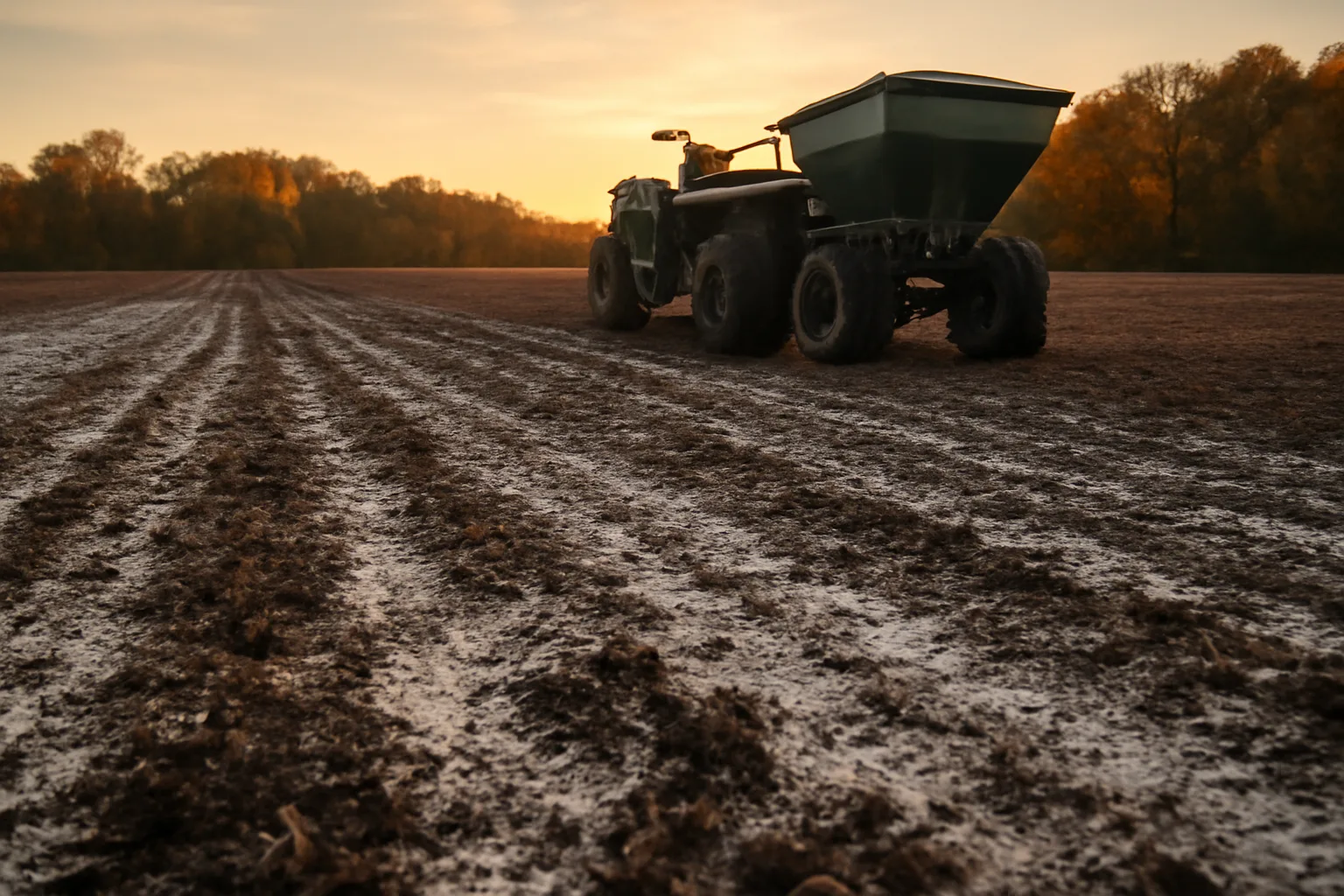
For plots under an acre, a tow-behind broadcast spreader on an ATV or a handheld crank spreader is enough, and costs run from $60 for a basic handheld unit to $300 to $600 for a decent tow-behind broadcast spreader. For anything over a couple acres, a tractor-mounted spreader is worth the investment if you're already running a tractor for tillage. Calibration matters more than people think. An uncalibrated spreader can put down 30% more or less product than intended, which either wastes money or leaves the crop short. Most spreader manufacturers and extension programs publish calibration charts or a simple catch-and-weigh method, run it once per product since granule size and density change the spread pattern [7]. Lime is heavy and often needs a different setting or a heavier-duty spreader than fertilizer granules, especially pelletized lime versus fine ag lime. If you're custom-blending fertilizer through a farm co-op, ask if they'll spread it for you; on larger acreage that's often cheaper than buying and maintaining your own spreader.
Should I use a custom fertility plan or just wing it
Winging it works about as well as you'd expect: sometimes you get lucky, often you don't, and you won't know why until the plot underperforms. A soil test plus a plan matched to your specific crop, acreage, and region removes most of the guesswork. If you want a structured starting point without hiring an agronomist, PlotSeason's $99 one-time Custom Food Plot Plan takes your soil test results, region, and species goals and turns them into a general fertility and planting plan. It's general guidance built around your inputs, not site-specific agronomy advice, and your soil-test lab's recommendations are still the final word on lime and fertilizer rates for your ground. For seed and species pairing ideas to plug into that plan, browse deer for food and domain food plot seed.
Frequently asked questions
Do deer eat sorghum in food plots
Yes, deer will browse grain sorghum heads, especially late in the season, but it's usually planted as a cover crop or screening border rather than a primary forage. For straight nutrition, clover, soybeans, and brassicas outperform sorghum; sorghum earns its place mainly through late-season standing grain and visual screening.
Do deer eat clover and is it a good food plot choice
Deer readily eat clover and it's one of the most reliable food plot perennials available, offering 20 to 30% crude protein in vegetative growth. It requires pH above 6.0, adequate phosphorus and potassium, and regular mowing to stay palatable, but a well-managed stand can last 3 to 5 years before needing reseeding.
When should I plant food plots for deer
Fall plots (clover, brassicas, cereal grains) generally go in mid-August through September in northern regions and September into October in the South. Spring/summer plots (soybeans, cowpeas) go in after your last frost date, typically April through June. Exact timing depends on your local hardiness zone and first/last frost dates.
Do deer like clover more than other food plot options
Clover ranks among the top preferred forages in most food plot programs because it's high protein, regrows after browsing, and stays available spring through fall. Preference does shift seasonally though; deer may favor acorns or standing grain in fall and winter even in fields with good clover stands.
When should I plant oats for deer food plots
Plant oats 6 to 8 weeks before your area's average first frost date, usually the last two weeks of August through mid-September in most of the whitetail range. Oats germinate fast, often in 7 to 10 days, but typically winterkill once temperatures drop into the low teens or single digits.
When should I plant turnips for deer
Plant turnips 90 to 100 days before your first expected hard frost so bulbs have time to size up, which is late July through mid-August across most of the Midwest and Northeast. Deer often ignore turnips until after a hard freeze converts starches to sugars, so don't be alarmed if the plot sits quiet in early fall.
What is a food plot exactly
A food plot is a planted, managed opening on hunting land, typically a half-acre to several acres, seeded with forage crops like clover, brassicas, or grains to supplement wildlife nutrition and concentrate deer activity for observation or hunting. It functions like a small managed crop field, needing soil testing, lime, fertilizer, and planting timed to the region.
What are deer's favorite foods overall
There's no single ranked list, but extension and wildlife agency forage research consistently shows acorns, soybeans, clover, corn, and alfalfa as top preferred whitetail forages, alongside native browse like greenbrier and honeysuckle outside food plot season. Preference shifts heavily by region, season, and what else is available nearby.
Do deer like honey or honey-based attractants
Honey isn't a natural deer food and whitetails don't seek it out the way bears do. Commercial attractants using honey or molasses scent rely on sugar and scent appeal, not evidence that honey is part of a deer's natural diet. Many states regulate feed and scent-based attractants under baiting rules, so check your state wildlife agency before using them.
How much fertilizer does a food plot need per acre
It depends entirely on the crop and your soil test, but common ranges are 0 to 30 lbs actual nitrogen per acre for established clover, versus 80 to 120 lbs actual nitrogen per acre for brassica or cereal grain blends, split between planting and a topdress. Phosphorus and potassium rates should come straight from your test results.
When is the best time to apply lime to a food plot
Apply lime as early as possible, ideally 3 to 6 months before planting, since it takes that long to fully adjust soil pH. If you're planting a fall plot, spring lime application is ideal; if you missed that window, apply lime at planting anyway and expect full pH correction the following season.
Can I just use an all-purpose fertilizer like 19-19-19 on any food plot
You can, but it's rarely the right ratio. Clover needs very little nitrogen and heavier phosphorus and potassium, while brassicas and grains need more nitrogen. A generic blend often overfeeds one nutrient and underfeeds another; matching fertilizer to your soil test and specific crop gives better results per dollar spent.
Sources
- University of Missouri Extension, Soil Testing for Lawns and Gardens: Cooperative extension soil tests typically cost roughly $10 to $20 per sample
- University of Georgia Extension, Soil pH and Nutrient Availability: Legumes like clover require soil pH above roughly 6.0 for effective nitrogen-fixing nodule function
- Mississippi State University Extension, Food Plots for White-tailed Deer: Fall planting windows and brassica/cereal grain fertility guidance for deer food plots
- USDA Natural Resources Conservation Service, Wildlife Habitat Management: Native browse and agricultural forage preferences in wildlife habitat management context
- Pennsylvania Game Commission, Feeding Wildlife Regulations: State wildlife agency regulations on feeding and baiting deer vary by state and may restrict attractant use
- University of Wisconsin-Madison Extension, Nitrogen Management for Field Crops: Splitting nitrogen applications reduces leaching risk compared to a single large application
- Iowa State University Extension, Calibrating Granular Fertilizer Spreaders: Uncalibrated spreaders can misapply fertilizer by significant margins, making calibration necessary
- University of Tennessee Extension, Wildlife Food Plots: Turnip and brassica planting timing tied to first frost date for bulb development