Last updated 2026-07-26
TL;DR
Spread lime based on your soil test's lime requirement, not a guess. Most food plot soils in the 5.0 to 5.8 pH range need 1 to 3 tons of ag lime per acre. Apply 3 to 6 months before planting when possible, work it into the top 4 to 6 inches, and retest every 2 to 3 years.
why does lime even matter for a food plot
Lime raises soil pH, and pH controls how much of the fertilizer you buy actually becomes available to your plants. Clover, brassicas, and most food plot crops want a soil pH somewhere between 6.0 and 7.0. Below that, especially under pH 5.5, aluminum and manganese start tying up phosphorus and other nutrients before the plant roots ever get to use them. You can dump 300 pounds of triple-19 on a plot sitting at pH 5.0 and still get a pale, stunted stand, because the fertilizer is locked up in the soil chemistry, not because you didn't apply enough. Oklahoma State University Extension explains it well: soil pH governs nutrient availability because "most nutrients are optimally available to plants in the pH range of 6.0 to 7.0," and outside that window, elements like phosphorus, iron, and manganese either become locked up or, in the case of aluminum and manganese, can reach levels toxic to roots [1]. That's not marketing language, that's just how cation exchange and nutrient solubility work in soil. A lot of hunters skip the lime step because it doesn't feel like it's doing much. It's not green and leafy like a fertilizer bag promises. But lime is the thing that makes the fertilizer bag worth the money you spent on it. If you've never pulled a soil sample on a piece of hunting ground, this is the starting point before you buy a bag of anything. Your food plot seed choice matters less than most people think if the soil underneath it is too acidic to support it.
how much lime does my food plot actually need
| 6.0 to 6.5 | 0.5 to 1 | Light maintenance application | |
|---|---|---|---|
| 5.5 to 6.0 | 1 to 2 | Common range for older plots | |
| 5.0 to 5.5 | 2 to 3 | Needs split application in most cases | |
| Below 5.0 | 3 to 4+ | Heavily acidic, may take 2 seasons to correct | These numbers assume standard ag lime with an ECCE near 100. Pelletized lime, dolomitic lime, and different particle sizes all change the effective rate, which is why your lab report and the product bag both matter. |
The honest answer: whatever your soil test says, because lime requirement depends on your soil's buffer capacity, more than its current pH. Two fields can both read pH 5.4 and need completely different lime rates. A sandy soil with low organic matter might need 1 ton per acre to get to pH 6.5. A heavy clay soil with more buffering capacity at the same starting pH might need 3 tons per acre or more. This is why serious soil tests report a separate number called the buffer pH or lime requirement, sometimes labeled ECCE (Effective Calcium Carbonate Equivalent) recommendation. The buffer pH test measures how strongly the soil resists a change in pH, and that resistance, not the water pH reading alone, is what the actual lime rate gets calculated from. If your test only gives you a water pH and no lime recommendation, that's a red flag that you're using a cheap test kit, not a real lab. As a rough field reference, general land-grant extension liming guidance runs lime rates from around 1 ton per acre for a soil near pH 6.0 up to 3 tons per acre or more for soils below pH 5.0 on medium to fine textured ground [2]. Those are ballpark figures for planning purposes only. Your specific lab report overrides any chart on the internet, including this one. | Soil pH range | Typical ag lime rate (tons/acre) | Notes |
when should I spread lime before planting a food plot
Lime works slowly. It's not a fertilizer that green-up shows in two weeks, it's a chemical reaction that takes months to fully play out in the soil. The general recommendation from land-grant extension programs is to apply lime 3 to 6 months before planting whenever you can swing it, so it has time to react and shift the pH before seed goes in the ground. Realistically, most hunters don't get 6 months of lead time. If you're liming in late summer for a fall brassica or clover planting, you're still better off than not liming at all, even if the full pH correction won't be done by planting day. Some correction beats none. Lime needs contact with soil moisture and soil particles to neutralize acidity, which is why incorporation matters so much. Surface-applied lime left untilled reacts far more slowly because it never mixes into the root zone where the acid-forming reactions are happening. If you till anyway to prep a seedbed, that pass is doing double duty by working the lime in at the same time. If you're planning a spring food plot whitetail planting, fall is the ideal lime window. If you're set on a fall planting, get lime down in late spring or early summer if soil access allows it. Don't wait until the week before you plant and expect the lime to have done its job.
what's the actual process for spreading lime on a plot
Start with the soil test. Pull samples from 4 to 6 inches deep across multiple spots in the plot, mix them in a clean bucket, and send a composite sample to a lab. Most state land-grant labs run a soil test for somewhere in the 10 to 20 dollar range per sample, and turnaround is usually 1 to 2 weeks. Once you have your lime recommendation in tons per acre, figure your plot's actual acreage (not a guess, measure it or use a mapping app) and calculate total lime needed. A half-acre plot needing 2 tons per acre needs 1 ton total, which is roughly 20 bags of 50-pound pelletized lime, or a single load of bulk ag lime if you can get a spreader truck in. For spreading equipment, you've got a few realistic options depending on plot size and access: - Bulk ag lime spread by a local co-op truck: cheapest per ton, best for plots with road or field access wide enough for a spreader truck, usually the most cost-effective option above 1 acre.
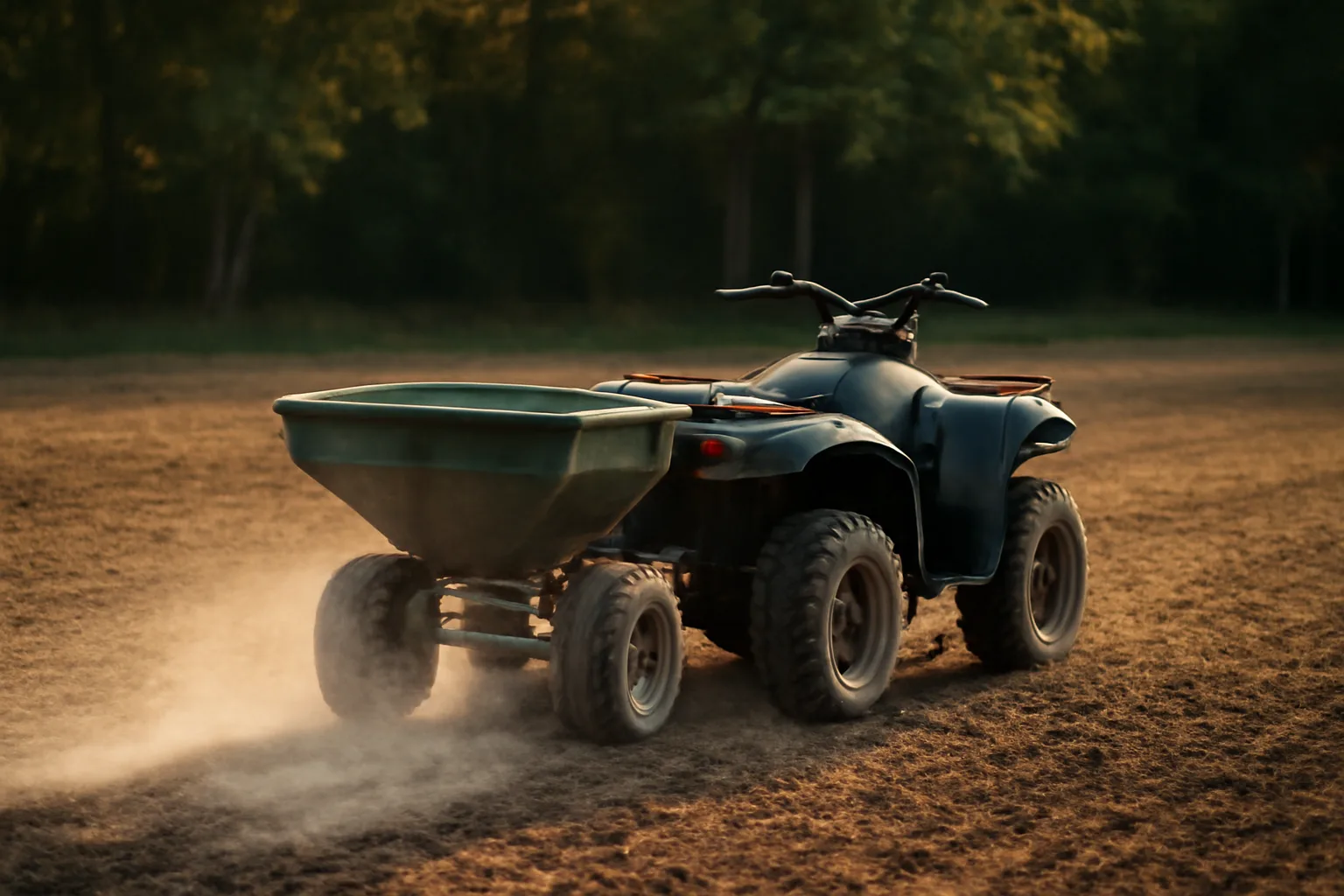
- Pull-behind broadcast spreader (ATV or tractor): works for pelletized lime, good for plots under 2 to 3 acres with rough or wooded access.
- Push spreader or hand-crank spreader: fine for small plots under a quarter acre, slow and tiring for anything bigger. After spreading, work the lime into the top 4 to 6 inches of soil with a disc, tiller, or cultipacker pass if you're tilling anyway for planting. Incorporation speeds up the reaction significantly compared to leaving lime sitting on the surface. If you're using a no-till approach, surface-applied lime will still work. It just takes longer, sometimes a full year or more to move down through the profile. Retest every 2 to 3 years. Lime isn't a one-time fix, soil pH drifts back down over time from rainfall, nitrogen fertilizer use, and plant uptake.
pelletized lime vs ag lime, which should I use
Ag lime (crushed agricultural limestone) is cheaper per ton and is what most bulk spreader trucks apply. It's coarser, which means it reacts slower but the pH change lasts longer once it kicks in. Pelletized lime is finer ag lime that's been compressed into pellets for easier handling through small spreaders, and it reacts faster because the particle size is smaller, but you typically pay more per ton of actual neutralizing capacity. For small food plots without truck access, pelletized lime through a pull-behind or push spreader is the practical choice even though it costs more per effective ton. For larger plots with road access, bulk ag lime delivered and spread by a local co-op is almost always the better value. Ask your supplier for the ECCE (Effective Calcium Carbonate Equivalent) rating on whatever product you're buying, since that number tells you how the product's actual neutralizing power compares to pure calcium carbonate, and it's how you translate a bag rate into a real per-acre lime credit.
what is a food plot and why does soil prep matter so much
A food plot is a planted area on hunting or wildlife land, usually somewhere between a quarter acre and several acres, seeded with forage crops like clover, brassicas, cereal grains, or soybeans to attract and hold deer and other wildlife. Food plots aren't a wildlife feeding program in the legal sense in most states, they're planted agriculture managed for habitat and hunting purposes, though the line between a food plot and supplemental feeding can matter for state law depending on how it's set up and whether attractants are added. Soil prep, and lime specifically, is the least exciting and most skipped step in food plot work. A hunter will spend real money on seed, a spreader, maybe a small tractor, and then broadcast seed onto ground that's sitting at pH 5.2. The seed germinates, the plot looks decent for a month, then it thins out and gets weedy because the crop can't access the nutrients it needs. Getting the soil chemistry right first is what makes every other dollar you spend actually pay off.
when to plant food plots for deer, and how does lime timing fit in
Planting windows depend heavily on your zone and the specific crop, but broadly: spring plantings (clover, chicory, soybeans) go in after the last frost date, typically April through May in northern states and March through April further south. Fall plantings (brassicas, cereal grains, annual clover) go in roughly 60 to 90 days before your area's first hard frost, which for a lot of the Midwest and Northeast falls in the August to early September window. State land-grant extension offices publish frost date and planting window guidance by region, and your local extension office is the most reliable source for your specific county. Because lime takes months to fully react, the smart approach is to soil test and lime in the season before your target planting window, not the same month. For a deeper breakdown of species-specific planting calendars, our guide on deer food plots covers regional windows crop by crop.
when to plant oats for deer
Oats are a fall food plot staple and go in 60 to 75 days before your first expected hard frost, which lines up with late August through mid-September across most of the whitetail's range. Oats germinate fast, often within a week in warm, moist soil, and they're one of the more forgiving cereal grains for slightly acidic soil, though you'll still get better tonnage and longer palatability if pH is in the 6.0 to 6.5 range. Oats are commonly planted in a mix with brassicas or clover rather than alone, since a straight oat plot tends to get hit hard early and then offers less once the leaves are gone.
when to plant turnips for deer
Turnips go in the ground roughly 90 to 100 days before your first hard frost, which typically lands in late July through mid-August for most of the Midwest and Southeast, and can shift to early July in the far north. Turnips need that long growing window because deer often don't hit the bulbs hard until after a couple of frosts sweeten the starches. Turnips are brassicas, and brassicas as a group are more sensitive to low pH than clover or cereal grains, they do best in that 6.0 to 6.8 range, so this is a crop where skipping the lime step really shows up in bulb size and plant vigor.
do deer like clover, and when should it go in the ground
Yes, clover is consistently one of the most preferred food plot forages for whitetail deer, and it's also one of the most forgiving crops to grow, tolerating a slightly wider pH range than brassicas while still performing best above pH 6.0. Perennial clovers like white clover and red clover are typically planted in spring (March to May depending on zone) or late summer/early fall (August to September), timed so the young plants aren't fighting brutal summer heat or a hard freeze right out of the gate. Clover's popularity with deer isn't just anecdotal hunter opinion, it shows up in forage quality data too: clover generally runs 20 to 30% crude protein in vegetative growth stages, which is well above most native browse. That protein content is a big part of why food plot managers lean on clover as a season-long staple rather than a single-season planting.
do deer eat sorghum, and does it fit a food plot rotation
Deer will eat sorghum, particularly the seed heads once they mature, and grain sorghum is sometimes used in food plot mixes as a standing grain crop that also doubles as cover. It's not typically a first-choice deer forage compared to soybeans, clover, or corn, but it's drought-tolerant and can work on marginal soils where other grain crops struggle. Sorghum is more commonly planted for its cover value and as a component in a diverse plot mix rather than as a standalone deer attractant, and it tolerates a fairly wide soil pH range compared to more sensitive crops like alfalfa or brassicas.
what are deer's favorite foods, and does honey factor in at all
Whitetail deer diets shift heavily by season and region, but acorns, soybeans, clover, and native browse consistently rank as heavily preferred foods across most of their range, with agricultural crops like corn and soybeans getting hit hard whenever available. Deer are opportunistic browsers, and state wildlife agencies that publish deer diet studies generally find that mast crops (acorns especially) and legumes make up a large share of fall and winter diets where available. As for honey: deer don't eat honey in any meaningful way as part of their natural diet. They're herbivorous browsers, not opportunistic omnivores looking for sweets, and there's no wildlife agency or extension research suggesting honey has any use as a deer attractant. If anything, honey attracts insects and bears far more reliably than deer, and using it as bait would also run into whatever your state's baiting and feeding regulations say about non-plot attractants, which vary widely and are worth checking with your state wildlife agency before using anything outside a planted crop.
does it matter what state I'm in for lime rules or baiting laws
Lime itself isn't regulated like a feed additive, but how you plant and manage a food plot can brush up against your state's baiting and supplemental feeding rules, and those vary a lot. Some states draw a clear legal line between a planted food plot (generally legal) and piling up grain, minerals, or other attractants (often restricted or banned, especially near a stand during season). Michigan is a useful example of how granular these rules get. Michigan's Wildlife Conservation Order restricts baiting and feeding of deer statewide, with narrower allowances and different rules depending on the region of the state and the presence of chronic wasting disease management zones, a distinction the Michigan Department of Natural Resources updates as CWD findings change [3]. Before you plant, it's worth a quick check of your state wildlife agency's current regulations, since baiting definitions and CWD-related feeding bans change from year to year in a lot of states. This isn't a lime question directly, but it's the kind of thing that trips up hunters who think a food plot and a bait pile are legally the same thing. They usually aren't, but the details matter.
what if I can't afford to lime the whole plot right now
Lime a portion first if budget is tight, rather than under-applying across the whole plot and getting a mediocre result everywhere. A half-limed plot at the correct rate on half the acreage will outperform a fully-limed plot that only got half the recommended tonnage spread thin, because pH correction isn't linear, you need enough lime to actually move the needle or you're just diluting your own results. If you're planning multiple plots across a property and trying to sequence lime and fertilizer spending over a season or two, a Custom Food Plot Plan from PlotSeason ($99, one-time) can help you prioritize which plots and species make sense first based on your soil test results and budget, though your soil test lab remains the final word on exact lime and fertilizer rates for your specific ground. It's general planning guidance, not a substitute for your lab's site-specific recommendation.
Frequently asked questions
How much lime per acre do food plots need?
It depends entirely on your soil test's buffer pH reading, but typical ranges run 1 ton per acre for soil near pH 6.0 up to 3 or more tons per acre for soil below pH 5.0. Always use your specific lab's lime recommendation rather than a general chart, since soil buffering capacity varies by texture and organic matter.
How long does it take lime to work in a food plot?
Lime typically takes 3 to 6 months to fully react and shift soil pH, especially if it's incorporated into the top 4 to 6 inches rather than left on the surface. Surface-applied lime without tillage can take a year or more to move down through the soil profile.
Can I spread lime and plant on the same day?
You can, but the lime won't have corrected the pH yet, so don't expect an immediate difference in that season's crop. It's still worth doing since some pH movement over the following months beats none, but plan ahead 3 to 6 months when possible for full effect.
Do deer eat sorghum?
Yes, deer eat sorghum, particularly mature seed heads, and grain sorghum sometimes shows up in food plot mixes as a standing grain and cover crop. It's not usually a first-choice forage compared to soybeans or clover, but it's drought-tolerant and works on marginal ground.
Do deer like clover?
Yes, clover is one of the most preferred food plot forages for whitetail deer and runs 20 to 30% crude protein in vegetative growth, well above most native browse. It's also more forgiving on soil pH than brassicas, though it still performs best above pH 6.0.
When should I plant food plots for deer?
Spring plantings like clover and soybeans go in after your last frost date, generally March through May depending on region. Fall plantings like brassicas and cereal grains go in 60 to 100 days before your area's first hard frost, commonly late July through September.
When should I plant oats for deer?
Plant oats 60 to 75 days before your area's first expected hard frost, typically late August through mid-September across most of the whitetail range. Oats germinate quickly and are often mixed with brassicas or clover rather than planted alone.
When should I plant turnips for deer?
Plant turnips roughly 90 to 100 days before your first hard frost, generally late July through mid-August in most of the Midwest and Southeast. Turnips need that long window because deer typically don't favor the bulbs until after a frost or two sweetens the starches.
What is a food plot?
A food plot is a planted area, usually a quarter acre to several acres, seeded with forage crops like clover, brassicas, or cereal grains to attract and support deer and other wildlife on hunting or managed land. It's planted agriculture for habitat, not the same as a bait pile under most state laws.
What are deer's favorite foods?
Acorns, soybeans, clover, and native browse consistently rank as heavily preferred foods for whitetail deer, with preference shifting by season and region. Agricultural crops get hit hard whenever available, and mast crops like acorns make up a large share of fall and winter diets.
Do deer like honey?
No, honey isn't part of a deer's natural diet, and there's no wildlife agency research supporting it as a deer attractant. Deer are herbivorous browsers, and honey is far more likely to attract insects or bears than whitetail deer.
Should I use pelletized lime or ag lime on my food plot?
Pelletized lime works better for small plots run through a push or pull-behind spreader since it's finer and reacts faster, though it costs more per effective ton. Bulk ag lime delivered by a local co-op is the better value for larger plots with road access.
Sources
- Oklahoma State University Extension, Soil pH and Liming (PSS-2225): Most nutrients are optimally available to plants in the pH range of 6.0 to 7.0, and outside that range aluminum and manganese can reach toxic levels
- University of Missouri Extension, Soil Testing for Lime and Fertilizer Recommendations (G9110): Lime recommendations vary by soil pH and soil texture, generally ranging from about 1 to over 3 tons per acre
- Michigan Department of Natural Resources, Wildlife Conservation Order, Baiting and Feeding of Deer: Michigan restricts baiting and feeding of deer statewide with rules that differ by region and change based on CWD management zones
- Purdue University Extension, Soil Acidity and Liming (AY-267): Lime needs to be mixed into the soil to neutralize acidity effectively, and surface application without incorporation reacts much more slowly
- Iowa State University Extension and Outreach, Soil pH (PM 1688): Soil pH affects the availability of plant nutrients and the activity of soil microorganisms that cycle nutrients