Last updated 2026-07-26
TL;DR
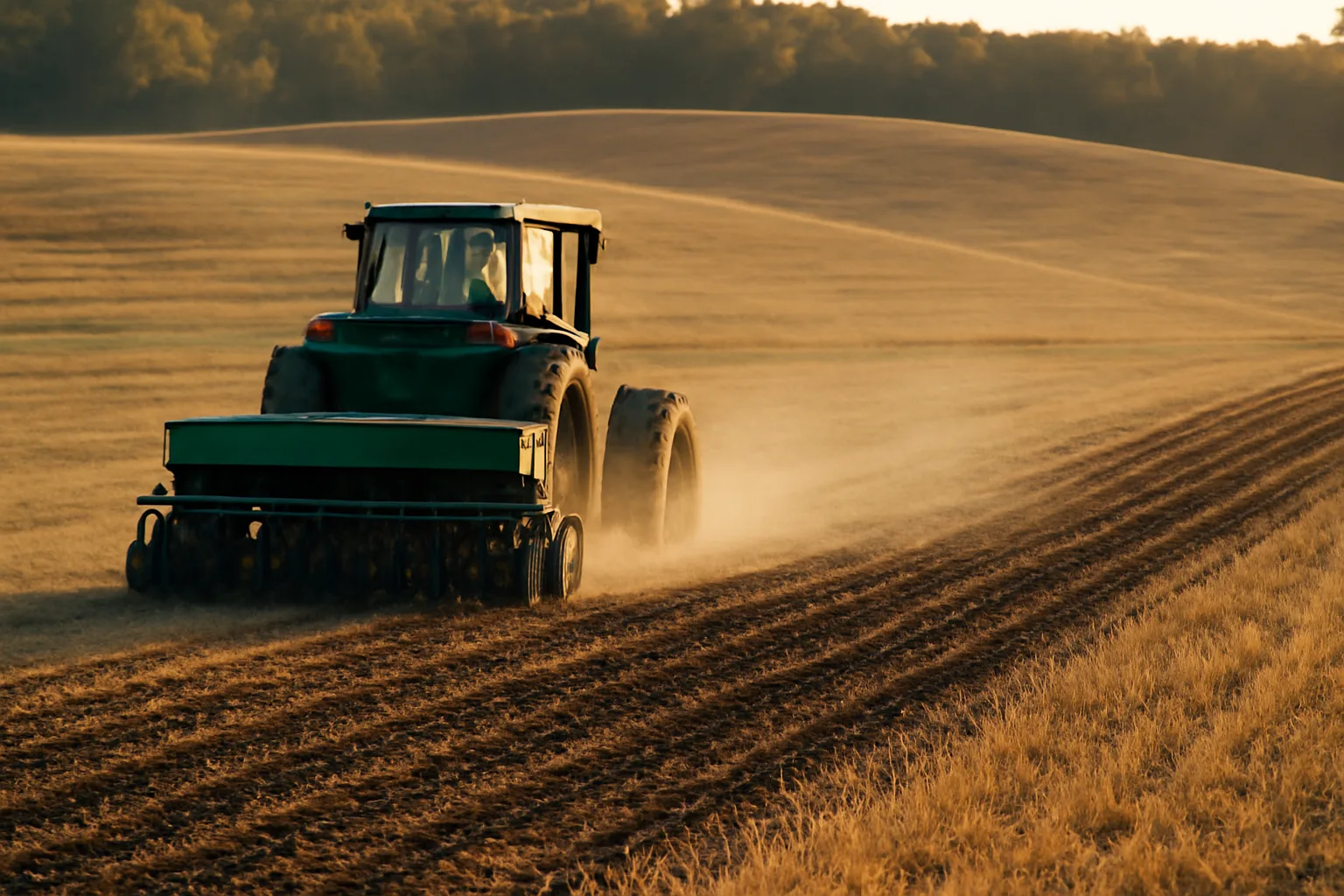
A no-till planter (drill) plants seed directly into standing residue or sod without tilling, cutting erosion and moisture loss while saving fuel and time. Compact units run $1,500-$4,000 used, full-size drills $8,000-$15,000+. They pay off on rolling or erodible ground, in dry years, and for anyone planting more than a couple acres a year.
What is a food plot, and where does a no-till planter fit in?
A food plot is a planted area on hunting land, usually somewhere between a quarter acre and several acres, seeded with forage or grain to attract and hold deer and to give them nutrition through the year. Most plots use annual grains like oats or brassicas, perennial clovers, or blends of both, chosen by season and soil type. A no-till planter (often called a no-till drill) is the tool that gets seed into the ground without plowing or disking first. Instead of turning over the soil, it cuts a narrow slot through existing sod, weeds, or crop residue, drops seed at a set depth, and closes the slot behind it. The USDA Natural Resources Conservation Service describes no-till as a system built around "minimizing soil disturbance" to protect soil structure and moisture between plantings [1], and food plot no-till drills apply the same idea at a smaller scale. For food plotters, the planter matters as much as the seed. You can buy the best deer food plot seed on the market, but if it's broadcast on top of hard clay or thick sod with no seed-to-soil contact, germination suffers. A drill solves that problem mechanically instead of hoping rain and luck do the work.
Why use a no-till planter instead of just disking and broadcasting?
Disking is faster to explain but not necessarily faster to do, and it costs you soil structure over time. Every pass of a disk or tiller exposes bare soil to wind and rain, which is exactly the condition erosion loves. USDA NRCS conservation practice standards for residue and tillage management identify reduced soil disturbance as a core tool for cutting erosion and building soil organic matter compared to conventional tillage [1]. There's also a moisture argument that matters a lot on food plots planted in August heat. Tilled soil dries out faster because you've broken capillary action and exposed more surface area to sun and wind. A no-till drill keeps the soil profile mostly intact, so the seed sits in soil that's still holding moisture from the last rain, which is often the difference between a stand that comes up and one that doesn't. There's a labor and cost side too. A disk, a tractor big enough to pull it, a cultipacker, and the time to make multiple passes adds up in fuel and hours. A no-till drill, run correctly, is often one pass. For a landowner with a day off and forty acres of plots to hit, one pass instead of three is not a small thing.
When should you plant food plots for deer?
Timing depends on your USDA plant hardiness zone, your species mix, and whether you're planting a spring/summer plot or a fall plot. Most food plotters run two windows: a spring planting for warm-season annuals and clovers, and a late-summer planting for fall annuals like brassicas, cereal grains, and winter peas. As a rough framework, spring plots go in after your last frost date, typically April through May in the Midwest and Northeast, and February through April in the South. Fall plots usually go in six to ten weeks before your average first frost, which for a lot of the whitetail range lands somewhere between late July and early September. Your state extension office publishes frost date tables specific to your county, and that's a better source than any national chart, since "the South" alone spans zones 7 through 9. Brassicas need real lead time because they build sugar content and bulb size over a long fall. General extension guidance on forage brassicas (turnips, radishes, rape) points to planting 60 to 90 days before you want them ready for deer, which usually means late July to mid-August in the North and August into early September further south. Plant them too late and you get small plants with none of the frost-sweetened palatability deer respond to. For a full breakdown by region, see food plot whitetail planning basics and adjust against your local frost dates, using USDA's plant hardiness zone map as your starting reference point.
When should you plant oats for deer?
Oats are a fall annual in most of the whitetail range, planted four to eight weeks before your first hard frost so they've got time to establish before cold really sets in. That usually means anywhere from mid-August in the northern tier to late September or even October in parts of the South. Oats germinate fast, often in five to seven days with decent soil moisture, and they green up quickly, which makes them a good nurse crop mixed with clover or brassicas. Deer hit young oats hard in September and October, then the plant loses palatability and often winterkills once temperatures drop into the teens for extended stretches, depending on the variety. If you want oats to persist deeper into winter, look at varieties bred for cold tolerance, and check with your local extension for what actually survives your zone. A South Dakota winter is a different question than a Georgia one.
When should you plant turnips for deer?
Turnips go in with the rest of your brassica window, generally 60 to 90 days ahead of your first expected hard frost. In practice that's late July through mid-August for the northern half of the whitetail range and mid-August through early September in the mid-South. Turnip bulbs and tops both get eaten, but the order matters. Deer usually browse the leafy tops first in early fall, then switch to digging up and eating the bulbs after a few hard frosts convert starches to sugars, which is why plots that look untouched in October can get hammered in December and January. If your plot gets grazed to the dirt on tops alone before frost, the bulbs never get their moment. Seeding rate matters more than people think. Most seed tag rates put turnips around 4 to 6 lbs per acre as a monoculture, less when blended with other brassicas or cereal grains, since they're a small, cheap seed prone to overcrowding if you go heavy.
Do deer eat sorghum?
Yes, deer eat grain sorghum, both the standing heads and the leaves, though it's more commonly grown as a screening or bedding cover crop and a late-season food source than a primary attractant. Sorghum's real value on a lot of properties is the six-to-eight-foot standing cover it provides, which doubles as security cover and a late-winter grain source once other food is gone. Compared to soybeans or corn, sorghum is more drought-tolerant, which makes it a reasonable choice on sandy or low-rainfall ground where corn struggles. It's not typically anyone's first-choice deer food plot forage on its own. It usually shows up as part of a mixed planting or a dedicated screen/cover block rather than the plot you'd expect deer to bed down in front of every evening.
Do deer eat clover, and do they actually prefer it?
Deer eat clover readily, and it's one of the most consistently productive forages across the food plot world because it regrows after grazing instead of getting wiped out by it. Ladino and red clover both show up constantly in food plot seed blends for exactly that reason: deer can hit the same acre a dozen times a season and the plant keeps coming back. Do deer "like" clover specifically, more than other options? Preference studies are limited and site-specific, but clover consistently ranks as a heavily-used forage in penned and field observation studies, largely because of its protein content. Extension forage testing programs commonly report crude protein in well-managed clover stands in the 25-30% range, similar to or higher than alfalfa. That protein level matters most in spring and summer when does are lactating and bucks are growing antlers, which is a big reason clover is the backbone of a lot of perennial food plot programs rather than a one-season novelty. Clover isn't a universal answer, though. It struggles on acidic soil below about pH 6.0 without lime correction, and it can get out-competed by weeds in year one if you don't manage it. That's a soil test question first, not a seed question. For species selection beyond clover, deer food plots covers blend strategy in more depth.
What are deer's favorite foods, and does that change what you plant?
There's no single scientifically-ranked "favorite food" list for whitetail deer, because preference shifts by season, region, and what's already available naturally. That said, wildlife research on deer diets consistently shows a few patterns worth planning around. In spring and summer, deer favor high-protein forbs and legumes, clover and soybeans among them, to support lactation and antler growth. In fall, they shift toward high-energy foods, acorns first when a good mast year happens, then standing grain, brassicas, and cereal grains as acorns run out or in poor mast years. Agricultural crops like corn and soybeans, where legal and available, get hit hard because of the raw caloric density, which is exactly why ag-heavy areas often see less food plot pressure than timber-heavy ground with no row crops nearby. The honest answer for a plot planner is that "favorite" matters less than "what fills a gap." A property surrounded by soybean fields doesn't need another soybean plot. A property in solid timber with no ag nearby benefits enormously from any quality forage, because the deer have fewer options to begin with.
Do deer like honey, or is that a food plot myth?
Deer don't seek out honey in the wild, and there's no wildlife research or extension guidance suggesting honey has a role in deer diets or attractant products beyond the small role it plays as a binder or sweetener in some commercial mineral and attractant mixes. Deer are herbivores built around forbs, browse, and mast. They're not drawn to honey the way, say, a bear is. If you've seen "honey" show up in an attractant product, it's almost always functioning as a sugar and scent carrier, not a primary food source deer are seeking out on its own. Worth noting: several states restrict or fully prohibit baiting and the use of scent or feed attractants for deer hunting, so check your state wildlife agency's regulations before using any product marketed that way, honey-based or otherwise, since rules vary widely by state and even by county in a few cases.
How does a no-till drill actually work, and what should you buy?
| ATV/UTV pull-behind no-till drill | 4-6 ft | $1,800-$5,500 | 1-10 acre plots, small tractors or UTVs | |
|---|---|---|---|---|
| Compact 3-point drill (25-40 hp tractor) | 5-7 ft | $4,000-$9,000 | Multiple small plots, mixed seed sizes | |
| Full-size farm no-till drill | 10-15 ft | $10,000-$25,000+ new, less used | Large acreage, ag-scale operations | |
| Broadcast seeder + cultipacker (not a true drill) | varies | $300-$2,000 | Prepared seedbeds, budget setups, overseeding | A broadcast seeder with a cultipacker isn't a no-till drill, but it's worth including because a lot of smaller food plotters use exactly that combo instead, and it works fine on a properly worked seedbed. It just doesn't give you the residue-cutting or moisture-retention benefits of a real drill on unbroken ground. |
A no-till drill has three jobs: cut through residue or sod, place seed at a consistent depth, and press soil back over the seed for contact. Most units use a coulter or double-disc opener to slice the ground, a metering system (box or plate) to drop seed at a set rate, and a press wheel behind each row to firm the soil. Depth control is the single most important spec for food plot use. Small seeds like clover and brassicas want 1/4 to 1/2 inch of coverage; oats and cereal rye want closer to 1 to 1.5 inches; soybeans and corn want 1.5 to 2 inches, a depth range supported by university crop guidance on soybean seeding [2]. A drill with adjustable depth per seed box (a lot of food-plot-specific drills split into a small-seed box and a large-seed box) handles blended plantings far better than a single-hopper unit. Here's a rough sense of what's out there in 2025 pricing, based on typical used and new equipment listings rather than any single source, since prices vary by dealer and region. | Drill type | Typical width | Rough price range (used/new) | Best for |
Is a no-till drill worth it for a small food plot operation?
If you're planting one half-acre plot a year, probably not. Renting or borrowing a drill, or just prepping ground the old way with a disk and cultipacker, is cheaper than owning $4,000 of equipment that sits in a shed 50 weeks a year. The math changes fast once you're planting multiple plots, rotating fields, or dealing with erodible or hard-to-access ground where a tractor and disk can't easily go. A lot of hunting clubs and multi-property landowners split the cost of a compact drill across members, which brings the per-acre cost down close to what a custom planting service would charge anyway. The other case for owning one: timing. Fall brassica and cereal grain windows are tight, sometimes a two-to-three-week sweet spot depending on your zone. If you're waiting on a rental unit or a neighbor's schedule, you can miss that window entirely. Owning the tool means you plant when the soil moisture and calendar say to, not when the equipment is free.
What soil and fertility prep still matters even with no-till?
No-till doesn't mean no soil work. You still need a soil test before you plant anything, because pH and nutrient levels drive germination and growth regardless of how the seed gets in the ground. University soil testing labs typically run a basic soil test for a modest fee and return lime and fertilizer recommendations within a couple weeks; the University of Missouri Soil and Plant Testing Lab, for example, publishes routine test pricing and turnaround on its own fee schedule [3]. Lime is the big one people skip. Clover and most brassicas want a pH between 6.0 and 7.0; alfalfa wants closer to 6.5-7.5. Below that, lime takes months to fully react in the soil, which is why extension agronomists recommend applying it as early as possible, ideally the season before you plant, not the week before [3]. If your soil test comes back at 5.2, no drill in the world fixes that. You need lime first, seed second. Herbicide burn-down is the other prep step that replaces tillage in a no-till system. Since you're not turning the soil to kill existing vegetation, most no-till food plot programs use a glyphosate burn-down two to three weeks before planting to knock back weeds and existing sod so the new seed isn't competing immediately. Check label rates and any grazing or wildlife-specific restrictions on the product you use. Your soil test lab is the actual authority here, not a blog post or a seed bag. Recommendations vary by region, crop, and existing nutrient levels, so treat any general guidance (including this one) as a starting point, not a substitute for your test results.
What planting depth and seeding rate should you set on the drill?
| Clover (ladino/red) | 1/4-1/2 in | 6-8 lbs/acre | |
|---|---|---|---|
| Brassicas (turnip/radish/rape) | 1/4-1/2 in | 4-6 lbs/acre | |
| Oats | 1-1.5 in | 60-100 lbs/acre | |
| Winter wheat/cereal rye | 1-1.5 in | 60-120 lbs/acre | |
| Soybeans | 1.5-2 in | 50-60 lbs/acre (drilled, narrower rows) | These are general reference ranges pulled from common extension and seed-tag guidance; exact rates shift with row spacing, blend ratios, and regional recommendations, so check your specific seed tag and state extension forage guide before locking in a rate. If you're running a blend, most food-plot drills let you split small seed into a shallow box and large seed into a deeper box, so you're not compromising depth for either one. |
Get this wrong and you can ruin an otherwise perfect plot in one pass. Small, round seeds like clover germinate from very shallow depth and rot or fail to emerge if buried past a half inch. Brassica seed is similar. Cereal grains and legumes like soybeans root from deeper and actually want that extra depth to develop a strong crown. Here's a general depth reference many drills are calibrated against: | Seed | Target depth | Typical seeding rate (monoculture) |
How do you get a food plot plan built around your equipment and soil?
A lot of the decisions above (species, timing, seeding rate, whether a drill even makes sense for your acreage) depend on details specific to your property: your zone, your soil test numbers, your equipment list, and what you're trying to accomplish (early season draw, late season food, screening cover). If you'd rather not piece that together field by field, PlotSeason's $99 one-time Custom Food Plot Plan takes your soil test, location, and equipment and builds a planting plan around them, species mix, timing windows, and rates included. It's general guidance built from your inputs, not a substitute for your soil test lab's site-specific recommendations, but it saves the hours of cross-referencing extension bulletins yourself. You can start one at /plot-plan-builder. Whatever tool or plan you end up with, the fundamentals don't change: test your soil, respect your planting windows, and match your seed depth to the seed. A $15,000 drill on the wrong pH soil still grows a bad plot.
Frequently asked questions
Do deer eat sorghum in food plots?
Yes. Deer eat both the grain heads and leaves of sorghum, though it's more often planted for its tall standing cover and late-winter grain value than as a primary attractant plot. It's drought-tolerant, which makes it a solid choice on sandy or low-rainfall ground where corn struggles.
Do deer eat clover, and is it a good food plot choice?
Deer eat clover heavily and it's one of the most reliable perennial food plot forages available. Well-managed clover commonly tests at 25-30% crude protein, comparable to alfalfa, which makes it especially valuable in spring and summer for lactation and antler growth. It needs pH above 6.0 to perform well.
When should you plant food plots for deer?
Spring plots (clover, warm-season annuals) go in after your last frost, typically April-May in the North and February-April in the South. Fall plots (brassicas, cereal grains) go in 6-10 weeks before your first frost, usually late July through early September depending on zone. Check your state extension's frost date tables for your county.
Do deer like clover more than other food plot forages?
There's no definitive ranked preference study, but clover consistently shows heavy, repeated use in field observations because it regrows after grazing and holds high protein levels. It's less about deer preferring clover over everything else and more about clover surviving repeated browsing better than most other forages.
When should you plant oats for deer food plots?
Plant oats 4-8 weeks before your area's first hard frost, generally mid-August in northern zones and into late September or October further south. Oats germinate in 5-7 days with good moisture and green up fast, making them a strong nurse crop for clover or brassica blends.
When should you plant turnips for deer?
Turnips go in 60-90 days before your first expected hard frost, usually late July through mid-August in the North and mid-August through early September in the mid-South. Deer browse the tops first in early fall, then switch to bulbs after a few hard frosts sweeten the starches.
What is a food plot?
A food plot is a planted area, typically a quarter acre to several acres, on hunting land seeded with forage, grain, or brassicas to provide deer nutrition and draw activity to a specific spot. Plots range from simple clover perennials to complex multi-species fall blends timed around hunting season.
What are deer's favorite foods overall?
There's no single ranked list, since preference shifts by season and region. Spring and summer favor high-protein forbs and legumes like clover and soybeans; fall favors acorns first, then standing grain, brassicas, and cereal grains once mast runs low. Local food availability shapes preference as much as the plant species itself.
Do deer like honey?
No, deer aren't drawn to honey as a natural food source since they're herbivores built around forbs and browse, not sugars like a bear would seek. Honey sometimes appears in commercial attractant products as a binder or scent carrier, not as a meaningful food value, and several states restrict scent/feed attractant use, so check your state's rules.
Is a no-till planter worth buying for a small food plot property?
For one small plot a year, probably not; renting equipment or disking and broadcasting the old way is cheaper. Once you're planting multiple plots or dealing with tight fall planting windows and erodible ground, owning or splitting the cost of a compact drill with a hunting club usually pays off.
How deep should a no-till drill plant clover versus corn?
Clover wants 1/4 to 1/2 inch of coverage since it's a small, shallow-germinating seed. Corn wants 1.5 to 2 inches to root properly. A drill with separate small-seed and large-seed boxes and adjustable depth settings handles both in the same blend without compromising either.
Does no-till planting still require a soil test and lime?
Yes. No-till changes how seed gets in the ground, not what the soil needs. Clover and brassicas want pH 6.0-7.0, and lime takes months to fully react, so apply it based on your soil test results well before planting, ideally the season before, not the week before.
Sources
- USDA Natural Resources Conservation Service, Conservation Practice Standard: Residue and Tillage Management, No-Till (Code 329): no-till and reduced tillage practices minimize soil disturbance and reduce erosion compared to conventional tillage
- USDA Natural Resources Conservation Service, Plant Fact Sheet and cover crop termination guidance referencing brassica growth windows: brassicas need real lead time before frost to reach usable size and palatability
- University of Missouri Extension, Soil Testing (publication G9101): soil test turnaround, cost, and recommendation to apply lime well ahead of planting since it reacts slowly
- Iowa State University Extension and Outreach, Soybean Planting Date, Seeding Rate, and Row Spacing (PM 1851): soybean planting depth of 1.5 to 2 inches supports proper root and crown development
- University of Georgia Extension: Wildlife food plots should be planted according to species-specific timing recommendations, informing when to plant food plots for deer