Last updated 2026-07-26
TL;DR
No-till plots skip the disc and tiller. You kill existing growth with glyphosate, broadcast seed and fertilizer based on a soil test, then either drag or roll to get seed-to-soil contact. It works best with small-seeded species like clover, brassicas, and cereal grains, and it saves soil moisture and structure that tillage destroys.
what is a food plot, and how is no-till different?
A food plot is a planted patch of forage, usually somewhere between a quarter acre and a few acres, put in specifically to feed and hold deer on a property. It's not farming in the commercial sense. You're not chasing max bushels per acre, you're trying to grow something deer want to eat at the right time of year, in a spot where you can hunt it or watch it. No-till just means you're not turning the soil over with a disc, plow, or tiller before you plant. Instead you kill whatever is growing there (usually with glyphosate), then plant directly into the dead residue. The old growth acts like a mulch layer once it browns out. Why bother? Tillage burns up organic matter and soil moisture fast, and on a lot of hunting land the equipment access alone is the bigger problem. A lot of food plot ground is small, oddly shaped, tucked into timber, or on a slope where you don't want to expose bare dirt to erosion. No-till lets you plant with a UTV, a boom sprayer, and a broadcast spreader instead of a tractor and a disc harrow. USDA's Natural Resources Conservation Service notes that reduced and no-till systems help maintain soil structure and reduce erosion compared to conventional tillage [1], which matters even more on a two-acre plot cut into a hillside than it does on a 200-acre corn field. If you're deciding between plot styles for your property, food plot whitetail planning starts with the same question either way: what do you want growing, and when do you need it mature?
when to plant food plots for deer?
Timing depends on what you're planting and where you hunt, but there are two big windows: spring planting for warm-season forage, and late summer into early fall for cool-season forage that deer hit hardest during hunting season. Spring plots (soybeans, cowpeas, clover establishment, corn) generally go in after your last frost date, which ranges from early April in the Deep South to late May or even early June in the northern tier states and Canada border counties. Check your local NOAA/NWS climate normals or your state extension's frost date table before you commit seed to the ground. Fall plots (brassicas, cereal grains, clover overseed) are the bread and butter for most hunters because they're at their most attractive right as deer season opens. The general rule extension agronomists use is to plant brassicas and cereal grains 60 to 90 days before your first hard frost, so the plants have time to size up before growth slows. In much of the whitetail belt that lands somewhere between early August and mid-September. In the Deep South it can push into October. Don't just go by the calendar date, go by soil moisture too. A no-till drill or broadcast seed sitting in bone-dry August dirt will just sit there. Watch the forecast for a rain window and plant a few days ahead of it if you can.
when to plant oats for deer?
Oats are a fall-planted cereal grain in most whitetail country, going in the ground 45 to 60 days before your average first frost. That puts most of the Midwest and Upper South planting oats sometime between mid-August and mid-September. Oats germinate fast, often within 5 to 10 days given decent soil moisture, and they green up quicker than wheat or rye in cool fall soil. That makes them a favorite for hunters who want a plot that's already drawing deer by opening weekend of bow season. The catch is winterkill. Oats aren't as cold-hardy as winter wheat, cereal rye, or triticale. In northern states oats will typically die back hard after a string of nights in the teens or lower, while rye can survive well below zero and green back up in spring. If you want a plot that holds attraction into late season and regrows in spring, blend oats with cereal rye or winter wheat so you get fast fall growth from the oats and lasting cold tolerance from the small grain. Seeding rate for oats broadcast alone runs 100 to 150 lbs per acre; drilled, you can drop that to 60 to 100 lbs per acre since drilling gets better seed-to-soil contact with less seed wasted. University extension guides for cover crop and forage oats generally fall in that range.
when to plant turnips for deer?
Turnips (and brassicas generally, like radishes and rape) go in during the same late-summer window as oats, roughly 70 to 90 days before your first expected hard frost. That's usually late July through early September depending on latitude. Turnips need more lead time than oats because deer typically won't touch the bulbs and leaves hard until after a couple of frosts convert starches to sugars, sweetening the plant. Plant too late and you get small, bitter bulbs that never get touched. Plant on time and a turnip plot can be the single hottest late-season food source on the property, often getting hit hardest in December and January after other food sources are gone. Seeding rate for turnips alone is light, only 4 to 6 lbs per acre broadcast, because the seed is tiny. Most hunters blend turnips with oats, clover, or other brassicas rather than planting a pure stand, since turnip alone leaves a lot of bare ground between plants. If you're shopping seed blends built for this exact window, deer food plot seed mixes usually already combine brassicas with a cereal grain for this reason.
do deer eat clover, and do they actually like it?
Yes, and it's one of the most consistently used food plot species there is. Clover (white clover, red clover, or ladino types) is a perennial legume, meaning a good stand can produce forage for 3 to 5 years off a single planting if you maintain fertility and mow it a few times a season. Deer favor clover because it's high in protein, often 20 to 30% crude protein in vegetative growth, which matters most in spring and summer when does are nursing fawns and bucks are growing antlers. Extension forage testing consistently ranks clover among the higher-protein forages available to deer compared to grasses [2]. Clover is also one of the easier no-till plantings because the seed is small and shallow-planted, ideally only 1/4 inch deep or less, so a light drag or cultipacker after broadcasting is often all you need. Frost seeding clover into late winter, broadcasting onto frozen or thawing ground in February or March so freeze-thaw cycles work the seed into the soil, is a classic no-till trick that skips equipment almost entirely. The tradeoff: clover is slow to establish and doesn't compete well with weeds in year one. Most failures come from planting into a weedy seedbed without a burndown first, or mowing too infrequently and letting weeds shade it out.
do deer eat sorghum?
Yes, deer will eat grain sorghum, both the seed heads and the young plants, but it's not typically a first-choice food plot species on its own. Sorghum is more commonly planted as a summer screening or bedding cover crop, or blended into a warm-season mix with soybeans and cowpeas, because the stalks grow 5 to 8 feet tall and hold up well through fall and into winter. Where sorghum earns its keep is late season. When snow covers low browse, standing sorghum heads still poke up above the snow line, and deer and turkey will work a sorghum plot hard in January when almost nothing else is standing. It's also a solid choice for screening a plot from a road or trail since it grows dense and tall by August. If your goal is straight attraction during archery season, sorghum isn't the play. Save it for a standing winter food source or a bedding/screening cover planting instead.
what do deer prefer to eat, and does that include honey?
Deer are ruminants that browse a wide variety of forbs, woody browse, mast (acorns, apples, persimmons), and agricultural crops depending on season and availability. Research on whitetail diets, including long-running work out of land-grant wildlife programs, consistently shows deer diet composition shifts heavily by season: forbs and soft browse dominate spring and summer, while acorns, crop residue like corn and soybeans, and woody browse take over in fall and winter when preferred food is scarce. Among food plot species specifically, soybeans and cowpeas usually top preference studies during the growing season because of high protein and digestibility, while brassicas, cereal grains, and clover carry the fall and winter load. Corn is a favorite too, though it's expensive to plant well and slow to mature. As for honey: no, deer don't eat honey and it's not a food plot input in any meaningful sense. If you're picturing whitetail deer showing any real interest in it, there's no wildlife research suggesting honey is part of their diet, and using it as bait or attractant would run headfirst into most states' baiting and feeding regulations anyway (more on that below). Deer occasionally chew on old comb or wax out of curiosity or mineral drive, but that's a stretch, not a food source.
how do you actually plant a no-till food plot, step by step?
Here's the real sequence, not the marketing version. First, get a soil test. Your state land-grant extension office runs soil labs for $10 to $20 a sample in most states, and it's the only way to know your actual pH and nutrient levels before you spend money on seed and fertilizer. Cornell's Cooperative Extension and most other land-grant programs walk through sample collection depth (typically 4 to 6 inches) and timing in their soil test guides [3]. Your lab's recommendation is the authority here, not a bag tag or a forum post; follow what your specific report says for lime and fertilizer rates. Second, spray your burndown. Glyphosate at labeled rates (commonly 1 to 3 quarts per acre of a 41% concentrate product, check your specific label) killed 10 to 21 days ahead of planting, depending on how much growth you're killing and the weather. Warm, actively growing weeds die faster than stressed or dormant ones. Third, apply lime and fertilizer per your soil test, broadcast on top of the dead residue. Lime especially needs time to react, so if your pH is low, get lime down months ahead if you can; it doesn't move fast through the soil profile. Fourth, broadcast your seed. Rates vary hugely by species (covered above for oats and turnips), so check your seed tag or the extension guide for that specific species rather than eyeballing it. Fifth, get seed-to-soil contact. This is the part people skip and it's why no-till plots fail. A drag harrow, a chain, an ATV tire dragged behind a chain, or a cultipacker all work. For small seed like clover and brassicas you want very shallow coverage, not buried. For bigger seed like beans and corn you generally need a no-till drill instead of broadcasting, since those need real depth (an inch or more) that a drag alone won't achieve. Sixth, wait for rain, and don't panic if germination looks patchy for the first two weeks. No-till emergence is often slower and less uniform than a tilled seedbed, especially in a dry year.
what equipment do you actually need for no-till plots?
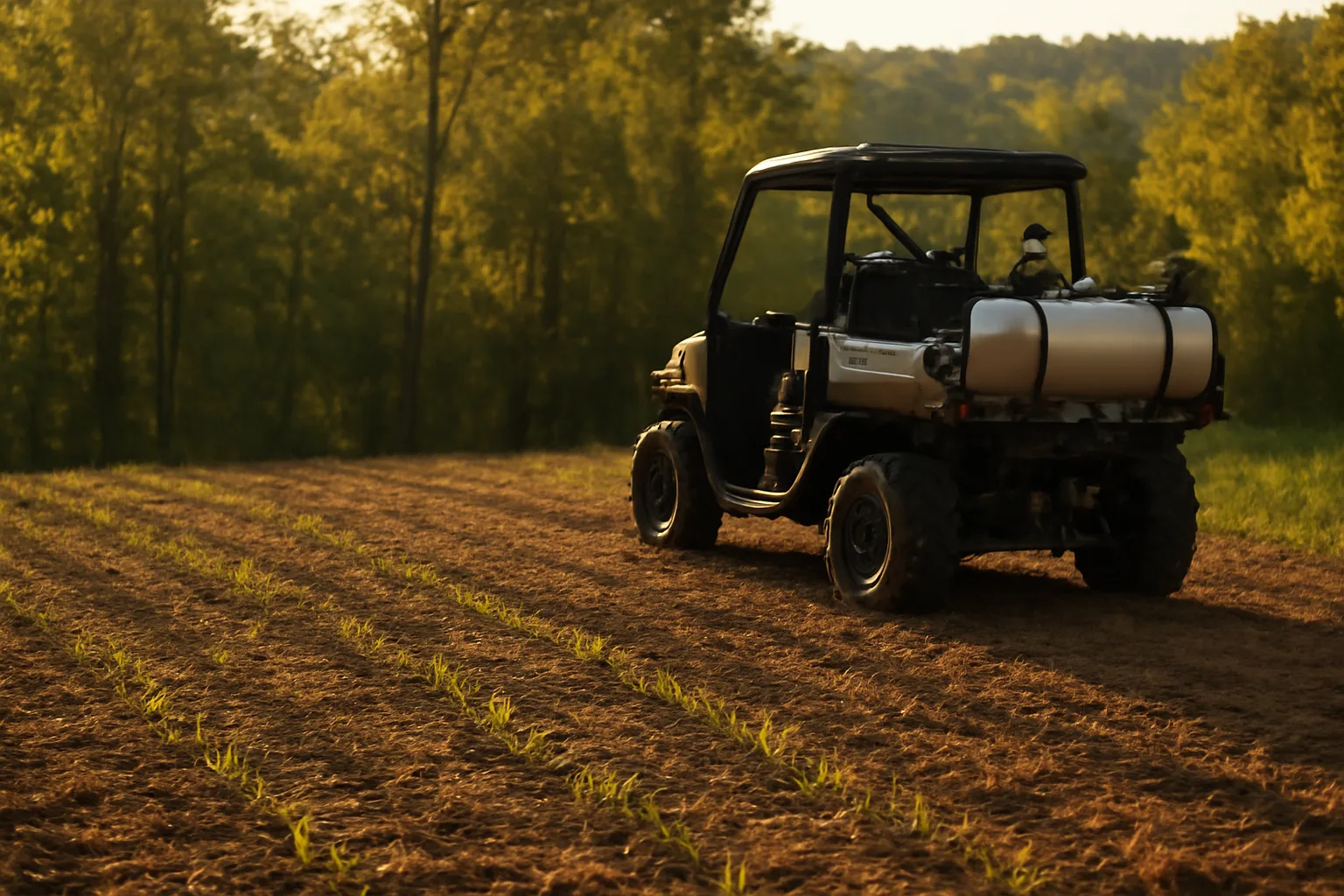
The honest minimum list: a sprayer (a 25-gallon UTV boom sprayer or even a backpack sprayer for small plots), a broadcast spreader (handheld or ATV-mount), and a drag of some kind (chain harrow, cultipacker, or a section of chain-link fence weighted down). A no-till drill is the upgrade that makes the biggest difference, especially for larger seed like soybeans, corn, and cereal grains, because it places seed at a consistent depth and gets contact without disturbing the whole surface. Drills are expensive to buy outright (used units still often run $3,000 to $8,000-plus depending on size), which is why a lot of hunters rent one through a local co-op, extension equipment program, or NRCS-affiliated conservation district rather than owning one for a couple of small plots a year. Check with your county NRCS office or Soil and Water Conservation District, some run equipment-share programs for exactly this reason. What you don't need: a tractor, a disc, or a tiller. That's the whole point of the method. If your plot is under an acre and tucked in timber, a UTV with a spreader and sprayer mounted on the back can do the entire job.
what's the difference between no-till and conventional tillage for a food plot?
| Factor | No-till | Conventional tillage | |
|---|---|---|---|
| Equipment needed | Sprayer, spreader, drag/drill | Tractor, disc, tiller | |
| Soil erosion risk | Lower, residue protects surface [1] | Higher, especially on slopes | |
| Weed control | Chemical burndown required | Mechanical burial of weeds | |
| Moisture retention | Better, less evaporation loss | Worse, tillage dries soil faster | |
| Access to tight/timber plots | Easy with small equipment | Often impossible | |
| Setup speed | Faster, no field prep pass | Slower, multiple passes needed | |
| Cost to start | Lower equipment cost | Higher equipment cost | No-till trades mechanical weed control for chemical weed control, and it trades some establishment speed for long-term soil health. On flat, accessible ground with tractor access, tillage still works fine and some hunters prefer it for a clean seedbed. On steep, small, or timber-locked plots, no-till is usually the only realistic option anyway. |
what mistakes wreck a no-till plot the most?
Skipping the burndown, or spraying too close to planting. Glyphosate needs live, actively growing weeds to work, and it needs time (10 to 21 days is the safe range) to actually kill the roots, more than brown the tops. Spray and plant the next day and you'll get a flush of weed regrowth competing with your new seedlings. Planting too deep. This is the number one broadcast-seeding mistake. Clover and brassica seed is tiny; bury it an inch deep and it'll never emerge. A light drag or cultipacker pass is meant to press seed into the soil surface, not cover it several inches down. Ignoring the soil test. A lot of failed plots aren't a planting problem at all, they're a pH problem. Forage legumes like clover struggle hard below pH 6.0, and no amount of good planting technique fixes acidic soil that hasn't been limed. Your soil report tells you exactly how much lime and fertilizer your specific field needs; that's not something a seed bag can tell you. Planting on the calendar instead of on conditions. A date on a bag is a starting guideline, not a guarantee. If your region is in a drought and there's no rain in the ten-day forecast, holding off a week or two usually beats planting into dust. If you want a plan built around your specific soil test results, planting window, and property goals instead of general guidance, that's exactly the gap our $99 one-time Custom Food Plot Plan is built to fill, you upload your soil test and property details and get species and rate recommendations back.
do you need to check baiting and feeding laws before planting?
Food plots themselves are legal everywhere as an agricultural practice, but a lot of states draw a hard legal line between a planted, standing food plot and other feeding practices like piling corn or using mineral/attractant products, especially near a hunting stand. Rules vary a lot by state and even change seasonally in some places (disease-related feeding bans tied to Chronic Wasting Disease are increasingly common). Some states restrict feeding statewide, others only restrict it in specific CWD management zones, and definitions of what counts as "baiting" versus a legitimate agricultural planting differ too. Before you plant, and especially before you supplement a plot with any mineral, salt, or feed product, check your state wildlife agency's current regulations directly, since a plot planted legally last year can fall under a new restriction this year if a CWD zone expands nearby. This isn't a place to guess. Pull up your own state fish and wildlife or natural resources department's current hunting regulations page before the season starts.
Frequently asked questions
Do deer eat sorghum?
Yes, deer eat both grain sorghum seed heads and young plants, but it's usually planted as a late-season standing food source or a screening/bedding cover crop rather than a primary attraction plot. It holds up above snow better than most other food plot species, which makes it valuable in January when low browse is covered.
Do deer eat clover?
Yes, clover is one of the most reliably eaten food plot species, and a well-maintained stand can produce forage for 3 to 5 years. It runs high in crude protein, often 20 to 30% in vegetative growth, which is a big reason deer favor it during spring and summer growing seasons.
When should you plant deer food plots?
It depends on species: spring plots (soybeans, cowpeas, corn) go in after your last frost date, while fall plots (brassicas, cereal grains, clover overseed) generally go in 60 to 90 days before your first hard frost. Check your local extension office's frost date data rather than a generic calendar date.
Do deer like clover?
Yes, clover ranks among the higher-preference food plot forages, largely because of its protein content and long growing season. It's also one of the easier species to establish no-till since the seed is small and shallow-planted, and frost seeding it onto late-winter ground works without any equipment at all.
When should you plant oats for deer?
Plant oats 45 to 60 days before your area's average first frost, which lands roughly mid-August to mid-September across most whitetail range. Oats germinate fast and green up quickly but aren't very cold-hardy, so blending with cereal rye or winter wheat extends attraction later into the season.
When should you plant turnips for deer?
Turnips need 70 to 90 days of lead time before your first hard frost, usually late July through early September depending on latitude. Deer typically won't hit the bulbs hard until after a frost or two sweetens them, so late-planted turnips often go untouched because they never mature properly.
What is a food plot?
A food plot is a planted patch of forage, typically a quarter acre to a few acres, established specifically to feed and hold deer and other wildlife on a property. It's planted for wildlife attraction and nutrition rather than commercial yield, and species choice depends heavily on the season you're targeting.
What is a deer's favorite food?
There's no single favorite; whitetail diets shift by season. Soybeans and cowpeas often top preference during the growing season for their protein content, while acorns, corn, brassicas, and clover carry more weight in fall and winter when other browse is scarce, based on long-running land-grant wildlife diet research.
Do deer eat honey?
No, honey isn't part of a whitetail deer's natural diet and there's no wildlife research supporting it as an attractant. Using it as bait would also risk running afoul of state baiting and feeding regulations, which vary by state and sometimes by CWD management zone.
How deep should you plant no-till food plot seed?
It depends on seed size. Small seed like clover, brassicas, and turnips should sit at 1/4 inch or less, just pressed into the surface with a light drag or cultipacker. Larger seed like soybeans, corn, and cereal grains generally need an inch or more of depth, which usually requires a no-till drill rather than broadcasting.
Can you plant a food plot without a tractor?
Yes, that's the entire premise of no-till planting. A UTV-mounted sprayer for burndown, a broadcast spreader for seed and fertilizer, and a drag harrow or cultipacker for seed-to-soil contact can plant a small plot completely without a tractor, disc, or tiller.
How long before planting should you spray glyphosate for burndown?
Spray 10 to 21 days ahead of planting, giving actively growing weeds time to fully die back to the root rather than just browning at the surface. Warm, actively growing conditions kill weeds faster than cool or drought-stressed ones, so adjust your window based on the weather that week.
Sources
- USDA Natural Resources Conservation Service, Soil Health / No-Till Management: No-till and reduced tillage systems reduce erosion and help maintain soil structure compared to conventional tillage
- Cornell University Cooperative Extension, Soil Testing Guidance: Soil sample collection depth and timing recommendations for land-grant extension soil tests
- Michigan State University Extension: Steps for establishing a no-till food plot
- University of Georgia Extension: Recommended planting dates and species for deer food plots
- Purdue University Extension: Equipment and techniques needed for no-till food plot planting
- Pennsylvania General Assembly: State regulations on baiting and feeding wildlife relevant to food plots