Last updated 2026-07-25
TL;DR
Shaded food plots need species tolerant of 3-4 hours of direct sun: brassicas (turnips, radish), cereal rye, and some clover blends do best. Full-sun plots (soybeans, corn) fail in shade. Thin the canopy where you can, soil test first, and expect lower yield than a sunny field regardless of what you plant.
what is a food plot, and why does shade change everything
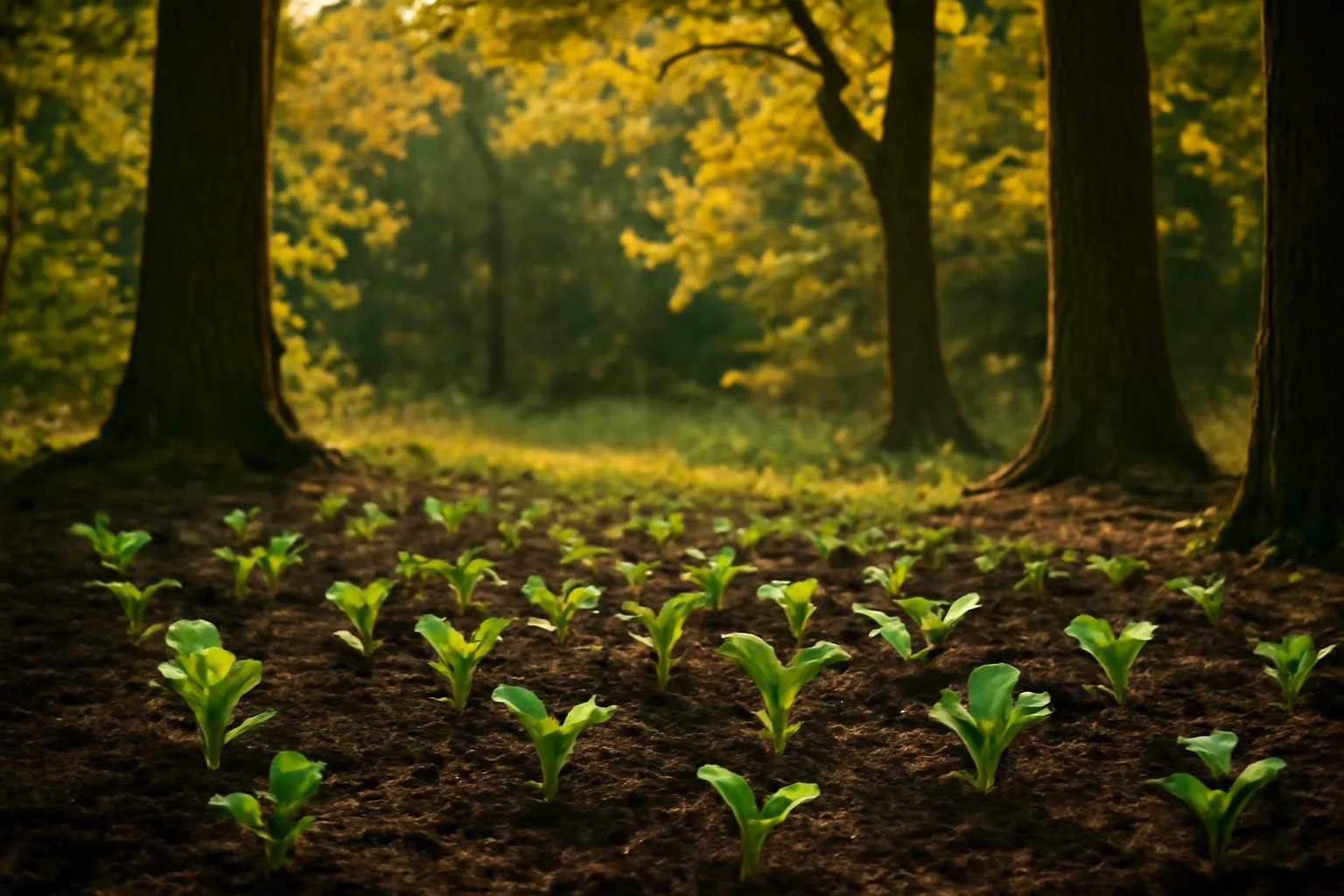
A food plot is a planted opening, usually somewhere between a quarter acre and several acres, seeded with forage crops to attract and hold deer or supplement their diet on a property. It's not a wildlife garden and it's not fertilizer scattered in the woods. It's a deliberate planting, often disked or drilled into prepared soil, timed to a growing season and a hunting season [1]. Sunlight is the first thing that decides whether a plot works, and it's the one variable a lot of hunters ignore until the plants come up spindly and yellow. Most food plot forages, corn, soybeans, most clovers, alfalfa, need at least 4 to 6 hours of direct sun to photosynthesize enough to produce real tonnage [2]. Drop below that and you're not looking at a smaller version of the same plot. You're looking at a different problem entirely: thin stands, weak root systems, and forage that dies out by midsummer no matter how good your soil test numbers look. Shaded plots, the kind carved into a timber opening, a logging road, or a north-facing bench under oaks, typically get somewhere between 2 and 4 hours of direct sun a day, filtered through leaf canopy the rest of the time. That's workable for a narrower list of species, but only if you're honest about the site and don't try to force a full-sun crop into it.
how much sun does a shaded plot actually need
You need to know your actual sun hours before picking seed, not guess at it. Walk the plot at three points in the day, mid-morning, noon, mid-afternoon, over a week in late spring when leaves are out, and note how much direct sun hits the ground. If you're getting 4+ hours, you have more options than you think. If you're under 3 hours, you're in true shade-tolerant territory and yield will always lag a sunny plot of the same size. University of Tennessee Extension wildlife specialists note that most food plot species perform best with a minimum of 6 hours of direct sunlight, and that plots receiving less should be planted with species known to tolerate partial shade rather than the standard soybean or corn mix [2]. That's the practical line: 6 hours is the target, 3 to 4 hours is the shade-tolerant zone, and under 2 hours isn't worth planting at all, no matter the seed. Canopy thinning is often the higher-leverage move before you even touch a seed bag. If you own the timber, dropping a few mature trees around the plot's south and east edges (in the northern hemisphere) can add an hour or two of usable light without changing the plot's footprint. It costs a chainsaw and a weekend, and it's usually a better return than buying a shade-tolerant blend and hoping.
what grows in shaded food plots (species that actually hold up)
| Soybeans | 6+ hours | Low | Fails badly under partial canopy | |
|---|---|---|---|---|
| Corn | 6+ hours | Very low | Not viable in shaded plots | |
| Forage turnips/radish | 3-4 hours | Moderate-high | Best all-around shade pick | |
| Winter rye | 3-4 hours | Moderate-high | Good nurse crop, holds soil | |
| Winter wheat | 4 hours | Moderate | Slightly less tolerant than rye | |
| Oats | 4 hours | Moderate | Fast fall growth, frost-killed | |
| White clover | 4+ hours | Moderate | Needs the higher end of shade range | |
| Red clover/alfalfa | 6+ hours | Low | Not suited to true shade | If you want a deeper species breakdown for full-sun ground too, food plot seed covers the standard options side by side. |
Brassicas are the strongest shade performers among common food plot crops. Turnips, forage radish, and kale tolerate partial shade better than most legumes because they push a lot of early growth before canopy closes in and they don't rely as heavily on nitrogen fixation, which slows in low light [3]. They're also cold-hardy, which matters because a lot of shaded plots are also cooler, damper sites. Cereal grains, winter rye and winter wheat especially, hold up reasonably well in partial shade and are often used as a nurse crop or a fall standalone planting in wooded plots. Oats are a bit less shade-tolerant than rye but still workable at 3-4 hours of sun, and they're a common choice for a fast-growing fall plot because they establish quickly and deer hit them hard early in the season before frost sweetens the leaves. Clover is a mixed bag in shade. White clovers (like Ladino types) have some shade tolerance and are more forgiving than red clover or alfalfa, but even the best clover blends thin out fast under a full canopy. If your shaded plot gets a genuine 4+ hours, a clover/chicory blend can work as a perennial; under 3 hours, expect it to struggle by year two. Here's a rough comparison to work from: | Species | Minimum sun needed | Shade tolerance | Notes |
do deer eat sorghum
Yes, deer eat grain sorghum, both the standing seed heads and the leaves, and it's a legitimate food plot and standing-crop option in warm-season plots, particularly in the South and Midwest where it tolerates heat and drought better than corn. It's not typically the first choice for a shaded understory plot, though, because sorghum wants full sun and a longer warm season to head out properly. Where sorghum earns its place is as a screening and late-season food source in open, sunny fields, not shaded ones. Some hunters plant it in strips as visual cover alongside a food plot rather than relying on it as the shade-tolerant answer. If your plot is genuinely shaded, sorghum is a poor use of seed money; save it for the sunny field edge.
do deer eat clover, and do deer like clover
Deer eat clover readily and it's one of the most consistently preferred forages across food plot studies and extension trials, largely because it's high in protein (often 20-25% crude protein in good stands) and stays palatable through most of the growing season [4]. Deer do like clover, and it's a reasonable perennial base for a plot that gets 4+ hours of sun. The catch in shaded ground is persistence, not initial preference. Clover germinates and gets browsed just fine in partial shade the first season, but stand density drops over two or three years as competing shade-tolerant weeds move in and the clover itself thins from reduced photosynthesis. If you're set on clover in a wooded plot, plan on it being a 2-3 year planting rather than the 4-5 years you'd expect from a sunny clover field, and be ready to overseed.
do deer like honey (and other odd attractant questions)
There's no real evidence deer are drawn to honey as a food source or attractant, and it's not part of any published food plot or supplemental feeding guidance from land-grant extension programs or state wildlife agencies. Deer are herbivores adapted to browse, forbs, mast, and agricultural forage; a sugar product like honey doesn't fit their natural diet or digestive pattern the way it might for bears or raccoons. Some commercial attractant products use sweet scents or syrups to draw deer to a mineral site or feeder, but that's a scent-based lure, not a nutritional food source, and it has nothing to do with an actual food plot planting. If you're planning a plot, put the budget into seed and soil amendments, not sugar-based attractant claims that aren't backed by any wildlife agency research.
when to plant food plots for deer (and does the shaded timing change)
| Deep South (Zone 8-9) | Late Aug - early Oct | Mid-March - May | |
|---|---|---|---|
| Mid-South/Transition (Zone 6-7) | Late Aug - mid Sept | April - late May | |
| Upper Midwest/North (Zone 3-5) | Early Aug - early Sept | Mid-May - mid-June | Check your local extension office's specific frost dates before committing; these are regional generalizations, and county-level frost data will shift the window by a week or two either direction. For a full breakdown by zone, deer food plots walks through calendar planning in more depth. |
Planting windows are set by region and by whether you're planting a warm-season (spring/summer) or cool-season (late summer/fall) plot, and shade doesn't move the calendar, it just narrows your species list within it. Most state wildlife agencies and extension services break planting into two windows: spring plots (April through June depending on latitude) for warm-season annuals like soybeans and sorghum, and late-summer plots (mid-August through September) for brassicas, cereal grains, and clover establishment ahead of fall hunting season [5]. In shaded plots specifically, timing actually matters more, not less, because you have less margin for a slow, weak stand to catch up. Get brassicas and cereal grains in the ground at the front edge of the recommended window for your zone so they get maximum growth before canopy leaf-out shades them further (in spring plantings) or before the days get too short and cool (in fall plantings). A general framework by zone: | Region | Cool-season planting window | Warm-season planting window |
when to plant turnips for deer
Plant turnips 60 to 90 days before your area's first hard frost, which puts most of the country in a late July to early September window, with the Deep South running into late September. Turnips need that runway to bulb out and build sugar content; planted too late, you get leafy top growth but small or no bulbs, which cuts the plot's late-season value since deer often switch to the bulbs after a few frosts sweeten them. In a shaded plot, lean toward the early end of that window. Slower photosynthesis under canopy means slower bulb development, so giving the crop the full 90 days rather than 60 gives it a better shot at reaching a usable size before frost and before hunting season starts.
when to plant oats for deer
Oats go in the ground in late summer for a fall/winter plot, typically 6 to 8 weeks before your first expected frost, which lands most of the country in mid-August through mid-September. Oats germinate fast, often within a week in warm, moist soil, and deer will hit young oat shoots hard within the first month, so a lot of hunters plant a succession or a larger acreage than they think they need to account for early browse pressure. Oats are a fair pick for a partially shaded plot at 4 hours of sun or better, but they're frost-killed, meaning the planting is a one-season fall food source, not a perennial. If you want oats to carry weight in a shaded plot, pair them with rye, which is hardier and will outlast the oats into winter.
soil prep and fertility in shaded plots: what changes
Shaded ground is very often compacted, root-choked, acidic forest soil, not the loamy field dirt most food plot advice assumes. Get a soil test before you do anything else. Woodland soils commonly run more acidic than open pasture ground because of leaf litter decomposition and lower biological activity, and a pH below 6.0 will choke off nutrient uptake no matter how much fertilizer you put down [6]. Your soil test lab is the authority here, not a blanket internet recommendation. Lime and fertilizer rates depend on your actual pH, phosphorus, and potassium numbers, and those vary plot to plot even on the same property. A general rule from most extension soil labs is that most food plot crops want a pH between 6.0 and 7.0, and getting there in acidic woodland soil can take 1 to 2 tons of lime per acre depending on how far off you're starting [6], but only your test results will tell you the real number for your dirt. Root competition is the other issue nobody talks about enough. Tree roots, especially from oaks and maples, will out-compete your food plot seedlings for water and nutrients even where sunlight isn't the limiting factor. If you're clearing a new shaded plot, cutting back roots along the edges (more than cutting the trees) helps the plot establish, though it's real labor with a mattock or a small trencher, not a weekend chore on a big plot.
equipment notes for small, shaded plots
Shaded plots tend to be smaller and more irregular than open-field plots, tucked into logging roads, benches, or clearings, and that changes the equipment math. A lot of hunters over-invest in a tractor and disk setup for a quarter-acre wooded plot when a walk-behind tiller, a hand-crank broadcast spreader, and a cultipacker (even a homemade drag made from chain-link fence and cinder blocks) will do the job. Seed-to-soil contact matters more in shaded plots because you're already fighting weak growth from low light; a poorly pressed seed bed compounds the problem. Broadcast small seed like clover or brassicas, then drag or cultipack to press it in, don't just walk away and hope for rain. For a rundown of small-plot gear that fits this scale, food plot whitetail covers equipment sized for exactly these tight, wooded plots.
what are deer's favorite foods, and where do shaded plots fit in
Deer preference studies and extension forage trials consistently rank a handful of crops at the top: soybeans and clover for growing-season protein, and brassicas (especially forage turnips and radish) plus acorns for fall and winter energy [4] [7]. Acorns in a good mast year can outcompete almost any planted food plot for deer attention, which is part of why a shaded plot under oaks is competing with a food source deer already prefer. That's worth being honest about. A food plot tucked into timber isn't just fighting for sunlight, it's often fighting for attention against the mast crop overhead in years when acorns are abundant. In a poor mast year, that same shaded plot becomes more valuable because it's one of the few green food sources left. Plan the plot as one piece of the property's overall food picture, not a standalone attraction, and check your state wildlife agency's rules on baiting and supplemental feeding before adding any mineral or feed station near the plot, since bait and feeding regulations vary significantly by state and by season [8].
building a plan for your specific shaded ground
Every wooded opening is different: the canopy species, the slope, the soil, the sun hours all shift the right species mix and the right timing. A soil test gives you the fertility side of the answer; walking the site at different times of day gives you the light side. Between those two, most of the guesswork in a shaded plot goes away. If you'd rather not build the plan species by species yourself, PlotSeason's $99 one-time Custom Food Plot Plan takes your soil test results, your region, and your site conditions, including shade, and builds a planting plan around them. It's general guidance built for your inputs, not a substitute for your soil test lab's specific lime and fertilizer recommendations, but it saves the trial-and-error most first-time shaded-plot planters go through. You can start one at /plot-plan-builder.
Frequently asked questions
Do deer eat sorghum in food plots?
Yes, deer eat both the leaves and grain heads of sorghum, and it's a common warm-season crop in sunny plots, especially in the South. It needs full sun and a long warm season to head out, so it's a poor fit for shaded woodland plots; save it for open field plantings.
Do deer like clover, and will it grow in shade?
Deer strongly prefer clover for its high protein content, often 20-25% crude protein in good stands. White clover has moderate shade tolerance and can work in plots with 4+ hours of sun, but stands thin faster under canopy than in open fields, often needing overseeding within 2-3 years instead of 4-5.
When should I plant food plots for deer?
Warm-season plots go in April through June depending on latitude; cool-season plots (brassicas, cereal grains, clover) go in mid-August through September in most of the country, earlier in the North and later in the Deep South. Shaded plots should be planted at the early edge of these windows to maximize growth before canopy closes or days shorten.
When is the best time to plant turnips for deer?
Plant turnips 60 to 90 days before your area's first hard frost, generally late July through early September, with the Deep South extending into late September. In shaded plots, aim for the full 90-day end of that range since slower light means slower bulb development.
When should I plant oats for deer food plots?
Plant oats 6 to 8 weeks before your first expected frost, usually mid-August through mid-September across most of the country. Oats germinate within about a week and are frost-killed, making them a one-season fall planting best paired with hardier rye in shaded ground.
What exactly is a food plot?
A food plot is a planted opening, typically a quarter acre to several acres, seeded with forage crops like clover, brassicas, or beans to feed and attract deer on a property. It requires soil prep, a planting calendar, and species matched to the site's sun, soil, and moisture conditions.
What are deer's favorite foods overall?
Extension forage trials and preference studies consistently rank soybeans and clover high for growing-season protein, and forage turnips, radish, and acorns high for fall and winter energy. Acorns in a strong mast year often outcompete any planted food plot for deer attention.
Do deer like honey or sugar-based attractants?
There's no published evidence or extension guidance showing deer are drawn to honey as a food source. Deer are adapted to browse and forage, not sugar syrups; commercial sweet-scent attractants work through scent lure, not nutrition, and aren't a substitute for planted food plot forage.
How many hours of sun does a food plot need?
Most standard food plot crops, soybeans, corn, alfalfa, need 6 or more hours of direct sun per day for solid yield, according to University of Tennessee Extension wildlife guidance. Plots getting 3 to 4 hours can still work with shade-tolerant species like brassicas and cereal rye, but yield will be lower than a sunny plot.
What food plot species tolerate shade best?
Forage turnips, radish, kale, and winter rye handle partial shade (3-4 hours of sun) better than most food plot species because they establish fast and don't rely heavily on nitrogen fixation. Soybeans, corn, and alfalfa need full sun and generally fail in shaded plots.
Should I thin trees around a shaded food plot instead of picking different seed?
Often yes. Removing a few mature trees along the plot's south and east edges can add an hour or two of usable sunlight, which usually improves yield more than switching to a different shade-tolerant seed blend. It costs labor and a chainsaw rather than ongoing seed expense.
Does soil pH matter more in shaded, wooded food plots?
Yes, generally. Woodland soils are often more acidic than open field soil due to leaf litter decomposition, and pH below 6.0 restricts nutrient uptake regardless of fertilizer applied. A soil test is the only way to know your actual lime needs; most food plot crops want a pH between 6.0 and 7.0.
Sources
- USDA NRCS, Wildlife Habitat Management Practices: Food plots are deliberate forage plantings used as a wildlife habitat management practice
- University of Tennessee Extension, Establishing Wildlife Food Plots: Most food plot species need a minimum of 6 hours of direct sunlight; shaded sites need shade-tolerant species
- Mississippi State University Extension, Brassicas for Deer: Brassicas establish fast and have moderate shade tolerance compared to legumes
- Noble Research Institute, Clover for Wildlife Food Plots: Clover provides high crude protein content, commonly 20-25%, and is highly preferred by deer
- Alabama Cooperative Extension System, Establishing Wildlife Food Plots: Cool-season and warm-season plots follow distinct planting windows tied to regional frost dates
- University of Missouri Extension, Soil Testing for Food Plots: Most food plot crops require soil pH between 6.0 and 7.0, and woodland soils often need lime correction
- Mississippi State University Extension, Deer Nutrition and Food Habits: Acorns are a preferred, high-energy fall and winter food source that competes with planted forage
- Quality Deer Management Association / National Deer Association, state baiting law summaries reference: Baiting and supplemental feeding rules for deer vary by state and should be checked before use