Last updated 2026-07-26
TL;DR
The best food plot equipment is whatever gets seed into good soil-to-seed contact at the right depth, on time. For most hunters that's a soil test ($10-20), an ATV/UTV or compact tractor, a disc or cultipacker, a broadcast spreader, and a sprayer. No-till drills help on tight budgets of time, not necessarily money.
What is a food plot, exactly?
A food plot is a planted patch of land, usually somewhere between a quarter acre and several acres, designed to feed deer and other wildlife and to concentrate animal activity where a hunter can see it. It's farming, just on a small scale and with a different customer. The USDA Natural Resources Conservation Service and state wildlife agencies both treat food plots as a wildlife habitat practice, similar in concept to wildlife food plots planted under NRCS conservation programs [1]. Functionally a plot does two things. It supplies nutrition (protein for antler and body growth in summer, carbohydrates and fat for winter energy), and it draws deer into a predictable location during shooting hours. Neither job gets done without decent equipment, because seed that doesn't get into the ground at the right depth with the right soil contact mostly just feeds birds and rots. If you're new to plotting, start with the basics on food plot whitetail planning before you buy anything. Equipment choice should follow your plan, not the other way around.
What equipment do you actually need to plant a food plot?
| Soil testing | Home test kit or extension lab, $10-20 [2] | Same, per zone | |
|---|---|---|---|
| Kill existing growth | Hand sprayer + glyphosate, $30-60 | ATV sprayer, $300-800 | |
| Till/prep seedbed | Hand tools or ATV disc, $200-600 | Tractor disc/harrow, $1,500+ | |
| Plant seed | Hand broadcaster, $20-40 | Broadcast spreader or no-till drill, $150-8,000+ | |
| Pack seed in | ATV tire, cultipacker, $150-1,000 | Cultipacker or drill packer wheels, built in or towed | A lot of hunters overspend on the tractor and underspend on the soil test. That's backwards. A $12 soil test from your state's land-grant extension lab tells you exactly how much lime and fertilizer to buy, which usually saves more money than it costs many times over [2]. |
At minimum: a way to test soil, a way to kill or turn existing vegetation, a way to work the seedbed, a way to spread or drill seed, and a way to pack it in. That's five jobs. Depending on plot size and budget, one machine can do two or three of them. Here's the honest breakdown of what each job requires and what it costs to cover it. | Job | Small plot (under 1 acre) | Larger plot (1-5+ acres) |
Do you need a tractor, or will an ATV/UTV work?
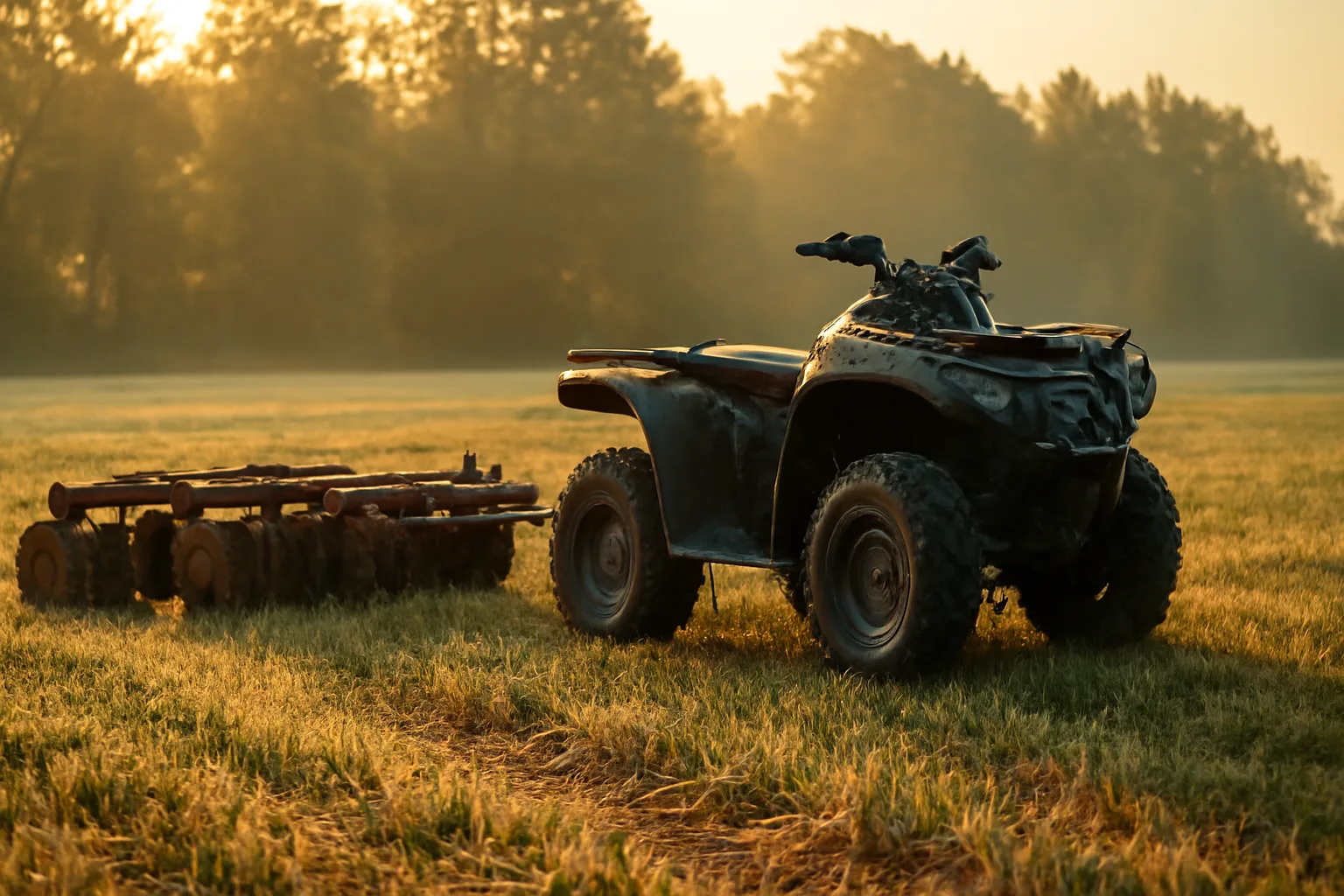
For plots under an acre or two, a UTV or ATV with pull-behind implements handles the job fine. Plenty of good plots get planted every year with nothing bigger than a four-wheeler pulling a disc, a drag harrow, and a small broadcast spreader. Once you're regularly working 2 to 5+ acres, or you're breaking new ground out of sod or hard clay, a compact tractor (25-45 horsepower range) earns its keep. It gives you three-point hitch attachments, more consistent depth control, and enough weight to actually cut through root mass. Used compact tractors in that range commonly run $8,000-20,000, and new ones easily clear $25,000-35,000 depending on attachments. The honest math: if you're planting under 3 acres total across your property, a UTV setup with implement attachments (usually $1,500-4,000 all in) will do 90% of what a tractor does, at a fraction of the cost. Save the tractor money for lime and fertilizer. Those do more for plot success than horsepower does.
Disc, drill, or no-till: which planting method is worth the money?
This is the question that burns the most money in food plot forums. Here's the real tradeoff. A disc harrow (or disc plus cultipacker) works by physically turning the soil, which buries thatch and exposes bare dirt for seed contact. It's cheap, versatile, and works in almost any soil, but it takes more passes, more diesel or gas, and it can wake up dormant weed seed banks you didn't want disturbed. A no-till drill cuts a slot, drops seed at a set depth, and closes the slot, all in one pass, without turning the whole seedbed. That means less erosion, less weed pressure from buried seed, and better performance on hillsides or in droughty years because you're not drying out a freshly turned surface. The catch is upfront cost. Used no-till drills sized for food plots run $3,000-10,000+, and the compact ag versions built for small acreage (like the Genesis or Firminator no-till line) often land in that same range new. Many land trusts and state wildlife agencies actually rent or loan no-till drills to landowners doing habitat work, since the equipment cost is the biggest barrier to no-till adoption. Check with your state wildlife agency or local NRCS office before buying one outright; several states run drill-loan programs through soil and water conservation districts. For a hunter planting one or two plots a year on already-tilled dirt, a disc and cultipacker combo is the better dollar-for-dollar buy. For someone converting CRP ground, hillsides, or heavy clay where erosion is a real risk, a no-till drill pays for itself in saved seed and better stands within a few seasons.
What's the minimum viable equipment list for a first-time plotter?
If you're planting your first plot this year and don't want to overbuy, here's the short list that actually gets seed in the ground correctly: 1. Soil test kit from your county extension office, $10-20 [2]. 2. Glyphosate or another labeled herbicide plus a pump or ATV sprayer, $50-500 depending on plot size. 3. A disc harrow or aggressive drag harrow, pull-behind, $200-800 used. 4. A hand-crank or ATV-mounted broadcast spreader, $30-300. 5. A cultipacker, roller, or even a drag made of chain-link fence and cinder blocks to press seed into contact with soil. That's it. Everything past this list (drills, tractors, soil finishers, cameras tied into planting timing) is an upgrade, not a requirement. Spend your first season's budget on lime and fertilizer per your soil test results, not on a bigger machine. For seed selection once your ground is ready, see deer food plot seed and food plot seed for species-specific guidance.
When to plant food plots for deer
Timing depends on species and region far more than it depends on equipment. Broadly, food plots fall into two planting windows: spring plots (planted after last frost, for summer nutrition) and fall plots (planted in late summer, for hunting season and winter nutrition). Spring plantings, things like soybeans, clover, and chicory, generally go in after soil temperatures reach 55-60°F and the risk of frost has passed, which varies from early April in the Deep South to late May or even early June in the northern tier and Canada. Fall plantings, brassicas, cereal grains, and annual clovers, are typically planted 6-10 weeks before your area's average first frost date, so the plants have time to establish before growth slows. Your state extension service publishes frost date maps and planting windows specific to your county; that's a better source than any generic national calendar, since a fall planting date in Georgia and one in Minnesota can be two months apart.
When to plant oats for deer
Oats are a fall-planted cereal grain in most whitetail range, going in the ground roughly 45-60 days before your first expected frost. That timing lets the oats establish, tiller, and put on the leafy growth deer prefer before cold weather slows things down. In much of the Midwest and mid-South that lands in late August through mid-September. Further north (Wisconsin, Minnesota, southern Canada) growers often plant in August; in the Deep South, growers can push into October. Oats winterkill in most of the whitetail's range once temperatures drop into the low 20s and below for sustained periods, so they're primarily an early-to-mid-fall attractant rather than a winter food source, unlike wheat or rye which tolerate more cold. Oats pair well in a mix with brassicas or clover because the quick germination gives deer something to eat while slower species establish underneath.
When to plant turnips for deer
Turnips are planted in late summer, typically 90-100 days before the first hard frost, since they need that much time to bulb out and reach peak palatability. In most of the Midwest that means late July through mid-August. Planting too early in hot, dry conditions can cause poor germination; planting too late means the bulbs won't size up before frost slows growth. Here's the part a lot of hunters miss: deer usually ignore turnip bulbs and tops until after one or two hard frosts convert starches to sugars, which is why a turnip plot can look completely untouched in October and get hammered in December. Land-grant extension programs note that brassica palatability increases markedly after frost due to this starch-to-sugar conversion [3]. If you're hunting early season, turnips alone are the wrong plot; pair them with something deer will eat immediately, like clover or oats.
Do deer eat clover, and do they actually like it?
Yes, and clover is arguably the most consistently used food plot forage across whitetail range. It's a perennial, it regrows after grazing, and it delivers protein levels well above most other forages when managed correctly, generally in the 20-30% crude protein range depending on species, maturity, and soil fertility, per land-grant forage testing data [4]. Deer show a strong preference for clover through spring, summer, and into fall, which is why it's the backbone forage in most seed mixes and why it shows up in nearly every plot planted for antler growth and lactation support. It does have limits: it goes semi-dormant in the coldest part of winter in northern climates, and it can't outcompete weeds without mowing or spot spraying. White clover (Ladino types) and red clover are the two most commonly planted for deer plots. Ladino handles grazing pressure better; red clover tends to be more drought tolerant and often persists 2-3 years versus Ladino's typical 3-5 year stand life under good management, though both vary a lot by region and maintenance.
Do deer eat sorghum, and what's it good for in a plot?
Deer will eat sorghum, particularly the grain heads once they mature, but it's rarely a primary forage choice on its own. It's more commonly used as a cover crop, a screening plant to block wind and sightlines around a plot, or a component in a fall/winter mix where the seed heads provide late-season carbohydrate energy after other food sources thin out. Grain sorghum and forage sorghum behave differently: grain types are shorter and produce a dense seed head deer and turkeys both use; forage/sudangrass types grow taller and are used more for biomass and screening than as a primary deer food. If your goal is pure deer nutrition, clover, brassicas, soybeans, and cereal grains will outperform sorghum. If your goal includes visual screening or standing winter cover with some food value, sorghum earns a spot in the mix.
Do deer like honey, or is that a food plot myth?
No, honey is not a natural or practical deer food or attractant, and it's not something you'd plant or use in a legitimate food plot program. Deer are herbivores built to digest cellulose and plant material through a four-chambered rumen system; honey isn't part of their natural diet and offers nothing nutritionally relevant to a plotting strategy. What likely drives this search is confusion with commercial deer attractant products that use sugar, molasses, or apple/acorn scent bases, some of which are marketed loosely with "sweet" branding. Those products function as scent or taste attractants poured on the ground or on a mineral site, not as food plot inputs, and many states classify them under baiting or supplemental feeding rules rather than habitat management. Before using any attractant product, check your state wildlife agency's baiting and feeding regulations, since rules vary widely and some states prohibit these products entirely during hunting season.
What are deer's favorite foods, and how does that change equipment needs?
Deer preference shifts by season and region, but across most whitetail range, the consistent favorites in cultivated food plots are soybeans and clover in summer, and brassicas, cereal grains, and clover in fall and winter. In natural habitat, acorns are typically the single most preferred and highest-energy fall food source where oaks are present, often outcompeting planted plots in years with a strong mast crop, per multiple state wildlife agency deer management reports. What this means for equipment: a soybean plot needs row spacing and planting depth control that a broadcast spreader alone can't reliably give you, which is where a drill or planter attachment matters more. Clover and brassica seed, by contrast, is small and shallow-planted, so a broadcast spreader followed by a cultipacker works fine. Match your equipment to the seed you're planting, not the other way around. Buying a drill and then choosing species that don't need one is backwards. For a broader look at species selection by region and goal, see deer food plots and domain food plot seed.
How does soil testing change your equipment and input budget?
A soil test is the cheapest, highest-leverage tool on this entire list, and it's the one hunters skip most often. Most land-grant university soil labs charge $7-20 per sample and turn results around in 1-2 weeks, with recommendations for lime and fertilizer specific to the crop you tell them you're planting [2]. Without a test, you're guessing at lime rates, and guessing wrong is expensive. Many food plot soils, especially reclaimed timber ground or old pasture, run acidic enough (below pH 6.0) that clover and brassicas struggle regardless of how good your planting equipment is. Lime takes months to fully react in soil, so testing in fall for a following spring or summer planting, or testing as early as possible before any planting, gives the lime time to actually work. Your soil test lab is the authority on exact lime and fertilizer rates for your specific field; treat any general planting guide, including this one, as a starting framework and defer to your lab's numbers. If you want a structured starting plan built around your test results, region, and equipment on hand, the $99 one-time Custom Food Plot Plan walks through species, timing, and rates without requiring you to piece it together from a dozen sources.
How much should you actually budget for food plot equipment?
| Bare minimum | $150-500 | Under 1/2 acre, hand tools, borrowed ATV | |
|---|---|---|---|
| Small plot standard | $1,500-4,000 | 1-3 acres, ATV/UTV plus pull implements | |
| Established plotter | $8,000-20,000 | 3-10 acres, used compact tractor plus implements | |
| Full setup | $25,000-50,000+ | 10+ acres, new tractor, drill, sprayer, finisher | Most hunters managing under 5 total acres of plots across a property never need to go past the "small plot standard" tier. The jump to a tractor only pays off in time saved once you're planting multiple plots a year or breaking new ground annually. Don't let equipment envy from forums or YouTube push you into the "full setup" tier before your acreage justifies it. |
Here's a realistic first-year and ongoing budget range based on plot size, separate from seed and fertilizer cost. | Setup tier | Typical total equipment cost | Best for |
Frequently asked questions
Do deer eat sorghum?
Yes, deer eat sorghum grain heads once mature, but it's usually planted as a screening or late-season cover crop rather than a primary forage. Clover, soybeans, brassicas, and cereal grains generally outperform sorghum for pure nutritional value in a food plot.
Do deer eat clover?
Yes, clover is one of the most consistently preferred food plot forages across whitetail range, often testing at 20-30% crude protein depending on species and soil fertility. It's used heavily spring through fall and semi-dormant in the coldest winter months in northern climates.
When should you plant food plots for deer?
Spring plots go in after your last frost date, typically April through early June depending on region. Fall plots, including brassicas and cereal grains, go in 6-10 weeks before your area's first frost, so check your state extension service's local frost date and planting window guidance.
Do deer like clover better than other food plot species?
Deer show strong, consistent preference for clover, particularly white (Ladino) and red clover, through most of the growing season. It's a backbone species in most mixes because it regrows after grazing and holds high protein levels, though it can't outcompete weeds without mowing.
When should you plant oats for deer?
Plant oats roughly 45-60 days before your area's first expected frost, generally late August through mid-September across most of the Midwest. Oats winterkill in sustained cold below the low 20s Fahrenheit, so treat them as an early-to-mid-fall food source, not a winter one.
When should you plant food plots, spring or fall?
Most properties benefit from both: spring plots (soybeans, clover, chicory) planted after last frost for summer nutrition, and fall plots (brassicas, cereal grains, annual clover) planted 6-10 weeks before first frost for hunting season. Your local extension office publishes exact dates by county.
When should you plant turnips for deer food plots?
Plant turnips 90-100 days before your first hard frost, typically late July through mid-August in most of the Midwest. Deer often ignore turnips until after one or two hard frosts convert the bulb's starches to sugar, so early season hunters should pair turnips with an immediately palatable species.
What exactly is a food plot?
A food plot is a planted area, often a quarter acre to several acres, established specifically to feed deer or other wildlife and to concentrate their activity for observation or hunting. It functions as small-scale farming aimed at a wild animal customer rather than a human one.
What are deer's favorite foods in a food plot?
Across most whitetail range, deer favor soybeans and clover in summer, and clover, brassicas, and cereal grains in fall and winter. Natural acorns, where oak mast is available, often outcompete any planted food plot in years with a strong acorn crop.
Do deer like honey or sweet attractants?
No, honey isn't a natural deer food and provides no real nutritional or attraction value; deer are herbivores that don't seek out honey in the wild. Commercial sugar or molasses-based attractant products are a different category and are often regulated under state baiting or feeding rules.
Do you need a tractor for food plots, or is an ATV enough?
For plots under 2-3 acres, a UTV or ATV pulling a disc, spreader, and cultipacker handles the job fine and costs a fraction of a tractor. A compact tractor (25-45 hp) becomes worthwhile once you're regularly working larger acreage or breaking new ground from sod.
Is a no-till drill worth the cost for food plots?
It depends on your ground and your acreage. No-till drills reduce erosion and weed pressure and perform better on hillsides or in dry years, but used units run $3,000-10,000+. For small, already-tilled plots, a disc and cultipacker combo is a better dollar-for-dollar choice; some states also loan drills through conservation districts.
Sources
- USDA Natural Resources Conservation Service, Conservation Practice Standard 645, Wildlife Habitat Planting: Food plots are treated as a wildlife habitat practice, similar to wildlife food plot practices supported under NRCS conservation programs
- University of Missouri Extension, Soil Testing for Lawns, Gardens and Crops: Land-grant soil test labs typically charge in the range of $10-20 per sample and provide lime and fertilizer recommendations by crop
- Purdue Extension, FNR-428-W, Improving Food Plots for Deer and Other Wildlife: Brassica palatability to deer increases after frost due to starch-to-sugar conversion
- University of Kentucky Cooperative Extension, AGR-76, Clover Species for Kentucky Pastures and Hayfields: Clover crude protein content commonly falls in the 20-30% range depending on species, maturity, and fertility
- NDSU Extension, R1004, Seeding Rates, Dates and Depths for Common North Dakota Crops: Land-grant extension services publish region-specific planting windows and seeding depths for cereal grains and forage crops
- USDA NRCS, Environmental Quality Incentives Program (EQIP) fact sheet: NRCS conservation cost-share programs, including EQIP, support wildlife habitat practices such as food plot and cover establishment