Last updated 2026-07-25
TL;DR
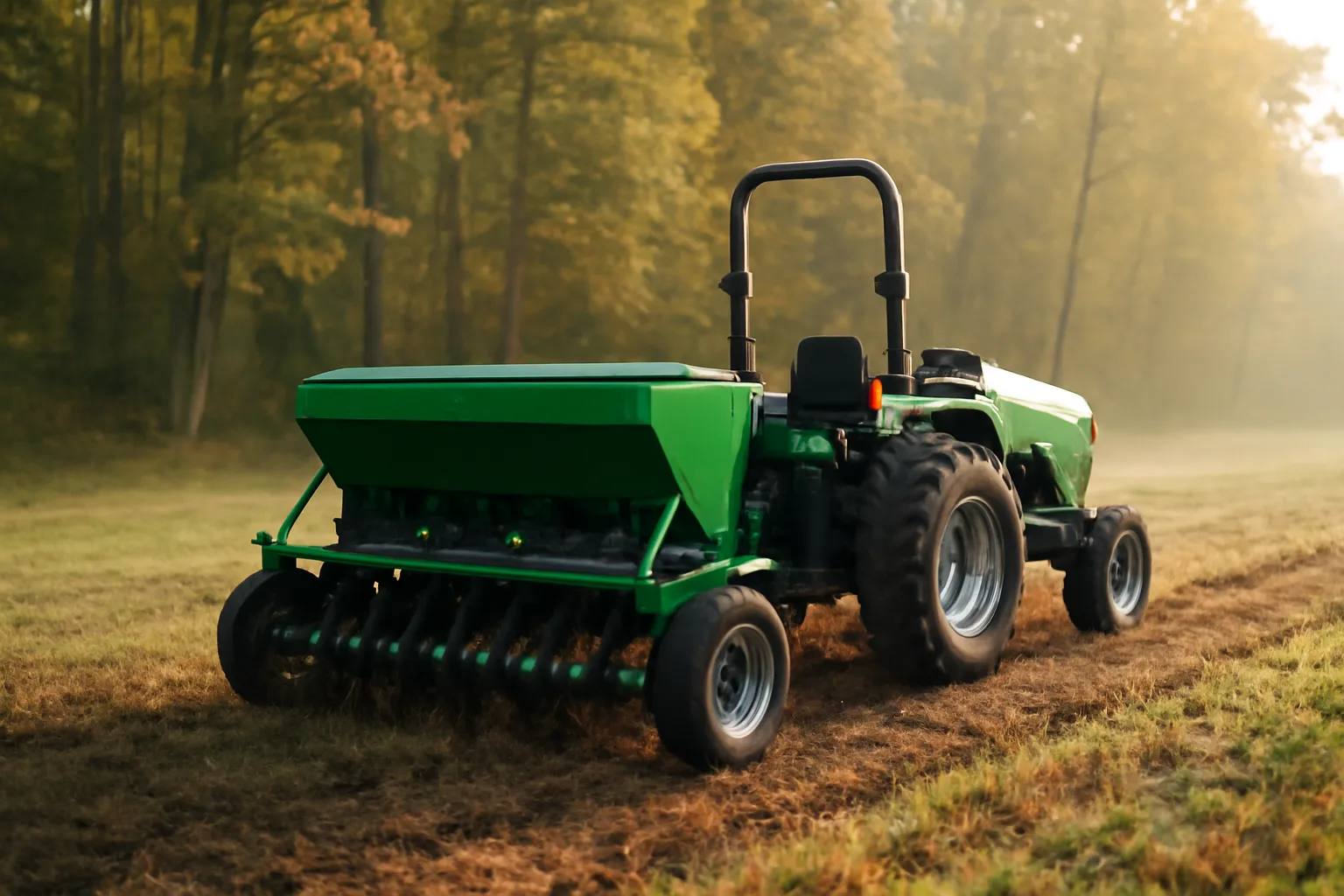
There's no single best no-till drill, only the right size for your ground. Small ATV/UTV units like the Genesis or Firminator run $1,500 to $4,000 and handle 5 to 30 acre plots. Tractor-pulled drills like the Great Plains or Land Pride cost $8,000 to $20,000+ but seed depth control and packer wheels matter more than brand.
What is a food plot, and why does drill choice matter?
A food plot is a planted area on hunting land, usually a fraction of an acre up to several acres, grown specifically to feed and hold deer or other game rather than to sell as a cash crop. Most food plots run somewhere between a quarter acre and 5 acres, though plots for large properties or ag-style operations can run bigger. Drill choice matters because seed-to-soil contact and planting depth decide whether your plot germinates evenly or comes up patchy. A no-till drill cuts a narrow slot through existing sod, crop residue, or a killed cover crop, drops seed at a set depth, then closes the slot with a press wheel. Broadcasting seed and hoping for rain works sometimes, but small-seeded species like clover and brassicas need shallow, consistent depth (often 1/4 inch or less) that a drill delivers far more reliably than a spinner spreader. The tradeoff is cost and complexity. A drill is a bigger investment than a spreader and a cultipacker, and it needs a tractor or at least a heavy ATV/UTV with real pulling power. For a lot of small-acreage plotters, the math doesn't pencil out until you're planting several plots a year or you've got tough sod to punch through. If you're still deciding what to plant before you decide how to plant it, food plot seed selection should come first. Drill choice follows seed choice, not the other way around.
What are the best no-till drills for food plots by size and budget?
| Tow-behind ATV/UTV drills (Firminator, Genesis, Woods) | $1,500 to $5,000 | ATV/UTV, 25+ hp | 1 to 10 acre plots, remote food plots | Slower per-acre coverage, narrower working width | |
|---|---|---|---|---|---|
| Compact tractor no-till drills (Great Plains 606NT, Land Pride NTA) | $8,000 to $18,000 | 35 to 75 hp tractor | Multiple plots, 5 to 40 acres total | High upfront cost, needs a real tractor | |
| Large ag no-till drills (Great Plains, John Deere 1590) | $20,000 to $60,000+ | 75+ hp tractor | Large-acreage operations, ag-style plots | Overkill for most hunting land, hard to justify | |
| Drill/cultipacker combo units (Firminator, Whitetail Institute Pro-Till) | $2,000 to $6,000 | ATV/UTV to compact tractor | One-pass seed and finish work in soft ground | Not true no-till (works better on tilled or loose ground) | For most hunters managing 1 to 3 plots under 5 acres each, a tow-behind unit in the $2,000 to $4,000 range covers it. If you're running a farm-scale operation with 10+ plots or you lease multiple properties, a compact tractor drill starts to make financial sense, especially if you can share the cost or use across other ag ground. Don't get hung up on brand loyalty forums. The University of Tennessee Extension and other land-grant programs that study no-till planting for wildlife food plots consistently point to seeding depth control and down-pressure adjustment as the features that matter, not the manufacturer's name on the frame [1]. |
There's real disagreement among plotters about which brand is "best," and that's because the right drill depends entirely on acreage, tractor size, and terrain. Here's how the main categories break down. | Drill type | Typical cost | Power needed | Best for | Downside |
What features actually matter on a no-till drill?
Seed depth control is the single most important feature, full stop. Clover and brassica seed wants to sit around 1/4 inch deep; cereal grains like oats and wheat want 3/4 inch to 1.5 inches; soybeans and corn want 1.5 to 2 inches. A drill that can't hold different depths for different seed sizes will shortchange you on at least one crop you plant. Down-pressure adjustment matters almost as much. If your ground is hard clay, you need enough down-pressure on the opener disc to actually cut through sod and thatch. If it's soft or sandy, too much pressure buries seed too deep. Drills with adjustable spring or hydraulic down-pressure let you dial this in per field. Packing wheels close the seed slot and firm the soil around the seed, which pulls moisture up to the seed and speeds germination. A drill without decent packer wheels behind each opener is really just a modified disc, not a true no-till drill. Row spacing affects which crops work well. Narrow row spacing (6 to 7.5 inches) suits small grains and clover mixes. Wider spacing (15 to 30 inches) suits corn and some soybean plantings where you want row cultivation options later. Multi-purpose drills with adjustable spacing cost more but flex across more of your seed list. Seed box capacity and metering matter for practical reasons. Small ATV drills often hold 1 to 3 bushels, which is fine for small plots but means refilling often on bigger acreage. Metering wheels or gates that handle both fine seed (clover, brassica) and large seed (beans, peas) without bridging or clumping save real frustration in the field.
When to plant food plots for deer, and how does that affect drill timing?
Planting windows depend entirely on your USDA plant hardiness zone and what you're planting, but most food plot species fall into a spring window (April through June) or a fall window (mid-August through early October). Warm-season plots (soybeans, corn, sorghum, cowpeas) go in the spring window after the last frost. Cool-season plots (clover, brassicas, cereal grains) go in the late summer to early fall window, timed so they establish before the first hard frost. Drill timing follows the same calendar, but no-till adds one more variable: you often need to kill existing vegetation with herbicide 1 to 3 weeks before drilling, especially if you're planting into standing sod or a cover crop. Glyphosate applications typically need 7 to 14 days to fully kill grass before you drill through it, per label guidance and extension weed control recommendations [2]. Skip that step and your drill is fighting living competition the whole season. For fall plots specifically, most extension guidance recommends getting seed in the ground 45 to 60 days before your area's average first frost date, which gives brassicas and cereal grains enough growing season to reach a palatable stage before deer season opens [3]. If you're drilling in late August or early September, don't wait on a rain forecast too long. Soil moisture at drilling time matters more than most people think for no-till germination rates.
When to plant oats for deer?
Oats for deer food plots go in during the late summer to early fall window, typically mid-August through mid-September depending on your zone, so they have time to establish before frost slows growth. Oats are a fast-germinating cereal grain, often up in 5 to 7 days under good moisture, and deer will hit young oat shoots hard in September and October. Oats don't tolerate deep cold as well as wheat or rye. In colder zones (Zone 4 and colder), oats often winterkill completely, which some plotters actually use as a strategy: plant a mix of oats and a hardier grain like wheat, let the oats provide fast fall attraction, and let the wheat carry the plot through late winter. Drilling depth for oats runs 1 to 1.5 inches. A no-till drill with a cereal grain-specific opener setting handles this well; broadcasting oats and cultipacking works too but usually costs you 10 to 20% germination compared to a properly drilled seed.
When to plant turnips for deer, and do deer actually eat them?
Turnips for deer food plots go in during the same late-summer window as brassicas generally, roughly 90 days before your first expected frost, which for most of the whitetail's range lands somewhere between late July and late August. Turnips need a longer runway than oats because deer often ignore the leafy tops early and don't hit the bulbs hard until after the first hard frost converts starches to sugars, making them sweeter and more palatable. Do deer eat turnips? Yes, and often heavily, but the timing of that use is the part people get wrong. A field can look totally untouched in October and then get hammered to bare dirt by late December once frost has sweetened the bulbs. If you're planting turnips as a late-season food source, don't judge the plot's success in early bow season. Turnip seed is tiny, similar in size to clover, and needs to sit no deeper than 1/4 to 1/2 inch. A no-till drill with fine-seed metering and shallow depth control handles this far more consistently than broadcasting, since buried-too-deep brassica seed simply doesn't come up.
Do deer like clover, and when should you plant it?
Yes, clover is one of the most consistently preferred food plot forages for whitetail deer, and it's also one of the most forgiving to grow. Clover food plots can be planted in either spring (April to May) or late summer/early fall (mid-August to mid-September), depending on your region and whether you're frost-seeding or drilling. Clover's appeal comes down to protein content and season-long availability. Established clover stands regularly test at 25 to 30% crude protein, and unlike annual grains, a well-maintained clover stand can produce for 3 to 5 years off a single planting, which is a real cost advantage over replanting annuals every season. Clover seed is small (roughly 350,000 to 400,000 seeds per pound for white clover) and needs shallow planting, no deeper than 1/4 inch. This is exactly the scenario where a no-till drill earns its cost: broadcast clover on top of ground with any thatch or residue and a lot of it never makes soil contact at all. A drill with a small-seed box and adjustable depth stop gets you dramatically better stand density. For species selection beyond clover, deer food plot seed breaks down blends by region and soil type.
Do deer eat sorghum, and does it fit a no-till rotation?
Yes, deer eat sorghum, both the standing forage and the grain heads, and it's a legitimate warm-season option, especially in the southern half of the whitetail's range where heat and drought stress kill less-tolerant crops like soybeans. Grain sorghum also draws turkey and other wildlife, which some landowners see as a bonus and others see as unwanted competition for the deer-specific plot. Sorghum fits a no-till rotation reasonably well because it's planted at a similar time and depth to corn, roughly 1 to 1.5 inches deep, late spring after soil temps hit 65°F consistently. It's not a top-tier deer attractant compared to soybeans or clover in most preference studies, but its drought tolerance makes it a practical choice on sandy or dry ground where beans struggle. A no-till drill handles sorghum's seed size fine with standard row-crop metering, no special small-seed attachment needed like you'd want for clover or brassicas.
What are deer's favorite foods, and does that change what you should drill?
Deer preference studies and decades of extension and wildlife agency observation point to a fairly consistent short list: acorns (especially white oak group), soybeans (both forage and grain stage), clover, and, seasonally, standing corn. Preference isn't fixed though; it shifts hard with season, local food availability, and regional habitat. A plot that gets hammered in October in one county might get largely ignored in a neighboring county thick with natural mast that year. This matters for drill choice because your top-preference species aren't always the easiest to drill. Soybeans need deeper planting (1.5 to 2 inches) and wider row spacing than clover, so if your plot rotation includes both beans and clover, you want a drill with adjustable depth and row spacing rather than a single-setting unit. A lot of plotters run a multi-species approach specifically because deer preference shifts: a spring soybean plot for summer/early fall, and a fall brassica/clover mix for late season. That rotation is exactly where a versatile no-till drill pays for itself, since you're using the same machine twice a year instead of buying separate equipment for each planting. For a broader look at species selection tied to preference data, deer food plots covers regional variation in more depth.
Do deer like honey, and is it relevant to food plots at all?
No, honey has no real place in food plot planning, and there's no meaningful deer attractant research suggesting deer seek out honey in the wild. Deer are not natural honey feeders; that behavior belongs to bears, not whitetail. Some commercial deer attractant and mineral products use sweeteners including molasses or sugar-based compounds to increase palatability of a mineral lick or supplemental feed, and it's possible a product marketed loosely could reference honey or sugar as an additive, but that's a supplemental feed or attractant product, not a food plot planting question. More relevant: check your state's baiting and supplemental feeding regulations before using any attractant product near a plot or stand. Rules vary widely by state and some prohibit feeding or baiting entirely, or restrict it seasonally or by distance from a stand. Your state wildlife agency's regulations page is the only reliable source here, since rules change year to year and vary a lot by state.
No-till vs. conventional tillage: which actually produces a better plot?
No-till has real agronomic advantages that go beyond convenience. USDA NRCS guidance on no-till and reduced-till systems notes that no-till reduces soil erosion, preserves soil moisture, and builds organic matter over time compared to conventional tillage, which is especially valuable on the marginal, often sloped or wooded-edge ground a lot of food plots occupy [4]. Conventional tillage still has a place. On ground with heavy sod, thick weed thatch, or compacted soil, a single tillage pass can outperform a no-till drill that just can't punch through. Some plotters run a hybrid approach: till once to establish a plot on new ground, then switch to no-till drilling for every planting after that, using cover crops and crop rotation to maintain soil structure. Cost is the other real factor. A disc, tiller, or plow setup for conventional tillage often costs less upfront than a quality no-till drill, but you're paying in fuel, time, and soil disturbance on every pass, plus higher erosion risk on sloped plots. Over 5 to 10 years of regular plotting, the no-till drill usually wins on total cost and soil health, according to multiple state extension no-till cost studies, though the breakeven point depends heavily on how many acres and how many years you're planting [4].
How do you get a food plot plan that matches your equipment and soil?
A soil test is the starting point for any plot, no-till or otherwise, since lime and fertilizer recommendations depend entirely on your specific soil's pH and nutrient levels. Your soil test lab is the authority on those numbers for your ground; a national article can give you ranges, but only your test results tell you what your specific field needs. Once you know your soil chemistry and what equipment you're working with, matching seed species to both gets a lot easier. If you'd rather not piece that together field by field, PlotSeason's $99 one-time Custom Food Plot Plan builds a species and timing plan around your zone, soil test results, and equipment, though it's general planning guidance, not site-specific agronomy advice; your soil lab's recommendations still take priority on lime and fertilizer rates. For a wider look at how plot type interacts with equipment choice, food plot whitetail and domain food plot seed both cover ground-prep decisions in more detail.
Frequently asked questions
Do deer eat sorghum?
Yes. Deer eat both standing sorghum forage and mature grain heads, and it's a reasonably drought-tolerant warm-season option, especially in the southern half of whitetail range. It's not typically a top-tier preference item compared to soybeans or clover, but it holds up better on sandy or dry ground where other warm-season crops struggle.
Do deer eat clover?
Yes, and it's one of the most consistently preferred food plot forages available. Established clover stands often test at 25 to 30% crude protein and can produce for 3 to 5 years from a single planting, making it one of the better cost-per-year options compared to replanting annual crops every season.
When should I plant food plots for deer?
Timing depends on species and your USDA hardiness zone, but most fall into two windows: spring (April to June) for warm-season crops like soybeans and corn, and late summer to early fall (mid-August to early October) for cool-season crops like clover, brassicas, and cereal grains. Check your zone's average first frost date to set the fall window.
Do deer like clover more than other food plot options?
Clover ranks among the top preferred forages in most observational and extension data, largely because of its high protein content and long growing season. Preference does shift though; during acorn drop or in areas with heavy soybean or corn availability, deer use of clover can drop noticeably, even in plots that were hammered earlier in the season.
When should I plant oats for deer?
Plant oats mid-August through mid-September in most zones, giving them time to establish before frost slows growth. Oats germinate fast, often within 5 to 7 days, and deer readily hit young shoots in September and October. Oats winterkill in colder zones (Zone 4 and colder), so pair with a hardier grain like wheat if you want late-winter coverage.
When should I plant turnips for deer?
Plant turnips roughly 90 days before your area's first expected frost, typically late July through late August depending on region. Deer often ignore turnip tops early in the season and don't hit the bulbs hard until after a hard frost sweetens them through starch-to-sugar conversion, so don't judge the plot's success before late season.
What is a food plot?
A food plot is a planted area, usually a fraction of an acre up to several acres, established specifically to feed and attract deer or other game rather than for commercial harvest. Plots typically use forage species like clover, brassicas, cereal grains, soybeans, or corn, chosen based on soil, climate zone, and the season you want to provide food.
What are deer's favorite foods?
Acorns (especially white oak group), soybeans, clover, and standing corn consistently rank among the most preferred deer foods across extension and wildlife agency observation. Preference isn't fixed; it shifts by season and local food availability, so a top-preference food in one area or year might see much less use elsewhere or in a mast-heavy year.
Do deer like honey?
No, honey isn't a natural or documented deer food, and there's no meaningful research showing deer seek it out. Some mineral or attractant products use sweeteners like molasses, but that's supplemental feed territory, not food plot planting. Check your state wildlife agency's baiting and feeding rules before using any attractant product, since regulations vary widely.
Is a no-till drill worth it for a small food plot under 2 acres?
Often not, financially. A quality ATV no-till drill starts around $1,500 to $2,000, which is a lot of cost for one small plot. If you're only planting clover on soft, worked ground, a spreader and cultipacker often gets you 80 to 90% of the germination result for a fraction of the cost. Drills earn their keep across multiple plots or tough sod.
What seed depth should a no-till drill use for clover versus soybeans?
Clover and other small-seeded species (brassicas included) want roughly 1/4 inch depth, no deeper. Soybeans need 1.5 to 2 inches, and cereal grains like oats and wheat fall between at 1 to 1.5 inches. A drill without adjustable depth control across these ranges will underperform on at least one species in a mixed rotation.
Can I use a no-till drill without spraying herbicide first?
You can, but results are usually worse. No-till drills work best when existing vegetation is dead or dormant, since living sod competes directly with new seedlings for moisture and light. Most guidance recommends a glyphosate application 7 to 14 days before drilling to fully kill competing growth, per herbicide label instructions and extension weed control recommendations.
Sources
- University of Tennessee Extension, No-Till Planting Considerations for Wildlife Food Plots: Seeding depth control and down-pressure adjustment are the features extension guidance identifies as most important on no-till drills
- University of Missouri Extension, Weed Control in Food Plots: Glyphosate applications typically require 7 to 14 days before tillage or drilling to fully control existing vegetation
- Mississippi State University Extension, Establishing Fall Food Plots for Deer: Fall food plot seed should go in roughly 45 to 60 days before the average first frost date
- USDA NRCS, No-Till and Strip-Till Soil Health Benefits: No-till systems reduce soil erosion and preserve soil moisture and organic matter compared to conventional tillage
- Iowa State University Extension, Cover Crop Termination Timing: Cover crop and existing vegetation termination timing affects no-till drill performance and seedling competition