Last updated 2026-07-25
TL;DR
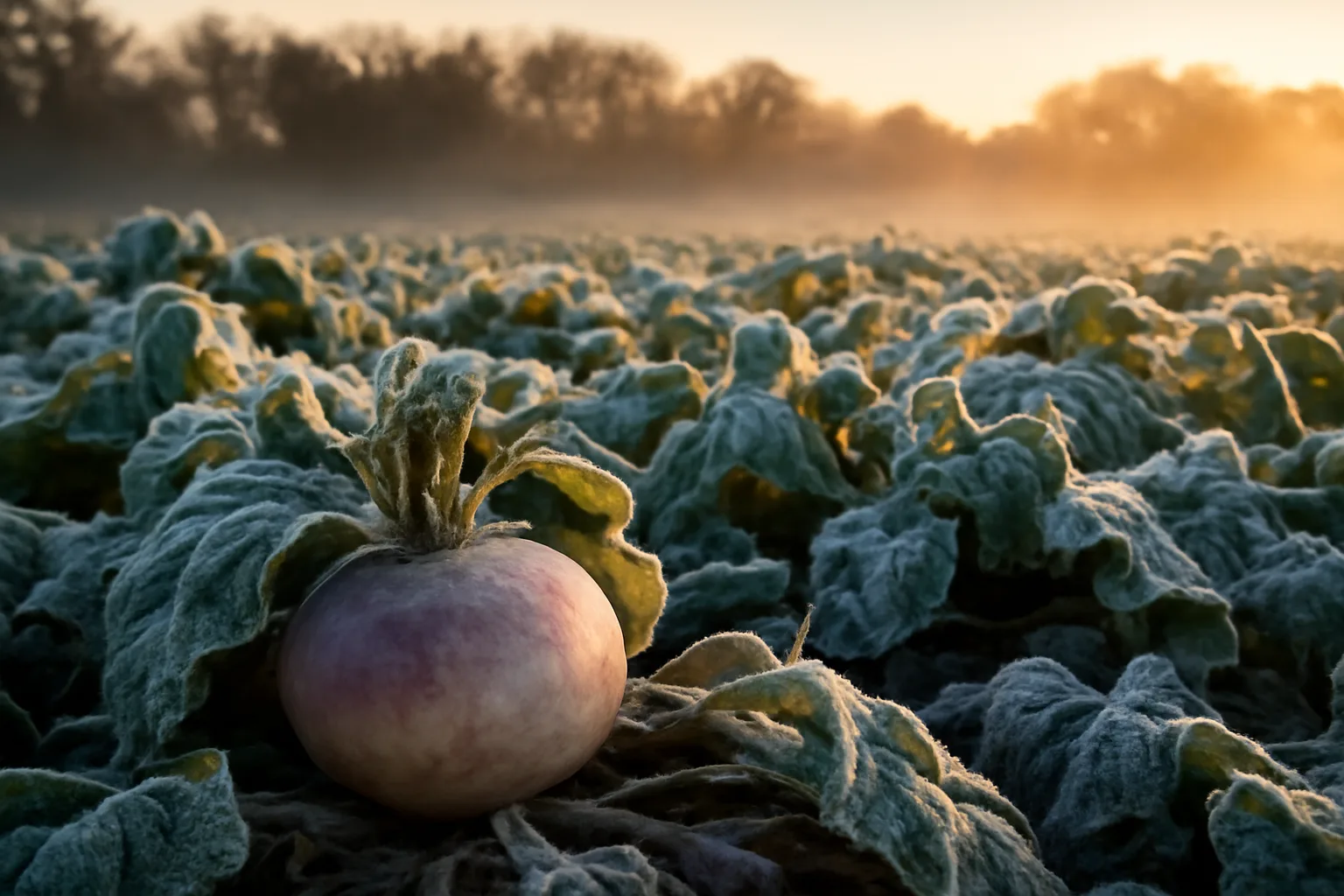
Late season food plots work best with brassicas (turnips, radish), cereal grains (oats, wheat) or standing soybeans/corn planted 60 to 90 days before your area's average first hard frost. Deer switch to high-carb, high-energy foods once temperatures drop, and brassicas actually get sweeter after frost converts starches to sugars.
What is a food plot, exactly
A food plot is a planted patch of forage or grain on land you own or lease, put in specifically to feed deer and other wildlife and to give hunters a place to watch and harvest animals. That's the whole definition. It's not a garden, it's not landscaping, and it doesn't need to look pretty. It needs to grow something deer want to eat at the time of year you need them to show up. Food plots range from a quarter-acre kill plot tucked into a bedding area to 5-acre destination fields planted in soybeans or corn. Cooperative extension programs generally treat food plots as a wildlife habitat management tool, similar to prescribed burning or timber stand improvement, rather than a farming operation, though the agronomy underneath it is identical to row-crop farming on a small scale [1]. Late season plots are a specific category. They're forage planted and timed to still be palatable, standing, and nutritionally useful in December, January, or later, after most native browse has died back or gone under snow. That's a different job than an early-season clover plot or a September brassica planted for bow season. The plant selection, the planting date, and the field size all change based on that goal.
When to plant food plots for deer
| Upper Midwest / Northern tier | mid-September | late July | mid-August | |
|---|---|---|---|---|
| Central Midwest / Mid-Atlantic | early October | mid-August | early September | |
| Southern Midwest / Upper South | late October | early September | mid-September | |
| Deep South | mid-to-late November | late September | early October | Miss that window and you'll still get a plot, just a smaller one. Brassicas planted too late stay leafy and skip the bulb entirely. That's not a disaster, deer still eat the greens, but you lose the tonnage that makes a late season plot worth the diesel. |
Planting dates depend entirely on what you're growing and when you want it mature, not on a single calendar date that works nationwide. Spring plots (clover, alfalfa, chicory) go in after your last frost, generally April through May in the Midwest and Northeast. Summer annuals for early fall hunting (soybeans, cowpeas) go in May through June. Late season plots (brassicas, cereal grains) go in from late July through early September, depending on your latitude. The rule of thumb most extension agronomists use for brassicas is 80 to 90 days before your average first hard frost, because turnips and radish need that much time to bulb up and reach peak tonnage [2]. Cereal grains like oats and wheat need less time, roughly 60 to 75 days, since you're growing them for leafy forage, not a root or bulb. Here's a rough planting window by region for a late-season brassica or cereal grain blend. Adjust based on your specific first-frost date, which you can pull from NOAA's climate normals for your county [3]. | Region | Typical first frost | Plant brassicas by | Plant oats/wheat by |
When to plant oats for deer
Plant oats 60 to 75 days before your first hard frost so they reach 8 to 12 inches of leafy growth before cold weather stalls them out. Oats are a cool-season annual grass. They green up fast, you'll see emergence in 5 to 10 days with decent moisture, and they're one of the more digestible, more preferred cereal grains for whitetails when planted alone or blended with brassicas [4]. Oats don't survive hard winters the way winter wheat or cereal rye does. In most of the whitetail's range, oats will die back once temperatures sit consistently below 20°F, which is exactly why they work so well for a November-December kill plot but a poor choice if you want green forage in February. If you want a plot that survives into late winter, blend oats with winter wheat or cereal rye. The oats give you fast, highly palatable early growth, the wheat or rye holds the plot together after the oats die. Seeding rate for oats runs 2 to 3 bushels per acre (roughly 64 to 96 lbs) drilled, or up to 120 lbs broadcast, according to standard extension forage guides [5]. Oats aren't picky about soil, but they respond hard to nitrogen. A soil test will tell you exactly how much you need. Your lab's recommendation is the number to follow here, not a bag rate printed for a corn field three states away.
When to plant turnips for deer
Plant turnips 80 to 90 days before your first expected hard frost, which for most of the whitetail's range lands somewhere between late July and early September. Turnips need that long runway to build both leaf mass and the swollen root (the bulb) that deer eat hard once temperatures drop and frost sweetens the starches into sugar [2]. That frost-sweetening effect is real and it's the whole reason turnip and radish plots get hammered in December and January instead of October. Cold temperatures trigger the plant to convert stored starches to sugars as a natural antifreeze response, and deer key in on that sugar spike. Purdue Extension has documented deer often ignoring brassica plots for the first month or two after planting, then hitting them hard once a few frosts have passed. Seeding rate for turnips alone runs 4 to 6 lbs per acre, broadcast into a clean, firm seedbed at a quarter-inch depth or less. Turnip seed is tiny and doesn't want to be buried deep. Most guys blend turnips with radish and a cereal grain, since a straight turnip plot skips the early-season grazing pressure and can look untouched for weeks. If you want a walk-through of blend options, food-plot-seed covers how different species pair together.
Do deer eat sorghum
Yes, deer eat sorghum, particularly the grain heads once they mature and dry down, and standing sorghum works as a late-season food source in the same category as standing corn. Sorghum (grain sorghum, also called milo) is more drought-tolerant than corn and grows well on ground that struggles to support corn, which is part of why it's a common late-season option in parts of the whitetail's southern and western range. Deer will browse young sorghum leaves in summer, but the real late-season value is the grain head. Left standing through winter, sorghum holds its seed reasonably well and gives deer a high-carbohydrate energy source at exactly the point in the year they need it most. It's not deer's first choice compared to corn or soybeans in side-by-side preference studies, but it holds up better to drought and, in some regions, to certain insect pressure that hammers corn. One practical note: sorghum can develop dangerous levels of prussic acid (cyanide-related compounds) in young, stressed, or frost-damaged regrowth. This is a well-documented risk in cattle, described by Kansas State University Research and Extension in its forage sorghum management guidance [6]. That risk is centered on livestock grazing stressed regrowth, not mature standing grain, and there's no established comparable risk documented for deer browsing dryland sorghum plots, but it's worth knowing if you're managing sorghum for multiple purposes on the same ground.
Do deer eat clover, and do deer like clover
Yes, deer eat clover readily and it's one of the most consistently preferred forages across whitetail range, but it's mainly a spring-through-fall plot, not a true late-season option once it's buried under snow or goes dormant. Clover, both white (like ladino) and red varieties, is high in protein (often 25 to 30% crude protein in vegetative growth) which makes it valuable during antler growth and lactation, not during the low-energy demands of winter. Clover's late-season role is real but limited. In the Southeast and lower Midwest, where snow cover is light or absent, clover can stay green and available well into December and gets browsed on warm days all winter. In the northern tier, once snow covers the ground or clover goes dormant, it's off the table until spring green-up. That's the core reason clover rarely stands alone as a late-season strategy north of, say, Interstate 70; it's a fantastic spring and summer plot, and you pair it with brassicas or grain for winter. If your whole plan is a perennial clover field, check out deer-food-plots for how to manage clover across a full season, and pair it with a fall annual planted along the edge for the late-season window.
What are deer's favorite foods, and do deer like honey
Deer's food preferences shift by season and by what's regionally available, but extension research and browse studies consistently rank acorns, soybeans, clover, and corn near the top, with brassicas and cereal grains climbing the list hard once cold weather hits. There's no single "favorite food" that holds true in July and January. A deer eating clover and soft mast in August will be keyed on acorns and standing grain by November, then swing to browse, brassicas, or whatever cereal grain is still green come deep winter. Acorns deserve a specific mention because in most of the whitetail's eastern and southern range, a good acorn crop will outcompete almost any food plot the moment it hits the ground. Wildlife biologists at several state agencies note that deer will bypass planted plots for a heavy white oak acorn drop, which is one reason plot performance varies so much year to year independent of anything you did right or wrong. Do deer like honey? There's no research or wildlife agency documentation showing deer seek out honey in the wild or that it's a meaningful attractant. It's not a natural browse item and it doesn't show up in deer diet studies. If you're picturing sugar-based mineral or attractant products marketed with honey or molasses scents, those are formulated attractants, not food plot forage, and their use is regulated the same as any bait or supplemental feed product under your state's rules, covered more below.
How big should a late season plot be, and where should you put it
Late season plots generally need to be bigger than early-season kill plots, because deer are under more nutritional stress, moving in groups, and browsing harder per acre. A half-acre brassica plot that looked lush in October can get grazed to the dirt by mid-December if it's the only green thing left in a square mile. Most experienced managers plant late-season destination plots in the 2 to 5 acre range where land allows, reserving smaller half-acre to 1-acre plots for tight, bedding-adjacent kill spots. Location matters as much as size. Late season deer movement is driven by energy conservation, so plots close to thick bedding cover, on the lee side of ridges or timber (out of prevailing winter wind), and with easy low-disturbance access get used far more than an exposed field in the middle of open ag ground. Southern and southeast-facing slopes hold sun and stay a few degrees warmer, which matters when deer are managing a real energy budget in January. Access and wind matter more in late season hunting than any other time of year, since deer are concentrated on fewer food sources and pressure-sensitive. A great plot hunted with the wrong wind a few too many times in December will train deer to use it only at night for the rest of the winter.
How do you prep soil and pick fertilizer for a late season plot
Soil testing is the starting point for any plot, late season included, and it's the one step most people skip and then wonder why their turnips came up thin. A basic soil test runs $10 to $20 through most state land-grant labs and tells you pH, phosphorus, potassium, and organic matter, which is what determines how much lime and fertilizer you actually need [7]. Brassicas and cereal grains both want a soil pH in the 6.0 to 6.8 range for best nutrient uptake. Below that, lime is doing more for your plot than any bag of fertilizer will. Lime takes months to fully react in the soil, so if your test comes back needing 2 tons of lime per acre, that application should ideally happen the season before, not the week you plant. If you're planting late season this year on ground that's never been tested, get it tested now and apply lime immediately, then adjust the fertilizer program next year once pH is corrected. Your soil test report is the actual authority here, not a generic bag rate on a fertilizer tag. A $99 Custom Food Plot Plan can take your test results, your region, and your equipment and turn them into a specific seed and fertilizer plan for that field, but the lab that ran your soil test is still the final word on lime and nutrient rates; any plan you build should follow those numbers, not override them.
What equipment do you actually need for a late season plot
You need less equipment than the ads suggest, but you do need a way to get seed into the ground and get decent seed-to-soil contact. A disc or tiller to break ground, a way to broadcast or drill seed, and a way to pack it in (a cultipacker, an ATV tire drag, or even truck tires) covers the core job for brassicas and cereal grains on most soil types. Brassica and turnip seed is small and wants to sit at or near the soil surface, roughly a quarter inch deep or shallower. Bury it too deep with an aggressive disc pass and germination drops hard. Cereal grains like oats and wheat want more depth, generally three-quarter inch to an inch and a half, which is why a lot of plotters run a drill for grain and broadcast-and-cultipack for brassica seed in the same blend, timed a few days apart. If you're working small, tight kill plots without tractor access, a UTV with a pull-behind disc, broadcast spreader, and drag section handles almost everything described above. For an overview of gear options by plot size, see food-plot-whitetail; for seed blend specifics by region, deer-food-plot-seed breaks down species pairing in more depth.
Are there rules against baiting or feeding deer near your plot
Yes, and they vary significantly by state, so check your specific state wildlife agency's regulations before assuming a food plot and a bait pile are treated the same. Food plots, meaning planted, standing crops grown in the ground, are legal for hunting over in the overwhelming majority of states, since they're considered normal agricultural practice rather than bait. Baiting rules get stricter around piled, processed, or supplemental feed: corn piles, mineral licks, protein pellets, manufactured attractants placed on the ground. Some states restrict or ban baiting statewide or in specific counties, often tied to chronic wasting disease management zones, while other states allow baiting with quantity or distance restrictions. Michigan's baiting and feeding order, for example, has gone through repeated changes tied directly to CWD detections in specific counties, and those changes get updated through the Michigan Wildlife Conservation Order under Part 401 of the Natural Resources and Environmental Protection Act . A standing food plot is almost never classified as bait, but a pile of turnips pulled and dumped in front of a stand, or a mineral supplement scattered near your plot, might cross into bait territory depending on your state's exact definition. The only reliable source here is your state wildlife agency's current regulations, since these rules change from season to season, sometimes specifically because of CWD detections. If you're hunting leased ground across a state line or managing land in a state with active CWD management zones, read the current regulation document directly rather than relying on last year's rule or a hunting forum summary.
Frequently asked questions
Do deer eat sorghum?
Yes. Deer browse young sorghum leaves and eat the mature grain heads, especially once left standing through winter as an energy source. It's a common late-season option in drier or hotter regions where corn struggles, though it's generally a second choice behind corn or soybeans in most preference comparisons.
Do deer eat clover?
Yes, clover is one of the most preferred whitetail forages, often running 25 to 30% crude protein in vegetative growth. It's primarily a spring-through-fall food source; in snowy northern regions it goes dormant in winter, so it's usually paired with brassicas or grain for a true late-season plot.
When to plant deer food plots?
It depends on the plot type. Spring perennials like clover go in after last frost (April-May in most of the Midwest). Summer annuals like soybeans go in May-June. Late-season brassicas and cereal grains go in late July through early September, roughly 60 to 90 days before your area's first hard frost.
Do deer like clover?
Yes, clover is a top-tier preferred forage across whitetail range and gets heavy use spring through fall. It's high in protein, easy to establish, and a perennial, meaning one planting can produce for 3 to 5 years with proper mowing and fertility maintenance, though it's less useful once snow covers it in winter.
When to plant oats for deer?
Plant oats 60 to 75 days before your average first hard frost so they reach 8 to 12 inches of growth before cold stalls them. Oats die back once temperatures sit consistently below roughly 20°F, so they're best for a November-December plot rather than a food source you need to survive into late winter.
When to plant turnips for deer?
Plant turnips 80 to 90 days before your expected first hard frost, generally late July through early September depending on your latitude. That runway lets the plant build both leaf mass and the bulb, which sweetens after frost converts starches to sugar, drawing heavy deer use in December and January.
What is a food plot?
A food plot is a planted area of forage or grain crop put in specifically to feed wildlife, usually deer, and to give hunters a location to hunt over. It ranges from a quarter-acre bow-season kill plot to multi-acre destination fields of soybeans or corn, and it's managed with the same basic agronomy as small-scale row-crop farming.
What are deer's favorite foods?
There's no single favorite; preference shifts by season. Acorns, soybeans, clover, and corn rank consistently high across most of whitetail range, with brassicas and cereal grains becoming more important once cold weather sets in and other food sources die back or go under snow.
Do deer like honey?
There's no wildlife research or agency documentation showing deer seek out honey as a natural food source; it doesn't appear in deer diet studies. Products marketed with honey or molasses scent are formulated attractants, not forage, and their use is subject to the same state baiting regulations as other supplemental feed.
How late can you plant a food plot and still get results?
Brassicas need 80 to 90 days before hard frost to bulb properly; planted later, they'll stay leafy without bulbing, which deer still eat but at lower tonnage. Oats need only 60 to 75 days. Planting past those windows generally means a thinner, shorter-lived plot rather than total failure.
Should I use a cereal grain and brassica blend for late season?
Many experienced plotters do exactly this. Oats or wheat provide fast, palatable early growth that draws deer in before frost, while turnips or radish provide the high-tonnage, frost-sweetened food source that peaks in December and January. Blending also spreads out your establishment risk if one species struggles on your soil.
Is a soil test really necessary for a late season plot?
Yes. A basic test through your state land-grant extension lab costs roughly $10 to $20 and tells you pH and nutrient levels, which determine how much lime and fertilizer to apply. Brassicas and cereal grains both want pH in the 6.0 to 6.8 range, and skipping the test is the most common reason plots underperform.
Are food plots legal to hunt over, or does that count as baiting?
Standing, planted food plots are legal to hunt over in nearly every state and are treated as normal agriculture, not bait. Baiting restrictions typically target piled, processed, or supplemental feed like corn piles or mineral licks. Rules vary by state and sometimes by county due to chronic wasting disease zones, so check your state wildlife agency's current regulations.
Sources
- USDA Natural Resources Conservation Service, Conservation Practice Standard: Wildlife Habitat Planting (Code 420): Food plots are treated as a wildlife habitat management practice, similar in scope to other conservation practices like timber stand improvement
- NOAA National Centers for Environmental Information, Climate Normals: First frost dates vary by region and can be looked up by county through NOAA climate normals
- Mississippi State University Extension Publication P2848, Cool-Season Food Plots for White-Tailed Deer: Oats are a highly digestible, highly preferred cereal grain for whitetail deer when planted alone or in blends
- Oklahoma State University Extension PSS-2587, Small Grains Seeding Rate, Seeding Date, and Seeding Depth: Standard oat seeding rates for forage plots run roughly 2-3 bushels (64-96 lbs) per acre drilled
- Purdue University Extension FNR-428-W, Deer Food Plots: Deer often ignore newly planted brassica plots for weeks before use increases sharply after frost
- Kansas State University Research and Extension MF3050, Nitrate and Prussic Acid Toxicity in Forages: Sorghum can develop dangerous prussic acid levels in young, stressed, or frost-damaged regrowth
- University of Missouri Extension Publication G9111, Soil Testing: Basic soil tests through land-grant labs typically cost $10-20 and report pH, phosphorus, potassium, and organic matter