Last updated 2026-07-26
TL;DR
spread lime based on your soil test's lime requirement (usually 1 to 3 tons per acre), broadcast it evenly with a spreader before or during tillage, and work it into the top 4 to 6 inches of soil. lime reacts slowly, so apply it 6 to 12 months before you need the pH corrected, ideally right after harvest or in early spring before planting.
why do you need to spread lime on a food plot at all
Lime raises soil pH, plain and simple. Most food plot species, clover especially, want a pH between 6.0 and 7.0 to access the nitrogen, phosphorus, and potassium already in your soil. Below that range, those nutrients lock up chemically and your fertilizer dollars go to waste no matter how much you spread. The University of Missouri Extension notes that "most plants absorb nutrients best when soil pH is between 6.0 and 7.0" and that phosphorus availability in particular drops off sharply below pH 5.5 [1]. If your plot sits at pH 5.0, which is common on acidic wooded ground in the Southeast and Appalachians, your clover or brassicas are starving even in fertile dirt. A lot of guys skip lime because it's cheap, slow, and boring compared to buying seed. That's a mistake. Lime is the single highest-leverage input in food plot work, and it's the one step most hunters shortcut. If you haven't pulled a soil sample yet, do that before anything else. Your state land-grant university extension office runs soil labs for $10 to $20 a sample in most states, and the report tells you exactly how much lime you need in tons per acre, not a guess.
how much lime does a food plot actually need
| Bulk ag lime | $30 to $60/ton | 6 to 12 months | Plots over 2 acres, co-op spreading | |
|---|---|---|---|---|
| Pelletized lime | $80 to $150/ton equivalent | 3 to 6 months (finer particles) | Small plots, ATV spreaders, quick correction | Prices above are rough ranges pulled from general ag lime cost reporting. Get a local quote, since freight is a huge chunk of lime cost and it varies by how far you are from a quarry. |
The honest answer is: whatever your soil test says. Lime requirements vary from zero (if you're already at pH 6.5) to 3 tons per acre or more on heavily acidic ground. There's no universal number, and any article that gives you one flat rate without a soil test is guessing. That said, ranges help you plan logistics and budget. Most food plots on newly cleared or long-neglected ground need 1 to 2 tons per acre of ag lime (calcitic or dolomitic limestone) to move pH up by roughly one full point. Clemson Cooperative Extension explains that the amount of lime needed to change pH depends on the soil's buffer capacity, with clay and high-organic-matter soils requiring considerably more lime than sandy soils to achieve the same pH shift [2]. Dolomitic lime also supplies magnesium, which matters if your soil test flags a magnesium deficiency. Calcitic lime is nearly pure calcium carbonate. Ask your extension office or soil lab which one fits your report; they'll usually say either works fine unless magnesium is specifically low. Pelletized (pelleted) lime is finer ground and reacts faster, but it costs two to three times more per effective ton and you need a lot less bulk to haul. For small food plots (under 2 acres) many hunters use pelletized lime through a smaller spreader just because hauling 2 tons of ag lime in a truck bed is a hassle. For anything over 3 to 5 acres, bulk ag lime spread by a local co-op is almost always cheaper per acre. | Lime type | Cost per ton (delivered/spread) | Speed to react | Best for |
when is the best time to spread lime on a food plot
Lime works slowly. It has to dissolve and react with soil moisture over months, not days. That means timing your application 6 to 12 months before you actually need the corrected pH is the real strategy, not a nice-to-have. For most hunters, that means liming in late summer or early fall right after you kill weeds and before you till in a fall planting, or liming in early spring ahead of a summer planting. If you're planting fall brassicas or cereal grains in September, get lime down by spring or early summer of that same year if you can. The University of Missouri Extension notes that lime reactions are gradual and that lime applied and incorporated well ahead of planting has much more time to neutralize acidity than lime applied right before seeding [1]. Waiting until the week before you plant and expecting a pH swing is the single most common mistake in food plot fertility. If you're behind schedule and pH is only mildly low (say 5.8 to 6.0), plant anyway. Clover and most brassicas will tolerate slightly acidic soil for a season while the lime catches up. If pH is under 5.5, expect a rough stand no matter what you plant that first year; the lime needs time to work before the plot performs. Check out when to plant food plots for deer for a full zone-by-zone calendar so you can back-plan your lime application from your target planting date.
how do you spread lime on a food plot step by step
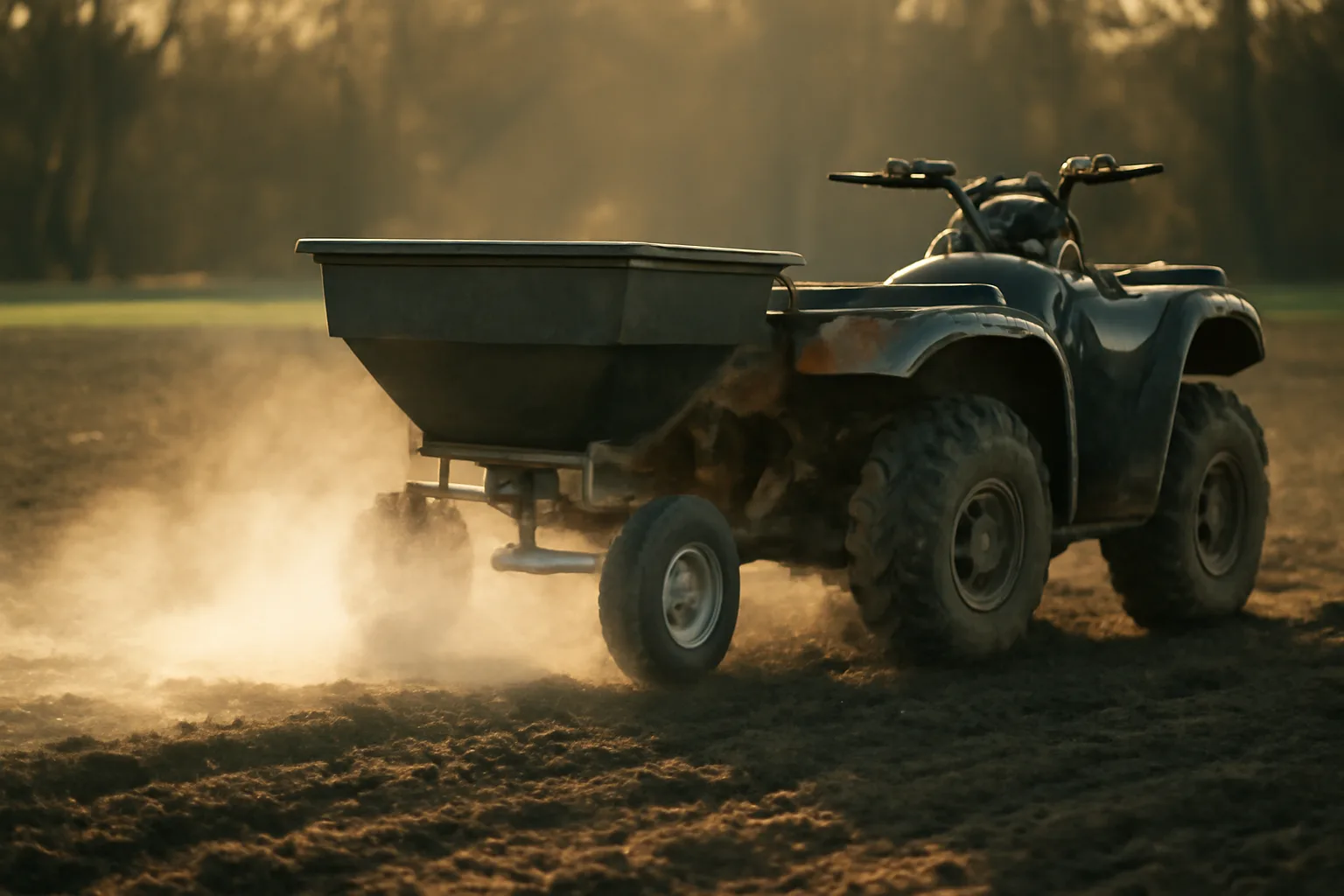
Here's the actual process, start to finish. First, pull your soil test and get the lime recommendation in tons per acre. Don't skip this. Second, clear the plot of heavy vegetation, mow or spray as needed, so lime contacts bare soil instead of sitting on top of thatch. Third, calculate total lime needed: multiply your per-acre rate by your plot's acreage. A half-acre plot needing 2 tons per acre needs 1 ton total. Fourth, load your spreader. Broadcast (cyclone) spreaders mounted on ATVs, UTVs, or tractor 3-point hitches work fine for pelletized lime. Bulk ag lime in ton quantities usually needs a tow-behind spreader or a lime truck from your local co-op, since it's heavier and lumpier than pelletized product. Fifth, spread in a consistent pattern, overlapping passes by about 10 percent to avoid stripes of under-limed soil. Walk or drive a grid pattern rather than random passes; uneven lime coverage creates uneven pH zones in the same small plot, which shows up as patchy clover growth later. Sixth, and this step actually matters more than people think: work the lime into the top 4 to 6 inches of soil with a disc, tiller, or cultipacker pass if you're tilling anyway. Surface-applied lime that just sits on top of untilled ground reacts far slower, sometimes taking years instead of months, because it has less soil contact. Oklahoma State University Extension notes that incorporating lime into the plow layer allows faster and more complete reaction with the soil than leaving it on the surface [3]. If you're running a no-till program, you can still surface-apply lime; it just takes longer to move down through the profile via rainfall. Plan an extra season of lag time in that case. Seventh, retest. Pull a follow-up soil sample about a year after liming to confirm pH actually moved. Lime rates from soil tests are estimates based on buffer pH calculations, and actual field response varies with rainfall and soil type.
what equipment do you need to spread lime on a food plot
For plots under an acre, a hand-crank or tow-behind broadcast spreader on an ATV handles pelletized lime fine. Expect to pay $60 to $200 for a basic tow-behind spreader that also doubles as your seed and fertilizer spreader. For plots 1 to 5 acres, a tractor-mounted broadcast spreader (either 3-point or pull-type) moves more volume per pass and handles bulk ag lime better than ATV units, which choke on wet lumpy lime. For anything over 5 acres, or if you don't own a tractor, call your local farm co-op or ag lime supplier. Many will deliver and spread bulk lime by the ton using their own truck-mounted spreaders, and the per-ton cost including spreading is often cheaper than buying, hauling, and spreading it yourself once you account for your own time and fuel. This is genuinely the move for most hunters with plots over 2 to 3 acres. It's not worth owning a lime spreader for once-every-three-years use. Whatever spreader you use, calibrate it. Spreaders are usually calibrated for granular fertilizer, not lime, which has a different density and particle size. Run a test pass over a tarp or driveway, weigh the output, and adjust your spreader's gate setting so you're actually hitting your target rate instead of guessing.
how often do you need to reapply lime to a food plot
Lime isn't a one-time fix. Soil naturally re-acidifies over time from rainfall, nitrogen fertilizer use, and plant uptake, so most food plots need a maintenance lime application every 2 to 4 years, more than once at plot establishment. The University of Georgia Extension recommends retesting soil pH every 2 to 3 years for perennial plantings like clover, and applying maintenance lime as needed based on that retest rather than assuming the original application holds forever [4]. Nitrogen fertilizer, particularly ammonium-based products, actively acidifies soil over repeated seasons, which is part of why annual grain plots (corn, sorghum) often need more frequent lime checks than clover plots that get less nitrogen. Budget for lime as a recurring cost, not a one-time startup expense. It's cheap compared to seed and herbicide, generally $20 to $60 per acre depending on rate and delivery distance, but it only pays off if you keep testing and reapplying on schedule.
what if you can't get lime down in time before planting
Plant anyway if pH is only moderately low. Clover, chicory, and brassicas will grow in soil down to about pH 5.5, just not at full potential. You'll get a plot, it just won't be your best plot. If pH is below 5.0, consider a more acid-tolerant option for that first season, like cereal rye or oats, which tolerate lower pH better than clover or alfalfa, according to general agronomic tolerance data from land-grant extension crop guides. Get lime down immediately regardless, and plan to switch to clover or a more pH-sensitive species the following year once pH has had time to climb. Don't try to compensate for low pH with extra fertilizer. It doesn't work. Fertilizer applied to acidic soil gets tied up chemically (particularly phosphorus), and a meaningful chunk of what you spread is wasted money until pH comes up [1].
do deer eat sorghum, clover, turnips, and other common plot species
Yes to all three, with real differences in how deer use them. Clover is the closest thing to a universal deer food; whitetails browse it heavily spring through fall, and it regrows after grazing, which makes it a strong perennial base for most plots. Do deer like clover? Overwhelmingly yes, it's one of the most consistently preferred forages in food plot research and observational data from state wildlife agencies. Do deer eat sorghum? Yes, deer eat grain sorghum, both the standing seed heads and the plant itself, though it's more commonly planted as a late-season grain/cover combo than a primary attractant crop. It also works well as a screening or bedding cover plant because of its height. Turnips get eaten in two phases: deer browse the leafy tops through fall, then hit the bulbs hard after a few hard frosts convert starches to sugars, making the roots sweeter. That's why turnips are a late-season, cold-weather food plot staple in the Midwest and North rather than an early-season draw. As for do deer like honey, that's not a real food plot or forage question; deer don't seek out honey in the wild and it's not part of any legitimate food plot strategy. Worth mentioning here mainly because it shows up in search, but there's no agronomic or wildlife management basis for it. For species-specific planting depth and blend advice, see deer food plot seed and food plot seed.
what is a food plot and what's the actual goal of one
A food plot is a planted area, usually somewhere between a quarter acre and several acres, established specifically to attract, hold, or nutritionally support deer (or other wildlife) on hunted land. It's more than a garden; the species selection, timing, and placement all get chosen around deer behavior and hunting season timing, not yield per se. Food plots generally fall into two categories: annual plots (brassicas, cereal grains, sorghum) replanted each year, and perennial plots (clover, chicory, alfalfa) that persist for 3 to 5 years with maintenance. Most serious plot programs run both, using annuals for hunting-season attraction and perennials as a lower-maintenance nutritional base through spring and summer. State wildlife agencies generally support food plots as a habitat management tool, though rules on baiting and supplemental feeding (which is legally distinct from planted food plots in most states) vary widely. Check your state wildlife agency's regulations before combining plots with mineral sites, feeders, or bait piles, since some states restrict feeding but explicitly exempt standing food plots as normal agriculture. For a broader overview of plot planning, see food plot whitetail and deer food plots.
what are deer's favorite foods, beyond food plots
In the wild, deer are opportunistic browsers, and their real diet shifts by season more than by any fixed preference list. Acorns are arguably the single most preferred natural food where available; deer will often abandon a food plot temporarily during a heavy acorn drop because acorns are calorie-dense and require less search effort. Outside of mast years, deer favor tender browse (young woody stems and leaves), forbs, and agricultural crops like soybeans and corn where available. Within food plot species specifically, clover and soybeans consistently rank as the most preferred planted forages in state agency and university forage trials, with brassicas and cereal grains typically ranked as strong secondary or late-season options rather than top choices. The practical takeaway: no single plot species holds deer year-round on its own. A mixed program, clover for spring/summer, brassicas or cereal grains for fall/winter, is the standard approach recommended by most extension wildlife programs, because it matches what deer actually need at different points in the year rather than betting everything on one plant.
when should you plant oats, turnips, and other food plot crops relative to your lime schedule
Timing your planting around your lime application, not the other way around, is the right sequence. Oats are a cool-season annual, generally planted in late summer to early fall (roughly August to September in northern zones, September into October further south) for fall and early winter grazing. Turnips follow a similar late-summer planting window, typically 60 to 90 days before your first expected hard frost, since the frost is what sweetens the bulbs. If your soil test called for lime and you're planting oats or turnips this fall, get lime down as early in the season as you can, ideally spring or early summer, so it has months to react before your fall planting date. If you missed that window, spread lime anyway at planting time; it won't fully correct pH before the crop goes in, but it starts working for next year and any perennial or subsequent planting. For exact regional planting windows by zone, the when to plant food plots for deer calendar breaks down oats, turnips, clover, and brassica dates by USDA hardiness zone, which matters more for timing than any single national date.
is it worth paying someone else to spread lime, or a soil-specific plan, instead of doing it all yourself
For bulk lime on plots over 2 to 3 acres, yes, paying a local ag co-op to deliver and spread is usually the better economic call once you factor your own time, fuel, and spreader wear. Most co-ops price delivery and spreading into the per-ton lime cost, and their equipment handles bulk lime far better than a small ATV spreader. Where a soil test and a general planting calendar aren't quite enough is matching species, seeding rates, and a full-season plan to your specific plot size, region, and goals. That's the gap a Custom Food Plot Plan is built for: for a $99 one-time fee, you get a plan built around your soil test results, your zone, and your acreage instead of piecing together generic advice from five different articles. It's general guidance built from your numbers, not a replacement for your soil lab's specific lime and fertilizer recommendation, which remains the authority on your dirt. You can start one at /plot-plan-builder. Either way, the soil test comes first. No plan, free or paid, is better than the actual chemistry of your specific field.
Frequently asked questions
How much lime does a food plot need per acre?
It depends entirely on your soil test, but most acidic food plot ground needs 1 to 2 tons per acre of ag lime to raise pH by about one point, per general extension guidance on lime and soil buffer capacity [2]. Some heavily acidic clay soils need up to 3 tons per acre or more. Always use your specific soil test's lime recommendation rather than a flat national number.
How long does it take lime to change soil pH in a food plot?
Lime reactions are gradual, and full pH correction commonly takes 6 months to a year, per University of Missouri Extension guidance on soil acidity and liming [1]. That's why it should go down 6 to 12 months before you need the corrected pH, not right before planting. Incorporating it into the soil with tillage speeds the reaction compared to surface application.
Do deer eat sorghum?
Yes, deer readily eat grain sorghum, both the standing seed heads and the plant material. It's often planted as a late-season food source paired with its use as tall screening or bedding cover, rather than as a primary early-season attractant like clover or soybeans.
Do deer like clover in food plots?
Yes, clover is one of the most consistently preferred food plot forages for whitetails, and it's a common base species in perennial plot programs because it regrows after grazing and provides forage from spring through fall in most regions.
When should you plant food plots for deer?
Timing depends on species and USDA zone: cool-season plots (clover, brassicas, oats) generally go in late summer to early fall, while warm-season plots (soybeans, sorghum, corn) go in late spring. See a full zone-by-zone breakdown at when to plant food plots for deer.
When should you plant oats for deer food plots?
Oats are typically planted late summer through early fall, roughly August into September in northern zones and September into October in warmer zones, timed so they establish before the first hard frost and provide fall/early-winter grazing.
When should you plant turnips for deer?
Turnips are usually planted 60 to 90 days before the first expected hard frost in your area, since deer preference for the bulbs increases after frost converts starches to sugars. That generally puts planting in late July through August across most whitetail range.
What is a food plot?
A food plot is a planted area, usually a quarter acre to several acres, established on hunted land specifically to attract, hold, or nutritionally support deer through targeted forage species, timed to align with hunting seasons and deer nutritional needs.
What are deer's favorite foods?
Acorns are arguably the top natural preference where available, often pulling deer off food plots during a heavy mast drop. Among planted crops, clover and soybeans consistently rank as top preferred forages in university and agency forage studies, with brassicas and grains as strong secondary options.
Do deer like honey?
No, honey isn't part of a deer's natural diet or any legitimate food plot or attractant strategy. Deer are browsers that eat forbs, browse, mast, and agricultural crops; there's no wildlife management basis for using honey to attract deer.
Should you till lime into the soil or just spread it on top?
Tilling lime into the top 4 to 6 inches speeds up its reaction with the soil significantly compared to surface application, according to Oklahoma State University Extension guidance on lime incorporation into the plow layer [3]. If you're running no-till, surface-applied lime still works, it just takes longer to move down through the soil profile via rainfall.
How often should you re-lime a food plot?
Most plots need a maintenance lime application every 2 to 4 years. The University of Georgia Extension recommends retesting soil pH every 2 to 3 years for perennial plantings like clover and re-liming based on that updated test rather than assuming the original application lasts indefinitely [4].
Sources
- University of Missouri Extension, Soil Acidity and Liming: Basic Information (G9101): most plants absorb nutrients best when soil pH is between 6.0 and 7.0, and lime reactions with soil are gradual, commonly taking months to fully adjust pH
- Clemson Cooperative Extension, Liming (Home & Garden Information Center HGIC 1650): the amount of lime needed to change soil pH depends on the soil's buffer capacity, with clay and high-organic-matter soils requiring more lime than sandy soils for the same pH change
- Oklahoma State University Extension, Soil Acidity and Liming (PSS-2227): incorporating lime into the plow layer allows faster and more complete reaction with the soil than leaving it on the surface
- University of Georgia Extension, Soil Testing for Home Lawns, Gardens and Wildlife Food Plots (Circular 896): retesting soil pH every 2 to 3 years is recommended for perennial plantings, with maintenance lime applied as needed
- USDA Natural Resources Conservation Service, Soil Quality Kit: Guides for Educators: soil pH controls the availability of many plant nutrients and most agronomic crops perform best in a near-neutral pH range