Last updated 2026-07-25
TL;DR
Pull a soil test, follow its lime and NPK recommendations in pounds per acre, and spread fertilizer before or at planting with a broadcast or drop spreader calibrated to your seed's needs. Work it in lightly if you can, and split nitrogen on heavy feeders like brassicas. A soil test costs $10 to $20 through most land-grant labs and beats guessing every time.
what is a food plot and why does fertilizer matter so much
A food plot is a planted area, usually a quarter acre to a few acres, seeded with forage crops like clover, brassicas, cereal grains, or beans specifically to attract and feed deer on land you own or lease. It's farming on a small scale, and like any farming, the soil underneath decides whether your seed turns into a thick stand or a thin, weedy mess. Fertilizer matters because most hunting ground was never cropland, or it was cropped hard for decades and never limed. Old pastures and cutover timber ground tend to run acidic, often below pH 6.0, which locks up phosphorus and nitrogen no matter how much you spread. Soil pH controls how available nutrients are to plant roots, and most food plot species want a pH between 6.0 and 7.0. Skip the soil test and you're guessing. Guess wrong and you either waste money on nutrients the soil already has, or you starve a planting that needed twice the nitrogen you gave it. A $10 to $20 soil test from your state land-grant university lab tells you exactly what to add, in pounds per acre, before you spend a dime on bags of fertilizer. If you want a plan built around your test results and region, that's exactly what the Custom Food Plot Plan is for. It's a one-time $99 tool, but your soil test lab result is still the final word on lime and fertilizer rates for your dirt specifically.
how do you read a soil test to know how much fertilizer to apply
Your soil test report gives you three main numbers to act on: pH, and recommended pounds per acre of phosphorus (P2O5) and potassium (K2O), plus a nitrogen recommendation based on the crop you tell the lab you're planting. Most university soil testing labs return results in this format with a specific crop code for food plot species like clover or brassica. Oklahoma State University Extension's forage guidance, for example, ties fertilizer and liming recommendations directly to the forage species you're establishing, since a legume like clover needs a very different nitrogen program than a grass or brassica planting [1]. Here's the part people skip: you have to tell the lab what you're planting. A soil test without a crop code just gives generic ranges. Tell them "clover" or "brassica" or "corn" and the recommendation changes, because nitrogen needs for a legume are near zero (they fix their own) while a brassica plot might need 40 to 60 pounds of actual nitrogen per acre. Read the report as pounds of nutrient per acre, then convert to bags. If your test calls for 60 pounds of P2O5 and 60 pounds of K2O per acre and you're using 0-20-20 blend, you'd need 300 pounds of that blend per acre to hit the P2O5 target. Do the math off the guaranteed analysis on the bag tag, not off the bag size. Lime recommendations show up separately, often as tons per acre of ag lime. This is the fix for low pH, and it's usually the single biggest yield lever on new food plot ground. Lime reactions in soil are slow. Plan on liming a full season ahead of planting whenever you can swing it, since a fall lime application ahead of a spring planting gives the material real time to raise pH before roots need it.
when should you apply fertilizer relative to planting
Apply lime as early as possible, ideally months before planting, since it needs time to react and raise pH. Apply your base phosphorus and potassium at or just before planting, worked into the top few inches of soil if you're using tillage, or broadcast right before a rain if you're no-till. Save some nitrogen for a topdress application if you're growing brassicas or cereal grains, since nitrogen leaches and volatilizes and a single big dose early can waste a chunk of it. For a fall brassica or cereal grain plot, a common approach is to broadcast and lightly incorporate your P and K plus a modest nitrogen starter (maybe a third of your total N) at planting, then come back 3 to 5 weeks later with a topdress of nitrogen (urea or ammonium nitrate) once the plants are established and pulling hard on nutrients. For clover, most of your fertility goes down at establishment. Clover fixes its own nitrogen once inoculated rhizobia bacteria colonize the roots, so heavy nitrogen application is actually a waste of money and can encourage grass competition instead of clover growth. Annual maintenance fertilizer on established clover is usually just P and K, applied in early spring based on a fresh soil test every year or two.
how do you actually spread fertilizer on a food plot
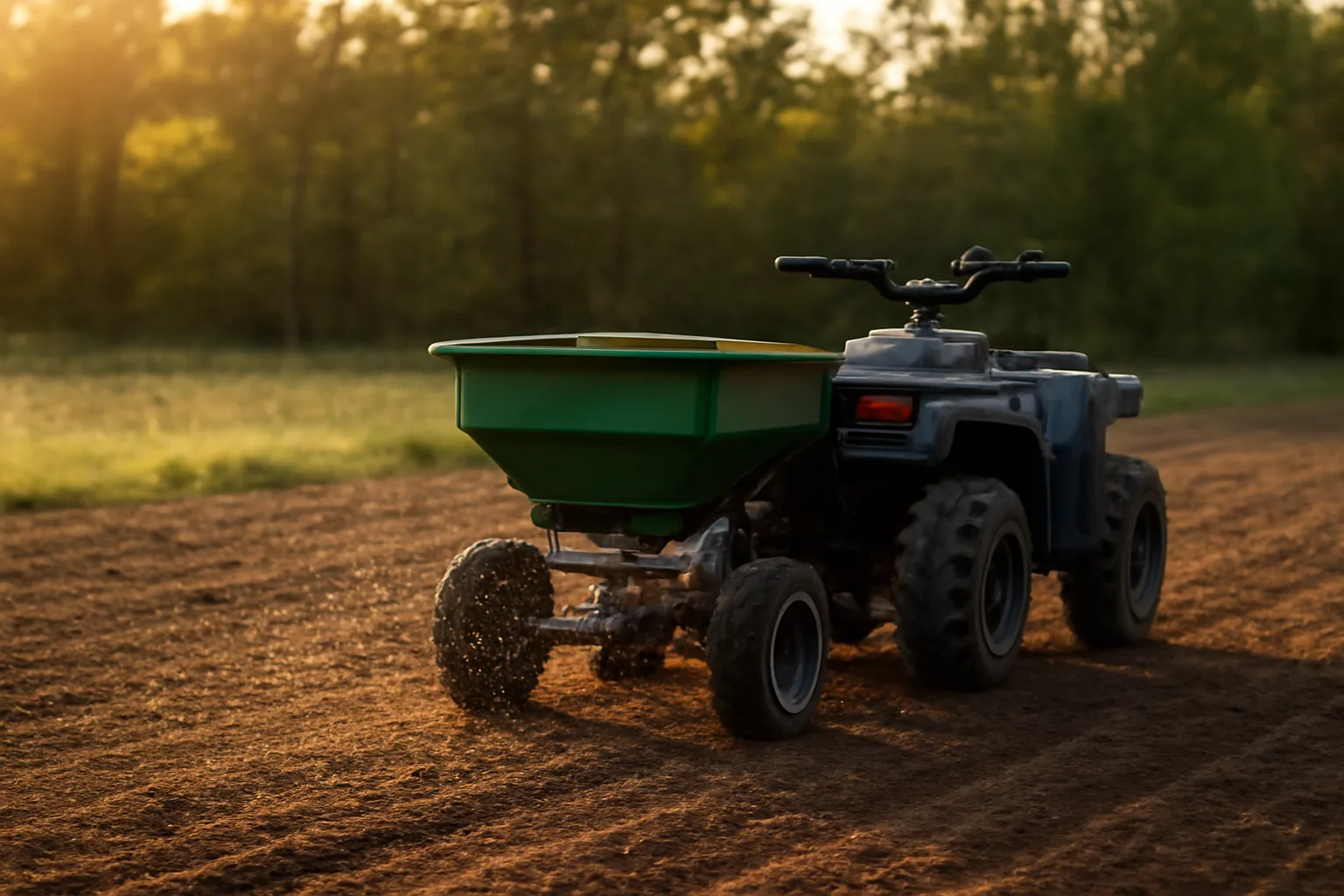
Three tools handle almost every food plot: a handheld or backpack broadcast spreader for plots under a half acre, a tow-behind broadcast (spin) spreader for anything from a half acre to several acres, and a drop spreader for precision work on small, oddly shaped plots near property lines where drift onto a neighbor's land or a road is a concern. Broadcast spreaders throw fertilizer in an arc, typically covering 20 to 40 feet depending on the granule size and spreader setting. They're fast and fine for most rectangular or open plots. Drop spreaders only release fertilizer directly beneath the hopper, so they're slower and need more passes, but there's zero drift, which matters if you're fertilizing right up against a food source you don't want overloaded, like a pond edge. Calibration is the step almost everyone skips and shouldn't. Weigh out a known amount of fertilizer, run the spreader over a measured area (a 50 by 50 foot square is easy math, that's about 0.057 acres), and see how close you land to your target rate. Adjust the spreader's flow setting and retest. It takes fifteen minutes and it's the difference between an even stand and stripes of dark green and pale yellow across your plot. Overlap your passes by about 10 percent to avoid skips. Most spreader flow charts are calibrated for a specific fertilizer blend's density, and real bags vary, so trust your own calibration test over the dial numbers printed on the spreader.
should you till fertilizer into the soil or leave it on top
Working fertilizer into the top 2 to 4 inches of soil gets phosphorus and potassium closer to root zones faster, since both nutrients don't move much in soil and can sit on the surface for a long time if just broadcast and left. Nitrogen in urea form volatilizes (turns to gas and escapes) if left on the surface in warm, dry conditions without rain or incorporation within a couple days. University of Nebraska-Lincoln Extension's guidance on nitrogen management notes that surface-applied urea is vulnerable to ammonia volatilization losses unless it's incorporated by tillage or moved into the soil by roughly a half inch of rain shortly after application [2]. If you're running a disc, tiller, or cultipacker, work your P and K fertilizer in during your normal seedbed prep, then broadcast seed on top and cultipack to firm the seedbed. If you're no-till drilling or broadcasting into standing residue, you're relying on rainfall to move the fertilizer down, which works fine for P and K over time but makes surface-applied urea riskier in dry spells. A compromise a lot of food plotters use: broadcast fertilizer first, disc it in lightly, broadcast seed, then cultipack. That gets nutrients mixed into the seed zone without burying seed too deep, which matters a lot for small-seeded species like clover and brassica that only want to be a quarter inch deep or less.
when to plant food plots for deer
Timing splits into two windows almost everywhere in whitetail country: spring plantings (April through June depending on latitude) for warm-season forages like soybeans, cowpeas, and summer clover establishment, and late summer to early fall plantings (mid-August through September, later in the Deep South) for cool-season forages like brassicas, cereal grains, and fall clover. The actual date depends heavily on your last spring frost and first fall frost, which your state extension office publishes as average frost date maps. Northern states (Wisconsin, Minnesota, Michigan) often plant fall plots by mid-August to give brassicas enough growing season before a hard frost, while southern states (Alabama, Georgia, Texas) can wait until late September or even October since their growing season runs longer. A reasonable rule for fall plots: count back 60 to 90 days from your area's average first hard frost for brassicas, and 90 to 120 days for a plot you want mature (bulbing turnips, standing corn) rather than just vegetative. Cereal grains like oats and wheat need less time and can go in later than brassicas in the same fall window. For a full breakdown by species and region, see food plot whitetail and deer food plots.
when to plant oats for deer
Oats go in as a fall planting in most whitetail range, typically from late August through September, timed so plants get 4 to 6 weeks of growth before the first hard frost. Oats grow fast, tolerate a wide pH range better than most legumes, and green up again in spring in milder climates, though they're usually killed outright by hard winters in the upper Midwest and Northeast. Spring oat plantings work too, mainly as a nurse crop for establishing clover, planted as soon as soil is workable in early spring. Oats germinate in soil temperatures as low as 45°F to 50°F, cooler than most warm-season food plot species need. Oats respond well to nitrogen, and a soil test based topdress once plants are 4 to 6 inches tall pushes tonnage and palatability noticeably compared to no topdress at all.
when to plant turnips for deer
Turnips are planted in late summer, generally 60 to 90 days before your area's first expected hard frost, so roughly late July through early September depending on latitude. Turnips need that full window to bulb properly; planted too late, you get leafy tops but no root development, which cuts your late-season food value substantially since deer often shift to digging up bulbs after a hard frost sweetens them. A hard frost converts starches to sugars in the turnip bulb and leaves, which is why deer use often spikes in December and January on turnip plots specifically, well after most other plantings have been picked clean or gone dormant. Turnips are heavy nitrogen feeders relative to clover. A soil test based rate is typically in the 50 to 100 pound per acre range of actual nitrogen for a pure brassica blend, split between planting and a topdress, though your specific test result should set the final number, not this general range.
do deer eat sorghum and what about honey
Yes, deer eat grain sorghum, both the standing seed heads and dropped grain, and it's planted in food plots mainly as a fall and winter standing grain source, similar in role to corn but more drought tolerant and often cheaper per acre in dry regions. It's not usually a first-choice food plot species on its own; it's more common as a component in a multi-species blend or as a screening/standing grain crop alongside soybeans or corn. Deer do not eat honey in any meaningful wild foraging sense. Honey isn't a natural browse food and isn't something deer seek out or a species that shows up in food plot or deer diet research. If you've seen "honey" mentioned near food plots, it's likely confusion with mineral or scent products marketed with "honey" branding, not an actual deer food source. There's no wildlife agency or extension guidance recommending honey as deer feed, and several states restrict feeding or baiting with any attractant, so check your state wildlife agency's regulations before adding any supplemental feed or attractant to a property. Pennsylvania, for instance, prohibits the unlawful feeding of big game under 34 Pa.C.S. Section 2361 [3].
do deer eat clover and do deer like clover
Yes, and clover is widely considered one of the most consistently used food plot forages available. White clover and red clover both show up repeatedly in university deer research and extension food plot guides as high-preference, high-protein forage. Oklahoma State University Extension's Forages for Deer fact sheet lists clover among the top forage choices for whitetail food plots and notes its strong protein contribution during the growing season [1]. Clover's advantage over annuals is that it's perennial. A well-maintained clover stand can produce for 3 to 5 years off one planting, with mowing and annual fertility maintenance instead of full replanting, which makes it one of the cheaper per-year food plot options once it's established. The tradeoff is establishment. Clover needs good seed-to-soil contact, a firm seedbed, and a pH close to 6.5 to really thrive, and it's slower to establish than fast annuals like oats or brassica. Weed pressure in year one is the main reason clover plots fail, not fertility, so mowing to keep weeds from shading out young clover matters as much as the fertilizer program. For species selection help beyond clover, deer food plot seed and food plot seed cover blend options by region.
what are deer's favorite foods overall
Deer preference shifts by season and region, but research consistently ranks acorns, soybeans, and clover among the highest-preference food sources where they're available, with acorns especially dominant in fall when they're dropping, since deer will often abandon food plots entirely for a good acorn crop. State wildlife agencies and university extension programs have documented this acorn preference through browse studies and forage research over decades of deer research. Outside of mast (acorns and other nuts), high-preference food plot species generally include soybeans and cowpeas in the growing season, clover nearly year-round where it stays green, and brassicas plus cereal grains in late fall and winter once frost sweetens them. Corn and grain sorghum rank lower on a pure preference basis but provide standing energy food through hard winters when little else is available. No food plot beats a good natural mast year for pulling deer, and that's fine. Food plots are best thought of as a supplement and a hunting tool, not a replacement for the surrounding habitat's native browse and mast production.
how much fertilizer should you actually buy per acre
| 19-19-19 | ~265 lbs | Balanced blend, common starter | |
|---|---|---|---|
| 10-20-20 | ~250 lbs (for P and K; N will be lower, ~25 lbs) | Good for legumes needing less N | |
| 0-20-20 | ~250 lbs | No nitrogen, pairs with a separate N source for legumes | |
| Triple 13 (13-13-13) | ~385 lbs | Lower analysis, need more product | This is why the blend you buy changes your total tonnage and cost per acre a lot. A higher analysis blend (more N-P-K per pound of product) usually costs more per bag but less per acre once you account for needing fewer bags. |
Buy based on your soil test's pound-per-acre recommendation, converted through the guaranteed analysis on your fertilizer bag, not based on "one bag per acre" rules of thumb you might see on forums. A 50 pound bag of 19-19-19 gives you 9.5 pounds each of actual N, P2O5, and K2O, which is a lot less than a soil test calling for 60-60-60 might need. You could easily need 3 to 4 bags per acre of that blend to hit a 60-60-60 target, not one. Here's a rough comparison of common blends and how many pounds of product per acre it takes to hit a 50-50-50 pound per acre nutrient target, assuming you need all three nutrients (actual amounts should come from your soil test, this is illustrative only): | Fertilizer blend | Lbs of product per acre to reach ~50 lbs P2O5/K2O per acre | Notes |
common mistakes when applying food plot fertilizer
The single biggest mistake is skipping the soil test and applying a flat rate everywhere, which either wastes fertilizer on soil that didn't need it or starves a plot that needed three times what got applied. Extension soil testing costs $10 to $20 in most states and pays for itself the first season by preventing a wasted bag purchase alone. Second is ignoring lime. Fertilizer applied to soil below pH 5.5 is partly wasted since phosphorus especially becomes chemically locked up and unavailable to roots in acidic soil, no matter how much you spread. If your test calls for 2 tons of lime per acre and you skip it, expect a weaker stand even with perfect fertilizer rates. Third is uneven spreading from a poorly calibrated spreader, which shows up as visible stripes weeks later, dark green where you overlapped, pale where you missed. Fifteen minutes of calibration testing before you start fixes this every time. Fourth is putting all your nitrogen down at planting on a heavy feeder like brassica or corn. A chunk of that nitrogen leaches or volatilizes before the plant can use it, especially in sandy soil or a wet spring. Splitting it, some at planting and the rest as a topdress three to five weeks later, gets more of it actually into the plant.
what does a soil-test based fertility plan look like start to finish
Start with a soil sample, pulled from 6 to 8 inches deep across 8 to 10 spots in the plot, mixed into one composite sample, sent to your state's land-grant extension lab with the correct crop code (clover, brassica, corn, etc.). Results usually come back in 1 to 2 weeks and give you pH, lime recommendation, and P and K rates in pounds per acre. Apply lime as early as your schedule allows, months ahead if possible, since it needs time to react. Apply your base P and K (and a starter dose of N if needed) at or just before planting, worked into the seedbed if you're tilling. Calibrate your spreader before you start, using a measured test area and known fertilizer weight. Plant your seed at the right depth for the species (clover and brassica want a quarter inch or less; grains and beans want an inch or more). Come back in 3 to 5 weeks for a nitrogen topdress if you're growing a heavy feeder like brassica, corn, or cereal grain, based on your original test's total N recommendation minus what you already applied. Re-test every 2 to 3 years on annual plots, and every year or two on perennial clover, since nutrient levels and pH drift over time even with good management. If building this out for a specific piece of ground feels like a lot to track species by species, the Custom Food Plot Plan at plotseason.com puts together a fertility and planting timeline for your zone for a one-time $99, though your own soil test result should always override any general recommendation when the two disagree.
Frequently asked questions
Do deer eat sorghum?
Yes. Deer eat grain sorghum heads and dropped grain, especially in fall and winter. It's more common as one component in a multi-species blend or a standing grain plot alongside corn or soybeans than as a stand-alone plot, and it's valued mainly for drought tolerance and winter standing energy rather than high preference ranking.
Do deer eat clover?
Yes, and clover ranks among the most consistently preferred food plot forages in university deer research. White and red clover both see heavy use where established, and clover stays attractive across most of the growing season, unlike many annuals, according to Oklahoma State University Extension's forage guidance for deer.
When to plant deer food plots?
Spring plots (soybeans, cowpeas, summer clover) go in April through June depending on your last frost date. Fall plots (brassicas, cereal grains, fall clover) go in mid-August through September in northern states, later (into October) in the Deep South. Count back 60 to 120 days from your area's first hard frost depending on species.
Do deer like clover?
Yes, clover is one of the highest-preference food plot forages available, and deer use it heavily through spring, summer, and fall wherever it's established and maintained. It's especially valuable because it's perennial, producing for 3 to 5 years off one planting with proper mowing and fertility upkeep instead of annual replanting.
When to plant oats for deer?
Plant oats in a fall window, late August through September in most whitetail range, giving 4 to 6 weeks of growth before a hard frost. Oats also work as a spring nurse crop for establishing clover, planted as soon as soil is workable, since oats germinate in soil as cool as 45°F to 50°F.
When to plant food plots for deer overall?
There are two main windows: spring (April to June) for warm-season forages like beans and summer clover, and late summer to early fall (mid-August to September, later in southern states) for cool-season forages like brassicas and cereal grains. Exact dates depend on your local frost dates from your state extension office.
When to plant turnips for deer?
Plant turnips 60 to 90 days before your area's first expected hard frost, generally late July through early September. That window lets the bulb fully develop before deer start digging them up, since a hard frost sweetens the turnip and drives a spike in use during December and January.
What is a food plot?
A food plot is a planted area, typically a quarter acre to several acres, seeded with forage crops like clover, brassicas, cereal grains, corn, or soybeans specifically to feed and attract deer on hunted land. It functions as small-scale farming aimed at supplementing native browse and creating a hunting location.
What are deer's favorite foods?
Acorns rank as the top preference in most fall research, often pulling deer off food plots entirely when there's a good mast crop. Among planted forages, soybeans, clover, and cowpeas rank highest in growing season preference studies, with brassicas and cereal grains gaining preference after fall frosts sweeten them.
Do deer like honey?
No. Honey isn't a natural deer food and doesn't appear in deer diet or browse research as something deer seek out. Confusion likely comes from honey-branded mineral or scent attractant products, not an actual food source, and several states restrict baiting or supplemental feeding, so check your state wildlife agency's rules before using any attractant.
How do I know how much fertilizer to apply to my food plot?
Pull a soil test through your state land-grant extension lab, tell them which crop you're planting, and follow the pounds-per-acre recommendation for lime, phosphorus, and potassium the report gives you. Convert that recommendation to bags using the guaranteed analysis printed on your fertilizer bag, not a flat one-bag-per-acre guess.
Should I till fertilizer into the soil or just broadcast it on top?
Working phosphorus and potassium into the top few inches gets them to roots faster since both nutrients barely move in soil. Surface-applied nitrogen (especially urea) can volatilize and be lost if it doesn't get incorporated or rained on within about 48 hours, so incorporation or timing around rain matters most for nitrogen specifically.
How often should I re-test food plot soil?
Re-test annual plots every 2 to 3 years and perennial clover plots every 1 to 2 years, since pH and nutrient levels drift with rainfall, crop removal, and fertilizer history. A fresh test costs $10 to $20 through most university extension labs and keeps your fertilizer spending matched to what the soil actually needs that season.
Sources
- USDA Natural Resources Conservation Service, National Soil Survey Handbook, Part 618: Soil Properties and Qualities: Soil pH controls nutrient availability and most plants prefer a pH range of about 6.0 to 7.0
- Oklahoma State University Extension, PSS-2586: Forages for Deer: Fertilizer and forage recommendations for food plot species should be tied to the specific crop being established, such as clover versus brassica
- University of Nebraska-Lincoln Extension, G1712: Nitrogen Management Considerations for Nebraska: Lime needs time to react in soil and surface-applied urea nitrogen can volatilize without incorporation or rainfall shortly after application
- Pennsylvania Consolidated Statutes, Title 34, Section 2361: Unlawful Feeding of Big Game: States regulate baiting and supplemental feeding of deer, and rules vary, so hunters should check state-specific regulations
- University of Georgia Cooperative Extension, Circular 1466: A Guide to Successful Wildlife Food Plots: Establishment timing, seedbed prep, and fertility recommendations for common food plot forages including clover and brassica