Last updated 2026-07-25
TL;DR
Test your soil, lime to a pH of 6.0-6.5, and plant clover 1/4 inch deep into a firm seedbed in early spring or late summer, using 6-8 lbs/acre of a ladino/red clover blend with the right rhizobium inoculant. Clover is a perennial, so a good stand can feed deer for 3-5 years with mowing and light fertilizer instead of replanting every year.
what is a food plot, exactly
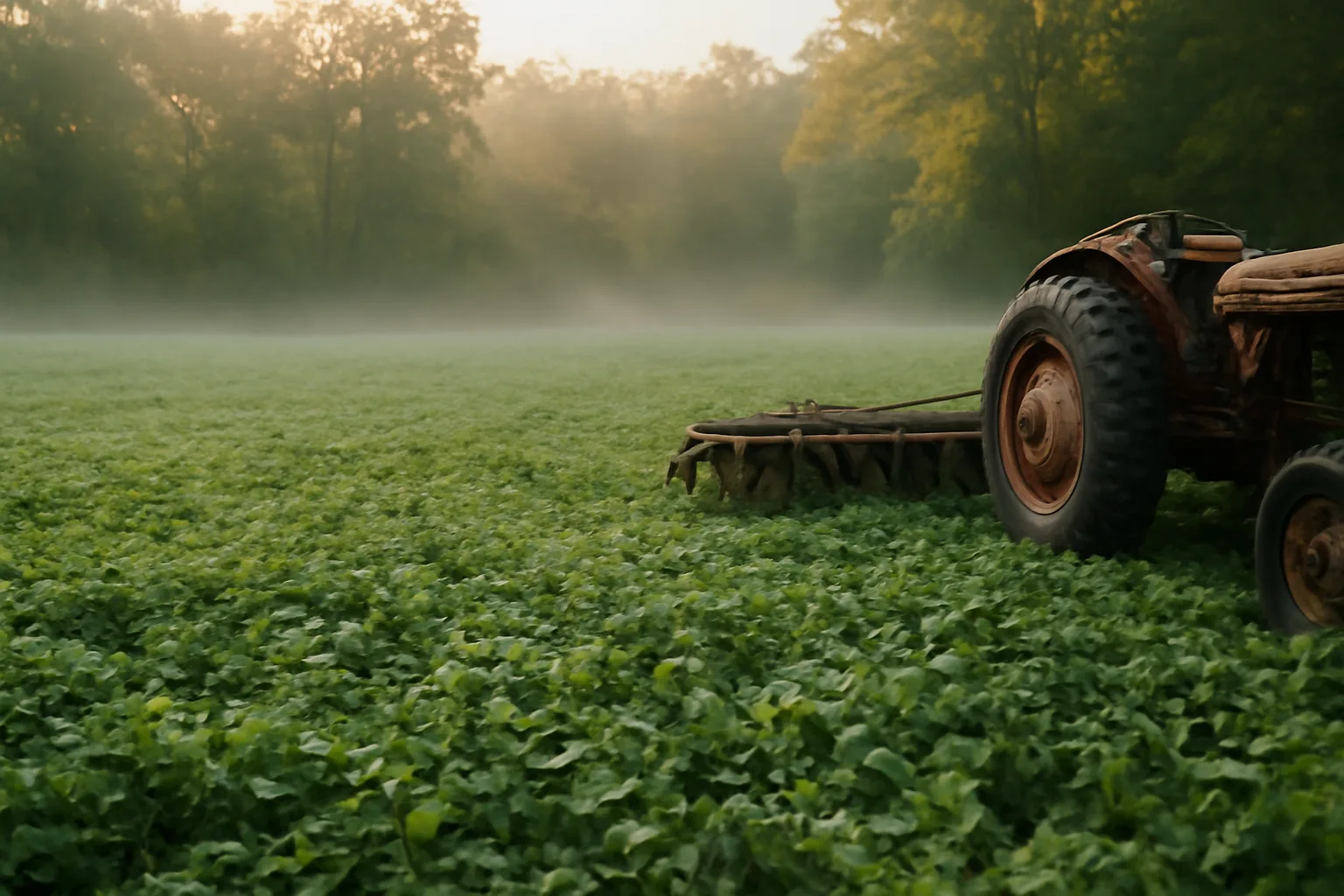
A food plot is a planted patch of forage, usually somewhere between a quarter acre and a few acres, established on hunting land specifically to feed deer and other wildlife and to concentrate animal activity where a hunter can watch or hunt it. It's farming, just scaled down and aimed at a different customer. Most food plots fall into two categories. Perennial plots (clover, alfalfa, chicory) get planted once and then managed for several years. Annual plots (brassicas, cereal grains, soybeans) get replanted every year, often timed to peak in the fall when hunting season opens. Clover is the workhorse perennial. The USDA NRCS lists white clover (Trifolium repens, which includes ladino types) as a commonly used forage legume suited to wildlife plantings across most of the whitetail's range [1]. If you're only ever going to plant one thing, clover is the one most land managers land on, because it comes back every spring without a drill. For a broader look at how food plots fit into an overall deer management plan, see food plot whitetail and deer food plots.
do deer like clover, and is it actually their favorite food
Yes. Clover is consistently one of the most heavily browsed forages in food plot studies and in deer diet research across the country. It's high in protein, usually 20-30% crude protein in a well-fertilized stand, and deer will hit it hard in spring and again in fall once cooler weather green-ups occur. Whitetail diets are regional and seasonal, so there's no single 'favorite food' that holds everywhere. Research from university deer programs and USDA plant guidance consistently shows legumes like clover rank among the most preferred and most nutritionally dense forages available to deer in the growing season, largely because of that sustained protein level [1] [2]. Acorns often out-compete everything once they drop in fall, because the fat content is hard for any planted forage to match. Practically speaking, clover wins because it's available for months, not weeks. A soybean field gets hammered to nothing by August in high deer-density areas. A well-established clover stand keeps growing back after each bite, all season long, which is exactly what makes it attractive to deer and durable for you as a manager.
when to plant clover for deer (by region)
| Northern (MN, WI, MI, ME, upper NY) | Mid-April to late May | Mid-July to mid-August | |
|---|---|---|---|
| Mid-South / Transition (KY, TN, VA, MO) | March to April | Late August to mid-September | |
| Deep South (AL, GA, MS, LA, FL) | February to March | September to early October | These are general windows, not guarantees. Your county's frost-free date from your local NOAA or land-grant extension office is the better final answer. Check your state cooperative extension's planting date guide before you commit seed to the ground. |
Clover goes in during one of two windows: early spring, as soon as the ground can be worked and frost risk for the seed itself has passed, or late summer into early fall, roughly 6-8 weeks before your first killing frost so seedlings can root in before winter. Spring planting works well up north where summers are short and a fall planting risks not establishing before frost. Late-summer/early-fall planting is often preferred farther south and in the transition zone, because it avoids competing with spring weed pressure and gives you a plot that's already established when bow season opens. Here's a rough regional breakdown, adjusted for your local frost dates: | Region | Spring window | Fall window |
how do i prepare the ground before planting clover
Start with a soil test, not a guess. Clover is sensitive to soil pH, and university extension guidance recommends a target pH of 6.0 to 6.5 for clover to fix nitrogen efficiently and grow well [3]. Below pH 5.5, clover struggles no matter how much fertilizer you throw at it. Your soil test lab is the real authority here, not this article. Send a sample to your state land-grant extension lab or a private ag lab, and follow their specific lime and fertilizer recommendation for your soil type and test results. Lime takes months to fully react in the soil, so apply it as early as you can, ideally the fall before a spring planting. Once lime and starter fertilizer (often something like 0-20-20 or similar, per your soil test) are worked in, you want a firm, fine seedbed. Clover seed is tiny. It should go no deeper than 1/4 inch, and a lot of failed clover plots come down to burying the seed too deep in loose, fluffy dirt. A cultipacker before and after seeding, or simply driving over broadcast seed with an ATV or truck tire, firms the seedbed enough for good seed-to-soil contact. If you're broadcasting into an existing plot or overseeding, a light disc pass or drag harrow to expose some bare soil works better than broadcasting onto thick thatch.
how much clover seed do i need per acre
| Ladino/white clover (pure stand) | 2-3 lbs | 1/8 to 1/4 inch | |
|---|---|---|---|
| Red clover (pure stand) | 8-10 lbs | 1/4 inch | |
| White/red clover blend | 6-8 lbs | 1/4 inch | |
| Clover + oats nurse crop | 6-8 lbs clover + 2 bu oats | 1/4 inch clover, 1-1.5 inch oats | Don't cheap out on seed quality to save a few dollars per acre. Clover seed is a small fraction of your total plot cost once you count lime, fertilizer, and equipment time, so buying a coated, inoculated, weed-free seed lot is worth it. |
For a ladino/white clover and red clover blend, plan on 6-8 lbs of pure live seed per acre. Straight ladino clover alone is often seeded at 2-3 lbs/acre because the seed is very small and has a high number of seeds per pound; blends with red clover run a bit higher because red clover seed is larger [2]. A rough seeding guide: | Seed type | Rate per acre | Seeding depth |
do i need to inoculate clover seed before planting
Yes, almost always. Clover fixes its own nitrogen through a symbiotic relationship with rhizobium bacteria in the soil, but the correct rhizobium strain has to be present for that to happen. Most raw clover seed you buy in bulk isn't pre-inoculated, and even pre-inoculated seed loses viability over time in storage. University extension guidance on legume establishment consistently recommends inoculating seed with the specific rhizobium strain matched to that legume species right before planting if the field hasn't grown that clover species recently, since the correct bacteria may not already be present in the soil [3]. Clover uses a different inoculant strain than soybeans or alfalfa, so buy the one labeled for clover specifically. Skip this step and you can still get a stand, but it'll often be pale, slow-growing, and nitrogen-starved compared to a properly inoculated planting. It's a two-dollar bag of powder that can be the difference between a thin plot and a thick one.
when to plant food plots for deer overall (clover vs. other species)
Timing depends entirely on what you're planting and what you want it to do. Perennials like clover, chicory, and alfalfa go in spring or late summer/early fall, as covered above. Annuals split into warm-season and cool-season groups with very different calendars. Warm-season annuals (soybeans, cowpeas, sorghum, corn) go in after your last spring frost, typically May into early June across most of the whitetail range, since they need warm soil to germinate and a full growing season to mature. Cool-season annuals (brassicas, cereal grains, winter peas) go in during late summer, usually 60-90 days before your first fall frost, so they mature right as hunting season opens and stay palatable into winter. A lot of managers run both: a perennial clover plot as the backbone, plus one or two annual plots timed to peak during archery and gun season. For seed selection across these categories, see deer food plot seed and food plot seed.
when to plant oats for deer
Oats are a cool-season annual, planted in late summer to early fall, roughly 60-75 days before your average first frost, so they're actively growing and highly attractive during archery season. In much of the whitetail range that lands somewhere between mid-August and mid-September. Oats can also go in as a spring nurse crop alongside new clover seedings; the fast-germinating oats hold soil and suppress weeds while slower clover gets established, then get mowed or grazed out before they compete too hard with the clover. Seed oats at 2-3 bushels per acre for a standalone fall plot, drilled or broadcast at 1-1.5 inch depth. A bushel of oats weighs about 32 lbs, so that works out to roughly 64-96 lbs/acre. Oats are extremely cold-tolerant compared to other cereal grains and will stay green and palatable well into early winter in many regions, which is part of why they're such a common fall food plot component.
when to plant turnips for deer
Turnips, like other brassicas, go in during late summer, typically 90-100 days before your first expected fall frost, since they need that full window to bulb up and reach peak sugar content. In most of the whitetail range this means late July through August, a bit earlier than oats or straight cereal grains because turnips take longer to mature. Brassicas including turnips get sweeter after a hard frost, because the cold triggers the plant to convert starches to sugars, which is why deer often ignore a turnip plot in September and then hammer it in December. Seed turnips alone at about 4-6 lbs/acre, or as part of a brassica blend at the rate on the bag, at a shallow 1/4 to 1/2 inch depth. One caution: don't plant turnips or other brassicas on the same ground year after year without a break. Brassicas are in the same family as canola and mustard, and repeated plantings build up disease and pest pressure in the soil, the same reason row-crop farmers rotate.
do deer eat sorghum, and how does it compare to clover
Yes, deer eat sorghum, both the grain heads and, to a lesser extent, the foliage, but it's a different tool than clover. Sorghum is a warm-season annual grain crop, more of a late-season/winter food source and cover crop than a season-long browse plot the way clover is. Grain sorghum matures over roughly 90-120 days and gets planted after the last frost, similar timing to corn. Deer will use standing sorghum heads through fall and winter, and it holds up well as standing cover into deep snow in northern states, which is part of its appeal beyond just food value. Where clover wins is season-long protein for lactating does and antler growth in spring and summer; sorghum's strength is calories and cover in the cold months. A lot of plot plans run both in different fields rather than picking one over the other.
does honey or sugar attract deer, and is it legal to use
Deer don't seek out raw honey the way they seek out browse, but they're drawn to high-sugar foods generally, which is part of why molasses-based mineral licks and sugar beets get used as attractants. There's no solid research showing honey specifically as a meaningful deer attractant compared to actual forage. More importantly, using honey, sugar, or any processed food to draw deer likely crosses into baiting in many states, and baiting/feeding rules vary widely and change often. Some states allow baiting with restrictions on distance from a stand or amount used; others ban it outright, including during specific disease-management periods for chronic wasting disease. Check your state wildlife agency's current baiting and feeding regulations before using any attractant, sugar-based or otherwise, since rules differ by state and can differ by county within a state where CWD zones exist. A planted clover or brassica food plot is regulated differently than bait piles in most states, since it's a standing crop rather than placed feed, but the line can get blurry with some agencies. When in doubt, call your state wildlife agency's regional biologist and ask directly.
how do i maintain a clover plot once it's established
Mow it. Clover left unmowed gets shaded out by taller weeds and grasses, and mowing to about 4-6 inches every few weeks during the growing season keeps it in a leafy, high-protein, actively-growing stage that deer prefer over old, woody growth. Re-test soil every 2-3 years and top-dress fertilizer or lime as recommended, since clover pulls nutrients out of the soil every season even though it fixes its own nitrogen. Potassium and phosphorus still need replenishing based on what your soil test lab tells you for your specific field. A well-maintained clover stand typically lasts 3-5 years before it thins out enough to need renovating or replanting, longer if you rotate mowing, control weeds with a grass-selective or broadleaf-selective herbicide as needed, and don't overgraze it in high deer-density areas. Ladino clover types tend to persist a bit longer than pure red clover, which is more of a 2-3 year forage before it declines. If you want a plan built around your specific acreage, soil test results, and region rather than general guidance like this, that's exactly what a Custom Food Plot Plan is for. PlotSeason's $99 one-time plan takes your soil test and property details and builds a planting calendar and species mix around them; check it out at /plot-plan-builder.
clover plot mistakes worth avoiding
The single most common mistake is planting too deep. Clover seed buried more than 1/2 inch often just doesn't emerge, because it doesn't have the energy reserves of a bigger seed like corn or soybeans to push through that much soil. The second is skipping the soil test and lime. Broadcasting clover onto acidic soil below pH 5.5 without correcting it first is close to wasting the seed money, since clover's nitrogen-fixing bacteria don't function well in acidic conditions [3]. Third is planting into a weedy, unprepared seedbed and expecting clover to compete on its own in year one. Clover seedlings are slow and small early on; a spring burndown herbicide application or a clean, tilled seedbed gives it a fighting chance against existing weed pressure. Last, a lot of people never mow. A clover field that never gets topped becomes a foxtail and ragweed field with clover hiding underneath it by year two. For more on picking the right species mix to avoid these traps from the start, see species and strategy and domain food plot seed.
Frequently asked questions
Do deer eat sorghum?
Yes. Deer browse both sorghum foliage and grain heads, though it's used more as a fall and winter food source and standing cover than a season-long forage. It's a warm-season annual planted after the last spring frost, maturing in roughly 90-120 days, similar to a corn planting timeline.
Do deer eat clover?
Yes, heavily. Clover is one of the most consistently preferred forages in deer diet studies, offering 20-30% crude protein in well-maintained stands. It stays palatable and available for months at a time, which is why it's the most common perennial food plot planting for whitetail deer across the country.
When should I plant deer food plots?
It depends on the species. Perennials like clover go in spring or late summer/early fall. Warm-season annuals like soybeans and sorghum go in after the last frost, typically May-June. Cool-season annuals like brassicas and cereal grains go in 60-100 days before your first fall frost. Check your local extension office's frost dates.
Do deer like clover more than other food plot options?
Deer strongly prefer clover during spring and summer for its high protein content, but acorns and other high-fat mast often out-compete it once fall drop begins. Most experienced managers plant clover as a season-long backbone plot and add annuals like brassicas or grains for peak fall and winter attraction.
When should I plant oats for deer?
Plant oats 60-75 days before your first fall frost, typically mid-August to mid-September across most of the whitetail range. Oats can also serve as a spring nurse crop for new clover seedings. Seed at 2-3 bushels (about 64-96 lbs) per acre at 1-1.5 inch depth.
What is a food plot?
A food plot is a planted patch of forage on hunting land, established specifically to feed deer and other wildlife and to concentrate animal activity for observation or hunting. Plots range from perennials like clover that last several years to annuals like brassicas or soybeans replanted each season.
What are deer's favorite foods?
There's no single universal favorite; it varies by region and season. Legumes like clover and soybeans rank among the most preferred forages during the growing season, but acorns and other high-fat mast often top the list once they drop in fall. Deer diets shift heavily with what's locally available.
Do deer like honey?
There's no solid research showing honey is a meaningful deer attractant compared to actual forage, though deer are drawn to sugar generally. More importantly, using honey or sugar to attract deer may count as baiting in many states, so check your state wildlife agency's current baiting and feeding rules before using any attractant.
When should I plant turnips for deer?
Plant turnips 90-100 days before your first fall frost, typically late July through August in most of the whitetail range. They need that full window to bulb up, and cold weather after a hard frost sweetens them by converting starches to sugar, which is when deer often start hitting them hardest.
How deep should clover seed be planted?
No deeper than 1/4 inch, and ideally 1/8 to 1/4 inch for pure ladino clover. Clover seed is tiny and doesn't have the energy reserves to push through deep soil. A firm, fine seedbed and a cultipacker pass before and after seeding improves seed-to-soil contact significantly.
What soil pH does clover need?
Most university extension guides recommend a target pH of 6.0 to 6.5 for clover to establish well and fix nitrogen efficiently. Below pH 5.5, clover struggles regardless of fertilizer applied. A soil test from your local extension lab or a private ag lab is the only reliable way to know your starting point.
How long does a clover food plot last before it needs replanting?
A well-maintained clover stand typically lasts 3-5 years with regular mowing and periodic fertilizer top-dressing based on soil tests. Ladino white clover tends to persist longer than red clover, which often declines after 2-3 years. Weed pressure and neglecting mowing are the main reasons stands fail early.
Do I need to inoculate clover seed?
Yes, in almost all cases, unless that specific clover species has grown recently in that soil. Inoculation introduces the correct rhizobium bacteria strain that lets clover fix nitrogen from the air. Uninoculated seed often produces pale, slow, nitrogen-starved plants compared to a properly inoculated planting.
Sources
- USDA NRCS, Plant Fact Sheet: White Clover: White clover (including ladino types) is a commonly used forage legume for wildlife plantings
- University of Tennessee Institute of Agriculture, Establishing and Managing Wildlife Food Plots (PB1743): Legumes like clover rank among the most nutritionally dense forages available for wildlife during the growing season
- Penn State Extension, Forage and Food Crops for Deer: Clover requires a soil pH near 6.0-6.5 for good growth and needs proper rhizobium inoculation to fix nitrogen
- USDA NRCS, Plant Fact Sheet: Red Clover: Red clover seeding rates and use as a forage legume for wildlife and livestock plantings
- USDA NASS, Agricultural Statistics, Standard Weights and Measures for Grain (Oats): Standard bushel weight for oats used for calculating per-acre seeding rates