Last updated 2026-07-25
TL;DR
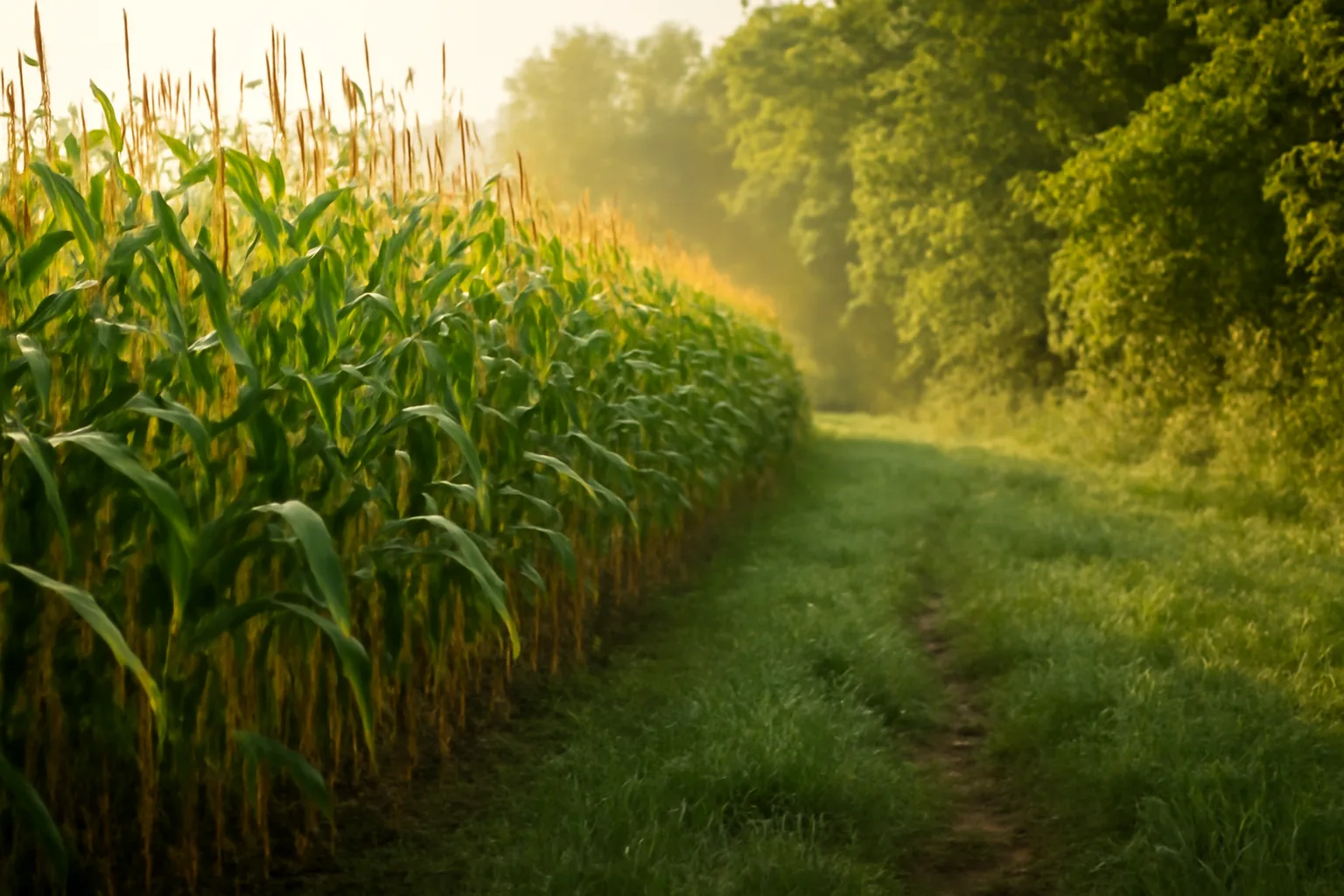
Corn works as a deer food plot when you have at least 3-5 acres, fertile soil (pH 6.0-6.8), and 90 to 120 frost-free days. Plant after soil hits 50°F, roughly 1-3 weeks after your local recommended corn planting date, at 28,000-32,000 seeds per acre, with nitrogen split between planting and sidedress.
What is a food plot, exactly?
A food plot is a planted patch of forage or grain on hunting land, built to feed deer, hold them on your property, and give you a place to hunt over natural food instead of guessing where deer will show up. Most plots run somewhere between a quarter acre and several acres, and they're usually split into two jobs: a small, hidden "kill plot" tucked near bedding for close shots, and a larger "destination" or feeding field that pulls deer from a wider area. Corn plots almost always fall into the second category. Corn is a grain crop, not a quick-growing green forage, and it takes real acreage and a full growing season to pay off. State wildlife agencies and land-grant extension programs both treat food plots as a supplemental habitat tool, not a replacement for natural browse, mast, and cover [1]. If you're brand new to plots in general, it helps to read up on food plot whitetail strategy before you commit a field to corn specifically, since corn is one of the more demanding options on the list.
Do deer eat corn, and how well does it work as a food plot crop?
Yes, deer eat corn readily, both the standing grain in fall and winter and the green leaf tissue earlier in the season. Whitetail research and extension nutrition studies list corn grain as a high-energy carbohydrate source, valuable for building fat reserves heading into winter, though it's low in protein compared to legumes like clover or soybeans [2]. The catch with corn is scale and cost. Deer will hammer a small corn patch under an acre before it ever reaches maturity, especially in high-density areas, so most agronomists and extension plot guides recommend at least 3 to 5 acres of corn if you want any of it left standing into hunting season [3]. If you've only got an acre or two to work with, a lot of land managers get better return from soybeans, brassicas, or a clover/chicory mix instead. Corn also asks more of your soil and your wallet: seed, fertilizer, and (usually) a pass of herbicide add up faster than a simple oats-and-clover plot. Where corn earns its keep is late-season cover and energy. A standing corn plot left through winter gives deer thermal cover in bad weather and a steady carbohydrate source right when natural browse is thin. That's the main reason serious plotters plant it at all.
When to plant food plots for deer (the big picture)
| Deep South (zones 8-9) | Late March to mid-April | |
|---|---|---|
| Mid-South / Transition | Mid-April to early May | |
| Upper Midwest / North | Early May to early June | |
| Northern tier / short season | Mid-May to early June, short-day varieties only | These windows shift year to year with soil temperature and moisture, so treat them as a starting point, not gospel. Your county extension office is the best local source. |
Timing depends entirely on what you're planting and your region, but the general rule is this: warm-season crops like corn, soybeans, and sorghum go in the spring after your last frost date, and cool-season crops like clover, oats, brassicas, and turnips go in late summer to early fall, roughly 60 to 90 days before your first hard frost. Corn is squarely a spring plot. You're planting a full-season grain crop that needs a long, warm growing window, so it goes in alongside (or a week or two behind) your local field corn planting recommendations. Land-grant extension offices publish planting date windows by county or climate zone, and those same windows apply to food-plot corn since it's usually just a shorter-season variety of the same crop farmers grow commercially [4]. A rough national spread looks like this: | Region | Typical corn planting window |
When should you actually put corn seed in the ground?
Corn germinates poorly and unevenly when soil temperature is below 50°F, and most agronomy guides recommend waiting until soil hits a steady 50°F at planting depth (about 2 inches) before you plant [5]. Planting into cold, wet soil is one of the most common corn-plot failures; the seed just sits there and rots or gets hit by seedling blight. In practice, that means waiting 1 to 3 weeks after your average last frost date, since soil warms slower than air. If you're not sure when that is locally, a soil thermometer costs under $15 and takes the guesswork out entirely. Push it 2 inches down at mid-morning for a few days running; once you're consistently at or above 50°F, you're clear to plant. Corn also needs 90 to 120 frost-free days to mature standing grain, depending on the variety's day rating. If your first fall frost historically lands in early October, back-calculate from there. A 100-day corn variety planted May 15 matures right around August 23, with some added time for dry-down before deer start hitting cobs hard in September and October.
How much corn seed and fertilizer does a plot need?
For food-plot purposes, most guides recommend a seeding rate of 28,000 to 32,000 seeds per acre in 30-inch rows, which is close to standard commercial corn population and gives you enough plant density to compete with weeds and deer browsing pressure [6]. Seed costs vary a lot by variety and treatment, but budget roughly $60 to $120 per acre for food-plot-grade corn seed as of recent seasons; treated, deer-resistant coatings and specialty blends run higher. Corn is a heavy nitrogen feeder. General extension guidance for grain corn calls for 150 to 200 pounds of actual nitrogen per acre over the season, split between a starter application at planting and a sidedress application when the corn is knee-high (roughly the V6 growth stage) [7]. Phosphorus and potassium needs depend entirely on what your soil already has, which is exactly why a current soil test matters more for corn than almost any other food-plot crop. Your soil test lab is the real authority here, not a blanket rule of thumb. Labs like your state extension soil lab return specific pound-per-acre recommendations based on your field's actual P, K, and pH numbers, and those numbers should override any generic advice, including this article's. Most extension soil test programs also recommend liming to a target pH of 6.0 to 6.8 for corn, since nutrient uptake drops off hard in acidic soil below that range. If you want a starting point tailored to your specific field, dimensions, and region before you spend money on seed and fertilizer, a Custom Food Plot Plan ($99, one-time) will map out species, rates, and a planting calendar built around your soil test and location. It's general planning guidance, though. It doesn't replace your lab's site-specific lime and fertilizer numbers.
Do deer eat sorghum, and how does it compare to corn?
Yes, deer eat sorghum (grain sorghum, sometimes called milo), both the leaves early on and the grain heads later in the season. It's a warm-season grain crop planted on a similar calendar to corn, and it's become a popular substitute in areas with drought risk or sandy soil, since sorghum tolerates dry conditions and poor soil noticeably better than corn does [8]. Sorghum generally needs less nitrogen and less water than corn to produce a grain crop, which makes it cheaper to grow per acre in marginal ground. The tradeoff is total tonnage and standing structure: corn stalks hold up better through winter storms and give more cover bulk, while sorghum heads can shatter and drop grain earlier, meaning less standing food late into the season in some climates. For a small plot with poor soil and no irrigation, sorghum is often the smarter play. For a larger, better-soil field where winter cover and a long feeding window matter most, corn still wins on volume and structure.
Do deer like clover, and how does it fit around a corn plot?
Deer like clover a great deal, and most whitetail nutrition research ranks clover among the most consistently used food-plot forages across the growing season, thanks to high protein content (often 20-25% crude protein in good stands) and season-long regrowth after grazing [2]. Clover is a cool-season perennial, so it doesn't compete directly with a spring corn plot for a planting window, but it works well as a companion plot nearby, giving deer a protein source in spring and summer while the corn field is still growing toward fall maturity. A lot of experienced plotters run corn or beans in one field for fall energy and a perennial clover plot in another spot for spring and summer nutrition. That combination covers more of the calendar than either crop alone. If you're deciding between the two for a single plot, clover is far more forgiving for a new plotter: lower seed cost, less equipment needed, and a lot more tolerance for planting date mistakes. For more detail on clover specifically, including varieties and mowing schedules, see deer food plot seed.
When to plant oats for deer, and do they fit with corn plots?
Oats are a cool-season cereal grain, planted in early fall (roughly August to September in most of the whitetail range) for quick fall green-up, or in early spring in northern climates for a short-lived spring plot . Deer readily eat young oat forage, and oats are one of the fastest-germinating, most forgiving cool-season plot options, often showing green growth in under two weeks. Oats don't overlap with corn on the calendar at all, which is exactly why a lot of plotters use them in rotation. A common pattern: corn or beans through summer, then oats (often mixed with brassicas or a cereal rye blend) planted into that same field in early fall after the corn is harvested or once deer have knocked it down enough to clear ground. That gives you a fall green food source on the same acreage without leaving it fallow. Oats also winterkill in most of the northern half of the country once temperatures drop into the teens for extended periods, so don't count on them as standing winter cover the way you would with corn.
When to plant turnips for deer, and how do they compare to a corn field?
Turnips, like other brassicas, go in the ground in late summer, typically 80 to 90 days before your first expected fall frost, which for most of the whitetail range lands somewhere between late July and mid-August. Deer often ignore young turnip plants through late summer and early fall, then switch hard to eating the leaves and, after a few frosts convert starches to sugars, the bulbs themselves, once temperatures drop. Turnips are a cool-season annual, so they don't share a planting window with corn any more than oats do. Where they do compare directly to corn is in the late-season food role: both are meant to be standing and available when hunting season and hard winter hit. Turnips cost far less to plant per acre (often $15-25 per acre in seed) and need a fraction of the fertility that corn does, but they don't give you the same standing cover or the same sheer volume of digestible carbohydrate that a mature corn field does. A lot of managers plant turnips or a turnip/radish/oat blend in a rotation field, and reserve corn for a dedicated, larger field where cover and tonnage matter more than cost per acre.
What are deer's favorite foods, overall?
There's no single official ranking, and preference shifts by season, region, and what's locally available, but whitetail nutrition studies and extension forage guides consistently point to a short list: acorns and other hard mast, soybeans, clover, and other legumes rank at or near the top for both palatability and protein content, with corn, brassicas, and cereal grains filling in as high-energy or late-season options [2]. Acorns deserve a special mention. In years with a heavy mast crop, deer will often bypass planted food plots entirely in favor of free acorns, which is a normal and frustrating reality of managing plots on timbered ground. That's not a sign your plot failed; it's a sign the woods had a good year. Soybeans and clover generally test highest for crude protein among common plot species, which matters most in spring and summer for antler growth and lactation, while corn and brassicas matter more in fall and winter for fat and energy. If you're weighing species against each other for a new plot, deer food plots and species-and-strategy style comparisons are worth reading before you settle on corn alone.
Do deer like honey (or anything sweet), and does it matter for plots?
There's no research showing deer seek out honey specifically, and it isn't a food-plot input in any real agronomic sense; it's not something you plant or spray on a field. Deer are drawn to sugar content in general, which is part of why brassicas and turnips get sweeter and more attractive after a frost converts stored starches to sugars, and why deer show a strong preference for sugar beets and other high-sugar root crops where those are grown. Some hunters use commercial mineral or attractant products with sweet scents or molasses-based additives near stands or feeders, separate from actual food plots. Before using any attractant, mineral supplement, or feed product, check your state wildlife agency's baiting and feeding regulations. Rules vary widely by state, and some states restrict or ban baiting and supplemental feeding entirely, sometimes tied to chronic wasting disease management zones, so a product that's legal in one state can be a cited violation in another .
Step-by-step: planting a corn food plot from scratch
Here's the order most successful corn plots follow, start to finish. First, pull a soil test the fall or early spring before you plant, and get it back from a lab (many state extension soil labs run $10-20 per sample) well before your planting window opens. Lime, if needed, works best applied months ahead since it takes time to adjust pH. Second, kill existing vegetation with a burndown herbicide or till it under, 2 to 3 weeks before planting, and give weeds and grasses time to actually die rather than just wilt. Third, apply lime and starter fertilizer per your soil test results, then work the field with a disc or field cultivator to get a smooth, firm seedbed. Corn wants a firm seedbed for consistent seed depth, not loose, fluffy dirt. Fourth, plant once soil hits 50°F at 2 inches deep, at 28,000-32,000 seeds per acre, in rows if you have row equipment, or broadcast and cultipacked if you don't (broadcasting corn works, but expect lower and less even stands than a planter gives you). Fifth, sidedress nitrogen around the V6 stage (knee-high corn, usually 5-7 weeks after planting), and scout for weeds and deer browsing pressure through the first month, since young corn is most vulnerable to both. Sixth, consider fencing off a portion of the plot with cheap poly fence for the first 6-8 weeks if you're in a high deer density area with a small planted acreage. It's the single most effective, low-cost way to keep deer from wiping out a young stand before it can get established.
Is corn worth the cost and effort for your plot?
Corn is one of the more expensive, more failure-prone food-plot options, and it's not the right choice for every property. It makes the most sense when you have several contiguous acres, decent soil, full sun, and a genuine goal of late-season standing cover and energy, more than spring or summer attraction. If your acreage is small, your soil is rough, or you're newer to plot management, you'll likely get a better return, in both deer use and your own sanity, from soybeans, a clover/chicory perennial mix, or a brassica blend. Those crops forgive planting mistakes, cost less per acre, and still deliver real nutritional and hunting value. For a broader look at how corn stacks up against those other options for your specific property size and goals, food plot seed and domain food plot seed walk through the tradeoffs in more depth.
Frequently asked questions
Do deer eat sorghum as well as corn?
Yes. Deer eat both the leaves and grain heads of sorghum, and it's a common corn substitute on dry or poor soil since it needs less water and nitrogen to produce a grain crop. Sorghum heads can shatter and drop grain earlier than corn, so it may not stand as long into late winter in some climates.
Do deer actually like clover, or is it overrated?
Deer use clover heavily through spring and summer, and it's one of the highest-protein forages commonly planted, often 20-25% crude protein in a healthy stand. It regrows after grazing and lasts for years as a perennial, which is why it's a staple companion to a fall-focused corn plot rather than a competitor for the same field.
When is the best time to plant food plots for deer overall?
It depends on the crop. Warm-season plants like corn, soybeans, and sorghum go in after your last frost, once soil hits about 50°F. Cool-season crops like clover, oats, brassicas, and turnips go in late summer, roughly 60-90 days before your first fall frost, so they mature right as hunting season opens.
When should I plant oats for a deer plot?
Plant oats in early fall, typically August into September across most of the whitetail range, for a quick-germinating fall green-up plot. In some northern areas oats also get planted in early spring for a short-season plot, but they winterkill once sustained temperatures drop into the teens.
When exactly should I plant food plots for deer in my area?
Check your county extension office or state land-grant university for local frost dates and planting windows, since they vary by hundreds of miles of latitude and by elevation. As a rule, corn and other warm-season crops go in spring after frost risk passes; clover, brassicas, and cereal grains go in late summer to early fall.
When is the right time to plant turnips for deer?
Plant turnips 80 to 90 days before your area's first expected fall frost, which lands roughly late July through mid-August for most of the whitetail range. Deer often ignore turnips until after a few frosts sweeten the leaves and bulbs, so don't judge the plot a failure just because it sits untouched in September.
What exactly is a food plot?
A food plot is a planted area on hunting land, ranging from a quarter acre to several acres, grown specifically to feed deer and other wildlife and to give hunters a predictable place to hunt. Plots supplement natural browse and mast; wildlife agencies and extension programs treat them as one habitat tool among several, not a full food source on their own.
What are deer's favorite foods in general?
Preference shifts by season and region, but acorns and other hard mast, soybeans, and clover consistently rank as top choices for palatability and protein. Corn, brassicas, and cereal grains matter more in fall and winter as energy sources. In a heavy acorn year, deer often skip planted plots for free mast entirely.
Do deer like honey or sweet attractants near a food plot?
There's no research showing deer specifically seek out honey, and it isn't a planted food-plot input. Deer do respond to sugar content generally, which is part of why frost-sweetened brassicas and turnips get eaten harder in late fall. Check your state wildlife agency's baiting and feeding rules before using any commercial attractant.
How many acres of corn do I need for it to actually work as a deer plot?
Most guides recommend at least 3 to 5 acres of corn for a food plot, since smaller patches often get browsed down to nothing before the crop matures. If you've only got an acre or two, soybeans, clover, or brassicas usually deliver a better return than corn on that same footprint.
What soil pH does corn need for a food plot?
Corn does best with a soil pH between 6.0 and 6.8. Below that range, nutrient uptake drops noticeably even if fertilizer levels are correct, which is why a current soil test and any needed lime application, done months ahead of planting, matter more for corn than for most other plot species.
Can I broadcast corn seed instead of using a planter?
Yes, broadcasting corn and cultipacking it in works, but expect a less even stand and lower germination than a row planter gives you. If you're broadcasting, bump your seeding rate somewhat to compensate, and expect more gaps and weed pressure in the thinner spots through the first month.
Sources
- USDA NRCS, Wildlife Habitat Management: Food plots are a supplemental habitat tool, not a replacement for natural browse and cover
- Iowa State University Extension, Corn Planting Date: Local corn planting date windows are published by land-grant extension by region
- Purdue University Extension, Corn and Soybean Field Guide / Soil Temperature: Corn germinates poorly below 50°F soil temperature at planting depth
- Iowa State University Extension, Corn Planting Rate Considerations: Standard corn seeding populations run in the 28,000-32,000 seeds per acre range
- Iowa State University Extension, Nitrogen Management for Corn: Corn nitrogen needs run roughly 150-200 lbs actual N per acre, often split at planting and sidedress
- Kansas State University Extension, Grain Sorghum Production: Grain sorghum tolerates drought and low soil fertility better than corn
- University of Tennessee Extension, Wildlife Food Plots: Oats are planted in late summer/early fall for quick-germinating cool-season forage
- QDMA/National Deer Association and state wildlife agencies, baiting and feeding regulation summaries: Baiting and supplemental feeding rules vary by state and are sometimes restricted due to chronic wasting disease