Last updated 2026-07-26
TL;DR
Food plot plant identification means telling clover, brassicas (turnips, radish), cereal grains (oats, wheat, rye), sorghum, and legumes (soybeans, peas) apart by leaf shape, growth habit, and season. Deer eat clover and turnip tops readily, sorghum less so unless it's grain heads. Planting windows run late summer for fall annuals, spring for warm-season plots.
what is a food plot, exactly
A food plot is a planted patch of ground, usually somewhere between a quarter acre and several acres, meant to feed and hold deer or other wildlife on a property. It's not a lawn and it's not a crop field meant for harvest and sale, though the agronomy overlaps quite a bit. Most hunters plant food plots to improve nutrition for deer herds, concentrate deer activity near stands, or both. The USDA Natural Resources Conservation Service treats food plots as a wildlife habitat practice. NRCS Conservation Practice Standard 645, Upland Wildlife Habitat Management, covers plantings that provide food and cover for wildlife on private land, often with cost-share support through state programs [1]. That's a formal way of saying what most hunters already know: a food plot is a small, deliberate planting meant to feed animals, not people. Plots generally fall into a few categories. Annual plots get replanted every year (clover is an exception, more on that below). Perennial plots like clover or alfalfa can produce for three to five years before you need to renovate them. Warm-season plots feed deer through summer stress and antler growth. Cool-season plots feed deer through fall and into the late-season crunch when native browse is gone. If you're trying to figure out which category fits your ground, food plot whitetail strategy and deer food plots basics are a good starting point before you worry about identifying individual plants in the field.
how do you identify clover in a food plot
Clover is probably the single most planted food plot species in North America, and it's easy to identify once you know what to look for. Look for the classic three-leaflet (trifoliate) leaf, low growing habit, and round or oval leaflets, often with a pale V or crescent marking on each leaflet. White clover (Trifolium repens) spreads by stolons, runners that creep along the ground and root at nodes, which is why a healthy white clover stand looks like a thick mat rather than individual plants. Red clover (Trifolium pratense) grows more upright, with hairier stems and leaves, and doesn't spread by stolons the same way. It's often mixed with white clover in food plot blends because it establishes fast and tolerates poorer soil, while white clover persists longer. Clover flowers give it away too. White clover produces small white or pale pink globe-shaped flower heads. Red clover produces larger, darker pink-to-purple heads. Both are legumes, meaning they fix nitrogen from the air through root nodule bacteria (Rhizobium), which is part of why clover plots need less nitrogen fertilizer than grain plots. University of Wisconsin-Madison Extension guidance on forage legume establishment notes that seed should be inoculated with the correct Rhizobium strain at planting for effective nodulation and nitrogen fixation, since these bacteria don't reliably persist in soils with no recent legume history. A quality perennial clover stand can last three to five years with proper mowing and weed control before yields drop enough to justify replanting, according to University of Georgia Extension wildlife forage guidance [2].
do deer like clover, and is it their favorite food
Yes, deer readily eat clover, and it ranks among the most consistently preferred food plot forages across the whitetail's range. Clover is high in protein, typically 20 to 30 percent crude protein in vegetative growth stages, and it's palatable through most of the growing season, which is why it shows up in nearly every food plot seed catalog. But "favorite food" is a moving target and depends on season, region, and what's available naturally. Native browse, soft mast like acorns and apples, and agricultural crops like soybeans often draw deer harder than clover when those are on the landscape. Acorns in particular can pull deer away from planted plots entirely during a heavy mast year, something most experienced plot managers have watched happen in real time. Deer preference research, including cafeteria-style trials run by university wildlife programs, generally ranks soybeans, clover, and brassicas near the top of preferred plantings, with the exact order shifting by region and by year. There's no single universally agreed "favorite," and any list claiming otherwise is oversimplifying real, messy field behavior. If you want species-specific comparisons for your own plot, deer for food breaks down preference trends by category.
do deer eat sorghum in a food plot
Deer will eat sorghum, but it's not a top-tier deer food and it's more commonly planted as a screening or bird-food crop than a primary deer attractant. Grain sorghum produces a heavy seed head that deer, turkey, and other wildlife will feed on once it matures and the seed heads droop or dry down, but deer generally prefer softer, more digestible forage earlier in the season. Sorghum's real value in a food plot mix is usually structural. It grows tall, often four to seven feet, and thick, which makes it a good screening plant along field edges or a nurse crop that shades out weeds while a perennial like clover establishes underneath. Some hunters plant sorghum specifically to create standing cover for late-season bedding or to break sightlines near a stand. If your goal is pure deer nutrition, sorghum is a lower priority than brassicas, clover, or soybeans. If your goal is cover, screening, or a mixed plot with turkey and deer benefit, sorghum earns a place. It's a "depends what you're solving for" plant, not a universal yes or no.
how do you identify brassicas like turnips and radish
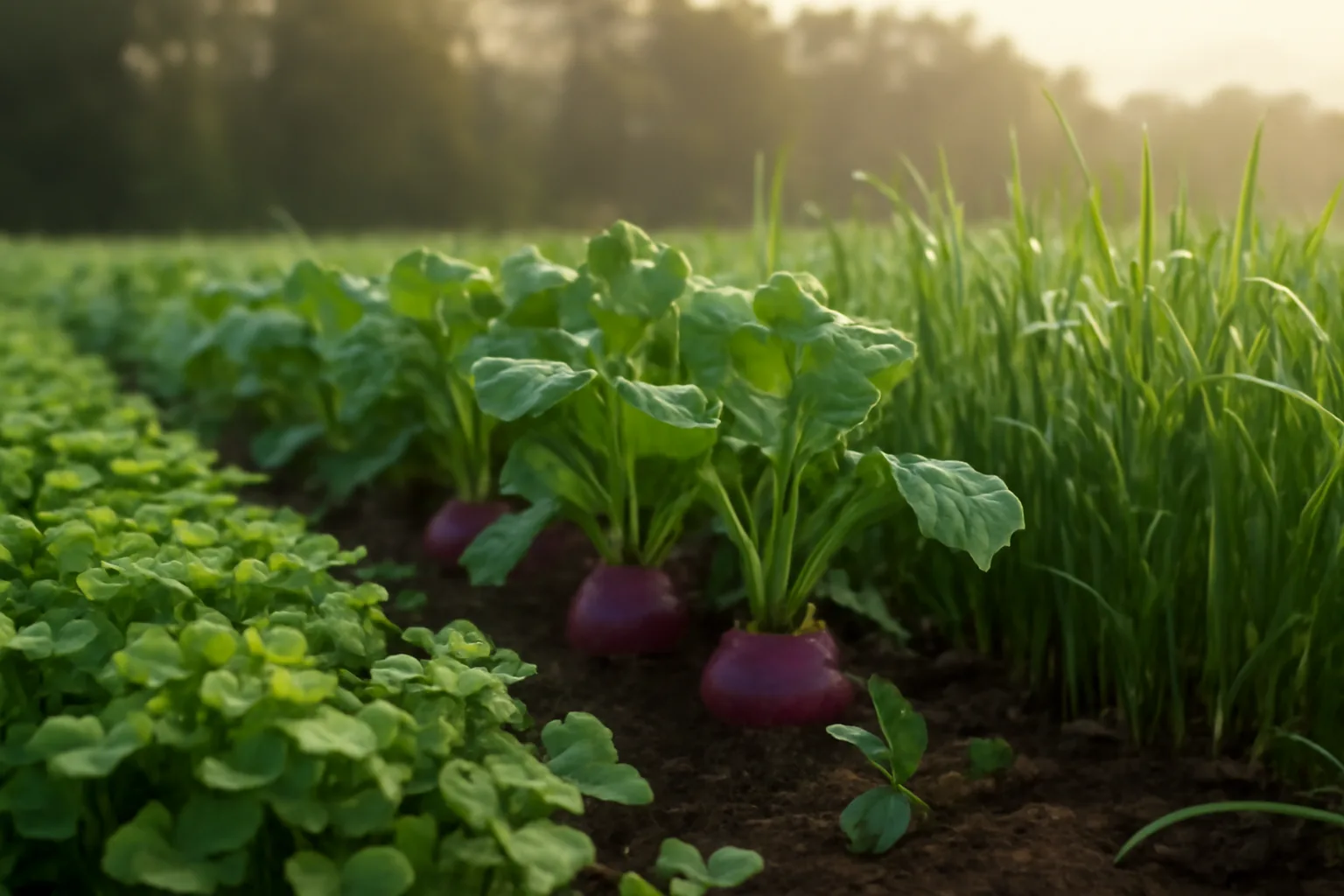
Brassicas are among the easier food plot plants to identify because of their broad, sometimes waxy or slightly fuzzy leaves and their strong, almost mustard-like smell when crushed. Turnips (Brassica rapa) have rounded, deeply lobed lower leaves with a slightly bristly texture, and they form a bulb at or just below the soil surface that ranges from mostly white to purple-topped depending on variety. Radishes, especially forage or "tillage" radish (Raphanus sativus), have similar lobed leaves but tend to grow more upright with a longer, tapering white root that can drive six inches or more into compacted soil. That's part of why they're popular for soil conditioning as well as deer food. Rape and kale, also brassicas, have smoother, waxier, blue-green leaves without the bulb, and they stay more leaf-focused through the season. Canola is another brassica sometimes seen in food plot blends, with narrower leaves and a more branching growth habit as it matures. All brassicas share a family trait: they're most palatable to deer after a hard frost. Cold temperatures convert starches to sugars in the leaves and bulbs, which is why brassica plots that deer seemed to ignore in October suddenly get hammered in December. A North Carolina State University Extension publication on brassica forages for wildlife describes this same frost-driven palatability shift, noting that deer use of brassica plots typically increases sharply after the first hard frosts convert starches to sugars in the leaf tissue.
when to plant food plots for deer, by region
| Clover (perennial) | Late summer or early spring | 55-65°F | |
|---|---|---|---|
| Brassicas (turnips, radish, rape) | Late July through August | 55°F+ | |
| Cereal grains (oats, wheat, rye) | Late August through September | 50-65°F | |
| Warm-season legumes (soybeans, cowpeas) | May through June | 60°F+ | |
| Sorghum | May through early June | 60-65°F+ | These windows are generalized. Local frost dates and soil temperature vary a lot year to year, so cross-check against your state's cooperative extension planting calendar and your own soil thermometer before committing seed to the ground. For a full seasonal breakdown by region, deer food plot seed covers zone-specific calendars in more depth. |
Timing depends entirely on what you're planting and what climate zone you're in, but the broad rule is this: cool-season annuals and perennials go in late summer to early fall, and warm-season plots go in late spring after the last frost. For fall and cool-season plots (clover, brassicas, cereal grains), a widely used rule of thumb is to plant 60 to 90 days before your area's average first fall frost date, so the plot matures heading into archery and gun seasons. In the Upper Midwest and Northeast, that often means planting in August. In the Mid-South and Southeast, September into early October works, and in the Deep South, plantings can push into late October. For spring and summer plots (soybeans, cowpeas, sorghum, warm-season blends), plant after your last spring frost date, typically April in the South, May in the transition zone, and late May into June in the northern tier. Here's a general planting window reference by species group: | Species group | Typical planting window | Soil temp guidance |
when to plant turnips for deer
Turnips for deer food plots are typically planted 60 to 90 days before the first expected fall frost in your area, which in most of the whitetail's range falls between late July and late August. Planting too early in hot, dry conditions can cause poor germination or early bolting. Planting too late means the bulbs won't size up before cold weather hits. Turnips need a firm, well-prepared seedbed and shallow planting, usually a quarter inch deep or less, because the seed is tiny. Broadcasting onto a clean, lightly disked or cultipacked seedbed works well, and many hunters mix turnips with radish and cereal grains in a single fall blend for a mix of leaf growth, bulb production, and structure. Remember the frost-sweetening effect covered above: turnip plots often look untouched for the first month or two and then get eaten hard once temperatures drop into the 20s and 30s Fahrenheit. That's not a failed plot, that's turnips doing what turnips do.
when to plant oats for deer
Oats are a fall-planted cereal grain in most of the country, going in the ground alongside or slightly before brassicas, generally six to eight weeks before the first fall frost. That timing puts oat planting in the same August-to-September window as most other cool-season plots, depending on latitude. Oats germinate fast, often within five to seven days in warm, moist soil, and they green up quickly, which makes them a good "instant gratification" component in a fall blend with slower-establishing clover or brassicas. Deer tend to hit young, tender oat shoots hard in early fall, then again in spring if the stand survives winter in milder climates. One caveat: oats aren't very winter-hardy compared to wheat or cereal rye. In colder zones, roughly USDA zone 5 and colder, oats will winterkill, meaning they provide great early fall and into early winter forage but won't green back up in spring the way rye often does. If you want spring regrowth, wheat or cereal rye is the more reliable choice. If you just need fast fall tonnage, oats deliver.
how do you tell cereal grains apart in the field
Oats, wheat, and cereal rye all look similar as young seedlings, thin upright grass blades, and it takes a closer look to tell them apart with confidence. Cereal rye (Secale cereale, not to be confused with ryegrass) has a bluish-green cast to the leaf and rolls its young leaves tightly, almost like a cigarette, when you look at a cross-section. It's the most cold-hardy and drought-tolerant of the three, and it's often the last thing standing green in a late-season plot after a hard winter. Wheat has a more upright, bright green blade, and its leaves are typically wider and flatter than rye at the seedling stage, with a visible auricle, a small claw-like structure, wrapping the stem where the leaf blade meets the sheath. Oats have the widest, softest, most drooping leaf blade of the three, and no auricle. Oat seed heads, once they emerge, look like an open, branching panicle, very different from the tight spike of wheat or rye. If you're buying a blended cereal grain bag and want to know what's actually growing in your plot come October, checking leaf width and that auricle structure is the fastest field test.
do deer like honey, and does it belong in a food plot
No, honey has nothing to do with food plot planting, and it's not something you'd plant or spread in a plot. This question usually comes up because hunters have heard about using scent or attractant products, some of which contain sugar-based ingredients, to draw deer to a specific spot, separate from the actual forage growing in a plot. Deer do have a documented preference for sugars, which is part of why frosted brassicas and post-frost forage become more attractive, the frost converts starches to sugar, as covered above. But that's a plant-based process, not honey or syrup being applied to the ground. It's also worth flagging here: many states regulate or restrict baiting and supplemental feeding, including placing food-based attractants like syrups, salt, or minerals outside of an actual planted crop, and rules can tighten further inside chronic wasting disease management zones. Michigan's Department of Natural Resources, for example, prohibits baiting and feeding of deer across most of the Lower Peninsula and in specific CWD-affected areas under its deer baiting and feeding regulations, published in the Michigan Wildlife Conservation Order [3]. Rules vary sharply by state and sometimes by county, so check your own state wildlife agency's current baiting and feeding regulations before using any attractant, mineral, or supplemental feed product. A legitimate food plot is treated very differently under most state law than a bait pile or feeder.
what do deer's favorite foods actually look like across a season
There's no single favorite food. Deer preference shifts hard with season, region, and what's available. But research and field observation point to some consistent patterns worth knowing when you're planning a mixed plot. In spring and summer, deer favor high-protein, tender growth: clover, soybeans in early vegetative stages, cowpeas, and natural browse like honeysuckle and greenbrier. In late summer through early fall, soybean pods, clover, and lablab remain strong draws, and acorns start to compete hard once they drop. In late fall and winter, frosted brassicas, cereal grains, and standing soybean pods or corn become the priority foods, especially once snow covers native browse. A study-backed pattern worth remembering: whitetail deer diet studies consistently show soft and hard mast (acorns, apples, soybeans) and legumes making up a large share of preferred forage where available, with grasses and cereal grains playing a secondary, more seasonal role. Research published in the Journal of Wildlife Management on white-tailed deer food habits has documented that acorn availability strongly influences deer distribution and forage selection in fall, with deer shifting away from herbaceous forage toward mast when acorn crops are abundant [4]. The practical takeaway: plant a mix, not a monoculture, if your goal is season-long attraction and nutrition. A single clover field looks great in June and gets ignored in November when acorns hit the ground.
how do you build a plot around what you can identify and grow
Once you can tell your plants apart in the field, the next step is matching species to your soil, your climate, and your hunting goals, which is exactly where a soil test earns its cost. A basic soil test through your land-grant university extension office typically costs somewhere in the $10 to $20 range and tells you pH and nutrient levels, the two things that determine whether clover, brassicas, or beans will actually thrive in your dirt. University of Missouri Extension's soil testing program, for example, lists a standard soil test fee in that range and returns lime and fertilizer recommendations tied to the specific crop you tell them you're planting [5]. Your soil test lab is the authority on how much lime and fertilizer your specific field needs. No article can substitute for that number. What a plan can do is help you translate those results into a species mix and planting calendar that fits your region and your goals, whether that's early-season attraction, late-season nutrition, or both. This is genuinely where a lot of hunters get stuck: they've got a soil test back, a disk and a drill, and no clear sense of which of the eight bags of seed on the shelf to actually buy. That's the exact gap PlotSeason's $99 one-time Custom Food Plot Plan is built to close, turning a soil test and your property's basics into a straightforward species and planting plan without guessing your way through a seed catalog. For species-by-species comparisons once you've narrowed down your options, food plot seed and domain food plot seed both cover selection criteria in more depth.
quick visual identification checklist
Here's a fast field reference for telling common food plot plants apart without a book in hand. Clover: three round leaflets, low creeping growth (white clover) or upright hairy stems (red clover), small round flower heads. Turnip: broad, lobed, slightly rough leaves, bulb forms at soil surface, strong mustard smell when crushed. Forage radish: similar lobed leaves to turnip but more upright, long tapering white root, deeper penetration into soil. Rape/kale: smooth, waxy, blue-green leaves, no bulb, stays leafy through the season. Soybean: broad trifoliate leaves (three leaflets, but larger and less rounded than clover), upright bushy growth, yellow flowers, pods forming by late summer. Cereal rye: bluish-green, tightly rolled young leaf, most cold-hardy of the small grains. Wheat: bright green, flatter blade, visible claw-like auricle at the leaf-stem junction. Oats: widest, softest, most drooping leaf blade, no auricle, open branching seed head. Sorghum: tall (four to seven feet at maturity), corn-like broad leaf, heavy drooping grain head late in the season. Keep this list on your phone during late summer scouting trips. Being able to identify what's actually growing in a neighbor's plot, a CRP field, or your own mixed blend saves a lot of guesswork about why deer are or aren't using a particular patch of ground.
Frequently asked questions
Do deer eat sorghum?
Yes, but it's a lower-priority deer food compared to clover, brassicas, or soybeans. Deer will eat mature sorghum grain heads, especially in fall and winter, but sorghum is more commonly planted for screening cover, weed suppression, or as a nurse crop than as a primary attractant.
Do deer like clover?
Yes, clover is one of the most consistently preferred food plot forages for deer, offering 20 to 30 percent crude protein during vegetative growth. It's palatable through spring and summer and a perennial stand can produce for three to five years with proper maintenance and mowing.
When should I plant food plots for deer?
Cool-season plots (clover, brassicas, cereal grains) generally go in 60 to 90 days before your area's first fall frost, often August through September depending on latitude. Warm-season plots (soybeans, cowpeas, sorghum) go in after the last spring frost, typically April through June depending on region.
When should I plant turnips for deer?
Plant turnips 60 to 90 days before your area's expected first fall frost, usually late July through late August in most of the whitetail's range. Use a shallow planting depth of a quarter inch or less into a firm seedbed, since turnip seed is very small.
When should I plant oats for deer?
Plant oats in the same fall window as brassicas, roughly six to eight weeks before your area's first frost, generally August into September. Oats germinate fast but aren't very winter-hardy in colder zones, so they may winterkill rather than regrow in spring.
What is a food plot?
A food plot is a planted area, often a quarter acre to several acres, established specifically to feed and attract deer or other wildlife rather than for commercial harvest. The USDA classifies these under upland wildlife habitat management practices, which can qualify for cost-share support in some states.
What is a deer's favorite food?
There's no single favorite; preference shifts with season and region. Soybeans, clover, and acorns tend to rank consistently high where available, while frosted brassicas and cereal grains become priority foods in late fall and winter once native browse and mast are gone.
Do deer like honey?
Honey isn't a food plot plant and isn't something you'd spread in a plot. Deer do prefer sugary forage, which is part of why frosted brassicas get sweeter and more attractive, but that's a plant chemistry process, not honey or syrup applied to the ground.
How can I tell clover and alfalfa apart in a plot?
Both are three-leaflet legumes, but alfalfa grows more upright with narrower, more pointed leaflets and purple flower spikes, while clover (especially white clover) spreads low with rounder leaflets and small globe-shaped flower heads. Alfalfa also tolerates drought better but needs higher soil pH, generally 6.5 to 7.5.
Why do deer ignore my brassica plot until winter?
Brassicas like turnips and radish become much more palatable after a hard frost because cold temperatures convert starches in the leaves and bulbs into sugars. A plot that looked untouched in October often gets heavily browsed once temperatures drop into the 20s and 30s Fahrenheit.
Is it legal to use food attractants near a food plot?
Rules vary sharply by state and sometimes by county, especially in chronic wasting disease management zones. Michigan, for instance, bans baiting and feeding deer across most of the Lower Peninsula and in CWD-affected parts of the Upper Peninsula. A planted food plot is typically treated differently under state law than a bait pile, mineral site, or feeder, so check your state wildlife agency's current regulations before adding any supplemental attractant.
How long does a clover food plot last before I need to replant?
A well-maintained perennial clover stand typically produces for three to five years before yield and stand density decline enough to justify renovation or replanting, according to university extension forage guidance. Regular mowing, weed control, and periodic soil testing extend productive stand life.
Sources
- USDA NRCS, Conservation Practice Standard 645, Upland Wildlife Habitat Management (eFOTG): Food plots fall under upland wildlife habitat management practices supported by USDA NRCS
- University of Georgia Extension, Food Plots for Wildlife (Bulletin 1348): Perennial clover stands can last three to five years before needing renovation
- Oklahoma State University Extension, Small Grain Forage Crop Comparison (PSS-2587): Relative winter-hardiness differences among small grains like oats, wheat, and rye
- Michigan Department of Natural Resources, Wildlife Conservation Order, Baiting and Feeding Provisions: Michigan restricts baiting and feeding of deer statewide and in CWD management zones
- Journal of Wildlife Management, research on acorn mast effects on white-tailed deer forage selection: Acorn availability can shift deer use away from planted food plots in heavy mast years
- University of Missouri Extension, Soil Testing for Lawns, Gardens, and Crops: Basic soil tests through university extension labs typically cost around $10 to $20