Last updated 2026-07-25
TL;DR
Food plot oats are planted 60 to 110 lbs per acre, 4 to 6 weeks before your area's average first frost, usually in a 1 to 2 inch deep, firmed seedbed. Deer hit young oat forage hard in fall, especially mixed with brassicas or clover. Oats winterkill in most northern zones but can overwinter in the Deep South.
what is a food plot, and where do oats fit in?
A food plot is a planted patch of forage on hunting land meant to feed deer, pull them into range, or hold them on your property longer than they'd stay on native browse alone. Plots range from quarter-acre kill plots tucked in timber to five-acre destination fields planted along field edges. The USDA Forest Service's National Agroforestry Center treats planted forage plantings as a wildlife habitat management tool, not a farming operation, even though the equipment and agronomy overlap heavily [1]. Oats fit into this picture as a fast, cheap, cool-season annual grain. They're not a season-long strategy on their own. Most experienced plot managers use oats as the nurse crop or fall attraction piece in a mix, not the whole plan. Compare that to food plot whitetail strategies built around perennial clover, which stays productive for two to four years instead of one season. Oat seed is cheap relative to brassica or clover seed, germinates fast (often visible in 5 to 7 days under good moisture), and gives you canopy cover for slower-establishing plants planted alongside it. That's the real value: oats do the early work while turnips or clover catch up underneath.
when to plant oats for deer?
| Northern (Zones 3-4) | Aug 1 - Aug 25 | Oats will winterkill; plan for fall-only forage |
|---|---|---|
| Transition (Zones 5-6) | Aug 15 - Sept 15 | Good window for oats + brassica mix |
Plant oats 4 to 6 weeks before your region's average first fall frost date. That gives the plant enough growing season to reach 8 to 12 inches of leafy growth before cold slows it down, which is when deer preference peaks. In the Upper Midwest and Northeast, that's roughly mid-August through early September. In the Mid-South and transition zone, late August through mid-September works. Deep South plots can go in September through October since frost comes later. Oats can also be planted in early spring in northern climates as a quick-growing spring forage, but most whitetail managers skip this because spring plots compete with an explosion of natural green-up and rarely pull deer the way a fall plot does. Here's a rough planting window by zone, based on USDA Plant Hardiness Zone frost data and standard extension guidance for oats as a forage crop [2]: | Zone / Region | Typical planting window | Notes | {"Southern (Zones 7-8)":"Sept 1 - Oct 15","Notes":"Oats may survive mild winters, regrow in late winter"} If you're not sure which zone you're in, the USDA Plant Hardiness Zone Map lookup by ZIP code is the fastest way to check [2].
when to plant food plots for deer in general?
Food plot timing splits into two seasons: spring plots (clover, chicory, soybeans, alfalfa) go in after your last frost date, typically April through May depending on latitude. Fall plots (oats, wheat, brassicas, cereal rye) go in 4 to 8 weeks before first frost, typically August through September. The reason for the fall window isn't arbitrary. Brassicas like turnips need 80 to 90 days to bulb out before a hard freeze sweetens them. Oats and cereal grains need 6 to 8 weeks of growth to build enough leaf mass to survive early browsing pressure and still have something left for hunting season. Planting too early in September heat can also expose seedlings to drought stress and grasshopper pressure before fall rains arrive. A lot of guys plant everything the same weekend because it's the only free weekend they've got. That's fine, but understand that a straight oat-only plot planted August 1 in zone 5 might get grazed down to nothing by October if you don't have any acreage to spare it.
when to plant turnips for deer?
Turnips are planted in the same late-summer window as oats, generally 80 to 90 days before your first killing frost. In zone 5-6 transition areas, that's roughly late July through mid-August, a couple weeks earlier than a straight oat planting. Turnips need that extra lead time to bulb because the tuber itself is the main fall/winter attraction, along with the leafy tops deer hit earlier in the season. Mixing turnips with oats is one of the most common combos in the food plot world. Oats germinate fast and give the plot green cover within a week, discouraging erosion and weed pressure while the slower turnip seedlings establish. By the time a hard frost hits and converts starches to sugars in the turnip bulb (the trigger that makes deer suddenly switch from ignoring turnips to plowing craters into the dirt for them), the oats have often already been grazed down or gone dormant. Extension horticulture guidance on brassica crops confirms that a hard frost converts starches to sugars in the root and leaf tissue, which is why turnip and other brassica plots get hit hardest after the first couple of frosts rather than right after planting [3].
how much oat seed per acre for a food plot?
Standard forage oat seeding rates run 60 to 110 lbs per acre depending on whether you're drilling or broadcasting. Extension agronomy guides for oats as a forage or cover crop generally recommend 2 to 3 bushels per acre (a bushel of oats weighs 32 lbs), which lands you in that 64 to 96 lb range, with broadcast seeding typically on the higher end to compensate for uneven seed-to-soil contact [4]. If you're drilling into a prepared seedbed, 60 to 80 lbs/acre is plenty. If you're broadcasting into a disked field or no-till drilling isn't available, bump to 90 to 110 lbs/acre and drag or cultipack afterward to improve soil contact. Skimping on rate is one of the most common mistakes; oats are cheap seed, often $10 to $20 per 50 lb bag depending on the year and region, so under-seeding to save a few dollars rarely makes sense. Planting depth matters more than people think. Oats want to go 1 to 2 inches deep. Broadcast oats that just sit on top of the soil with no cultipacking pass will germinate at a much lower rate, especially in dry falls.
do deer eat sorghum?
Yes, deer will eat grain sorghum, particularly the seed heads once they mature and dry down in late fall, and they'll also browse young sorghum forage earlier in the season. Sorghum is more commonly planted as a summer annual for warm-season plots or as a screening/cover crop along field edges rather than a primary fall attraction crop, since standing sorghum heads well into winter also functions as a food source when snow covers other plots. Sorghum isn't in the same category as oats agronomically. Oats are a cool-season cereal grain planted for fall/winter forage; sorghum is a warm-season grass planted in late spring after soil temps hit 60°F or higher. If you're building a full-season plot plan, sorghum belongs in the summer rotation, not stacked with your oat planting.
do deer eat clover, and do deer like clover?
Deer eat clover readily, and most whitetail managers rank it among the top perennial plot forages available. Clover (white clover, red clover, and various ladino varieties) offers high crude protein, often in the 25 to 30% range on a dry matter basis during active growth, which matters most in spring and summer when does are lactating and bucks are growing antlers [5]. Do deer like clover compared to other options? In most head-to-head observations from extension wildlife programs and plot managers, clover holds up as one of the most consistently grazed plantings across the growing season, largely because it regrows after grazing (unlike a lot of annuals that get grazed once and are done). The tradeoff is establishment time and maintenance. Clover needs a properly limed and fertilized seedbed based on a real soil test, mowing a few times a season to control weed competition, and it takes a full year before it hits peak production. If you want a forage that's productive spring through fall without replanting every year, clover is worth the extra setup work. If you want fast fall tonnage with minimal fuss, oats and brassicas win. A lot of good plot plans run both: perennial clover in one field, annual oats/brassica mix in another. See deer food plot seed for how these combos typically get built out.
what are deer's favorite foods?
There's no single scientifically ranked "favorite food" list, but research on whitetail diet composition consistently shows deer are opportunistic browsers that shift preference by season, region, and what's locally available. Acorns are one of the most heavily documented preferred natural foods; studies tracking fall diets in oak-heavy habitat routinely find acorns making up a large share of rumen contents when mast crops are strong, since they're calorie-dense and easy to digest [6]. Among planted forages, soybeans, clover, and brassicas consistently show up as heavily used in food plot research and extension trials, alongside natural browse like honeysuckle, greenbrier, and forbs depending on the region. Preference also depends heavily on what else is available; a plot that looks ignored in October during a heavy acorn drop might get hammered in December once mast is gone. The honest answer for a hunter planning this fall is: don't chase a single "best" plant. Build a plot mix that gives deer something palatable across as much of the year as possible, and expect natural food sources to compete with (and sometimes beat) whatever you planted.
do deer like honey?
Deer aren't drawn to honey itself in any meaningful, documented way, and it's not something used in legitimate food plot or attractant research. What deer are documented to respond to are mineral licks, salt, and certain scent/food attractant products sold commercially, though effectiveness studies on commercial deer attractants are thin and mostly anecdotal rather than peer-reviewed. More importantly, using bait or attractants like syrupy scent products, feed piles, or mineral supplements is regulated or outright banned in a lot of states during hunting season. Baiting law varies enormously; some states allow supplemental feeding year-round, some ban it entirely, and some allow feeding but not hunting over bait within a set distance or timeframe. Check your state wildlife agency's current regulations before using anything beyond a standard planted food plot, since baiting rules change and enforcement varies by state game agency.
how do you plant an oat food plot, step by step?
Start with a soil test. This is the one step people skip most often and regret most. A basic soil test through your state's land-grant extension office (often $10 to $20 per sample) tells you your pH and nutrient levels, and your soil test lab's recommendations are the actual authority on how much lime and fertilizer to apply, not a generic online chart . Once you have results, the general sequence for an oat plot looks like this: 1. Kill existing vegetation with herbicide (glyphosate is standard for a clean start) 2 to 3 weeks before planting, or disk it under if you're not spraying. 2. Apply lime if your soil test calls for it. Lime takes months to fully adjust pH, so fall applications often won't fix pH until the following season; some plot managers apply the season before for that reason. 3. Work the seedbed to a fine, firm texture, disking or tilling to break up clumps. 4. Broadcast or drill oat seed at 60 to 110 lbs/acre, 1 to 2 inches deep. 5. Apply starter fertilizer per your soil test recommendation, commonly balanced blends supplying nitrogen, phosphorus, and potassium. 6. Cultipack or drag to firm the seedbed and improve seed-to-soil contact. 7. Water isn't usually an option on wild ground, so timing planting ahead of a forecasted rain is the practical substitute for irrigation. If you'd rather not build this plan from scratch field by field, this is where a service like the $99 Custom Food Plot Plan earns its keep. You enter your location, soil test results, and equipment, and get back a general seed mix, rate, and calendar built for your zone. It's guidance, not site-specific agronomy advice; your soil test lab is still the final word on lime and fertilizer amounts for your particular field.
what equipment do you actually need for an oat plot?
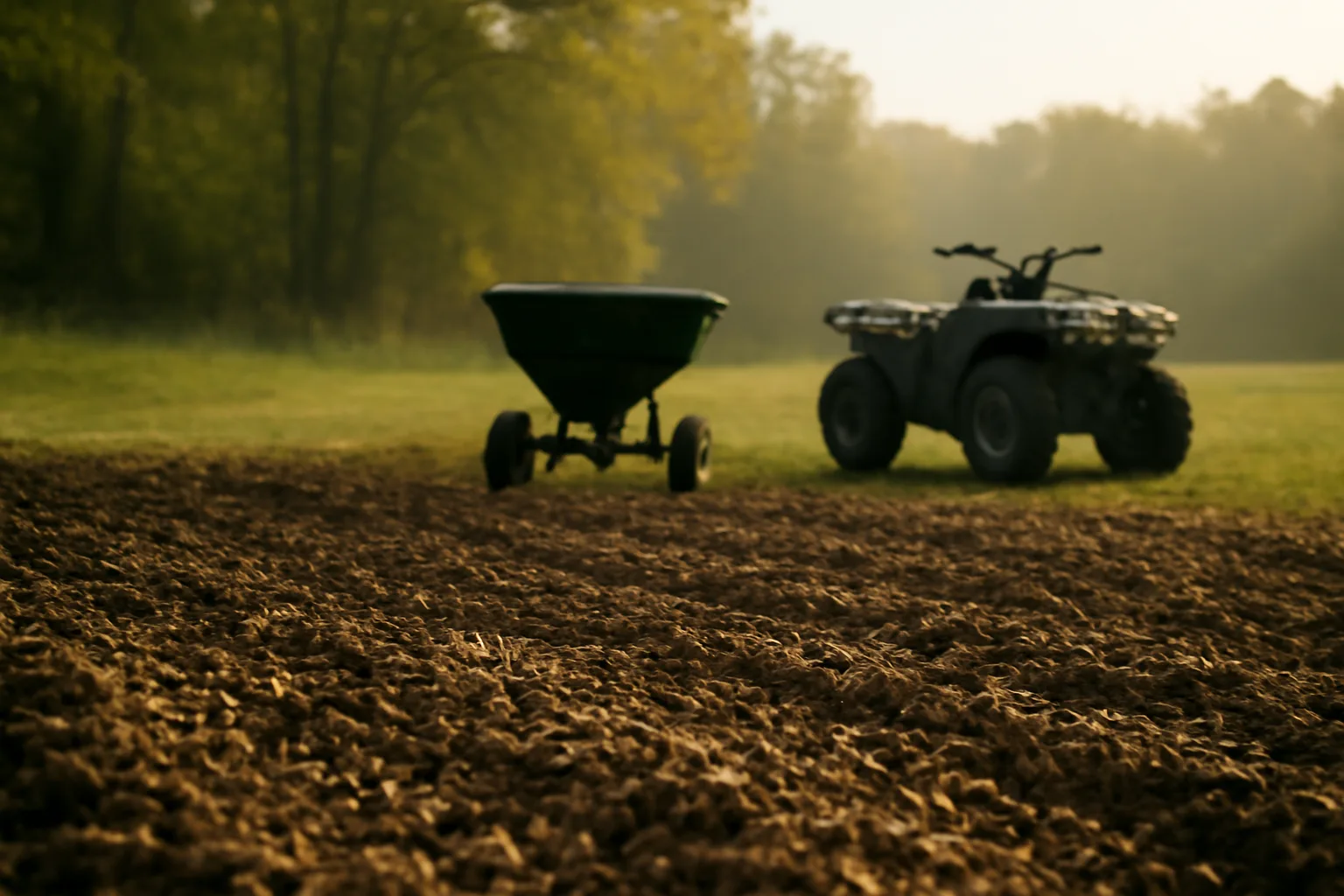
You don't need a full-size farm tractor to plant oats successfully, but you do need something to prep a seedbed and something to get seed in the ground. At minimum: an ATV or UTV with a disk or harrow attachment, a broadcast spreader (even a hand-crank one works for small plots), and a cultipacker or drag to firm the seedbed after seeding. A no-till drill is the upgrade path if you're planting multiple plots a year or dealing with heavier clay soils where broadcast seed struggles to get contact. Drills cost more upfront (used units often run $2,000 to $6,000+ depending on width and condition) but improve germination rates and let you skip a full tillage pass, which also helps with erosion control on sloped ground. For a quarter-acre to half-acre plot, honestly, a hand spreader, a rake or drag made from a chain-link section, and patience will get you a usable stand. Bigger acreage is where equipment investment starts paying for itself in labor saved.
oat mixes: what should you plant with oats?
Straight oats work, but most experienced plot managers pair them with something else to extend the plot's usefulness. Common combos: Oats + brassicas (turnips, radishes): oats give fast cover and early grazing, brassicas bulb up for late-season sweetness after frost. This is probably the single most common fall mix in the Midwest and Northeast. Oats + winter wheat or cereal rye: extends the plot's life since wheat and rye are more cold-tolerant and can survive into spring in many zones, giving you green-up before spring plots come online. Oats + clover (as a nurse crop): oats germinate fast and shade out weeds while slow-establishing clover gets its roots down; the oats then die back or get grazed off, leaving clover as the following year's perennial stand. A reasonable starting blend for a transition-zone plot: 60 lbs/acre oats, 8 to 10 lbs/acre turnip/radish blend, planted together in early-to-mid September. Adjust rates down proportionally if you're mixing three or more species so you're not overcrowding the seedbed. For more built-out mix ideas by region, deer food plots and food plot seed both break down species pairings in more depth.
do oats winterkill, and does that matter?
In most of the northern and transition U.S. (roughly Zone 6 and colder), oats reliably winterkill once sustained temperatures drop into the low 20s°F or below, turning the plant brown and mushy. That's actually a feature for a lot of plot managers: dead oat residue breaks down into the soil, adds organic matter, and leaves a clean slate for a spring planting without extra tillage. In milder zones (roughly Zone 7 and warmer, parts of the Deep South), oats can survive a mild winter and continue growing, giving you a second flush of green forage in late winter before spring green-up. This is one reason Southern food plot rotations sometimes lean on oats more heavily than Northern ones do, since the plant does double duty as fall forage and late-winter forage. If you're depending on an oat plot to still be standing and green in January in Wisconsin, you're going to be disappointed. Plan mixed plantings (oats with wheat, rye, or brassicas) if you need something still green after the first hard freezes.
Frequently asked questions
How many pounds of oat seed do I need per acre for a deer food plot?
Plan on 60 to 110 lbs of oat seed per acre. Drilled plots can run 60 to 80 lbs/acre since seed-to-soil contact is better; broadcast plots should go 90 to 110 lbs/acre with a cultipacking pass afterward to compensate for less even coverage.
When should I plant oats for deer in my area?
Plant oats 4 to 6 weeks before your area's average first fall frost. That's roughly mid-August in the Upper Midwest and Northeast, late August to mid-September in the transition zone, and September into October in the Deep South. Check your USDA Plant Hardiness Zone for a more exact local frost date.
Do deer actually prefer oats over other food plot options?
Deer readily eat young oat forage, especially in early fall when it's tender and high in sugars, but oats aren't consistently ranked above brassicas, clover, or soybeans in extension studies. Preference shifts by season and what natural food, like acorns, is available at the time.
Can I plant oats and turnips together in the same plot?
Yes, this is one of the most common fall mixes. Plant them together in the same late-summer window; oats germinate fast and give early cover while turnips take longer to bulb. A common ratio is around 60 lbs/acre oats with 8 to 10 lbs/acre of a turnip or turnip-radish blend.
Do deer eat sorghum in food plots?
Yes, deer eat both young sorghum forage and mature grain heads, especially once heads dry down in late fall and winter. Sorghum is a warm-season crop though, planted in late spring, so it doesn't share a planting window with cool-season oats.
Is clover better than oats for a food plot?
They serve different purposes. Clover is a perennial that produces spring through fall for two to four years but takes a full season to establish. Oats are a cheap, fast annual best used for a quick fall attraction plot or as a nurse crop while a perennial like clover gets established.
What is a food plot, exactly?
A food plot is a planted area of forage crops on hunting land, meant to supplement natural browse, attract deer into range, and improve habitat nutrition. Plots range from small hidden kill plots to multi-acre fields and are managed with agronomy practices similar to farming, guided by a soil test.
When is the best time to plant food plots, spring or fall?
It depends on the species. Spring plots (clover, soybeans, chicory) go in after your last frost, typically April to May. Fall plots (oats, wheat, brassicas) go in 4 to 8 weeks before first frost, typically August to September, timed so plants mature before the ground freezes.
Do deer like honey or sweet attractant products?
There's no solid evidence deer are specifically drawn to honey. Commercial food attractants have thin, mostly non-peer-reviewed data behind them, and baiting or supplemental feeding rules vary a lot by state, with some states banning it outright during hunting season. Check your state wildlife agency's current regulations first.
Will oats survive the winter or do they die off?
In Zone 6 and colder, oats typically winterkill once temperatures hit the low 20s°F, which is common and fine since the residue breaks down into the soil. In milder Zone 7+ climates, oats can survive winter and regrow, giving you extra late-winter forage.
How deep should I plant oat seed?
Plant oat seed 1 to 2 inches deep. Broadcasting on top of bare soil without covering it or cultipacking afterward significantly lowers germination, especially in a dry fall, so a firming pass after seeding matters as much as the depth itself.
What's the cheapest way to plant a small oat food plot?
A hand-crank broadcast spreader, a disked or tilled seedbed, and a drag made from chain-link fencing or a section of pipe to firm the soil afterward will get a quarter-acre to half-acre plot planted for well under $100 in equipment, aside from seed and any lime or fertilizer your soil test calls for.
Sources
- USDA Forest Service, National Agroforestry Center: Food plots and planted forage are recognized wildlife habitat management practices
- University of Minnesota Extension, Growing Turnips and Rutabagas: Frost exposure converts starches to sugars in brassica roots and leaves, increasing sweetness
- University of Wisconsin-Madison Extension, Oat Cultivation Guide: Standard forage oat seeding rates and bushel weight guidance
- University of Georgia Extension, Clover for Wildlife: Clover crude protein levels during active growth stages
- Journal of Wildlife Management, White-tailed deer diet composition and acorn use: Whitetail deer diet composition shifts seasonally and acorns are heavily used when available
- University of Missouri Extension, Soil Testing for Lawns, Gardens and Food Plots: Soil test guidance and typical cost for a basic soil test through extension labs