Last updated 2026-07-25
TL;DR
A no-till food plot seeder cuts a slot into standing sod or residue, drops seed at a set depth, and closes the slot without turning the soil. It saves fuel and time, protects soil structure, and works well on hillsides or in dry years, but it demands good seed-to-soil contact and a clean kill of competing vegetation first.
What is a no-till food plot seeder?
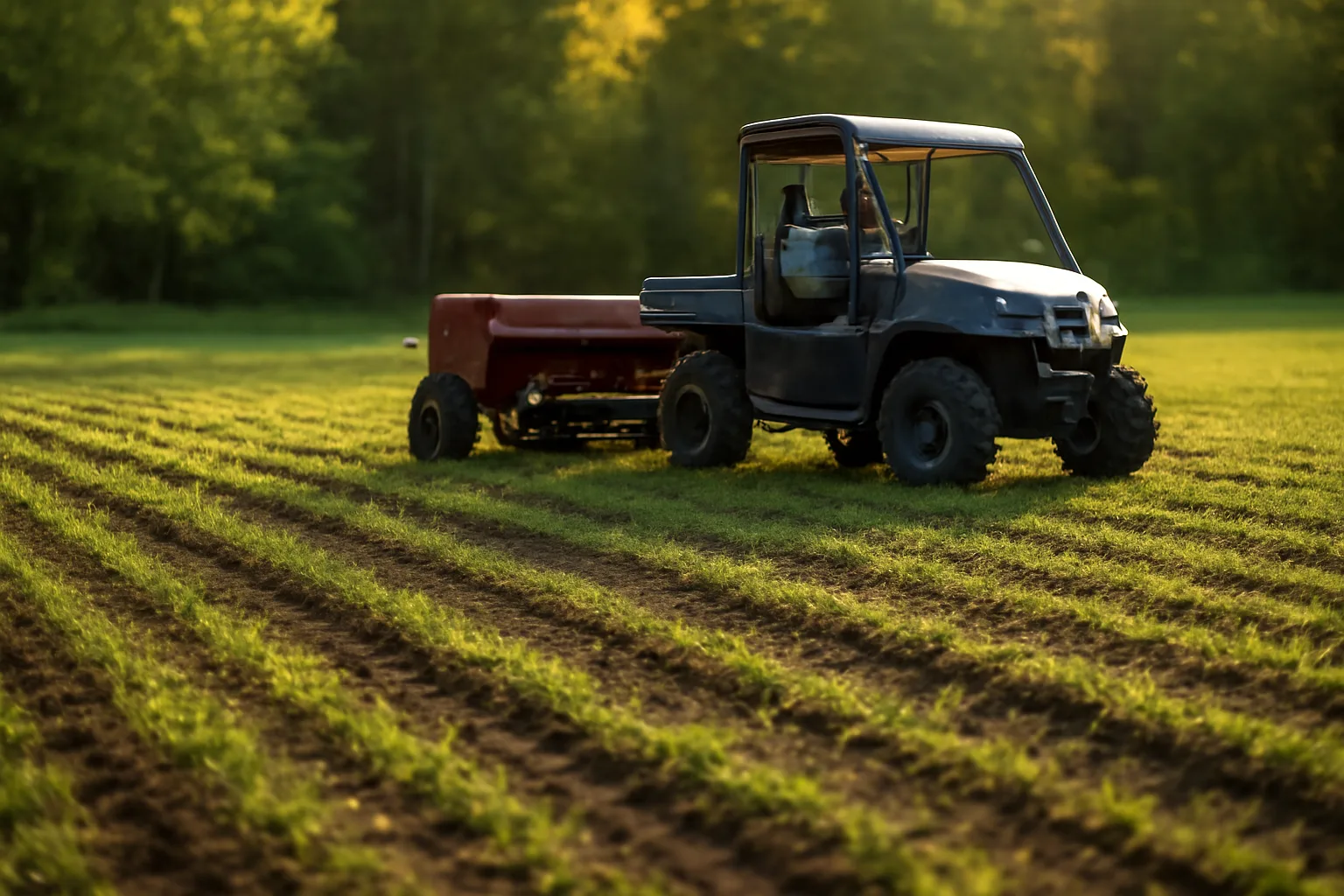
A no-till food plot seeder is a drill or planter built to place seed directly into existing sod, crop residue, or a killed cover crop without plowing or disking the ground first. Instead of a plow blade or disk gang turning soil, the machine uses coulters (thin rotating discs) to slice a narrow furrow, a seed tube to drop seed at a set depth, and press wheels to close the slot and firm the soil around the seed. Most units on the market for food plots are scaled-down versions of ag no-till drills, built to be pulled behind an ATV, UTV, or compact tractor. Brands like Whitetail Institute, Firminator, Woods, and Genesis all sell versions, with box widths generally running 4 to 6 feet for ATV models and up to 8 feet for tractor-pulled units. Weight matters a lot here: a drill needs enough down pressure to cut through sod, so lightweight units often struggle in heavy thatch or clay. The core idea traces back to conventional no-till row-crop drilling, which USDA's Natural Resources Conservation Service promotes specifically because it "reduces soil erosion, improves soil health, and can reduce fuel and labor costs" compared to full tillage [1]. Food plotters borrowed the same logic: less disturbance, less erosion, and a faster path from bare dirt (or bare-ish dirt) to a growing plot. If you're new to the whole food plot idea, our overview of what a food plot actually is and how to build one is a good place to start before you shop for equipment.
How does a no-till drill actually work in the field?
You drive the drill across the plot, and three things happen in sequence at each row: a coulter cuts a slit through residue or sod, a seed boot drops seed into that slit at a calibrated depth, and a closing wheel (often a spring-loaded rubber or cast wheel) presses the slit shut over the seed. Row spacing on food plot drills usually runs 6 to 8 inches, which works fine for cereal grains, clover, and brassicas. Depth control is the single biggest factor in success or failure. Clover and small brassica seed want to be barely covered, maybe 1/4 inch. Cereal grains like oats or wheat want closer to 1 to 1.5 inches. Most drills have adjustable depth bands or spring tension so you can dial this in per seed type, and getting it wrong is the number-one reason a no-till plot comes up thin. Down pressure is the second variable. In compacted clay or thick sod, you need enough weight on the frame (sometimes with added ballast) to get coulters to actually cut rather than ride on top. Many small ATV-pulled units simply don't have the mass to punch through tough sod on their own, which is why some manufacturers spec optional weight kits. A properly set no-till drill leaves a field that looks almost untouched from a distance, just thin slits in the grass, but underneath, seed sits at consistent depth with real soil contact. That's the whole game: get seed-to-soil contact without exposing the whole surface to sun, wind, and erosion.
No-till vs conventional tillage: which is actually better for food plots?
| Soil disturbance | Minimal | Full | |
|---|---|---|---|
| Fuel/time per acre | Lower | Higher | |
| Erosion risk | Lower | Higher, especially on slopes | |
| Weed control needed first | Yes, usually herbicide burndown | Often handled by tillage itself | |
| Works on steep or rocky ground | Yes | Often difficult | |
| Best seedbed for tiny seed (clover) | Good if depth is dialed in | Excellent, very fine seedbed possible | |
| Equipment cost | Moderate to high | Moderate (plow/disk + tractor) | If you're deciding between species and want the seedbed prep to match, our guide to food plot seed options breaks down what each species needs from the ground before it goes in. |
Neither approach is universally better. It depends on your soil, your weed pressure, your time, and your budget. Conventional tillage (plowing, disking) buries competing vegetation and residue, warms the soil faster in spring, and gives small-seeded species like clover a clean, loose seedbed. It also exposes bare soil to erosion, burns more fuel and time, and can bring buried weed seed to the surface where it germinates right alongside your plot. No-till avoids most of that soil disturbance. USDA NRCS notes that no-till and reduced-tillage systems can cut fuel use and labor time compared to conventional tillage, largely because you're skipping multiple passes with a disk or plow [1]. On sloped ground, no-till also protects against the kind of sheet and rill erosion that a bare, tilled plot is prone to after a hard spring rain, a real concern that several state extension services flag for erodible upland fields. The tradeoff is weed and sod control. If you drill into standing grass or weeds without killing them first, your food plot species compete against an established stand and often lose. That means no-till plots almost always need a burndown herbicide application (commonly glyphosate) a few weeks ahead of planting, which conventional tillage can sometimes substitute for by just turning the vegetation under. | Factor | No-till drill | Conventional tillage |
When should you plant food plots for deer?
Timing depends on region and species, but there are two broad windows most food plotters work within: spring plantings (roughly April through June) for warm-season annuals and perennials, and late-summer to fall plantings (roughly late July through September) for cool-season annuals and brassicas. Spring plots (soybeans, corn, clover, chicory) need soil temperatures warm enough for germination and a long enough growing season before frost. Extension guidance generally points to planting these after the last frost date for your area, since sub-32°F temps can kill young seedlings [2]. Fall plots (cereal grains, brassicas, clover overseed) are timed to hit peak palatability and growth right as hunting season approaches and natural food sources decline. Most state wildlife agency and extension recommendations put fall plot planting somewhere between 6 and 10 weeks before your typical first hard frost, though that window shifts a lot by latitude, from late July in the upper Midwest to late September in the Southeast. Because frost dates and season length vary so much by state, a lot of hunters find it easier to work off a zone-based calendar than a single national date. That's the kind of gap a service like the $99 one-time Custom Food Plot Plan is built to fill: you plug in your ZIP code and soil test, and it maps species and dates to your actual property instead of a national average. You can start that at /plot-plan-builder. For a broader seasonal breakdown by species and region, see our deer food plots guide.
When should you plant oats for deer?
Oats are typically planted in late summer to early fall, timed so they establish before the first hard frost but still deliver tender, palatable growth during hunting season. Most extension guides suggest a planting window roughly 45 to 60 days ahead of your area's average first frost date. Oats germinate fast, often within 7 to 10 days in warm, moist soil, and they green up quickly, which is part of why they're a staple in fall food plot blends. They also winterkill in cold climates (unlike winter wheat or rye), so in northern zones they act as an annual that dies back after a hard freeze, while in milder southern zones they can persist and regrow into winter. A no-till drill works well for oats because the seed is large enough to handle imperfect depth control better than something like clover. A depth of around 1 to 1.5 inches with firm soil contact is typical. Oats are also one of the more reliably attractive cereal grains to whitetails in early fall, before acorns drop and pull deer away from plots, according to observations from multiple state agency food plot guides [3].
When should you plant turnips for deer?
Turnips (and brassicas generally) are planted in mid to late summer, usually 90 to 100 days before your first expected hard frost, since they need that full window to bulb out and reach peak palatability. That translates to roughly late July in northern states and into August or even early September in the mid-South. Planting too late means the plants stay leafy and small, without the bulb development that makes turnips such a strong late-season draw once a hard frost sweetens the starches into sugars. Brassica seed is tiny, similar in size to clover, so depth control on a no-till drill really matters here. Extension guidance generally recommends no more than 1/4 to 1/2 inch of coverage [4]. Too deep, and germination rates drop hard. One practical note: deer often ignore turnip bulbs and tops early in the season and hammer them after a few frosts convert starch to sugar, so don't judge a turnip plot's success in October. Judge it in December or January.
Do deer eat sorghum?
Yes, deer eat sorghum, both the grain heads and, to a lesser extent, the foliage, though it's generally considered a secondary or supplemental food plot species rather than a primary draw compared to soybeans, corn, or clover. Grain sorghum is planted similarly to corn, in late spring once soil temps warm, and it's notably more drought-tolerant, which makes it a reasonable choice in dry regions or sandy soils where corn struggles. It's also cheaper per acre in a lot of cases and matures faster than corn in some varieties. A lot of food plotters use sorghum as part of a blend rather than a monoculture, mixed with something like soybeans or cowpeas, both to spread risk (drought, deer pressure, disease) and to give deer more forage options in one plot.
Do deer eat clover, and do deer actually like it?
Yes, deer eat clover heavily, and it's widely considered one of the most consistently attractive food plot species available, both for its taste to deer and its nutritional value. Clover is a legume, meaning it fixes nitrogen in the soil, and quality clover forage commonly tests in the 25 to 30% crude protein range depending on variety, soil fertility, and cutting stage, per multiple university forage testing summaries. That protein level matters most in spring and summer when does are lactating and bucks are growing antlers, which is why perennial clover plots are often the backbone of a food plot system rather than a one-off planting. Clover's downside is establishment. The seed is tiny, needs shallow planting (often just pressed into the surface, not buried), and competes poorly against weeds in the first month or two. A no-till drill with a properly calibrated small-seed box can handle clover well, but a lot of hunters still broadcast clover seed and cultipack it rather than drilling, simply because the seed is so small that depth control errors are easy to make. Perennial clover stands, if maintained (mowed, limed per soil test, sprayed for weeds), can last 3 to 5 years before needing to be reestablished, which makes the upfront cost of a no-till drill or good broadcast setup pay off over multiple seasons. For a deeper look at clover among other seed choices, check our deer food plot seed breakdown.
What are deer's favorite foods, and where does honey fit in?
Deer diet studies consistently show acorns, soft mast (apples, persimmons), agricultural crops (soybeans, corn), and high-protein forbs and legumes (clover, alfalfa) rank among the most preferred whitetail foods, with actual preference shifting seasonally based on what's available and what nutritional need is highest. Acorns in particular show up again and again in deer diet research as a preferred fall food when available, often pulling deer off food plots entirely during a heavy mast year, a pattern noted in state wildlife agency deer management publications [5]. That's part of why plot placement near, but not directly under, oak stands is a common strategy. Do deer like honey? There's no meaningful research or field data suggesting deer seek out honey as a food source, and it's not a plant or plot species, so it doesn't fit into food plot planning at all. Deer are herbivores whose diet centers on browse, forbs, mast, and agricultural forage; honey isn't part of that picture in any practical sense. If you're picturing deer at a bait pile with a honey-based attractant, note that most states regulate or outright ban baiting and supplemental feeding for deer hunting, so check your state wildlife agency's current regulations before using any attractant, honey-based or otherwise [6].
What kind of no-till seeder actually fits your setup?
The right seeder depends mostly on what you're pulling it with and how many acres you're planting each season. Someone with 2 to 5 acres and a UTV needs a very different machine than someone drilling 40 acres with a 75-horsepower tractor. ATV/UTV-pulled units: generally 4 to 6 feet wide, seed box capacity often in the 100 to 175 pound range, designed to be light enough for a mid-size UTV to pull but heavy enough to cut sod with some down-pressure assist or added weight. These run roughly $2,500 to $6,000 depending on brand and features, based on current published pricing from major food plot equipment manufacturers. Tractor-pulled units: wider (6 to 10 feet), heavier frames, true coulter gangs, often with electric or ground-drive seed metering. These start around $5,000 and climb well past $15,000 for larger, more precise ag-grade drills adapted for food plot use. Rental or co-op access: a lot of hunters skip ownership entirely and rent a no-till drill from a local NRCS soil and water conservation district or ag co-op for a day, which is often the most cost-effective path if you're only planting once or twice a year on a handful of acres. Many conservation districts maintain drill rental programs specifically because of the erosion and soil health benefits NRCS promotes [1]. If your acreage is small and irregular in shape, a broadcast spreader followed by a cultipacker can sometimes get you 80% of the result for a fraction of the cost of a drill, especially for shallow-seeded species like clover and brassicas.
What should you do before you ever pull the drill into the field?
A no-till drill doesn't fix bad prep. It just avoids adding tillage to the list of things you have to get right. First, kill existing vegetation. Most no-till plots start with a glyphosate burndown 2 to 4 weeks ahead of planting, timed so the existing sod or weeds are dead and starting to break down before the drill runs through. Second, pull a soil test. Lime and fertilizer needs vary enormously by soil type and prior land use, and your soil test lab, not a general guide like this one, is the real authority on how much lime or fertilizer your specific field needs. A university extension soil test typically costs $10 to $20 and takes 1 to 3 weeks to turn around [7], which is cheap insurance against wasting a whole season of seed on soil with the wrong pH. Third, check your drill's calibration against the seed you're actually using. Seeding rate charts differ by species (a drill set for soybeans is wildly wrong for clover), and most manufacturers publish rate charts by seed type. Once vegetation is killed and soil chemistry is corrected per your test results, the no-till drill's job is simple: place seed at consistent depth with good soil contact, and let the lack of disturbance work in your favor against erosion and weed reflush.
What is a food plot, really, and why does planting method matter this much?
A food plot is a planted area, usually somewhere between a quarter acre and several acres, established specifically to provide supplemental forage for deer and other wildlife, distinct from natural browse or agricultural fields planted for harvest. Food plots serve two loose categories: destination plots (small, often hidden, meant to hold deer for a hunt) and feeding or nutrition plots (larger, meant to support herd health and antler growth through spring and summer). Species choice, size, and location differ a lot between the two. Planting method (no-till drill, conventional till, or broadcast-and-cultipack) is really just the delivery mechanism for getting seed into contact with soil at the right depth. None of the three methods overrides bad species choice, bad timing, or skipping the soil test. A no-till drill on the wrong species at the wrong time of year still produces a thin, disappointing plot. Where method actually matters most is site condition: steep ground, existing sod, limited equipment access, or a desire to minimize erosion and fuel costs all point toward no-till. Flat, weedy, rock-free ground where you're starting from bare dirt anyway sometimes makes conventional tillage just as fast and a lot cheaper if you don't already own a drill. For a state-by-state and zone-based look at how planting windows shift across the whitetail's range, our deer for food resource lays out regional timing in more depth than a single national calendar can.
Frequently asked questions
Do deer eat sorghum?
Yes. Deer eat both the grain heads and, to a lesser degree, the foliage of sorghum, though most food plotters treat it as a supplemental or blend component rather than a primary plot species. It's more drought-tolerant than corn, which makes it a useful option in sandy or dry soils where corn performance is inconsistent.
Do deer eat clover, and do deer actually like it?
Deer readily eat clover and it's one of the most consistently preferred food plot forages available. Quality clover often tests at 25 to 30% crude protein, which supports lactating does and antler growth in spring and summer. The main challenge is establishment, since clover seed is tiny and needs very shallow planting for good germination.
When should you plant food plots for deer?
Timing splits into two windows: spring plantings (April to June) for warm-season annuals like soybeans and corn, and late-summer plantings (late July to September) for cool-season annuals like oats, wheat, and brassicas. Exact dates shift by latitude and frost timing, so check your local extension office or state wildlife agency for zone-specific guidance.
When should you plant oats for deer?
Plant oats roughly 45 to 60 days before your area's average first hard frost date, which usually lands in late summer or early fall depending on region. Oats germinate quickly, often within 7 to 10 days, and typically winterkill in cold climates, making them a reliable annual cereal grain for fall food plots.
When should you plant turnips for deer?
Turnips need about 90 to 100 days before your first expected hard frost to bulb out properly, which usually means planting in late July to late August depending on your region. Deer often ignore turnips early in the season and hit them hard after repeated frosts sweeten the bulbs, so evaluate turnip plots in late fall or winter, not early fall.
What is a food plot?
A food plot is a planted area, typically a quarter acre to several acres, established specifically to provide supplemental forage for deer or other wildlife rather than for human harvest. Plots generally fall into two categories: small destination plots meant to hold deer during hunting hours, and larger nutrition plots meant to support herd health through spring and summer.
What are deer's favorite foods?
Diet studies and state agency deer management publications consistently point to acorns and other mast, soft mast like apples and persimmons, agricultural crops such as soybeans and corn, and high-protein legumes and forbs like clover as top preferred whitetail foods. Preference shifts seasonally with availability and nutritional need, and a heavy acorn crop can pull deer off food plots entirely in fall.
Do deer like honey?
There's no research or field data indicating deer seek out honey as a food source, and honey isn't a food plot species since it's not a plant. Deer diets center on browse, forbs, mast, and agricultural forage. Honey-based products sometimes show up as deer attractants or bait, but many states regulate or ban baiting, so check your state wildlife agency's current rules first.
What's the difference between a no-till drill and just tilling the ground?
A no-till drill cuts a narrow slot into existing sod or residue and places seed at a set depth without disturbing the rest of the soil surface, while conventional tillage plows or disks the entire seedbed loose. No-till reduces erosion and fuel use but requires killing existing vegetation first, usually with a herbicide burndown, since the drill won't bury competing weeds the way tillage does.
How much does a no-till food plot seeder cost?
ATV or UTV-pulled no-till drills generally run $2,500 to $6,000 depending on width and features, while tractor-pulled units start around $5,000 and can exceed $15,000 for larger, more precise models. Many hunters rent a drill for a day from a local soil and water conservation district or ag co-op instead of buying one outright, especially for small acreage.
Can you no-till drill clover, or does it need a finer seedbed?
You can no-till drill clover successfully if the drill has a properly calibrated small-seed box and you set depth to roughly 1/4 inch or less, since clover seed germinates poorly if buried too deep. A lot of hunters still broadcast clover and cultipack it instead, simply because shallow small-seed depth control is easier to get right by hand than through some drills.
Do I need to spray herbicide before using a no-till drill?
In almost all cases, yes. A no-till drill doesn't bury or kill existing vegetation the way tillage does, so if you drill into standing grass or weeds without a burndown herbicide application first, your food plot species will compete against established growth and usually lose. Most no-till plots get a glyphosate application 2 to 4 weeks ahead of planting.
How do I know what seeding depth to use for different food plot species?
Seeding depth varies a lot by species: cereal grains like oats and wheat go around 1 to 1.5 inches deep, while tiny seeds like clover and brassicas need just 1/4 inch or less of coverage. Most no-till drill manufacturers publish depth and rate charts by species, and getting depth wrong is one of the most common reasons plots come up thin.
Sources
- USDA Natural Resources Conservation Service, No-Till Farming benefits overview: No-till reduces soil erosion, improves soil health, and can reduce fuel and labor costs compared to conventional tillage
- NOAA National Weather Service, Frost/Freeze information: Sub-32°F temperatures can kill young seedlings, informing spring planting timing after last frost
- Mississippi State University Extension, Establishing Wildlife Food Plots: Oats and other cereal grains are commonly recommended fall food plot species and are attractive to deer in early fall
- University of Tennessee Extension, Brassicas for Deer Food Plots: Brassica and turnip seed should be planted no more than 1/4 to 1/2 inch deep
- Pennsylvania Game Commission, White-tailed Deer Management: Acorns are a preferred fall food and heavy mast years can pull deer away from food plots
- Michigan Department of Natural Resources, Baiting and Feeding Regulations: States regulate or restrict baiting and supplemental feeding of deer, and rules vary by state
- University of Missouri Extension, Soil Testing for Lawns, Gardens and Crops: A university extension soil test typically costs around $10 to $20 and takes one to a few weeks to process