Last updated 2026-07-26
TL;DR
A Kasco food plot planter is a tow-behind unit (like the Kasco 6-ft or Wildlife Ultimate series) that tills, seeds, and cultipacks in one pass. It runs $2,000 to $7,000 depending on size and box configuration, works best on prepped soil pulled by a 25+ hp tractor, and pairs with planting windows that shift 6 to 10 weeks between southern and northern zones.
What is a food plot, exactly
A food plot is a planted patch of ground, usually somewhere between a quarter acre and several acres, put in specifically to feed and hold deer or other wildlife. It's not a garden and it's not a lawn. Most plots run a mix of legumes (clover, alfalfa), brassicas (turnips, radish, rape), cereal grains (oats, wheat, rye) or annual grasses like sorghum, chosen for the season and the soil you've got. The USDA's NRCS treats food plots as a wildlife habitat practice, not agriculture in the commodity sense, and many state wildlife agencies offer cost-share or seed programs for exactly this reason [1]. The goal is nutrition and attraction during specific windows: spring green-up for antler growth and lactation, late summer for pre-rut condition, and late fall into winter when native browse thins out and a plot can be the difference between a deer sticking around or drifting off your ground. A planter like Kasco's line exists to make putting seed in the ground faster and more consistent than a hand spreader and a drag chain. That matters more than people think. Seed depth is the single biggest killer of food plots, more than soil pH, more than deer pressure. Too deep and clover or brassica seed never emerges. Too shallow and it dries out or blows away. If you want a plan built around your specific soil test, zone and acreage instead of general advice, that's the whole point of a Custom Food Plot Plan, a one-time $99 build that tells you what to plant, when, and how much seed and fertilizer to buy.
What is a Kasco food plot planter and how does it work
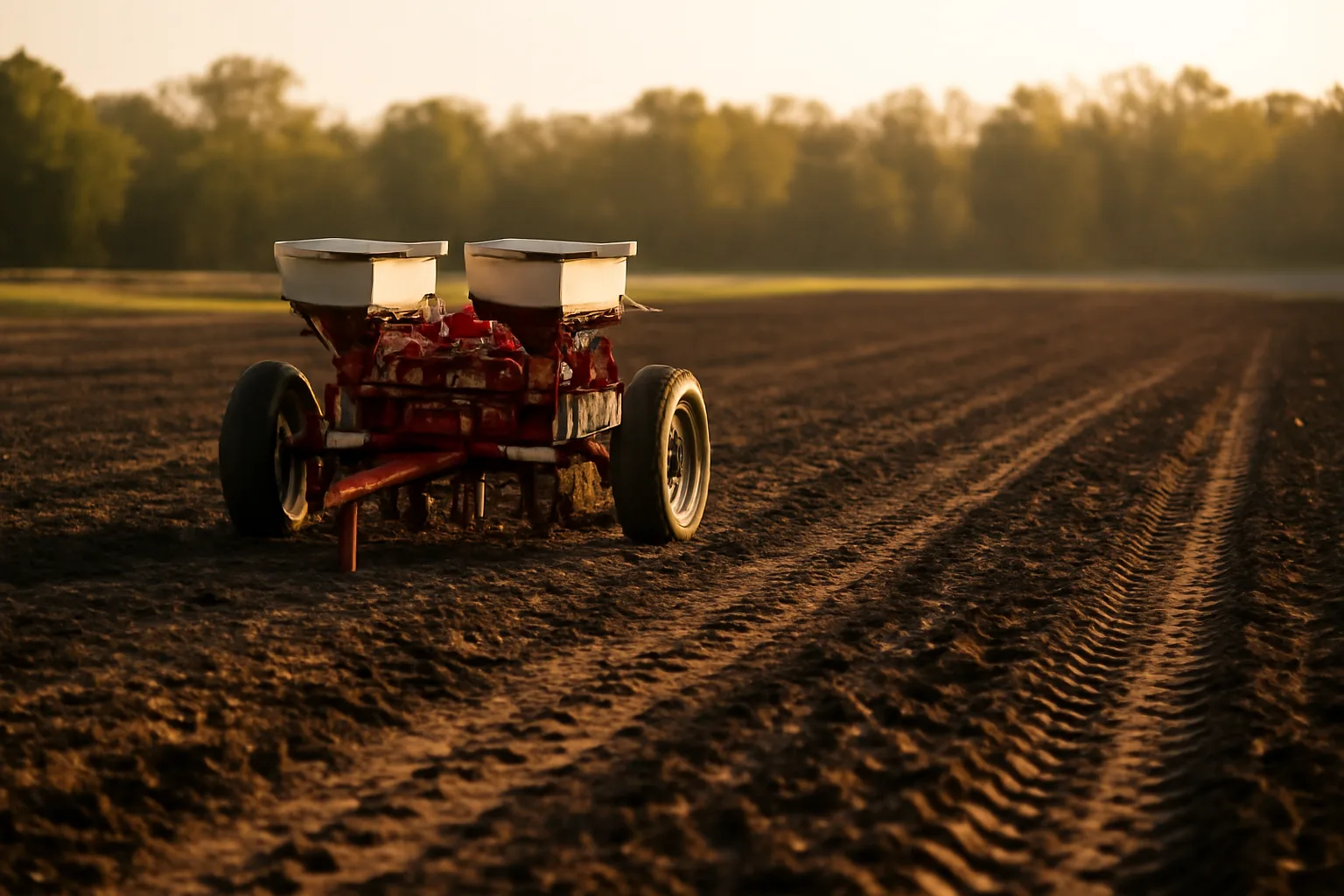
Kasco Manufacturing (based in Shawano, Wisconsin) makes tow-behind planters built specifically for small-acreage wildlife plots, not row-crop farming. The core models run from a compact 4-foot unit up through 6-foot and 8-foot Wildlife Ultimate planters, and they're designed to do three jobs in one pass: light tillage, metered seed drop, and cultipacking (firming the soil over the seed). Most units have two seed boxes, a small-seed box for clover, brassica and chicory, and a large-seed box for oats, wheat, peas, beans and sorghum. That matters because small seed and large seed need completely different drop rates and depths. A single hopper can't do both jobs well, which is why most cheap broadcast spreaders struggle with mixed plantings. The basic sequence on a Kasco unit is: a set of disc gangs or a cultivator section breaks the soil surface, seed drops from the correct box at a calibrated rate, and a cultipacker roller (or spike-tooth section) follows to press seed into contact with soil. That seed-to-soil contact step is what a lot of DIY planting misses entirely, and it's a major reason germination rates in do-it-yourself plots run inconsistent. Kasco planters need a tractor, typically 25 horsepower minimum for the smaller units and up toward 40 to 50 hp for the 8-foot Wildlife Ultimate, plus a category 1 or category 2 three-point hitch depending on model. This is not a UTV-towed implement in most configurations, though Kasco and other manufacturers do make smaller ATV/UTV drag and spreader combos for guys without a tractor.
How much does a Kasco food plot planter cost
| Hand spreader + ATV drag | $50 to $300 | Under 1 acre, tight budget | |
|---|---|---|---|
| UTV-mounted spreader/drag combo | $500 to $1,800 | 1 to 3 acres, no tractor | |
| Kasco 4 to 6-ft planter | $2,000 to $5,500 | 3 to 10 acres, tractor owner | |
| Kasco 8-ft Wildlife Ultimate | $5,500 to $7,500+ | 10+ acres, multiple plots | None of this replaces a soil test. A $2,000 mistake seeding into 5.2 pH dirt with no lime still fails. Your soil test lab is the authority on how much lime and fertilizer your specific field needs; a planter just gets seed in the ground correctly once the dirt is right. |
Street pricing on Kasco planters runs roughly $2,000 for the smallest no-till drill-style units up to $6,000 to $7,500 for the 6-foot and 8-foot Wildlife Ultimate combination planters with both seed boxes, according to dealer listings from Kasco's authorized network. Used units show up on Facebook Marketplace and equipment auction sites in the $1,200 to $4,000 range depending on age and condition. Here's the honest math most guys skip: if you're planting under 3 acres a year, a dedicated planter rarely pencils out against renting one, borrowing a neighbor's, or hiring a local ag service to disc and drill for you. Break-even usually shows up somewhere around 5 to 10 acres of annual planting, or if you're doing multiple plots across leased ground every year for a decade-plus. | Setup | Typical cost | Best for |
When to plant food plots for deer
Timing splits into two windows almost everywhere in the whitetail's range: a spring/summer planting for warm-season plots, and a late-summer planting for fall/winter plots. The exact dates shift hard by zone, and this is the single most common mistake new plotters make, using a date they saw online for a totally different climate. Spring plots (clover, chicory, alfalfa, warm-season annuals like soybeans or sorghum) generally go in after your last frost date, once soil temps hit 50-55°F consistently. That's late March to early April in the Deep South, April to May in the Midwest and mid-Atlantic, and late May into June in the northern Midwest and New England [2]. Fall plots (brassicas, oats, wheat, rye, clover overseed) get planted 60 to 90 days before your first hard frost, so the plants have time to establish before growth slows. In practice that means late July through early August in the northern tier, August into early September in the transition zone, and September into early October in the Deep South, per Mississippi State University Extension's food plot planting guide [3]. The biggest variable isn't the calendar, it's soil moisture. Cooperative extension guidance across multiple states repeatedly notes that planting into dry soil ahead of a rain event beats hitting a calendar date into dust. If the ten-day forecast shows nothing, wait.
When to plant clover for deer
Plant clover in early spring (as soon as soil is workable, roughly 50°F soil temp) or in late summer to early fall, 45 to 60 days before your first frost, according to Penn State Extension's forage establishment guidance. Clover is a perennial, so timing matters less than for annuals, but spring seedings compete harder with weeds while late-summer seedings usually establish cleaner. Clover needs firm seed-to-soil contact and shallow planting, about a quarter inch deep or less; too deep and it won't come up at all. This is exactly the kind of small-seed job a Kasco planter's small-seed box and cultipacker section handle better than a broadcast-and-drag setup, because depth control on tiny seed is unforgiving. Soil pH matters more for clover than almost anything else you'll plant. Most clover species want pH between 6.0 and 6.8, and extension data consistently shows clover stands fail or thin out fast below pH 5.5 regardless of fertilizer applied. If your soil test comes back low, lime first, plant later. It's not optional.
Do deer like clover, and is it really a favorite
Yes. Clover is one of the most consistently preferred food plot forages across whitetail range, and it's also one of the most nutritionally solid, running 20 to 30% crude protein in vegetative growth stages according to university forage testing summarized by University of Tennessee Extension [4]. It's also a perennial, so a good stand can produce for 3 to 5 years with proper maintenance (mowing, liming, occasional reseeding), which makes it cheaper per year of production than most annuals. The catch: clover is browse-sensitive when young. In areas with high deer density, new clover seedlings can get hit hard enough in the first few weeks that the stand never fully establishes. This is a real, documented problem, more than plot lore, and it's part of why fencing off small plots for the first month is common advice from extension wildlife specialists. Clover isn't magic, though. It goes semi-dormant in summer heat in the South and gets buried under snow in the North come December, so most serious plotters treat it as one leg of a rotation, not the whole plan. Pairing a clover perennial plot with a brassica or cereal grain annual plot nearby covers more of the calendar.
When to plant oats for deer
Oats go in as a fall annual, typically 6 to 8 weeks before your first expected frost, which lines up with late August in the northern tier down through late September in the transition zone and into October in the Deep South [3]. Oats germinate fast, often within 5 to 7 days in warm soil, and they're one of the most palatable cereal grains available to deer through fall and early winter. Oats aren't very cold-hardy compared to wheat or rye, so in the far North they'll get knocked flat by a hard freeze earlier in the season than winter wheat would. That's fine if your goal is October-through-December attraction. If you need a plot that holds into February, blend oats with wheat or cereal rye so something's still green after the first killing frost takes the oats out. A cereal grain like oats is a large-seed job, planted 1 to 1.5 inches deep, which is the other seed box on a two-hopper Kasco unit. Running oats and clover in the same pass in a blend is common, but depth compromise is real; you're usually planting a bit deeper than ideal for the clover fraction to get the oats right.
When to plant turnips for deer
Turnips go in 60 to 90 days before your first fall frost, which for most of the whitetail's range lands between late July and early September, according to the same brassica planting windows used across multiple land-grant extension guides [3]. Turnips need that runway because deer typically ignore the leafy tops early and don't hit the bulbs hard until after a couple of frosts, when cold converts starches to sugars and the whole plant gets sweeter and more palatable. This frost-sweetening effect is well documented in brassica agronomy literature and it's the reason turnip plots often look untouched in October and get hammered in December [3]. If you plant too late and skip that maturity window, you get small bulbs and thin tonnage right when deer finally start eating them. Seeding rate matters a lot here. Turnip seed is tiny (over 200,000 seeds per pound in most varieties) and broadcasting too heavy wastes seed and produces spindly plants competing for light. Extension guidance generally recommends 4 to 6 lbs per acre broadcast, shallower than a quarter inch [3]. Again, this is a small-seed calibration job, and it's where a planter's metering system earns its keep over a hand crank spreader.
Do deer eat sorghum
Yes, deer eat sorghum, both the grain heads and the young foliage, though it's typically planted as a summer annual for tonnage and cover rather than as a top preference food. Grain sorghum and forage sorghum both show up in Midwest and southern food plot mixes, often blended with soybeans or cowpeas for a warm-season plot that also doubles as screening cover along field edges. Sorghum is more drought-tolerant than corn, which is a real advantage in the Great Plains and parts of the South where summer corn plots can burn up without irrigation. Several state agriculture extension programs list grain sorghum as a viable low-input alternative to corn in wildlife plantings specifically because of that drought tolerance [5]. One caution worth knowing: sorghum and sudangrass hybrids can develop dangerous prussic acid (cyanide) levels in young, frost-damaged, or drought-stressed regrowth, a documented livestock and forage concern covered by Kansas State University Extension [6]. It's mostly a livestock grazing issue rather than a deer plot issue since deer browse selectively rather than grazing tonnage, but it's worth knowing if you're also running cattle or goats on the same ground.
What are deer's favorite foods, really
There's no single universal favorite, deer preference shifts by season, region, and what's locally available, but research and extension data point to a consistent shortlist: acorns (especially white oak family) in fall, soybeans and clover through summer, and standing corn or brassicas in late fall and winter when other browse is gone. A widely cited Auburn University and Mississippi State study on whitetail food plot forage preference found clover, soybeans, and cowpeas ranked among the highest-preference plantings in controlled feeding trials, while brassicas ranked lower in preference until frost sweetened them [4] [3]. Acorns, when available, tend to draw deer away from planted plots entirely in big mast years, which is a real and frustrating thing plot owners run into every 3 to 5 years when oaks produce a bumper crop. Protein content is part of the story but not the whole story. Deer select based on palatability, digestibility, and what's easy to find, not lab-measured protein alone. That's why a low-protein but highly palatable plant can outperform a higher-protein one deer just don't prefer as much.
Do deer like honey, and does it belong in a food plot
There's no research support for deer specifically seeking out honey, and it's not a standard food plot input at all, it's bee product, not a plant. Some hunters use sweet liquid attractants or scent products marketed with honey or molasses as an ingredient, but that's a different category entirely from planting seed, and it crosses into bait or attractant regulation territory in a lot of states. This matters more than it sounds like. Baiting and feeding rules vary enormously state to state, and some states classify mineral licks, sugar-based attractants, and even food plots planted and hunted a certain way differently under baiting statutes. Wisconsin, for example, defines baiting under specific placement and quantity rules enforced by the DNR [7], and Michigan's DNR maintains a baiting and feeding ban in the Lower Peninsula with limited exceptions [8]. Always check your state wildlife agency's current baiting and feeding regulations before using any attractant, mineral, or supplemental feed, food plots planted in the ground and grown naturally are almost universally treated differently (and more permissively) than piled feed or liquid attractants.
Kasco planter vs. other setups: what actually fits your acreage
A Kasco unit makes sense once you're planting enough acreage, or enough separate plots, that calibration accuracy and time saved actually pay for the machine. Under 2 acres a year, most people are better off with a good broadcast spreader, a cultipacker or drag, and patience. Between 3 and 10 acres, a 4 to 6-foot Kasco planter usually earns its keep within a few seasons, especially if you're doing both a spring and fall planting on the same ground. For leased ground where you don't own a tractor at all, renting a no-till drill from a local co-op, or hiring someone to disc and plant, often costs less over a few years than buying and maintaining equipment you'll use twice a year. Check with your county's NRCS office or local ag extension; many run equipment-share or cost-share programs for wildlife habitat plantings specifically [1]. If you're stacking multiple food sources across a property, clover for spring/summer, brassicas and oats for fall, maybe a sorghum or bean screen for cover, matching seed selection to your zone and soil test is the harder part, not the hardware. That's the gap a Custom Food Plot Plan is built to close: for $99 one-time, you get a plan mapped to your zone, acreage, and soil test results, not a generic seed bag label. For more on specific seed blends and what fits which plot type, see food plot seed, deer food plot seed, and deer food plots for broader plot-building strategy.
Frequently asked questions
Do deer eat sorghum in food plots?
Yes. Deer browse both sorghum foliage and grain heads, though it's usually planted for summer tonnage and screening cover rather than top preference. It's more drought-tolerant than corn, making it a common substitute in dry regions. Watch for prussic acid risk in frost-damaged or drought-stressed regrowth if livestock also graze the field.
Do deer like clover more than other food plot plants?
Clover consistently ranks as one of the most preferred food plot forages in university feeding studies, running 20-30% crude protein in vegetative stages. It's not universally the top choice year-round since it goes dormant in summer heat and under snow, so most plotters pair it with seasonal annuals rather than relying on it alone.
When should I plant food plots for deer?
Spring/summer plots (clover, beans, sorghum) go in after last frost once soil hits 50-55°F, roughly late March in the Deep South to June in the far North. Fall plots (brassicas, oats, wheat) go in 60-90 days before first frost, typically late July through early October depending on zone. Match the window to your region, not a generic date.
When is the best time to plant oats for deer?
Plant oats 6 to 8 weeks before your first expected fall frost, typically late August in northern zones through October in the Deep South. Oats germinate fast (5-7 days) but aren't very cold-hardy, so blend with wheat or cereal rye if you need the plot to hold green growth into mid-winter.
When should I plant turnips for deer food plots?
Plant turnips 60-90 days before your first fall frost, generally late July through early September. Deer often ignore turnips until after a couple of hard frosts convert starches to sugars, sweetening the bulbs and tops. Planting too late shortens that maturity window and leaves you with small, thin bulbs.
What exactly is a food plot?
A food plot is a planted area, from a quarter acre to several acres, seeded specifically to feed and hold deer or other wildlife. Common plantings include clover, brassicas, cereal grains, and warm-season annuals like soybeans or sorghum, chosen based on season, soil, and what nutritional gap you're trying to fill on your property.
What are deer's favorite foods overall?
No single favorite exists everywhere, but research consistently ranks acorns (especially white oak), soybeans, clover, and cowpeas among the highest-preference foods across seasons. Brassicas rank lower until frost sweetens them. In heavy mast years, acorns can pull deer away from food plots entirely, which frustrates plot owners every few seasons.
Do deer like honey or sweet attractants?
There's no research showing deer specifically seek out honey; it's not a standard food plot input since it's not a plant. Sweet liquid attractants exist commercially, but they fall under bait and feeding regulations in many states, which vary widely. Always check your state wildlife agency's current rules before using any attractant product.
How much does a Kasco food plot planter cost?
Street pricing runs roughly $2,000 for small no-till drill units up to $6,000-$7,500 for the 6 to 8-foot Wildlife Ultimate combination planters with dual seed boxes. Used units on the secondary market typically run $1,200-$4,000 depending on age and condition. Break-even against renting usually shows up around 5-10 planted acres per year.
What size tractor do I need for a Kasco planter?
Most Kasco planters need at least 25 horsepower for smaller 4 to 6-foot units, and 40-50 hp for the 8-foot Wildlife Ultimate models, with a category 1 or 2 three-point hitch depending on the model. Check the specific model's spec sheet before buying, since hitch category and weight vary across the lineup.
Is a food plot planter worth it for a small property?
Usually not under 2-3 acres of annual planting. A broadcast spreader, cultipacker, and patience handle small plots fine and cost a fraction of a dedicated planter. Dedicated planters start paying off once you're regularly planting 5+ acres, running multiple plots, or replanting spring and fall every year on the same ground.
Do I need a soil test before using a food plot planter?
Yes, always. A planter controls seed depth and placement, but it can't fix soil pH or missing nutrients. Extension data shows clover stands fail below pH 5.5 regardless of fertilizer applied. Your soil test lab is the authority on lime and fertilizer rates for your specific field; get that right before you plant anything.
Sources
- USDA NRCS, Wildlife Habitat conservation practices: NRCS treats food plots as a wildlife habitat conservation practice with state-level cost-share programs
- NOAA National Centers for Environmental Information, US Climate Normals: Regional last-frost and soil temperature timing used to frame spring planting windows
- Mississippi State University Extension, Establishing and Managing Wildlife Food Plots: Fall planting windows for oats, brassicas and turnips, and frost-sweetening effect on brassica palatability
- University of Tennessee Extension, Wildlife Food Plots publication: Clover crude protein content in vegetative stage and forage preference ranking among plot species
- University of Georgia Extension, Grain Sorghum Production Guide: Grain sorghum drought tolerance as an alternative to corn in low-input plantings
- Kansas State University Extension, Prussic Acid Poisoning: Prussic acid (cyanide) risk in frost-damaged or drought-stressed sorghum and sudangrass regrowth
- Wisconsin DNR, Baiting and Feeding Regulations: Wisconsin defines and enforces specific baiting placement and quantity rules for deer hunting
- Michigan DNR, Baiting and Feeding Regulations: Michigan maintains a baiting and feeding ban in the Lower Peninsula with limited exceptions