Last updated 2026-07-26
TL;DR
For most food plots, you need three ATV implements: a disc or tiller to break ground, a cultipacker or drag to firm the seedbed, and a boom or pull-behind sprayer for herbicide and lime. Broadcast spreaders round it out. Skip the fancy no-till drills unless you're planting 10+ acres a year.
what implements do you actually need for a food plot
You need four jobs done: kill existing vegetation, break up soil, plant seed at the right depth, and firm the seedbed so seed makes contact with soil. That's it. Everything else is convenience. For a typical 1/2 acre to 3 acre plot on an ATV or UTV, the core kit is a disc harrow or tine tiller, a cultipacker or drag section, a broadcast spreader, and a sprayer. Add a plot-specific ATV disc or a small no-till drill if you're planting more acreage or want to cut your trips across the field in half. The Custom Food Plot Plan tool a lot of readers use walks through species picks and rates for their zone, but it doesn't tell you what steel to buy. That's this article's job. One thing worth saying up front: your soil test lab is the authority on how much lime and fertilizer your dirt needs, not a blog post. Get that test done through your county's land-grant university extension office before you buy a single implement, because a $12 soil test can save you from wasting $200 in fertilizer on ground that just needs lime.
do you need a disc or a tiller for food plots
A disc harrow is the right call for most food plot ground; a rotary tiller is better on compacted clay or where you're breaking sod for the first time. Discs are cheaper, lighter, and more forgiving of rocks. Tillers pulverize soil finer but cost more and beat up tines on rocky ground. A basic ATV disc harrow (4 to 5 feet wide, 16 to 20 blades) runs $400 to $900 new. Brands like Firminator, Fecon, and Woods Equipment all make ATV-rated versions. Used ones show up on Facebook Marketplace for half that. If you're breaking new ground, sod, or heavy clay for the first year, plan on two or three passes with the disc. First pass just to break the surface, second pass angled differently to actually mix soil. A single pass on virgin ground usually just scratches the top inch and leaves you with clumps that won't take seed. Rotary tillers cost more, generally $800 to $1,800 for ATV-rated units, and need more horsepower to pull. They do a better job of one-pass seedbed prep on tough ground, but they're slower (you're moving 2 to 4 mph instead of 5 to 8) and tine wear on rocky soil adds up fast. If your plot ground is old pasture or ag field you're rotating into food plots, a disc is enough. If it's compacted logging deck or heavy clay that's never been worked, spend the extra money on a tiller.
is a cultipacker worth the money
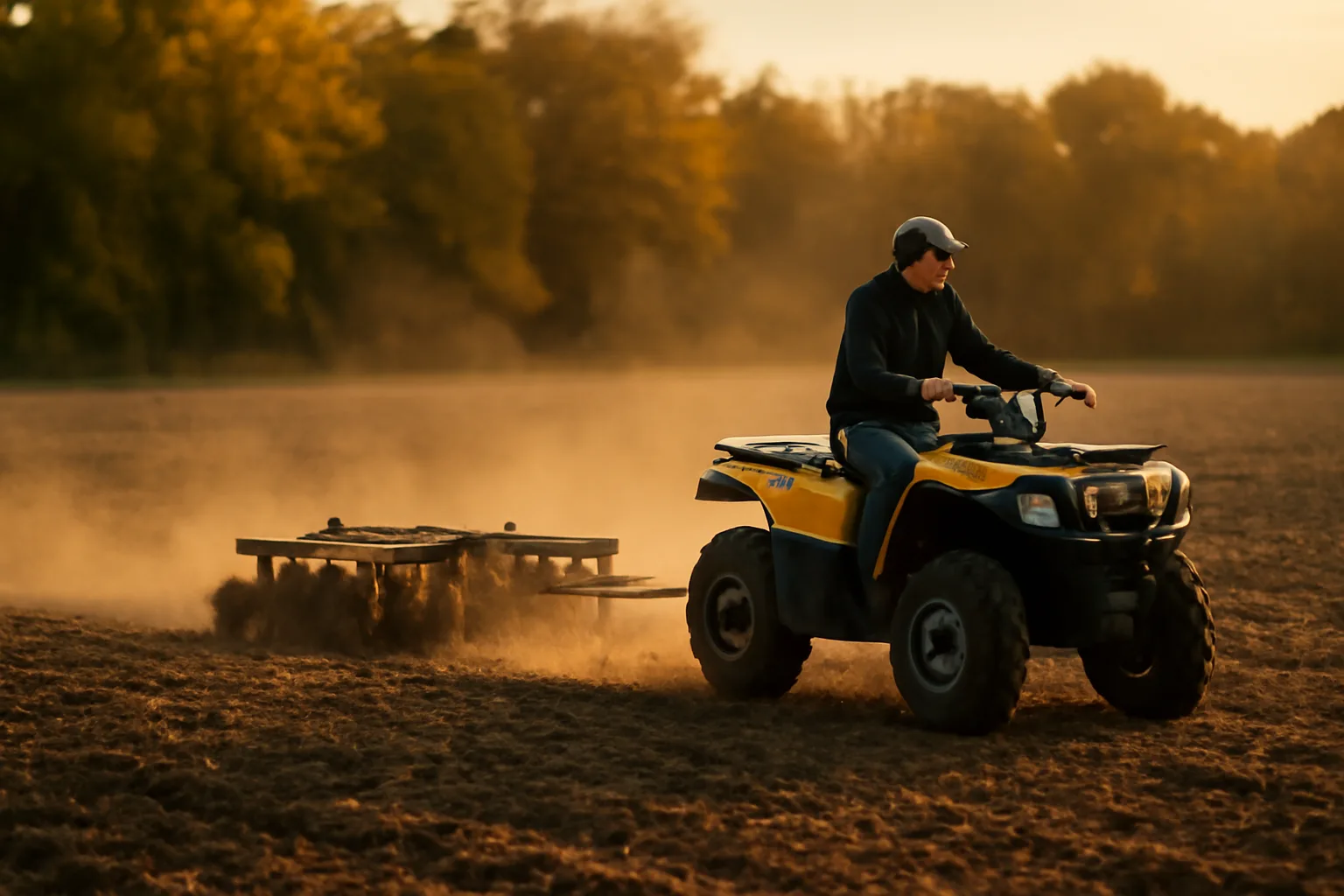
Yes, if you're planting anything with small seed like clover, brassicas, or chicory. A cultipacker firms the seedbed and presses small seed into good soil contact, which is the single biggest reason food plots fail to germinate evenly. Small seeds planted too deep just rot. The rule most agronomists use is that seed shouldn't be buried deeper than 3 to 4 times its diameter. Clover seed is roughly the size of a pinhead. A cultipacker (or even a drag made from chain-link fence and cinder blocks) after broadcasting keeps you from having to worry about exact depth, because it presses seed to the right shallow contact instead of burying it. ATV-pull cultipackers cost $500 to $1,000 for a 4 to 5 foot unit. A cheaper option that a lot of long-time plotters actually prefer: a homemade drag made from a section of chain-link fence with a couple of cinder blocks or a length of railroad rail on top, towed behind the ATV. It costs $50 in scrap materials and works nearly as well for firming small-seed plots. For big seed like corn, soybeans, or sorghum, a cultipacker matters less because you're planting deeper (1 to 1.5 inches) with a drill or planter that controls depth mechanically.
do you need a no-till drill or can you broadcast
Broadcasting and cultipacking works fine for small-seed blends (clover, brassicas, chicory) on worked ground. A no-till drill earns its cost if you're planting into standing residue or sod without tillage, or if you're putting in acreage of corn, beans, or sorghum where seed spacing and depth actually matter. ATV no-till drills (Great Plains, Firminator FX, Whitetail Institute's Imperial line) cost $2,500 to $6,000+ depending on width and row spacing. That's a real investment for someone planting 2 acres a year. It makes more sense if you're farming 8 to 15 acres of plots across multiple properties, or if your soil erodes badly when tilled and you want to keep residue cover. For the average lease-holder with 1 to 5 acres split across two or three small plots, skip the drill. Broadcast seed with a spreader, cultipack it in, and put that $3,000 toward better fertilizer, more lime, or a second plot instead.
what sprayer setup do you need for food plots
A 15 to 25 gallon ATV boom sprayer covers most food plot herbicide and burndown work. You're spraying glyphosate for burndown before planting, and possibly a grass or broadleaf herbicide mid-season depending on what you planted. Tank size and boom width matter more than brand here. A basic ATV sprayer with a 4 to 6 foot boom runs $150 to $400. Look for one with a spray wand attachment too, useful for spot-spraying fence lines or treating weeds the boom misses. Fimco and Chapin both make widely available ATV sprayer kits in that price range. Calibration matters more than the sprayer itself. A boom that's mis-calibrated by 20% either wastes herbicide or under-kills weeds, and either mistake costs you a wasted planting window. Most state extension services publish sprayer calibration worksheets; Penn State Extension's calibration guide is a good one to work through once a season, because tire pressure and speed drift over time and change your actual application rate.
what is a food plot, and how does equipment fit in
A food plot is a planted area, usually between a quarter acre and a few acres, established specifically to feed and attract deer or other wildlife rather than for human harvest. Most are on hunting land the owner or lessee controls, and most run a rotation of annual and perennial forages timed to the hunting season. According to the Quality Deer Management Association / National Deer Association's food plot resources, food plots work best as a supplement to natural habitat, not a replacement for it. That distinction matters for equipment too. You don't need to farm your whole property. A well-prepped half-acre plot with good seed-to-soil contact will out-produce a poorly-prepped three-acre plot every time, so buy implements sized to do a small job right rather than a big job halfway. Before you buy anything, decide how many acres you're actually planting this year and next. That number drives every equipment decision in this article. One acre, go cheap and manual. Five-plus acres across multiple plots, start looking at the drill and the bigger disc.
when should you plant food plots, and does timing change your equipment needs
Planting windows depend entirely on your zone and what you're planting, generally split into spring plantings (warm-season, perennial establishment) and late-summer to fall plantings (brassicas, cereal grains, clover overseed). Cool-season plots like clover, oats, and brassicas typically go in 60 to 90 days before your first fall frost; warm-season plots like soybeans and sorghum go in after your last spring frost. Your county extension office publishes frost date tables specific to your area, and that's the actual source to check, not a national chart. USDA's National Agricultural Statistics Service county-level data plus your state extension's planting guide gives you a real date range instead of a guess. Timing affects equipment mainly through soil moisture. Spring planting into wet ground means you'll want a disc, not a tiller, because tillers can smear wet clay into a hardpan. Late summer planting into dry, hard ground after a dry August means you may need two disc passes just to get workable tilth. Check the ground, more than the calendar, before you hook up the implement.
when to plant oats, turnips, and other fall food plot species
Oats and turnips both go in during the same late-summer window in most of the whitetail's range, roughly 6 to 10 weeks before your area's average first frost. That puts most of the Midwest and Northeast in a mid-August to early September planting window, and the Southeast a few weeks later, into September or even early October. Oats are a cereal grain deer hit hard in fall and early winter, especially after a frost sweetens the starches. Turnips (and other brassicas like radish and rape) need that same 60 to 90 day window before frost to bulb out and reach the size deer actually prefer. Plant either one too late and you get small plants deer barely touch before winter locks the ground. Both are small-to-medium seed. Oats want about 1 inch of planting depth, turnips barely 1/4 inch. That means a cultipacker or light drag after broadcasting is nearly mandatory for turnips, less critical for oats which can handle a shallow disc pass alone.
do deer eat sorghum, clover, and other common plot species
Yes to both. Deer readily eat grain sorghum, especially the seed heads in fall and winter, and it's a common food plot component in the Southeast and parts of the Midwest where drought tolerance matters. Clover is arguably the single most planted food plot species in North America because deer eat it heavily through spring, summer, and fall, and it's a perennial that comes back for 3 to 5 years with proper maintenance. Mississippi State University Extension's food plot forage guide lists clover as one of the highest-preference forages for whitetail in terms of both protein content (typically 25 to 30% crude protein) and deer selection in browse studies. Sorghum's advantage is standing cover and a fall/winter food source that holds up through weather better than soybeans, which get hammered early and often disappear before deer season even opens in high-pressure areas. Deer don't eat honey; that one's not a food plot question at all, it's about bears and raccoons raiding hives, but it comes up in search enough to answer plainly: no meaningful connection to food plots or deer diet. As for what's a deer's actual favorite food, there isn't one universal answer. Diet studies (see the National Deer Association's annual deer report) consistently show acorns and other hard mast rank above almost any planted forage when they're available, because of the fat content. Among planted options, clover, soybeans, and brassicas after a frost tend to top preference studies, but availability, season, and local deer density all shift the answer.
a comparison of core ATV food plot implements
| Implement | Typical cost (new) | Best for | Skip if | |
|---|---|---|---|---|
| ATV disc harrow (4-5 ft) | $400-$900 | Breaking sod, general seedbed prep | You're only maintaining an existing plot | |
| Rotary tiller (ATV-rated) | $800-$1,800 | Heavy clay, compacted, first-year ground | Ground is already worked ag soil | |
| Cultipacker (4-5 ft) | $500-$1,000 | Small seed (clover, brassica, chicory) | You mainly plant corn/beans with a drill | |
| Homemade chain-link drag | $50-$100 (DIY) | Same as cultipacker, budget option | You want speed over cost savings | |
| ATV boom sprayer (15-25 gal) | $150-$400 | Burndown herbicide, spot spray | N/A, almost everyone needs one | |
| No-till drill (ATV) | $2,500-$6,000+ | 8+ acres, no-till residue plots | 1-5 acres total, small budget | |
| Broadcast spreader (tow or ATV-mount) | $80-$300 | Seed and granular fertilizer/lime | You're only drilling seed | The honest read on this table: three implements (disc, cultipacker, sprayer) cover 90% of what a food plot on 1 to 5 acres actually needs. The drill and the tiller are upgrades for bigger operations, not requirements for a first plot. |
what's a waste of money in ATV food plot equipment
Skip the drill if you're under 5 acres total. It's the single most expensive implement on this list and the least necessary for small plots. Broadcasting and cultipacking gets you 90% of the germination result for a fraction of the cost. Skip a second, bigger ATV before you upgrade implements. A lot of first-time plotters think they need a bigger machine before they can pull a disc. Most ATVs in the 400cc-plus range with a real hitch and low gearing pull a 4 to 5 foot disc just fine on worked ground. Where you actually need more power is a rotary tiller in heavy clay or a wide drill, not basic disc work. Skip combo implements that claim to till, plant, and cultipack in one pass unless you've read independent reviews from other plot owners, more than the manufacturer's marketing. Some of these (the Firminator and similar all-in-one units) work well and save real trips across the field, but they cost $2,000 to $4,000+ and the cheaper knockoff versions often do all three jobs poorly instead of one job well.
do deer like clover and other high-preference plot forages more than others
Yes, clover ranks consistently high in deer preference and use studies, and it's a reasonable default first plot for most new plotters because it's forgiving, perennial, and cheap per acre relative to its lifespan. That said, preference shifts by season and by what else is available on the landscape. A clover plot in a landscape dominated by row-crop soybeans might get lighter pressure in late summer when beans are still green and easier for deer to reach in volume, then get hit hard again after bean harvest. A clover plot surrounded by hardwoods with no ag nearby often gets pounded from spring through fall because there's simply less competing forage. If you're deciding between species for a first plot, Deer for food and Food plot seed both cover species selection in more depth than this equipment-focused piece can. The short version for equipment purposes: clover and brassica blends both work fine with the disc-cultipack-broadcast combo described above. Neither needs a drill.
how does soil prep equipment change what fertilizer and lime you need
It doesn't change the amount, but it changes how evenly that lime and fertilizer actually get incorporated. Lime especially needs to be worked into the top 4 to 6 inches of soil to correct pH at the root zone, more than sit on the surface. A disc pass after spreading lime does that job; broadcasting lime onto unworked ground and hoping it works down on its own can take 2 to 3 years to fully correct pH, according to most extension lime guidance. University of Missouri Extension's guide to soil pH management states that surface-applied lime on no-till ground moves down through soil very slowly, often less than an inch per year without incorporation. That's the practical argument for disking lime in on new plots rather than skipping tillage even where you'd otherwise consider no-till. Again: your soil test result, not this article, tells you how much lime and fertilizer to put down. A soil test costs $10 to $20 through most state land-grant labs and tells you your actual pH and nutrient levels instead of leaving you guessing. Buy the test before you buy the spreader.
check your state's baiting and feeding rules before you plant near a stand
Food plots are generally legal everywhere and are treated differently from baiting under most state game codes, but the line between the two varies by state and matters for where you place a plot relative to a stand. Some states restrict hunting over any supplemental feed but explicitly exempt standing food plots; others have specific distance or visibility rules. Check your own state wildlife agency's regulations before assuming your plot setup is legal, because the definitions genuinely differ. Pennsylvania Game Commission's baiting regulations and similar agency pages in other states spell out exactly what counts as bait versus a legitimate planted plot in their jurisdiction. This is a five-minute check that avoids a real legal problem later, and it's worth doing every season since rules do get updated.
Frequently asked questions
Do deer eat sorghum?
Yes. Deer eat grain sorghum readily, particularly the seed heads in fall and winter. It's common in food plot blends in the Southeast and drought-prone parts of the Midwest because it tolerates heat and dry spells better than corn or soybeans while still drawing consistent deer use.
Do deer eat clover?
Yes, heavily. Clover is one of the most preferred food plot forages for whitetail deer, with crude protein typically in the 25 to 30% range according to extension forage data. It's a perennial that persists 3 to 5 years with mowing and fertilization, making it a common first choice for new plotters.
When should you plant food plots for deer?
It depends on species and zone. Cool-season forages (clover, oats, brassicas) generally go in 60 to 90 days before your area's first fall frost. Warm-season plots (soybeans, sorghum, corn) go in after your last spring frost. Check your county extension office's frost date data rather than a generic national calendar.
Do deer like clover more than other food plot forages?
Clover ranks consistently high in preference studies and is forgiving to grow, which is why it's the most common perennial food plot choice. But actual use in the field shifts by season and by what other food (row crops, mast) is available nearby, so 'favorite' depends on local competition for forage.
When should you plant oats for deer?
Plant oats in the same late-summer window as most fall food plot species, roughly 6 to 10 weeks before your area's average first frost date. That's typically mid-August to early September across most of the Midwest and Northeast, and a few weeks later through the Southeast.
When should you plant turnips for deer?
Turnips need 60 to 90 days before your first frost to bulb properly, so plant them in the same late-summer window as oats. Planting too late means small, underdeveloped turnips that deer barely touch before winter. Broadcast and cultipack shallow, about 1/4 inch deep, since turnip seed is very small.
What is a food plot?
A food plot is a planted area, typically a quarter acre to a few acres, established specifically to feed and attract deer or other wildlife rather than for crop harvest. Most hunters plant a rotation of annual and perennial forages timed around hunting season and local frost dates.
What are deer's favorite foods overall?
Acorns and other hard mast typically outrank planted forages when available, largely because of fat content deer need heading into winter. Among planted food plot species, clover, soybeans, and frost-sweetened brassicas consistently rank as top preferences in browse studies, though availability and local deer density shift the answer.
Do deer like honey?
This isn't really a food plot or deer diet question. Deer have no notable dietary connection to honey; it's bears and raccoons that raid hives for it. There's no meaningful reason to consider honey in food plot planning.
Do I need a no-till drill for a small food plot?
No. If you're planting 1 to 5 acres total, a broadcast spreader plus a cultipacker gets you nearly the same germination result for a fraction of the cost. No-till drills ($2,500 to $6,000+) make more sense past 8 to 10 acres or when planting into standing residue without tillage.
What's the minimum ATV implement setup for a first food plot?
A disc harrow ($400-$900), a cultipacker or homemade drag ($50-$1,000), a broadcast spreader ($80-$300), and a small boom sprayer ($150-$400) cover nearly every task on a 1 to 3 acre plot. That's roughly $700 to $2,500 total for a full starter kit, less if you buy used.
Should I till or disc new food plot ground?
Disc first if the ground is workable ag soil or old pasture; it's cheaper and faster. Use a rotary tiller if you're breaking compacted clay, old logging decks, or ground that's never been cultivated, since a tiller does a better single-pass job on tough, unworked soil.
Do I need to check state rules before planting a food plot near my stand?
Yes. Food plots are legal in nearly every state and are treated differently from baiting, but the exact distinction (distance from stand, visibility, standing crop versus piled feed) varies by state. Check your state wildlife agency's current baiting and feeding regulations before finalizing plot placement.
Sources
- USDA Natural Resources Conservation Service, Conservation by State: county-level land-grant extension and soil testing resources are available by state
- National Deer Association, Food Plots resource category: food plots work best as a supplement to natural habitat rather than a replacement
- Mississippi State University Extension, Food Plots for White-tailed Deer: clover crude protein content (25-30%) and high deer preference ranking among food plot forages
- University of Missouri Extension, Soil pH Management (G9101): surface-applied lime on unworked ground moves down through soil slowly, often less than an inch per year without incorporation
- Pennsylvania Game Commission, Baiting Regulations: state-specific rules distinguish baiting from standing food plots and vary by jurisdiction