Last updated 2026-07-25
TL;DR
Deer favor clover, soybeans, and brassicas above most other plantings, but the "best" seed depends on your soil, region, and season. Cool-season plots (clover, oats, turnips) go in late summer to early fall; warm-season plots (soybeans, sorghum, corn) go in spring after frost. A soil test should drive your fertilizer and lime decisions, not a bag label.
what is a food plot, exactly?
A food plot is a planted patch of ground, usually somewhere between a quarter acre and several acres, seeded specifically to feed and attract deer or other wildlife. It's not a garden and it's not a lawn. Most plots sit on land the owner already hunts or leases, and the goal is twofold: give deer better nutrition than what the surrounding woods offer, and give hunters a predictable place to watch or hunt from. Food plots generally split into two categories. Annual plots get replanted every year (or every season) with things like clover, brassicas, cereal grains, or soybeans. Perennial plots, mostly clover and chicory blends, can produce for three to five years before you need to start over. Most state wildlife agencies and university extensions treat food plots as a habitat management tool, not a magic bullet. The USDA's NRCS lists food plots for wildlife under its wildlife habitat practice standards as a supplemental practice, meaning it works best alongside native habitat, not instead of it. If you're new to this, a plain patch of clover or oats is a legitimate food plot. You don't need five acres and a tractor. A lot of the best small plots on leased ground run under one acre, planted with hand tools and a UTV. For a broader look at how plot types differ, see food plot whitetail and deer food plots.
what are deer's favorite foods, really?
Deer are opportunistic browsers, and their favorite food changes by season, region, and what's available. That said, several plants show up again and again in preference studies and extension trials: white clover, soybeans (especially in the vegetative and pod stage), and brassicas like forage turnips and radishes once the weather turns cold and sugar content in the leaves spikes. Acorns are arguably the single most preferred natural food across the whitetail's range in fall, when available, because of their fat and carbohydrate density. That's a big reason plot performance can look disappointing during a heavy mast year. Deer aren't ignoring your plot out of spite. They're going where the calories are cheapest to get. In spring and summer, deer key in on high-protein forage to support antler growth and lactation. That's when clover, alfalfa, and soybean leaves get hit hardest. Cereal grains like oats and wheat get heavy attention in fall and winter, especially after a frost sweetens the plant's sugars. There's no single universal "favorite." A Mississippi State University Extension deer nutrition publication notes that preference studies consistently rank legumes (clover, soybeans, cowpeas) and certain brassicas among the most preferred plantings, but actual use on any given property depends heavily on what else is on the landscape [1].
do deer like clover, and is it worth planting?
Yes, deer like clover, and it's one of the most consistently preferred food plot plantings across the whitetail's range. White clover (Trifolium repens) and red clover (Trifolium pratense) both show up in extension forage trials as high-preference, high-protein options, often tested at 25 to 30 percent crude protein in vegetative growth [2]. Clover's real advantage isn't just palatability, it's duration. A well-maintained perennial clover stand can produce from spring through fall for three to five years before you need to reseed, which makes it one of the better returns on planting effort and seed cost. Purdue University's forage extension notes that white clover persists best on well-drained soils with a pH of 6.0 to 7.0 and moderate fertility, and that stands decline faster on acidic, poorly limed ground [3]. The tradeoff: clover needs decent soil moisture to establish and it can get out-competed by weeds if you don't mow or spray in year one. It also doesn't hold up well to constant summer drought without irrigation or a shaded microclimate. If your dirt is heavy clay with poor drainage, clover struggles and something like chicory or a brassica blend may perform better. For seed selection specific to clover blends, see deer food plot seed and food plot seed.
when to plant food plots for deer
| Upper Midwest / Northeast | late July to mid-August | mid-May to early June | |
|---|---|---|---|
| Mid-South / Mid-Atlantic | mid-August to mid-September | late April to mid-May | |
| Deep South | September to October | March to April | These are general starting points, not guarantees, since local frost dates vary by elevation and microclimate. Check your state's cooperative extension planting guide or the USDA's plant hardiness zone map for your specific county before locking in dates [4]. A lot of failed plots trace back to timing, not seed choice. Planting clover too late in September in a zone 4 county, for example, gives the plant too little root development before winter dormancy and you'll lose a chunk of the stand to winterkill. |
Timing splits into two windows: cool-season plantings and warm-season plantings, and the right window depends entirely on your USDA plant hardiness zone and first/last frost dates. Cool-season plots (clover, oats, wheat, rye, brassicas) generally go in from late July through September in the northern half of the whitetail's range, and August through October in the mid-South, so they establish before the first hard frost. Warm-season plots (soybeans, cowpeas, sorghum, corn) go in after your last spring frost, typically April through June depending on latitude. A simple planting calendar by broad region: | Region | Cool-season planting window | Warm-season planting window |
when to plant oats for deer
Oats are a cool-season cereal grain, and they go in the ground in late summer to early fall, generally 60 to 90 days before your area's first killing frost. That usually lands in the August to September window across most of the whitetail's range, per state extension planting guides [5]. Oats germinate fast, often within 5 to 10 days in warm, moist soil, and deer will hit young oat shoots hard within the first month. That quick green-up is the main reason oats show up in almost every fall blend: they give you visible growth and attraction while slower-establishing plants like clover are still filling in. One planting nuance: oats aren't very cold-hardy compared to winter wheat or cereal rye. In zones with harsh winters, oats will winterkill after the first hard freeze, which is actually a feature for some hunters, since the dying plant material breaks down and adds organic matter without you tilling again. If you want a plot that regrows in spring, blend oats with wheat or rye rather than planting oats alone. Oats also do fine as a nurse crop, planted alongside clover to give quick cover and shade while the clover establishes underneath.
when to plant turnips for deer
Turnips, like other brassicas, go in the ground in mid to late summer, generally 90 to 100 days before your first expected hard frost, so the bulb has time to size up before deer start using it heavily in late fall and winter. For most of the whitetail range that means planting turnips sometime between late July and mid-August. Clemson Cooperative Extension recommends planting brassica forages 60 to 90 days prior to the first frost date, which for South Carolina generally falls in the July 15 to August 15 window . Turnips are a slow-burn plot. Deer often ignore the leaves and bulbs for the first month or two after planting, then hit them hard once a few frosts convert the plant's starches to sugars, which is why turnip plots seem to explode in popularity in November and December, seemingly overnight. That's not deer suddenly discovering the plot. It's the plant chemistry changing. A common mistake is planting turnips too early in warm soil, where they bolt to seed or get hammered by flea beetles before they ever build a bulb. Another is planting them alone in a region with very short falls, since the plant simply doesn't have enough season to size up before the ground freezes.
do deer eat sorghum?
Yes, deer eat sorghum, both the leaves as forage and the grain heads later in the season, though it's typically planted more as a screening and soil-building crop than a primary attractant. Grain sorghum is a warm-season crop, planted after the last spring frost once soil temperatures hit around 60°F, similar timing to corn . Sorghum's real value in a plot rotation is threefold in practice, even if we're not fans of listing things in threes: it tolerates drought and poor soil better than corn, it produces a grain head deer and turkey will use into winter, and its tall stalks make good screening cover along field edges or plot boundaries. Some hunters plant a sorghum border around a clover or bean plot specifically to break sightlines and give deer confidence to enter during daylight. Sorghum isn't usually anyone's first-choice attractant plant on fertile ground, since soybeans or corn will out-produce it in tonnage per acre where soil quality is good. But on thin, sandy, or drought-prone dirt where corn struggles, sorghum often out-performs it. It's a practical, not glamorous, plot component.
do deer like honey (honey locust, honeysuckle, or literal honey)?
This one needs untangling because "honey" means different things depending on who's asking. If you mean literal honey (bee honey), no, it's not a natural deer food and it's not something you'd plant or use in a legitimate food plot. Deer aren't drawn to honey the way bears are, and using it as bait raises the same legal issues as any other bait product. If you mean honey locust (Gleditsia triacanthos), yes, deer readily eat the sweet, sugary seed pods that drop in fall, and honey locust trees are sometimes left standing or planted along field edges specifically for that reason. The pods have a notably high sugar content, which is part of why deer key in on them once they drop. If you mean honeysuckle (Lonicera species), deer do browse the leaves and stems, particularly Japanese honeysuckle, though it's classified as an invasive species across much of the eastern U.S. and several states restrict planting it. The USDA Forest Service lists Japanese honeysuckle as a significant invasive threat to native plant communities in the eastern United States , so it's not something extension programs recommend planting even though deer will eat it. None of these are seeds you'd order for a food plot planting. If "honey" showed up in your search because you saw a bait or attractant product with honey in the name, check your state's baiting and feeding regulations before using it. Baiting rules vary widely and some states classify liquid attractants or scent products differently than solid feed.
how do I pick the right seed for my soil and region?
Start with a soil test, not a seed catalog. Your local cooperative extension office or a private ag lab can run a standard soil test for somewhere between $10 and $20 in most states, and it'll tell you your pH, phosphorus, potassium, and organic matter, which drives everything else you do . Your soil test lab is the actual authority on how much lime and fertilizer to apply. A seed bag's fertility recommendation is generic; your lab report is specific to your dirt. Most food plot species want a soil pH between 6.0 and 7.0. Clover and alfalfa are especially picky about this and will underperform badly below pH 6.0 regardless of how much fertilizer you throw at them, because acidic soil locks up nutrients the plant can't access. If your test comes back at 5.2, lime needs to go down months before seed, not the same week, since lime takes time to react and raise pH. Beyond soil chemistry, match the plant to your rainfall and season length. Clover wants moisture and a longer growing window. Brassicas want a real fall with several hard frosts to sweeten up. Warm-season beans and sorghum want heat and a full frost-free stretch of 90 to 120 days depending on variety. If you'd rather not piece this together field by field, a service like PlotSeason's $99 Custom Food Plot Plan takes your soil test results, location, and acreage and builds a planting plan around them. It's general guidance built for your inputs, not a substitute for your soil lab's specific lime and fertilizer recommendation, but it saves the trial-and-error a lot of first-time plotters go through. You can start one at /plot-plan-builder.
annual vs perennial seed: which should you plant first?
| Cool-season annual | oats, wheat, rye | every year | fast (5-10 days) | 5.5-7.0 | |
|---|---|---|---|---|---|
| Cool-season perennial | white clover, chicory | every 3-5 years | slow (60-90 days) | 6.0-7.0 | |
| Cool-season brassica | turnips, radish | every year | moderate | 6.0-6.8 | |
| Warm-season annual | soybeans, cowpeas, sorghum | every year | moderate | 6.0-7.0 | A lot of experienced plotters run a mixed rotation: perennial clover in the most reliable, accessible spot, with annual brassicas or cereal grains in secondary plots that get rotated or refreshed each year. For seed sourcing across these categories, deer food plot seed and domain food plot seed cover specific blends. |
If you're planting your first plot ever, start with something forgiving. Oats or a cheap cereal grain blend will show you fast results, tolerate mediocre soil prep, and won't punish a planting mistake the way a finicky perennial clover stand will. Once you've got a season under your belt and a soil test in hand, perennial clover is usually the better long-term investment because you're not rebuying seed and re-tilling every year. The tradeoff is a slower start; clover can take 60 to 90 days to really fill in, and it needs a mow or two in year one to keep weeds from choking it out. Here's a rough comparison for planning purposes: | Type | Examples | Reseed frequency | Establishment speed | Soil pH need |
what equipment do you actually need to plant these seeds?
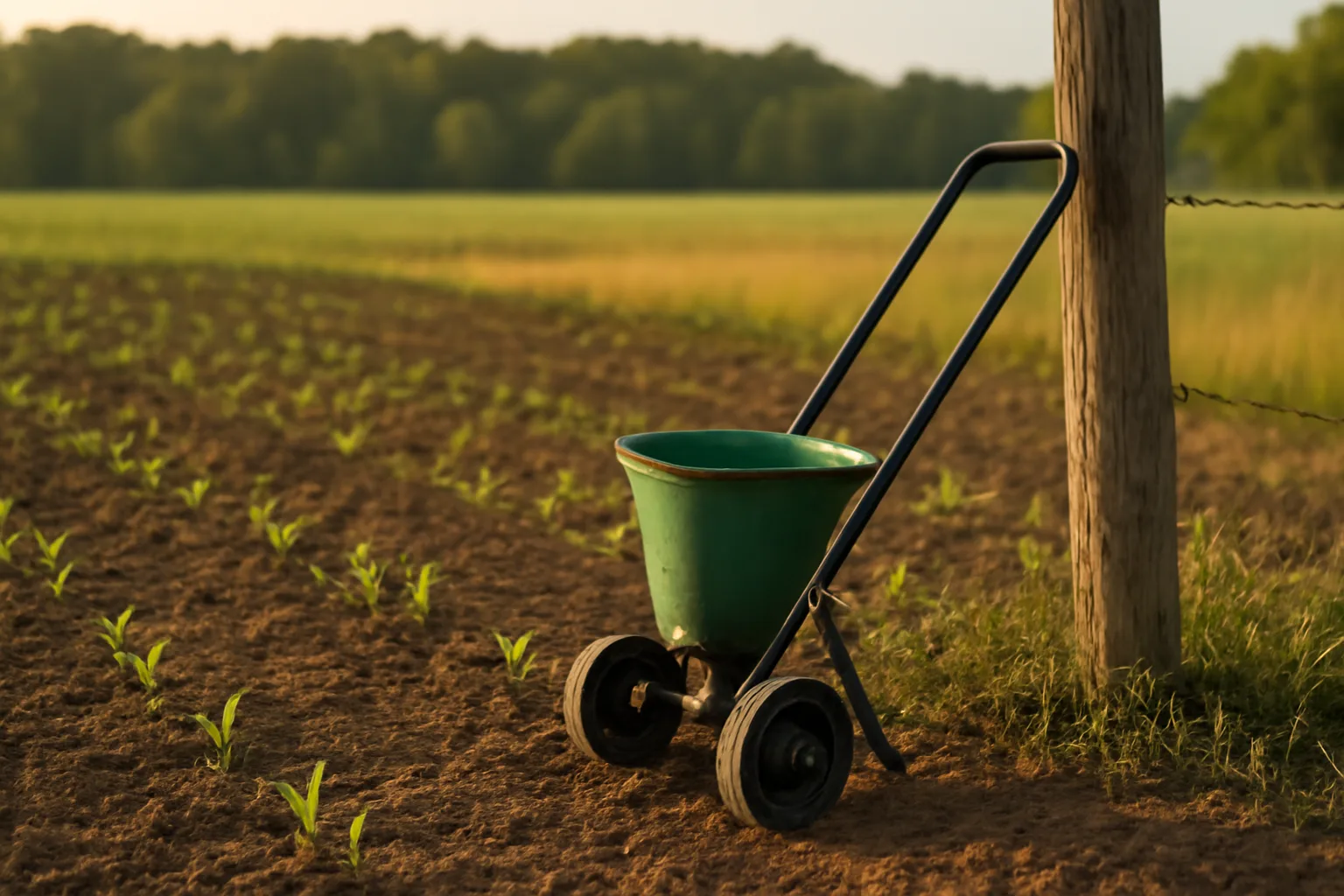
You don't need a full-size tractor to plant a productive plot, but you do need a way to break ground, get seed-to-soil contact, and manage weeds. At minimum: something to kill or knock down existing vegetation (a mower, herbicide, or both), something to disturb the soil surface (a disc, harrow, or hand rake on small plots), a way to spread seed (a hand-crank spreader works fine under an acre), and a way to firm the seed in (a cultipacker, ATV tire drag, or even foot traffic on tiny plots). Seed depth matters more than people think. Clover and brassica seed is tiny and should barely be covered, often just pressed into the soil surface. Cereal grains like oats and wheat want roughly 1 to 1.5 inches of coverage. Planting fine seed too deep is one of the most common reasons a plot fails to come up at all. Fertilizer application should follow your soil test, not the bag's generic rate. A test might call for 300 pounds per acre of a specific blend, or it might tell you your potassium is already high and you'd be wasting money buying more. Your extension office or private soil lab will give you those exact numbers; general seed bag guidance is a starting estimate, not a prescription for your dirt.
Frequently asked questions
Do deer eat sorghum?
Yes. Deer browse sorghum leaves and eat the grain heads, especially later in fall and winter. It's more commonly used as a drought-tolerant screening and soil-building crop than a primary attractant, since corn or soybeans usually out-produce it on good soil.
Do deer like clover?
Yes, clover is one of the most consistently preferred food plot plantings, ranking high in protein (often 25-30% crude protein) and palatability in extension forage trials. White and red clover both work well when soil pH sits between 6.0 and 7.0.
When should you plant food plots for deer?
Cool-season plots (clover, oats, brassicas) go in late July through October depending on your region and frost date. Warm-season plots (soybeans, sorghum, corn) go in after your last spring frost, typically April through June. Check your local extension planting calendar for exact dates.
When should you plant oats for deer?
Plant oats 60 to 90 days before your area's first hard frost, generally August to September across most of the whitetail range. Oats germinate quickly, often in 5 to 10 days, and give fast green-up while slower plants like clover establish.
When should you plant turnips for deer?
Plant turnips 90 to 100 days before your first expected frost, generally late July through mid-August in most regions. Deer often ignore turnips until after a few hard frosts sweeten the leaves and bulbs, so don't judge the plot too early.
What is a food plot?
A food plot is a planted area, often a quarter acre to several acres, seeded specifically to feed deer or other wildlife and give hunters a predictable place to observe or hunt. It supplements natural habitat rather than replacing it, according to USDA NRCS habitat guidance.
What are deer's favorite foods?
There's no single universal favorite, but acorns rank among the top natural fall foods where available, and among planted crops, clover, soybeans, and brassicas consistently show up as high-preference options in extension forage trials. Actual use depends heavily on what else is on the landscape.
Do deer like honey?
Literal bee honey isn't a natural deer food or a legitimate plot input. Deer do eat honey locust seed pods and browse honeysuckle leaves, but honeysuckle is invasive in much of the eastern U.S. and isn't something extension programs recommend planting.
What's the difference between an annual and perennial food plot seed?
Annuals like oats, brassicas, and soybeans need replanting every year but establish fast and forgive planting mistakes. Perennials like white clover can produce for three to five years once established, but they take longer to fill in and need more careful first-year weed management.
How much does a soil test cost before planting a food plot?
A standard soil test through a state cooperative extension office or private ag lab typically runs $10 to $20 per sample. It reports pH, phosphorus, potassium, and organic matter, which should guide your lime and fertilizer decisions rather than a generic seed bag rate.
Can you plant a food plot without a tractor?
Yes. Plots under an acre can be planted with a mower, hand-crank spreader, a rake or hand tools for seedbed prep, and a drag or roller to firm seed into the soil. Many productive small plots on leased ground are managed entirely with a UTV and hand equipment.
Is it legal to bait deer with feed or attractants?
It depends entirely on your state. Baiting and feeding rules vary widely, some states ban it outright, others allow it with restrictions on distance or timing. Check your state wildlife agency's current regulations before using any bait, mineral, or feed product.
Sources
- University of Tennessee Extension, food plot planting dates: Cool-season cereal grains like oats are planted roughly 60-90 days before first frost
- Clemson Cooperative Extension, brassica forage planting guidance: Brassica forages should be planted 60-90 days before first frost date
- Kansas State University Extension, grain sorghum production: Grain sorghum is planted after soil temperatures reach approximately 60°F
- USDA Forest Service, Japanese honeysuckle invasive species profile: Japanese honeysuckle is classified as an invasive threat to native plant communities in the eastern United States
- University of Georgia Extension, soil testing for food plots: Standard soil tests cost roughly $10-$20 per sample through extension or private ag labs