Last updated 2026-07-25
TL;DR
The best seed for food plots depends on your soil, region, and hunting goals. Clover and brassicas (turnips) work almost everywhere; oats and cereal grains are cheap fall draws; sorghum and grain crops feed deer and other wildlife but aren't top whitetail preference. Planting windows run late summer to early fall for most of the U.S., with spring windows for perennial clover and warm-season annuals.
What is a food plot, exactly?
A food plot is a planted area, usually a fraction of an acre to a few acres, designed to grow forage that attracts and holds deer or improves their nutrition. Most hunters plant them on private or leased ground, sometimes tucked into a field corner, a logging cut, or a strip along a fence line. Food plots aren't one thing. Some are annual plots reseeded every year with cereal grains or brassicas. Others are perennial clover or alfalfa stands that can produce for three to five years with the right maintenance. The USDA Natural Resources Conservation Service and state wildlife agencies both treat food plots as a wildlife habitat practice, not agriculture in the commercial sense, and many states offer cost-share or technical help through NRCS programs for landowners planting for wildlife [1]. The point isn't just to grow something green. A plot that fits your soil, your region's rainfall pattern, and the time of year deer need extra protein or energy will outperform a bigger plot planted with the wrong seed at the wrong time. That's really the whole game: matching seed choice to site and season, more than buying whatever bag is on the shelf at the farm store. If you want a walkthrough of how plot type, size, and location interact, see food plot whitetail and deer food plots for broader groundwork before you pick seed.
When to plant food plots for deer
Timing is the single biggest factor in food plot success, more than seed brand or fertilizer rate. Most food plot seed falls into two windows: spring/early summer for warm-season annuals and some perennials, and late summer/early fall for cool-season annuals like brassicas and cereal grains. Cool-season plots (clover, brassicas, oats, wheat, rye) generally go in 45 to 90 days before your area's average first fall frost, which gives plants enough growing time before cold slows them down. Purdue Extension recommends planting brassicas like turnips and radishes from late July through August in the Midwest, adjusted for your specific frost date [2]. In the South, that window can push into September because frost comes later. Warm-season plots (soybeans, cowpeas, sorghum, corn) go in after your last spring frost, typically May through June depending on latitude, similar to row-crop planting dates in your area. Perennial clover can be frost-seeded in late winter/early spring in the North, or planted in early fall in the transition zone and South where fall moisture is more reliable. Here's the honest complication: soil moisture matters as much as the calendar date. A perfectly timed planting into dry dust will sit ungerminated for weeks, and by the time rain comes your window may have closed. Watch your local forecast, more than the calendar, and be ready to plant a few days early or late to catch rain.
When to plant oats for deer
Oats are typically planted in late summer to early fall as a cool-season annual, generally 6 to 10 weeks before your first expected frost, so they have time to establish before growth slows. In much of the whitetail range that lands somewhere between mid-August and mid-September, though the exact date depends heavily on your latitude and elevation. Oats germinate fast and put on a lot of leafy growth quickly, which is why they're a popular fall attractant. They're also more tolerant of poor soil and less fussy about pH than clover, though a soil test result in the 6.0 to 6.5 range still helps yield. Oats generally winterkill in cold climates (zone 5 and colder), so in the North they act as an annual fall/early winter plot, not a year-round stand. In milder climates they may persist into late winter. A lot of hunters mix oats with brassicas or with winter wheat/rye, since oats give quick early growth while the other species carry the plot longer into winter.
When to plant turnips for deer
Turnips are planted in late summer, generally late July through August in the North and up to early September in southern states, so the bulbs and leaves mature by the time deer start hitting them hard in late fall and winter. Turnips need roughly 80 to 90 days to reach full bulb maturity, so counting backward from your first hard frost is the standard method. Here's the thing about turnips: deer often ignore the leaves early in fall and don't touch the bulbs until after a couple of hard frosts convert starches to sugars, making them sweeter. This is well documented anecdotally by wildlife extension programs, and it means a turnip plot can look untouched in October and get hammered in December and January, especially once other food sources thin out. Don't judge a turnip plot's success in the first month. Pennsylvania State Extension notes brassica species including turnips are commonly planted in food plot mixes because they tolerate frost, produce high-tonnage forage, and provide late-season nutrition when other plants have died back. Turnips do best with adequate phosphorus and boron; a soil test is the only reliable way to know if you need to add either.
Do deer eat clover, and do they actually like it?
Yes. Clover is one of the most consistently preferred food plot forages across whitetail range, and it's palatable through spring, summer, and fall as long as it's actively growing and not overly mature or drought-stressed. Both white clover (including Ladino types) and red clover are common in food plot mixes. Clover's appeal comes down to protein content and digestibility. Clover forage regularly tests in the 20 to 30 percent crude protein range when actively growing, which is well above most grasses and many other plot species, and that protein matters most during spring green-up (post-rut recovery, antler growth) and lactation in does [3]. It's also a perennial in many mixes, meaning one planting can produce for three to five years with mowing and periodic fertilization, which makes it one of the better cost-per-year options once established. The tradeoff: clover needs decent soil moisture and doesn't love acidic soil. Most extension guidance recommends a soil pH of 6.0 to 6.5 for clover establishment, and yields drop off hard in soils below pH 5.5 unless lime is applied [4]. If your soil test comes back at pH 5.2, spreading clover seed on it without addressing lime first is close to wasting the bag. For species comparisons across a whole planting plan, deer food plot seed and food plot seed break down blends beyond clover alone.
Do deer eat sorghum?
Yes, deer will eat sorghum grain and browse young sorghum plants, but it's not typically a top-choice forage compared to clover, soybeans, or brassicas. Sorghum (grain sorghum, or milo) is more commonly planted as a dove and upland bird food source, or as a standing grain crop that also gets some deer use, especially in winter once the grain heads dry down. Sorghum's real value in a food plot context is drought tolerance and its ability to grow on marginal soil where corn or soybeans would struggle. It's a warm-season annual, planted after last frost like corn, and it can serve double duty as both a wildlife food source and standing cover. Some hunters use sorghum in a blend specifically for its cover value during late season, since standing stalks hold up better through wind and snow than most other plot plants. If your main goal is maximizing deer attraction and nutrition, sorghum is a lower priority than clover or brassicas. If you're managing a property for multiple species or want winter cover as much as forage, it earns a spot in the mix.
Do deer like honey (honeysuckle, honey locust, or literal honey)?
This question usually means one of two things: Japanese honeysuckle or honey locust pods, not literal honey (deer aren't drawn to honey itself; it's not a natural forage for them and isn't part of any food plot recommendation). Japanese honeysuckle is a semi-evergreen vine that deer do browse, especially in winter when other green browse is scarce, and it's actually listed as a significant winter food source in parts of the Southeast, though it's also an aggressive invasive species that many states restrict or discourage planting due to its ability to overrun native vegetation. Honey locust pods (the long, flat seed pods, not the tree's thorns) are eaten by deer in fall, and honey locust trees are sometimes retained or planted as a mast source in mixed habitat plans, similar to how oaks are managed for acorns. Neither honeysuckle nor honey locust is a standard food plot seed you'd plant in a prepared, tilled plot the way you would clover or brassicas. If you're seeing heavy browse on existing honeysuckle or locust on your property, that's useful information about deer use patterns, but it's a habitat observation, not a seed-buying decision.
What are deer's favorite food plot species overall?
| Clover (white/red) | Spring or early fall | 20-30% [3] | Spring-fall perennial forage | |
|---|---|---|---|---|
| Soybeans | Late spring/early summer | 30-40% (forage) | Summer forage, fall grain | |
| Brassicas (turnips) | Late summer | 15-25% (leaves) | Late fall/winter forage | |
| Oats | Late summer/early fall | 12-20% | Fast fall growth, mix component | |
| Grain sorghum | Late spring/early summer | Lower deer preference | Cover, marginal soil, multi-species | Crude protein ranges vary by growth stage, soil fertility, and lab method, so treat these as general ranges rather than fixed numbers. Your own forage or soil test results are the better reference for your specific plot. |
There's no single universal favorite because preference shifts by season, region, and what else is available on the landscape, but a few species show up again and again as top performers in food plot research and extension trials: clover, soybeans, and brassicas (turnips, radishes) consistently rank high for deer preference and nutritional value. Soybeans, when they can survive early browse pressure (a real problem on small plots or high-deer-density properties), produce a huge amount of high-protein forage through summer and standing grain into fall. Clover covers spring through fall. Brassicas cover late fall into winter. Together those three species groups cover almost the whole calendar year, which is why most serious food plot programs plant some combination of all three rather than betting on one species alone. | Species | Season planted | Crude protein (approx.) | Best use |
How does soil test data change what seed you should buy?
Your soil test result should drive seed selection more than any other single factor, because pH and nutrient levels determine whether a species can even establish, let alone thrive. A soil test measures pH, phosphorus, potassium, and often organic matter, and most land-grant extension labs (University of Kentucky, Mississippi State, Penn State, and others) return specific lime and fertilizer recommendations tied to the crop you tell them you're planting [5]. Clover, alfalfa, and most legumes want pH 6.0 to 6.5 and fail hard below 5.5 without lime correction. Brassicas tolerate a slightly wider pH range but still perform best above 6.0 and respond strongly to added phosphorus and boron. Cereal grains like oats, wheat, and rye are the most forgiving of low pH and poor fertility, which is exactly why they're often the first crop planted on a new, untested, or hard-to-reach plot. Lime takes time to work, often 6 to 12 months to fully react with soil, so a fall soil test showing you need lime doesn't help this year's fall planting much; it sets up next year's plot. This is one of the most common food plot mistakes: buying premium clover seed for a plot that's never been limed, then blaming the seed when it struggles. Your soil test lab is the authority on your specific lime and fertilizer rates; that's site-specific agronomy and no general article, including this one, can substitute for your actual test results. If you want a starting point for matching species to a soil test and building out a full-season plan, that's exactly the kind of decision the $99 one-time Custom Food Plot Plan is built to help with. It's general guidance based on your inputs, not a replacement for your soil lab's specific lime and fertilizer recommendations.
Annual vs. perennial seed: which should you buy first?
If you're planting your first plot ever, annuals (oats, brassicas, or a cheap annual clover like crimson) are the lower-risk starting point because they establish fast, tolerate imperfect soil prep, and don't require years of maintenance to judge success. Perennials like Ladino clover or alfalfa pay off better over time but need more patience and more consistent mowing and weed control in year one and two. Annual seed costs less per bag but you're buying it every year. Perennial clover seed costs more upfront (per pound, clover seed often runs several times the price of oats or wheat by weight, though seeding rates are much lower for clover) but can produce for three to five years with mowing and occasional reseeding of thin spots. A lot of experienced plotters run both: a perennial clover plot as the anchor food source, plus one or two annual plots (brassica/oats mix in fall, soybean or sorghum plot in summer) rotated to spread out risk and cover more of the calendar.
What equipment do you actually need for planting food plot seed?
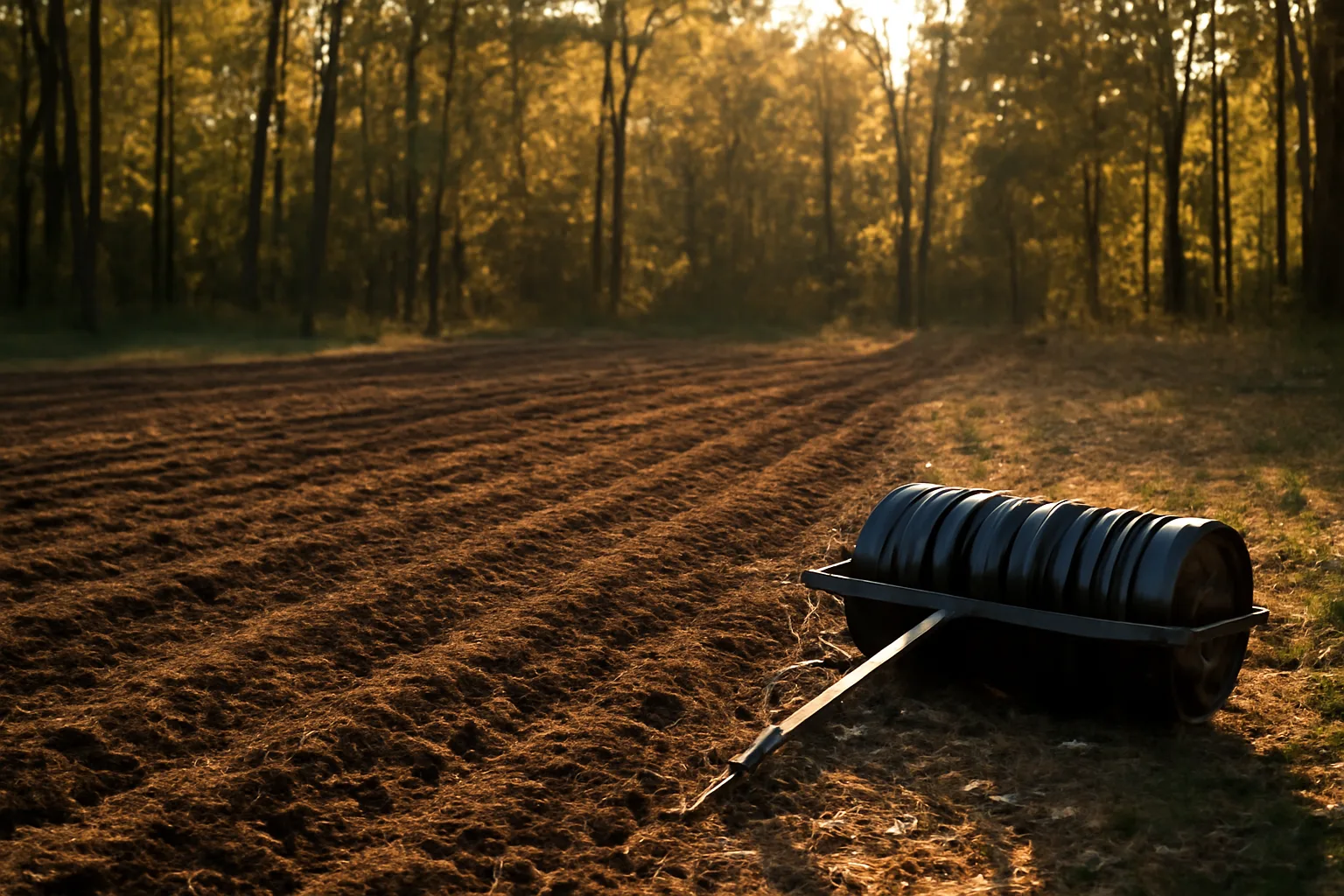
At minimum you need a way to kill or turn existing vegetation, a way to place seed at the right depth, and a way to firm the soil for seed-to-soil contact. That can be a tractor with a disc and cultipacker, an ATV with a small implement, or for tiny plots, hand tools and a broadcast spreader. Small-seeded species like clover and brassicas need very shallow planting depth, often just pressed into the surface (1/4 inch or less), while larger seeds like soybeans, corn, and sorghum need real planting depth (1 to 2 inches) and benefit from a drill or planter rather than broadcasting. Broadcasting large seed and hoping rain washes it in works sometimes, but germination rates are typically lower and less consistent than drilled seed, a point most land-grant agronomy guides make when comparing planting methods [6]. pH testing, mowing, and spraying equipment matter as much as planting gear. A plot planted into thick existing sod or weeds without herbicide or tillage prep usually underperforms no matter how good the seed is.
Check your state's baiting and feeding rules before you plant
Food plots are legal in every state as a wildlife habitat practice, but baiting and supplemental feeding rules are a different, often stricter, category, and they vary widely by state. Some states draw a legal line between a planted, standing food plot (generally legal to hunt over) and piled or spread feed like corn, minerals, or processed attractants (often restricted or banned, especially in states managing chronic wasting disease). Michigan, for example, bans baiting and feeding of deer in the entire Lower Peninsula and in CWD-affected areas of the Upper Peninsula, with narrow exceptions . Other states like Texas allow baiting broadly. Because rules change and vary by county in some states, check your state wildlife agency's current regulations before assuming a practice is legal, and don't assume a food plot and a bait pile are treated the same way under your state's code.
Common seed-buying mistakes to avoid
The most common mistake is buying seed before getting a soil test, then discovering after a poor stand that the pH was wrong for the species. A basic soil test costs somewhere in the range of $10 to $20 through most state land-grant labs and takes one to two weeks to process, which is cheap and fast compared to a wasted planting season [5]. The second most common mistake is planting too late for the species. Brassicas and clover both need real time to establish before frost or before deer pressure hits them hard; a plot planted three weeks late can look thin all season compared to one planted on time into good moisture. The third mistake is ignoring plot size relative to deer density. A quarter-acre soybean plot on a property with heavy deer pressure often gets browsed to the ground before it can produce grain, while the same seed on a two-acre plot survives fine. Bigger isn't always better, but on high-pressure ground, small plots of preferred forage sometimes just don't survive long enough to pay off. For a broader look at how seed choice fits into whole-property planning, deer for food and domain food plot seed cover adjacent decisions like plot placement and blend selection.
Frequently asked questions
Do deer eat sorghum?
Yes, deer eat sorghum grain and will browse young plants, but it's not a top preference species compared to clover or soybeans. Sorghum is more valuable for drought tolerance, marginal-soil performance, and winter cover than for peak deer attraction, and it's often planted as part of a mixed-species plot rather than alone.
Do deer eat clover?
Yes, clover is one of the most preferred food plot forages for whitetail deer, and it's palatable through spring, summer, and fall while actively growing. It regularly tests at 20 to 30 percent crude protein, well above most grasses, which is why it's a staple in food plot mixes across whitetail range.
When should I plant deer food plots?
Cool-season plots like clover, brassicas, and oats generally go in 45 to 90 days before your area's first fall frost. Warm-season plots like soybeans, corn, and sorghum go in after your last spring frost. Exact dates depend heavily on your latitude, so check your local extension office's frost date charts.
Do deer like clover?
Yes, clover is consistently one of the highest-preference food plot species for whitetail deer, largely because of its high protein content and long growing season. It works spring through fall as long as soil pH is in the 6.0 to 6.5 range and moisture is adequate.
When should I plant oats for deer?
Plant oats 6 to 10 weeks before your first expected fall frost, typically mid-August to mid-September across much of whitetail range, adjusted for your specific latitude. Oats germinate quickly and provide fast fall growth, though they usually winterkill in colder climates.
When should I plant turnips for deer?
Plant turnips late July through August in northern states, or up to early September farther south, counting back roughly 80 to 90 days from your first hard frost. Deer often ignore turnips until after a few frosts sweeten the bulbs, so don't judge the plot until late fall or winter.
What is a food plot?
A food plot is a planted area, typically under a few acres, established specifically to attract deer and other wildlife and to supplement their natural nutrition. Plots can be annual (replanted yearly with grains or brassicas) or perennial (clover or alfalfa lasting several years) depending on species and goals.
What is deer's favorite food plot species?
There's no single universal favorite, but clover, soybeans, and brassicas consistently rank highest in preference and nutrition across food plot research and extension trials. Most experienced plot managers plant a combination of these three groups to cover spring through winter rather than relying on one species.
Do deer like honey?
No, literal honey isn't a deer food or food plot ingredient. People usually mean Japanese honeysuckle (a browsed winter forage vine in parts of the Southeast, though invasive in many states) or honey locust pods, which deer do eat in fall, but neither is planted as prepared food plot seed.
How much does a soil test cost before planting a food plot?
A basic soil test through most state land-grant extension labs costs roughly $10 to $20 and takes one to two weeks to process. It's the cheapest way to avoid planting the wrong species in the wrong pH, since lime and fertilizer needs vary a lot by property.
Is grain sorghum good for a deer food plot?
Grain sorghum works well as a drought-tolerant, marginal-soil crop that also provides winter cover, but it's a lower deer preference than clover or soybeans. It's most useful mixed with other species or planted where a property needs multi-species wildlife food, not as the sole plot species for maximum deer attraction.
Can I plant food plot seed without a soil test?
You can, but yields are often disappointing on soil with wrong pH or low fertility, especially for clover and brassicas. Cereal grains like oats and wheat are the most forgiving of untested, low-fertility soil, making them a reasonable first planting while you wait on soil test results.
Sources
- USDA Natural Resources Conservation Service, Wildlife Habitat programs: NRCS offers technical and cost-share assistance to landowners for wildlife habitat practices including food plots
- Purdue Extension, forage and brassica planting guidance: Brassica planting windows for Midwest food plots run late July through August
- USDA Natural Resources Conservation Service, plant fact sheets on clover forage quality: Clover forage crude protein regularly falls in the 20 to 30 percent range during active growth
- University of Kentucky Cooperative Extension, forage soil fertility guide: Clover establishment is recommended at soil pH 6.0 to 6.5, with reduced yield below pH 5.5
- University of Tennessee Extension, food plot planting method comparisons: Drilled seed generally achieves more consistent germination than broadcast seeding for larger-seeded species
- Michigan Department of Natural Resources, deer baiting and feeding regulations: Michigan bans baiting and feeding of deer across the Lower Peninsula and CWD-affected areas, with narrow exceptions