Last updated 2026-07-25
TL;DR
Plant brassica radishes (like Groundhog or Daikon types) 60 to 90 days before your first hard frost, roughly late July through early September in most whitetail country. Drill or broadcast at 6 to 10 lbs/acre, 1/4 to 1/2 inch deep, into a limed and fertilized seedbed. Deer often ignore radishes until a frost sweetens them, then hammer the tubers and tops hard into winter.
What is a food plot, and where do radishes fit in?
A food plot is a planted patch of ground on hunting or agricultural land, managed specifically to feed deer or other wildlife and to draw them into range of a stand or blind. It's basically a small farm field with a different customer: the goal isn't yield per bushel, it's tonnage and timing that lines up with hunting season. Radishes fit into that picture as a fall/winter brassica, usually planted alone or blended with other brassicas, cereal grains, or clover. They're a fast-growing taproot crop, related to turnips and canola, that whitetails will eat both above ground (the leafy top) and below ground (the root itself once it's been softened by cold). Most serious plotters don't run radish as a monoculture across their whole property. It works best as one piece of a rotation: a soil-building, deer-feeding tool used in specific fields or specific years, mixed with cereal grains for structure and grazing pressure spread. If you want a full rundown on how radish plots stack up against clover, brassica blends, and cereal grain plots, the food plot whitetail overview is a good next stop.
When should you plant radishes for deer?
| 3-4 | Late July to mid-August | Late Aug to mid-Sept | |
|---|---|---|---|
| 5-6 | Mid-Aug to early Sept | Late Sept to mid-Oct | |
| 7-8 | Late Aug to mid-Sept | Mid-Oct to early Nov | These are general windows, not guarantees; local microclimate, elevation, and a wet or dry year all shift things. Your state extension office publishes frost date tables specific to your county, and that's the number to actually plan around, not a national average [1]. |
Plant radishes 60 to 90 days before your area's average first hard frost. For most of the whitetail's range in the U.S., that lands somewhere between late July and early September, with northern states planting earlier (late July to mid-August) and the mid-South and southeast planting later (late August into mid-September). Radishes are a cool-season annual. They germinate fast in warm late-summer soil, then use the shortening days and cooling nights of fall to bulk up their root. Plant too early in hot, dry conditions and you risk poor germination or bolting; plant too late and the taproot never sizes up before a killing freeze shuts down growth. A rough planting window by USDA hardiness zone looks like this: | Zone | Approx. planting window | First frost reference |
When to plant food plots for deer in general (more than radish)
Timing depends entirely on what you're planting. Spring/summer plots (clover, chicory, soybeans, cowpeas) go in after your last frost, typically April through June depending on latitude. Fall plots (brassicas, cereal grains, radish, most annual blends) go in 60 to 90 days before first frost, typically late July through September. The practical way to think about it: warm-season plots need the plant to establish and produce all summer for a food source deer use during stress periods (antler growth, lactation) and to build soil. Cool-season plots need to hit peak palatability right as hunting season opens and food gets scarce elsewhere. A lot of hunters make the mistake of planting everything on one weekend in early fall. That works fine for radish and cereal grains, but it's too late for anything you wanted established and thick by opening day of archery season in September. If your goal is a plot that's already producing when bow season opens, you need summer annuals or perennials planted months earlier, not a Labor Day radish patch. Soil test results should also drive your calendar. Lime takes months to fully react with soil and correct pH, so if your test comes back needing 2 tons of lime per acre, getting that lime down in spring gives it time to work before a fall planting [2]. Your soil test lab's recommendations are the actual authority here, not a generic chart; extension labs calibrate their lime and fertilizer math to your specific soil type and target crop.
When to plant turnips for deer, and how is that different from radish timing?
Turnip timing is nearly identical to radish: 60 to 90 days before first frost, same late-summer window. The two are often planted in the same blend for exactly that reason; they share a planting date and similar growth habits, but they behave a little differently in the ground. Turnip bulbs sit partially at or above the soil surface and tend to get hit earlier in fall than radish roots, which grow deeper and stay less accessible until the ground softens or deer paw them up. Turnip tops also tend to hold up a little better through repeated grazing pressure than some radish varieties. A lot of commercial "deer blend" bags mix radish, turnip, and sometimes rape or kale together specifically because deer preference shifts through the season and having root depth diversity keeps something available even as the plot gets browsed hard. If you're buying bagged seed instead of building your own mix, check the label for percentage breakdown; some blends are mostly cheap filler seed with a small radish or turnip component. The deer food plot seed guide breaks down how to read those labels.
Do deer eat radish tops and bulbs, or just one?
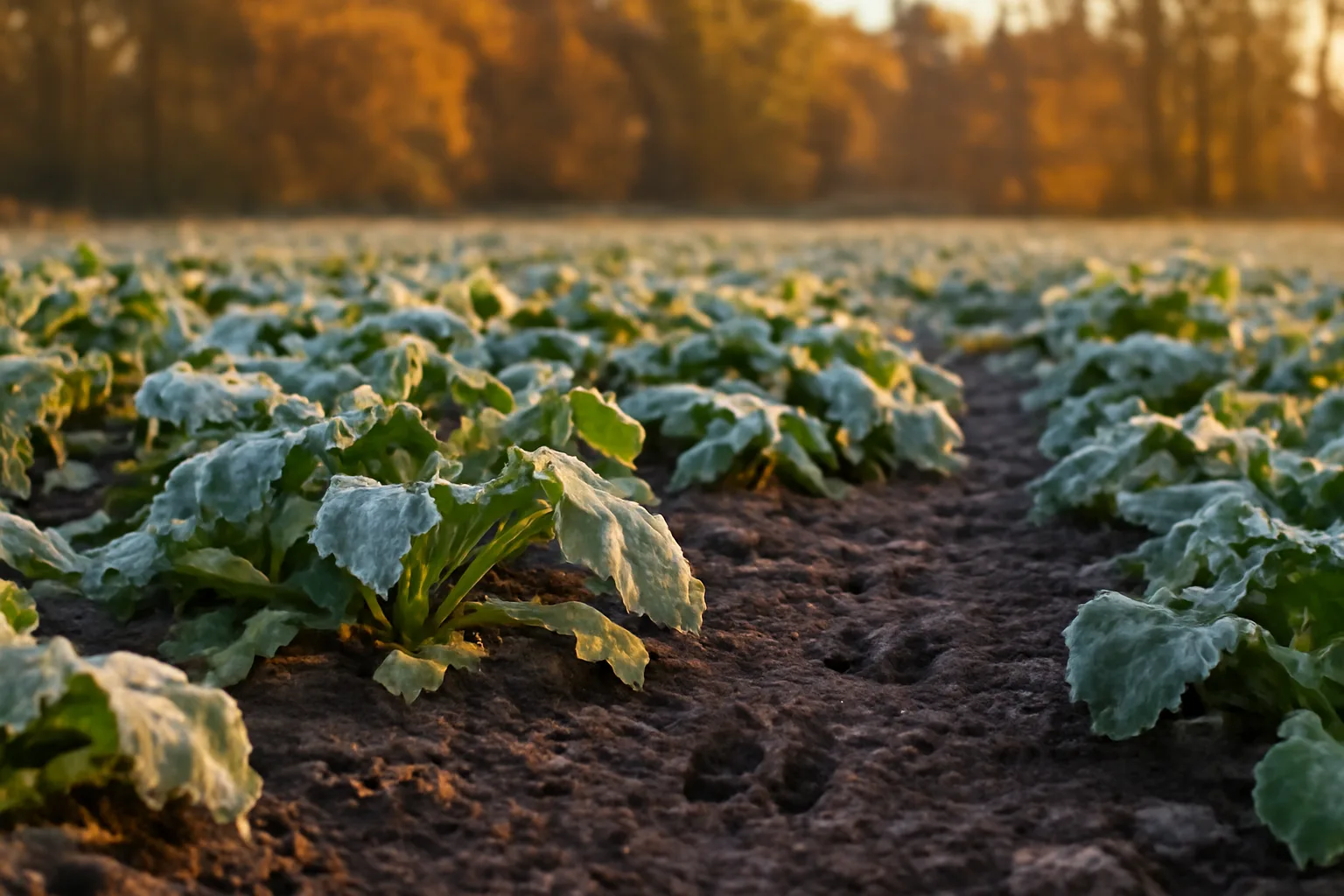
Deer eat both, but usually in a specific order. Early in the season, right after planting, deer often ignore radish almost entirely, or nibble the leafy tops lightly. That's normal, not a sign of a failed plot. As temperatures drop and a few frosts hit the field, radishes (like other brassicas) convert starches to sugars as a cold-tolerance response, and that's when palatability jumps. Deer will strip the tops first, then start digging up and eating the roots themselves, sometimes leaving noticeable craters in the plot where they've pawed roots out of the ground. University extension work on brassica forages for livestock confirms this same sugar-conversion effect after frost, which is part of why brassicas are popular as a late-season grazing and hunting food source rather than an early-season draw. If you're hunting an early archery season in September, don't expect radish to be your best card; save your stand time over radish for December and January hunts, especially in the northern half of the whitetail's range where the ground stays cold enough to hold that sugar content.
Do deer like clover, and how does it compare to radish?
Yes, deer like clover a great deal, and in most regions it's one of the most consistently used food plot forages available, spring through fall. Clover (white clover, red clover, ladino types) is a perennial or biennial that regrows after grazing, unlike radish, which is a one-shot annual that dies after its growing season. The practical difference: clover gives you season-long grazing pressure and lasts 3 to 5 years with good management, while radish gives you one big pulse of late-season tonnage and then it's done, decomposing into the soil. Clover needs mowing, weed control, and periodic overseeding to stay productive; radish needs almost none of that because it's replanted every year anyway. Many plot plans use both: clover in a perennial field for spring through early fall use, and a radish/brassica/cereal grain blend in a separate field or in rotation for late season. If you're deciding between the two for a single field, the deer food plots hub compares perennial versus annual strategy in more depth.
When to plant oats for deer, and do they pair with radish?
Oats go in on the same general schedule as radish, 60 to 90 days before first frost, typically August into early September depending on zone. Oats are a cereal grain, fast-germinating, cold-tolerant to a point, and highly attractive to deer especially in the first 6 to 10 weeks after planting while they're still leafy and tender. Oats and radish (or turnip) are a classic combination for a reason. Oats germinate fast and give the plot green groundcover within days, which helps suppress weeds and gives deer something to eat while the radish is still building its root underground. By the time oats get grazed down hard or winterkill in a harder freeze, the radish roots are sizing up and taking over as the food source. A simple oats/radish blend for a half-acre plot might run something like 50 lbs of oats plus 3 to 4 lbs of radish seed per acre, adjusted based on your seed source's specific recommendations. Oats generally winterkill somewhere in the 15 to 20 degree F range depending on variety and snow cover, while radish roots can survive colder temperatures underground even after the tops die back [3].
Do deer eat sorghum, and does it fit with radish plots?
Yes, deer eat sorghum, both the grain heads and, to a lesser extent, the foliage, though it's used more as a screening and standing-grain crop than a primary attractant compared to brassicas or legumes. Grain sorghum is a warm-season crop, planted late spring after soil warms past roughly 60 degrees F, and it matures over the summer into standing grain heads that persist into winter [4]. Sorghum doesn't share a planting window with radish; it goes in months earlier, as a summer crop. Where the two connect is in a rotational or multi-field plan: a sorghum field can provide both standing cover and a grain food source into late fall and winter, right around the same time a separate radish/brassica field is hitting peak palatability after frost. Some hunters also use sorghum as a screen crop planted along plot edges or travel corridors, less for the food value and more to break sightlines and give deer confidence approaching a field in daylight. It's not a radish substitute, more a complementary piece in a bigger property plan.
What is deer's favorite food, and where does radish rank?
There's no single universal "favorite," because preference shifts by season, region, and what else is available. That said, research and long-term field observation consistently put a few categories at the top: acorns (especially white oak acorns) when they're dropping, soybeans and clover during the growing season, and standing corn or brassicas in late fall and winter [5]. Radish specifically tends to rank as a strong late-season preference food once frost has sweetened it, often pulling deer hard in December and January when other food sources are picked over or buried under snow. Multiple state agency and university plot trials note that brassica plots, radish included, see light use in early fall and heavy use after several frosts, which lines up with the sugar-conversion behavior described earlier. If you're trying to build a property that has a "favorite food" available in every season, that's really a multi-plot, multi-species plan, not one crop. This is one of the reasons a written, season-by-season plan pays off more than throwing one bag of seed at one field; a Custom Food Plot Plan from PlotSeason maps out which crops go where and when based on your zone and goals, for a flat $99 one-time fee, though a soil test from your own local lab is still the real authority on your lime and fertilizer numbers, not any generic online chart.
How do you plant radish for deer, step by step?
Start with a soil test 2 to 3 months before planting if you can swing the timing; that gives you room to apply lime if your pH needs correcting, since lime takes time to react in the soil [2]. Radish tolerates a fairly wide pH range but grows best in the 6.0 to 6.8 range like most brassicas. Prep a clean seedbed, either tilled or through a burndown herbicide application on a no-till field, roughly 2 to 3 weeks before planting. Radish seed is small, so a rough, cloddy seedbed makes for spotty germination. Broadcast at 6 to 10 lbs/acre if planting radish alone, or 3 to 5 lbs/acre if it's one part of a blend with oats, clover, or other brassicas. Seed depth matters more than people think: radish wants 1/4 to 1/2 inch of soil coverage, no deeper. Too deep and it won't emerge; broadcast on top with no coverage at all and you'll lose a lot of it to birds and drying out. A cultipacker or light drag after broadcasting improves seed-to-soil contact significantly. If you're running a drill, set it shallow and slow down; radish seed flows differently than a larger grain like oats or wheat, and drills calibrated for one won't necessarily meter the other correctly without adjustment. For a rundown of the actual gear that makes this easier on food plot size ground (broadcast spreaders, cultipackers, small drills), the equipment-and-methods hub has more detail.
Do deer like honey, and does bait like that matter for plots?
This question comes up because "do deer like X" search patterns often include odd items, and honey is one of them. Deer aren't drawn to honey as a food source in any meaningful field sense; it's not part of natural whitetail diet, and there's no wildlife agency or extension guidance recommending it as an attractant. Deer are herbivores built around browse, forbs, mast, and agricultural crops, not sugars in that form. What actually matters for a plot is boring by comparison: soil fertility, seed choice matched to your zone and season, and planting timing. If you're looking for something to boost attraction, mineral supplementation (where legal) and a well-timed brassica or cereal grain plot do far more work than any novelty bait product. One genuinely important note here: check your state wildlife agency's baiting and feeding regulations before using any supplemental attractant, mineral, or feed product, since rules vary widely by state and some prohibit baiting for hunting purposes entirely or restrict it seasonally . A food plot itself is almost universally legal since it's a planted crop, not a bait pile, but the line between the two can get blurry with some mineral or feed products, so check your specific state's regulations before assuming a product is fine to use.
What can go wrong with a radish plot, and how do you avoid it?
The most common complaint is "deer aren't touching it," filed in September, three weeks after planting. That's usually not a failure, it's just too early; radish palatability climbs after frost, and a field that looks ignored in early fall can get hammered flat by December. The second common problem is thin, spotty germination, usually from planting too deep, too shallow, or into a cloddy seedbed with poor seed-to-soil contact. Radish seed is small and doesn't have big energy reserves to push through heavy coverage. Third, deer pressure can overwhelm a small radish plot before it ever matures if the surrounding property has heavy deer density and limited other food. A half-acre radish plot on a property with 40 deer per square mile can get grazed to nothing before the roots ever size up. Bigger plots, multiple smaller plots spread across a property, or blending radish with a faster-growing companion like oats to buy grazing time all help spread that pressure out. Last, don't skip the soil test. Brassicas are heavy nitrogen feeders and respond strongly to correct fertility; a plot planted into acidic, unfertilized ground will produce small, sparse roots no matter how well you time the planting date [2]. For a broader look at building fertility into any plot plan, the soil-and-fertility hub covers the testing and amendment process in more depth, and the food plot seed and domain food plot seed pages cover seed selection and sourcing if you're still deciding what to buy.
Frequently asked questions
Do deer eat sorghum?
Yes. Deer eat sorghum grain heads and some foliage, though it functions more as a standing-grain and screening crop than a primary attractant compared to brassicas, clover, or beans. It's a warm-season crop planted in late spring, on a completely different schedule than fall radish or brassica plantings.
Do deer eat clover?
Yes, and clover is one of the most consistently used food plot forages available across the growing season. It's a perennial that regrows after grazing and can last 3 to 5 years with mowing and weed control, unlike annual radish, which dies off after one season.
When to plant deer food plots?
It depends on the crop. Warm-season plots (clover, soybeans, chicory) go in after your last spring frost. Cool-season plots (radish, turnips, oats, other brassicas) go in 60 to 90 days before your first fall frost, roughly late July through September depending on your zone.
Do deer like clover more than radish?
Preference shifts by season. Deer typically use clover heavily spring through early fall, then shift hard toward brassicas like radish once frost sweetens the roots and tops. Neither beats the other universally; they cover different parts of the calendar, which is why many plans use both.
When to plant oats for deer?
Plant oats 60 to 90 days before your area's first hard frost, typically August into early September. Oats germinate fast and provide quick green groundcover, which pairs well with slower-establishing radish in a combined blend.
When to plant food plots for deer overall?
Spring/summer for warm-season perennials and annuals like clover and beans; late summer (60 to 90 days before first frost) for fall annuals like radish, turnips, brassicas, and cereal grains. Your state extension office's frost date tables are the best local reference for exact timing.
When to plant turnips for deer?
Same window as radish: 60 to 90 days before first frost, typically late July through September depending on zone. Turnip and radish are often planted together since they share a planting date and complementary root depths.
What is a food plot?
A food plot is a planted area on hunting or managed land grown specifically to feed deer or other wildlife and draw them into range of a stand. It's managed for tonnage and hunting-season timing rather than commercial yield.
What are deer's favorite food?
There's no single favorite; it shifts by season. Acorns (especially white oak) rank high when dropping, soybeans and clover dominate the growing season, and brassicas like radish and standing corn take over in late fall and winter once other food sources thin out.
Do deer like honey?
No meaningful field evidence supports honey as a whitetail attractant. Deer are herbivores built around browse, forbs, mast, and crops, not sugar sources like honey. It's not recommended by any wildlife agency or extension program as a plot or bait strategy.
Why aren't deer eating my radish plot right after planting?
This is normal, not a failure. Radish palatability is low right after emergence and climbs sharply after a few frosts convert the plant's starches to sugars. Expect light use in September and October, then heavy use in December and January in most regions.
Can you plant radish alone, or does it need a mix?
Radish can be planted alone at 6 to 10 lbs/acre, but many hunters blend it with oats, wheat, or other brassicas for faster groundcover, weed suppression, and a longer grazing window. A mix also spreads deer feeding pressure across more plant types.
How deep should you plant radish seed?
Cover radish seed 1/4 to 1/2 inch deep. Planting deeper often prevents emergence since it's a small seed with limited energy reserves; broadcasting with no coverage at all risks losing seed to birds and drying out before germination.
Sources
- NOAA National Centers for Environmental Information, Frost/Freeze Data: Local first-frost date tables that vary by county and should guide fall plot planting timing rather than national averages
- University of Missouri Extension, Soil Testing and Liming: Lime takes months to react with soil and correct pH, so it should be applied well ahead of a fall planting
- Iowa State University Extension and Outreach, Grain Sorghum Production: Grain sorghum is a warm-season crop planted after soil temperatures warm in late spring
- Quality Deer Management Association / National Deer Association, Deer Food Preferences research summaries: Acorns, soybeans, clover, and brassicas rank among top seasonal whitetail food preferences depending on time of year
- Example state wildlife agency baiting regulation page (verify with reader's specific state agency): State wildlife agencies set baiting and feeding rules that vary by state and season, separate from food plot legality