Last updated 2026-07-25
TL;DR
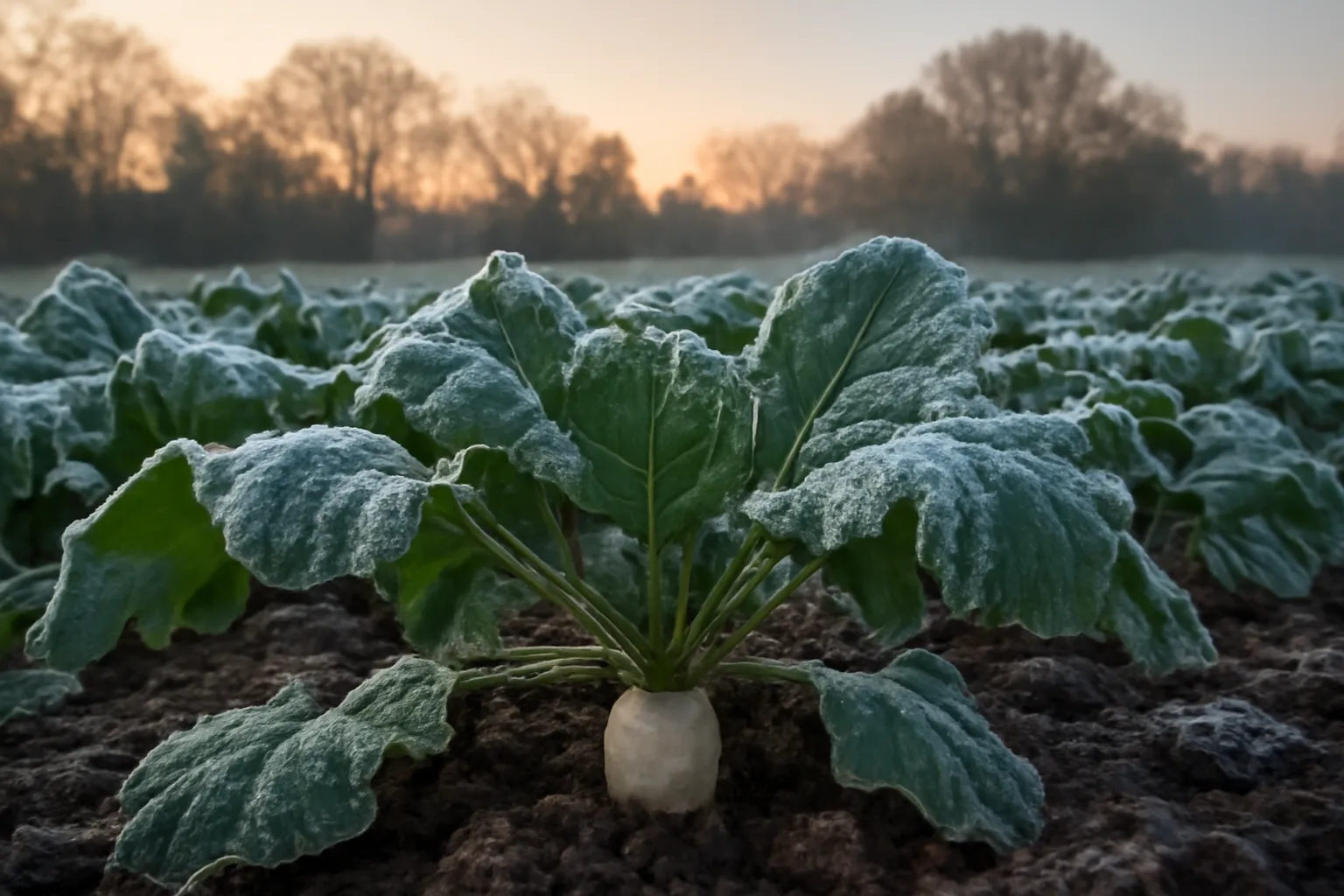
Radish (usually forage or tillage radish) is a fast-growing brassica planted 60 to 90 days before first frost, at 6 to 10 lbs/acre alone or 2 to 4 lbs/acre in a blend. Deer often avoid the bulb until repeated hard frosts convert starch to sugar, so radishes shine as a late-season draw and soil conditioner, not an early-season attractant.
what is a food plot, and where do radishes fit in?
A food plot is a planted area on hunting land, usually a fraction of an acre to a few acres, seeded with forage crops that deer will eat and that also draw deer into range or hold them on your property longer. Extension programs frame it as a wildlife habitat tool, more than agriculture: the goal is nutrition and attraction, timed around hunting season rather than commodity harvest. Radish fits into that plan as a brassica, in the same family as turnips, kale, and rape. Most food-plot "radish" seed sold today is forage radish or tillage radish (Raphanus sativus), bred for a long taproot that can punch through compacted soil, not the small red radish from a garden center. That taproot is the whole selling point: it can grow 12 to 18 inches deep in loose soil, pulling up nutrients and leaving a channel behind when it rots over winter [1]. So radish plays two roles in a plot. One, it is deer forage, mostly the leafy top growth early and the bulb late. Two, it is a soil-building cover crop that a lot of hunters plant even in years they don't expect big deer use, because it breaks up hardpan and adds organic matter cheaply. If you're weighing radish against other options, it helps to see it next to food plot seed blends built around clover or brassica mixes instead of a straight stand.
when to plant food plots for deer in general?
Timing depends on whether you're planting a spring/summer plot (usually a legume like clover or soybeans meant to feed deer through the growing season) or a fall plot (usually a brassica or cereal grain timed to first frost and hunting season). Radish belongs almost entirely to the fall category. As a rough national framework, cooperative extension guidance breaks food plots into cool-season annuals (planted late summer to early fall, includes brassicas and cereal grains) and warm-season annuals or perennials (planted spring, includes soybeans, clover, and chicory) [2]. Your local frost date is the anchor for every fall planting decision, and that varies by 6 to 8 weeks across whitetail range, from late August in the northern Great Lakes and New England to mid-October or later in the Deep South and Texas. A simple rule that most extension brassica guides repeat: count backward 60 to 90 days from your area's average first hard frost, and that's your planting window for radish and other brassicas [3]. Planting too early in warm climates risks bolting or pest pressure before fall growth kicks in; planting too late anywhere risks stunted plants that never build the bulb size deer eventually key on.
when to plant turnips for deer, and how does that compare to radish?
Turnips and radishes get planted on almost identical schedules, because both are brassicas that need 60 to 90 days of cool-season growth before a killing frost sweetens them up. Most hunters plant turnips and radishes in the same window, often in the same bag, because seed companies sell brassica blends combining both. The practical difference: turnip bulbs sit higher and are eaten earlier and more readily by deer than radish bulbs, which grow deeper and stay tougher until repeated hard freezes break down the starches. Purdue Extension's food plot brassica work notes that deer tend to hit the leafy tops of brassicas first, then shift to bulbs as cold weather progresses and other food sources thin out [4]. If you're deciding between the two, or whether to blend them, radish brings more soil benefit (deeper taproot, more aggressive compaction-breaking) while turnip usually brings more reliable deer use on the bulb itself. A lot of experienced plotters run both in one blend for that reason, alongside a cereal grain like oats or winter wheat to spread out the attraction window.
do deer eat sorghum?
Yes, deer will eat grain sorghum (milo) heads and, to a lesser extent, the leaves, but it isn't a top-tier food plot choice on its own. Sorghum is more commonly grown as a wildlife food source for game birds and as cover, and it shows up in food plot mixes aimed at multiple species rather than as a dedicated deer attractant [2]. Compared to a brassica like radish or a legume like soybeans, sorghum's protein content is lower and its main value to deer is the grain itself, which matures late and can require standing cover management or specific equipment to plant at the right population. Most food-plot-focused land managers treat sorghum as a component of a diverse plot (useful for screening cover and turkey or quail food) rather than a primary deer draw. If deer are your main target species, your seed dollars generally go further in brassicas, clover, or a cereal grain blend.
do deer eat clover, and do deer like clover?
Yes, deer eat clover readily, and most wildlife biologists rank it among the most consistently used food plot forages available. Clover (white clover, red clover, and various perennial blends) is a legume, meaning it fixes its own nitrogen and offers high crude protein, commonly cited in the 25 to 30 percent range for quality forage clover, which matters most during antler growth and lactation in spring and summer [5]. Deer do like clover, and it tends to get hit hard from spring green-up through fall, as long as it isn't shaded out or overgrazed in small plots. The tradeoff against radish and other brassicas is timing: clover is a perennial or semi-perennial that needs to establish over a full season and gets grazed all year, while radish is an annual that you replant each fall and that deer often ignore until frost. Many experienced plot managers run both: clover in spring/summer plots for season-long nutrition, and a brassica or cereal blend including radish in fall plots timed to hunting season. If you're building out clover acreage, it's worth reading through deer food plots strategies that pair perennial clover with annual fall plantings on the same property.
when to plant oats for deer?
Oats get planted on the same general fall schedule as radish and turnips, roughly 60 to 90 days before your first expected hard frost, though oats tolerate a slightly wider planting window because they establish fast and germinate in cooler soil than some brassicas. In much of the whitetail's range that puts oat planting somewhere between late August (northern states) and early October (southern states) [3]. Oats are a cereal grain, not a brassica, and deer typically hit the leafy growth hard right after germination, which makes oats a strong early-fall draw while radish and turnip bulbs are still maturing underground. That complementary timing is exactly why oats show up in so many blended fall food plot bags alongside radish: oats bring immediate attraction, radish and turnip bring a second wave once frost hits. Oats generally don't survive hard winters in northern climates the way winter wheat or rye can, so in cold regions oats function as an annual that dies back, while the radish's rotted taproot channel is really the thing left improving your soil into spring.
how do you plant radish food plot seed, step by step?
Start with a soil test. Radish and other brassicas do best in the 6.0 to 6.8 pH range, and your soil test lab's specific lime and fertilizer recommendation is the real authority here, not a generic online number. Extension brassica guidance consistently flags soil pH and fertility as the biggest variable in bulb size and tonnage produced [1]. Seedbed prep matters more for radish than for some other food plot species because germination depends on good seed-to-soil contact at a shallow depth. Broadcast radish seed at roughly 1/4 to 1/2 inch depth (some growers just broadcast on a worked, firm seedbed and cultipack or drag lightly, since radish germinates fine from a shallow broadcast if soil moisture is there). Seeding rate for a straight radish stand runs about 6 to 10 lbs per acre for forage/tillage radish, per common seed company and extension recommendations; in a blend with turnip, clover, or a cereal grain, radish is usually cut back to 2 to 4 lbs per acre so it doesn't dominate the stand [1] [4]. Fertilize according to your soil test result, typically a nitrogen application helps brassica tonnage since they're heavy nitrogen feeders, unlike clover which fixes its own. Weed control before planting matters too. Radish seedlings compete poorly with existing grass and weed pressure in the first few weeks, so a burndown herbicide application or thorough tillage ahead of planting on unclipped ground pays off in stand density.
what do deer's favorite foods actually look like, and where does radish rank?
There's no single scientifically ranked "favorite food" list for whitetails, because preference shifts by season, region, and what else is available. What extension and wildlife agency research does show consistently is that deer select foods based on protein content, digestibility, and availability relative to other options nearby [5] [6]. In practical food-plot terms, the forages that reliably draw heavy, consistent use across most of the year are clover, soybeans (as a summer forage and later as dropped beans), and standing corn or brassica tops in fall and winter. Radish tends to rank lower on "favorite" lists early in the season and higher after several hard frosts, when the bulb's starches convert to sugars and deer will dig up and eat bulbs they walked past in October. So radish isn't typically a deer's first choice food; it's a late-season fallback that becomes very attractive exactly when natural food sources are getting scarce and other plot species are grazed down or gone. That's actually the strategic value: a well-timed radish plot can be pulling deer in during the exact weeks (late season, post-rut) when a lot of other food sources have played out. If you want a broader comparison of what species to combine for that effect, see species and strategy guidance on staggering forage types across the season.
do deer like honey, and does that matter for food plots?
No, this isn't a real food plot consideration, and it's worth addressing directly because the question comes up. Deer are herbivores that browse plants, forbs, mast (acorns, fruit), and agricultural crops; honey isn't part of their diet and has no role in any legitimate food plot planning [6]. If you've seen "honey hole" used around deer hunting, that's slang for a highly productive stand location or plot, unrelated to actual honey as bait. Worth noting: baiting rules vary heavily by state, and some states classify mineral, salt, or scent products as bait under their regulations even though hunters don't think of them that way. Always check your state wildlife agency's current baiting and feeding regulations before adding anything beyond a standard planted food plot to your property, since rules differ on distance from stands, timing, and what substances count .
how does radish compare to other common food plot species?
| Species | Typical planting window | Seeding rate (alone) | Primary deer draw | Soil benefit | |
|---|---|---|---|---|---|
| Forage/tillage radish | 60-90 days before first frost | 6-10 lbs/acre | Late season, post-frost | High, deep taproot breaks compaction | |
| Turnip | 60-90 days before first frost | 4-6 lbs/acre | Late season, bulb + tops | Moderate | |
| Oats | 60-90 days before first frost (wider window) | 60-100 lbs/acre | Early fall, fast green-up | Low, dies back | |
| White/red clover | Spring (or late summer in some zones) | 6-12 lbs/acre | Spring through fall, season-long | Moderate, nitrogen-fixing | |
| Soybeans | Late spring after frost risk | 50-60 lbs/acre drilled | Summer forage, fall dropped beans | Moderate, nitrogen-fixing | Rates above are general ranges pulled from common extension and industry planting guides; bag labels and your local extension office are the best final word since regional cultivars vary [1] [2] [4]. |
what's the biggest mistake hunters make planting radish?
Planting too early or too late for the local frost date is the single most common error. Plant radish too early in a warm climate and you risk the plant bolting to seed or getting hammered by summer weeds and insects before fall growth kicks in. Plant it too late anywhere and the bulb never sizes up before winter locks the ground. The second common mistake is planting a pure radish stand and being disappointed when deer walk past it in October. That's normal. Radish is a slow-burn play; the payoff usually comes after two or three hard frosts, sometimes not until December or January depending on your zone. If your goal is early-season attraction, pair radish with oats or winter peas rather than relying on radish alone. Third, skipping the soil test. Brassicas are heavy feeders, and radish bulb size in particular tracks pretty directly with available nitrogen and correct pH. A soil test from your local extension lab or a private ag lab is cheap, usually 15 to 30 dollars, and it tells you exactly how much lime and fertilizer your specific field needs rather than guessing off a bag label average. If you'd rather not build the blend and rates yourself, that's the kind of site-specific decision a $99 one-time Custom Food Plot Plan is built for: you get species and rate recommendations matched to your zone, frost dates, and soil test results, without guessing off a generic bag label. Start at /plot-plan-builder.
how do you blend radish with other species for a stronger fall plot?
A common and effective approach is a three-way or four-way blend: radish, turnip, a cereal grain (oats or winter wheat), and sometimes a legume like crimson clover or winter peas. This spreads attraction across the whole fall and winter window instead of betting on one species' timing. A reasonable starting mix per acre, adjusted down from the straight rates above: 2 to 3 lbs radish, 2 to 3 lbs turnip, 40 to 60 lbs oats or wheat, and 10 to 15 lbs winter peas if included. These numbers are commonly cited starting points across seed company and extension blend guidance, but your exact rates should flex based on your soil test fertility numbers and regional recommendations [1] [4]. Drilling gives more even stands than broadcasting for the cereal grain component, but radish and turnip both broadcast fine into a firm, prepped seedbed. If you're running a no-till or minimal-till setup, check out equipment and methods guidance for what a broadcast-and-cultipack setup versus a drill actually requires in terms of gear.
Frequently asked questions
When should I plant radish food plot seed for deer?
Plant 60 to 90 days before your area's average first hard frost. That's late August to early September in the northern whitetail range, and September into early October across most of the mid-South. Check your state extension office's frost date map to nail down the local number, since it shifts by weeks even within a single state.
Do deer actually eat radish bulbs?
Yes, but usually only after several hard frosts convert the bulb's starches to sugars, making it more palatable. Before that, deer mostly browse the leafy top growth and often ignore the bulb entirely. That's why radish plots are typically a late-season or post-rut draw rather than an early-fall attractant.
What's the difference between forage radish and tillage radish?
They're largely the same plant type (Raphanus sativus) marketed under different names by different seed companies, both bred for a long taproot. Some tillage radish varieties are selected more heavily for soil compaction relief than deer forage, but in practice most food plot bags use the terms almost interchangeably.
Can I plant radish alone, or should I always blend it?
You can plant a straight radish stand, and it works fine for soil conditioning. For deer attraction, most experienced plot managers blend it with a cereal grain like oats and often a turnip or clover, since a pure radish stand offers little draw until well into frost season and deer may ignore it for weeks.
How deep does radish seed need to be planted?
About 1/4 to 1/2 inch deep into a firm, prepped seedbed. Radish seed is small enough that many growers just broadcast it onto worked ground and drag or cultipack lightly rather than drilling, as long as soil moisture is decent at planting.
Does radish need nitrogen fertilizer?
Yes, brassicas including radish are heavy nitrogen feeders and generally respond strongly to added nitrogen, unlike legumes such as clover that fix their own. Your soil test result is the right guide for exact rate; a generic starting range often cited is 40 to 60 lbs of actual nitrogen per acre, but confirm against your test.
Is radish good for soil, or just for deer?
Both. Forage and tillage radish are widely used as cover crops specifically because the deep taproot breaks up compacted soil layers and the rotting root leaves organic matter and channels for water infiltration, benefits that show up in the following year's plantings even in years deer don't hit the radish hard.
When do deer start eating radish plots in fall?
It varies by region and frost timing, but most hunters report deer ignoring bulbs through early fall and then hitting them hard after the first hard freeze or two, often in November through January depending on latitude. Leafy top growth may get browsed earlier, well before the bulb is targeted.
What's a good seeding rate for radish in a blend versus alone?
Alone, roughly 6 to 10 lbs per acre. In a blend with turnip, clover, or a cereal grain, cut radish back to about 2 to 4 lbs per acre so it doesn't outcompete the other species for light and nutrients in the stand.
Do deer prefer clover or radish?
Neither is universally preferred; they serve different roles. Clover gets grazed consistently spring through fall and offers high protein for antler growth and lactation. Radish is mostly ignored until frost, then becomes a strong late-season draw. Most plot plans use both, in different plots or planting windows, rather than picking one.
Will planting radish attract deer better than corn or soybeans?
Not necessarily, and it depends entirely on timing. Corn and soybeans draw deer heavily in late summer and fall while standing, while radish's draw is concentrated late season after frost. A property with only radish may see less late-summer deer activity than one with beans, but a stronger post-frost pull.
Are there baiting law concerns with planting radish or other food plots?
Standard planted food plots are legal in every state and are not classified as baiting, which usually refers to placing loose grain, mineral, or feed on the ground. Still, some states have specific rules on plot proximity to stands or blinds during hunting season, so check your state wildlife agency's current regulations before hunting over any plot.
Sources
- University of Tennessee Extension, "Brassicas for Deer": radish/brassica taproot growth, soil compaction benefit, and general seeding/fertility guidance
- USDA NRCS, Plant Fact Sheet: Forage Radish: forage radish characteristics and use as a cover crop / wildlife planting
- Purdue University Extension, FNR-428-W, "Brassicas for Deer": deer browsing pattern on brassica tops before bulbs, and turnip vs radish deer use difference
- University of Georgia Extension, "Food Plots for Deer": clover crude protein range and its value during antler growth and lactation
- USDA Forest Service, "White-tailed Deer Habitat Requirements": whitetail deer diet composition and forage selection basis (browse, forbs, mast)
- National average first frost date reference, NOAA Climate Data Online: regional variation in average first frost dates used for planting window calculation