Last updated 2026-07-24
TL;DR
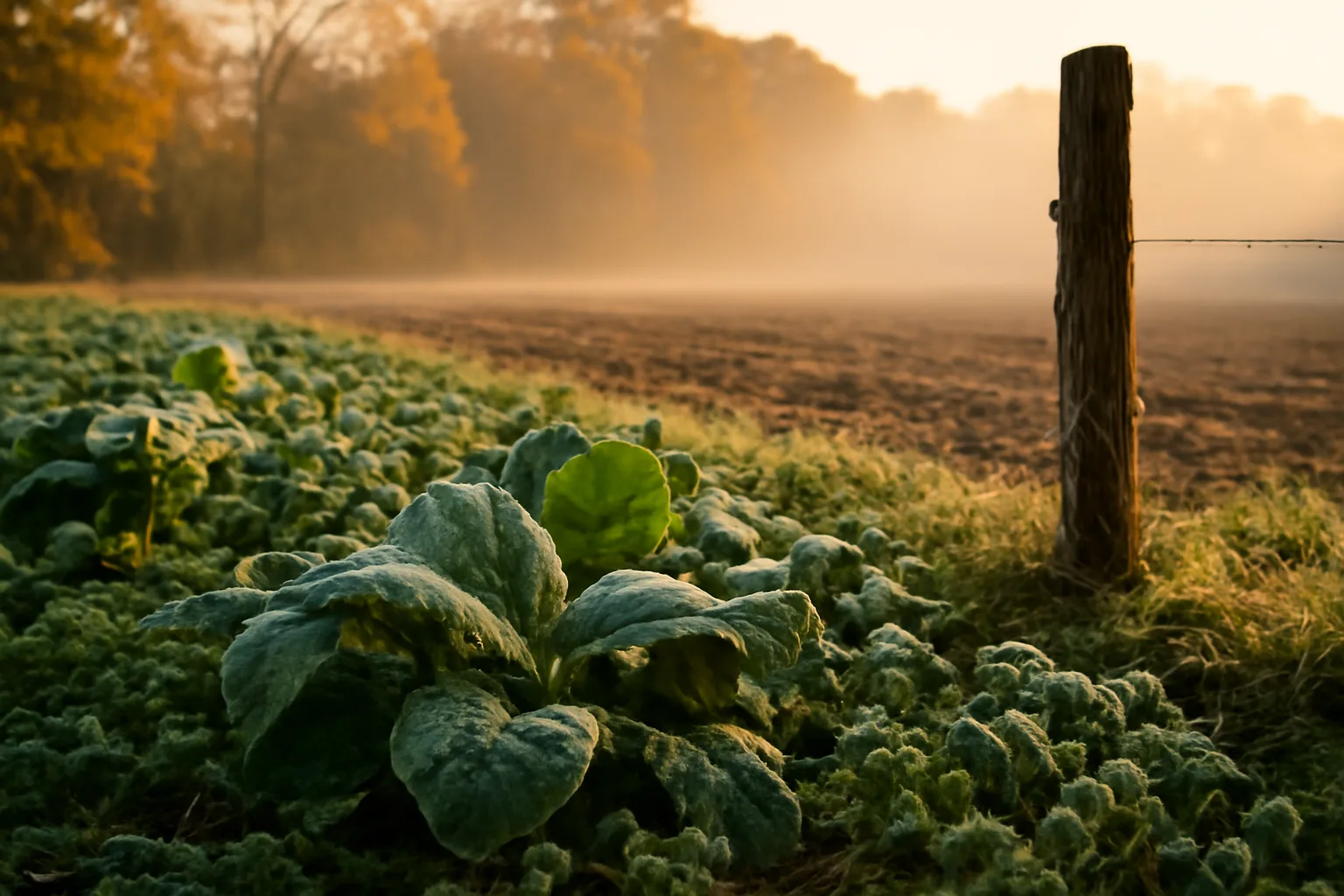
The core food plot plants are clover (perennial protein), brassicas like turnips and radish (fall energy), cereal grains like oats and wheat (early attraction and cover), and grain sorghum or corn (carbohydrate and standing cover). Plant timing depends on your zone: brassicas and clover go in late summer, cereal grains in early fall, warm-season plots in late spring.
What is a food plot, exactly
A food plot is a planted patch of forage, grain, or browse on hunting land, put in the ground specifically to feed and hold deer (and often turkey, rabbits, and other wildlife) rather than to sell as a cash crop. Most run anywhere from a quarter acre to several acres, though plenty of guys hunt over plots smaller than a garden. Food plots do two different jobs. It helps to know which one you're planting for. Attraction plots draw deer in for a shot, usually planted small and close to stand sites, heavy on brassicas or cereal grains that deer find in late season when other food is gone. Nutrition plots, usually clover or alfalfa, run all season and are about growing bigger bodies and antlers, not necessarily about killing a deer over them that day. One more thing worth saying plainly: check your state's baiting and feeding regulations before you plant anything near a stand you intend to hunt. Some states draw a legal line between a planted food plot (generally legal) and piled or spread feed (often restricted or banned), and the definitions vary by state wildlife agency. Michigan's Wildlife Conservation Order restricts baiting and feeding of deer in much of the Lower Peninsula, and the Michigan DNR treats standing food plots as a separate category from placed bait piles under its baiting and feeding guidance [1]. Always check your specific state agency page before the season starts.
What are deer's favorite foods
Deer are picky, seasonal eaters, not indiscriminate grazers. Their favorite foods shift with the calendar: in spring and summer they chase protein-rich forbs and legumes, in fall they shift hard toward carbohydrates and fat to build reserves for winter, and in winter they'll eat almost anything with calories including woody browse. Deer research broadly shows whitetails select forbs (broadleaf weeds and legumes) over grasses through most of the growing season, and clover consistently ranks among the most preferred plot forages in browse studies conducted by the USDA Forest Service Southern Research Station [2]. Acorns are usually the single most preferred natural food in fall wherever oaks are present, and deer will often walk past a planted plot for a good acorn drop in a mast year. That's the whole ballgame in a mast year: plots take a back seat to the woods. Among planted crops, the rough pecking order most extension agronomists and wildlife biologists agree on goes something like this: soybeans and cowpeas in summer, clover and alfalfa through the growing season, then brassicas (turnips, radish, rape) and cereal grains (oats, wheat) once cold weather sweetens them up. Corn and grain sorghum matter more for the calories and the standing cover than for being a deer's first choice of taste. If you're building out a full plot rotation and want a species breakdown by acreage and season, the food plot seed guide and deer food plot seed comparison both go deeper on brand-level seed choices.
Do deer like clover, and is it worth planting
Yes. Clover is one of the most consistently preferred food plot forages, and most whitetail biologists rank it at or near the top of the list for spring and summer nutrition. White clovers (ladino types especially) and red clover both test high in crude protein, often 25 to 30 percent in vegetative growth stages, which lines up well with lactating does' and antler-growing bucks' nutritional needs according to University of Georgia Extension forage testing data [3]. Clover's real advantage is that it's a perennial. A well-maintained stand of ladino or red clover can produce for three to five years off one planting, which makes it cheaper per season than annuals even though the seed costs more up front. University extension guidance generally recommends a soil pH of 6.0 to 6.5 for clover plots for good nodulation and nitrogen fixation, and liming acidic soil is usually the single biggest yield fix a landowner can make [3]. The tradeoff is clover needs mowing two to four times a season to stay vegetative and keep from getting shaded out by weeds, and it does not tolerate standing water or heavy shade well. If you want a low-maintenance perennial and you're willing to mow, clover is close to the default answer. For a full comparison of clover against other food plot species, see the food plot whitetail breakdown.
Do deer eat sorghum
Yes, deer eat grain sorghum (milo), though it's rarely their first choice compared to soybeans, clover, or corn. Sorghum matters more for what it does structurally: it grows tall, stands up through snow and wind better than corn in a lot of regions, and gives late-season cover along with grain. Deer will hit standing sorghum heavily in late fall and winter once the heads dry down and other food thins out, and it's a common component in wildlife food plot mixes sold specifically for that reason. Extension guidance from Kansas State University lists grain sorghum as a viable dryland option for wildlife plantings in regions too dry or too short-season for corn, since sorghum tolerates drought better and needs less nitrogen per bushel of yield . If you're in a drier region or on sandy soil where corn struggles, sorghum is a smart substitute that still gives you the standing grain and cover benefit at lower input cost. It's not a plot most guys plant alone; it usually shows up mixed with soybeans or as a border planting around a clover or brassica field.
When to plant food plots for deer (by season and zone)
| 3-4 (northern MN, WI, ND) | Late May-early June | Early-mid August | |
|---|---|---|---|
| 5-6 (southern WI, IA, OH, PA) | Mid-late May | Mid August-early Sept | |
| 7 (VA, NC, TN, AR) | Late April-May | Early-mid September | |
| 8-9 (deep South, TX, FL) | March-April | Late Sept-October | These windows come from land-grant extension planting calendars, adjusted for regional frost dates published by NOAA's climate normals . Your local extension office will have a tighter window for your specific county, and that's worth a phone call before you buy seed. A $99 Custom Food Plot Plan can take your zip code, soil test, and equipment list and hand you exact planting windows and species picks for your ground, which saves the guesswork of cross-referencing four different extension PDFs. It's general guidance built off your inputs, not site-specific agronomy; your soil test lab is still the final word on lime and fertilizer rates. |
Timing is the single biggest variable in food plot success, and it depends far more on your first frost date and soil temperature than on a calendar date that works nationwide. Broadly, there are two planting windows: spring/early summer for warm-season annuals and perennials, and late summer/early fall for cool-season annuals. Spring plots (soybeans, cowpeas, corn, clover establishment) generally go in after your last frost date, when soil temps hit 55 to 60 degrees F, which in most of the whitetail's range falls between mid-April and early June depending on latitude. Fall plots (brassicas, cereal grains, clover overseed) go in 60 to 90 days before your average first hard frost, which gives brassicas time to bulb and cereal grains time to establish before dormancy. Here's a rough breakdown by USDA plant hardiness zone, cross-referenced against university extension planting guides: | Zone | Spring plot window | Fall plot window |
When to plant oats for deer
Plant oats 6 to 8 weeks before your first fall frost date, which lines up with late August through mid-September across most of the whitetail range, or in early spring (March-April) in the South where mild winters allow a spring oat crop too. Oats germinate fast, often in 5 to 7 days in warm soil, and deer will hit young oat shoots almost immediately. Oats are a cool-season annual grain and one of the fastest, cheapest ways to get green in the ground for early bow season. They winterkill in most northern zones once temps drop into the teens for extended periods, so in zones 4 and colder they're really a fall-only attraction plot, not a food source that carries into late winter. Further south (zone 7 and warmer), oats can survive winter and provide forage into late season. Oat seed is cheap, usually $15 to $25 per 50-pound bag depending on region, and a lot of plot mixes use it as a nurse crop to shade out weeds while clover or brassicas establish underneath. If you're planting a mix, drop the oat seeding rate to around a third of the straight rate so it doesn't outcompete the clover you're trying to establish.
When to plant turnips for deer
Plant turnips 90 to 100 days before your first expected fall frost, which for most of the whitetail's range falls between late July and mid-August. Turnips need that long runway to bulb out and reach the sugar content that makes them attractive once cold weather hits. Turnips (and other brassicas like radish and rape) go through a chemical change after the first hard frost: starches convert to sugars, which is why deer often ignore a brassica plot in September and hammer it in December. This is one of the most consistent patterns in whitetail food plot behavior and it's the reason brassica plots are planted as late-season attraction, not early bow season draws. General brassica planting guidance from University of Georgia Extension recommends a soil pH of 6.0 to 6.8 and notes that brassicas are heavy nitrogen feeders, generally needing 50 to 100 pounds of actual nitrogen per acre depending on soil test results [3]. Skimping on nitrogen is the most common reason a turnip plot looks thin and gets ignored; deer will walk past a stunted plot for better forage elsewhere. If your plot gets hit hard the moment it comes up and never recovers, that's usually a sign the plot is too small for your deer density, not a species problem. A half-acre brassica plot in an area with heavy deer pressure can get grazed to the dirt before it ever bulbs.
Do deer like honey (and does honey belong in a food plot)
No, honey has nothing to do with food plots and deer don't seek it out as a natural forage item. This question usually comes from confusion with commercial deer attractant products that use sugar, molasses, or apple scent, some of which are marketed with names that reference sweetness. Deer can taste sweetness and will investigate sugary substances out of curiosity, but honey isn't part of a whitetail's natural diet and there's no wildlife research showing it functions as an attractant the way a mineral lick or a brassica plot does. If you're looking at a mineral or attractant product, check your state wildlife agency's baiting rules first. Many states classify any placed scent, mineral, or feed product under baiting law even if the product itself is legal to buy [1]. A planted food plot is a different legal category in most states, but adding sprays or granular attractants to it can sometimes cross into baiting territory depending on how your state defines the term.
What's the best soil pH and fertility setup for food plot plants
Most food plot species, clover, brassicas, cereal grains, and soybeans included, grow best in a soil pH range of 6.0 to 7.0. Below pH 6.0, nutrient availability drops fast, especially phosphorus, and legumes like clover struggle to fix nitrogen through their root nodules regardless of how much fertilizer you add. A soil test is the only honest way to know where you stand, and most land-grant universities run them for landowners for $10 to $20 through the county extension office. Your results will come back with a specific lime and fertilizer recommendation for the crop you tell them you're planting; that recommendation, not a generic blog number, is what you should follow. Lime takes months to fully react in the soil, so testing and liming in fall for a spring planting (or vice versa) gives it time to work. Nitrogen, phosphorus, and potassium (N-P-K) needs vary a lot by species. Legumes like clover and soybeans need starter phosphorus and potassium but little nitrogen since they fix their own. Brassicas and cereal grains are nitrogen-hungry and will look pale and stunted without 40 to 100 pounds of actual nitrogen per acre split across the season, depending on your soil test [3]. If you want the full mechanics of pulling a soil sample correctly and reading the results, that's a separate topic worth its own read. Short version: sample 6 to 8 inches deep, pull 10 to 15 cores per plot, and mix them into one composite sample per field.
Cool-season vs warm-season food plot plants: how to pick
| Perennial legume | White/red clover, alfalfa | All season, best spring-summer | 6.0-6.5 | |
|---|---|---|---|---|
| Cool-season annual grain | Oats, wheat, rye | Early fall bow season | 6.0-7.0 | |
| Brassica | Turnips, radish, rape | Late season, post-frost | 6.0-6.8 | |
| Warm-season legume | Soybeans, cowpeas | Summer, early bow season | 6.0-6.8 | |
| Warm-season grain | Corn, grain sorghum | Late season standing cover | 5.8-6.8 | Most experienced plotters run at least two of these categories on a property: a perennial clover field for season-long nutrition and a fall annual plot (brassica or cereal grain) for late-season hunting pressure. If you're mapping out which combination fits your acreage, the deer food plots and deer for food guides both cover species pairing in more depth. |
Cool-season plants (clover, brassicas, oats, wheat, rye) grow best in spring and fall temperatures, roughly 40 to 75 degrees F, and most either go dormant or die back in summer heat. Warm-season plants (soybeans, cowpeas, corn, grain sorghum) need summer heat to thrive and will not tolerate frost. The mistake a lot of first-time plotters make is planting a warm-season bean plot expecting it to still be green in November, or planting brassicas in June expecting deer to hit them right away. Match the plant to the season you're targeting: early bow season and turkey season favor warm-season summer plots or early cool-season grains, while late gun season and post-rut hunting favor brassicas and standing corn or sorghum. | Category | Examples | Best hunting window | Soil pH target |
How much seed and how big should a plot be
Seeding rates vary widely by species, and going too heavy wastes seed while too light lets weeds win the competition. Clover typically goes down at 6 to 8 pounds per acre broadcast, oats at 100 to 120 pounds per acre, and brassica blends at 4 to 6 pounds per acre, though exact rates depend on the specific variety and whether you're drilling or broadcasting [3]. Plot size matters as much as species choice. A quarter-acre plot in heavy deer density can get grazed down before it ever produces, especially brassicas and clover in their first few weeks. Wildlife biologists generally recommend food plots make up 1 to 3 percent of total property acreage split across multiple smaller plots rather than one large field, since scattered plots spread pressure and give deer more edge habitat to bed near. If you're working with less than 5 acres total, one well-placed half-acre to one-acre plot is usually plenty; on larger tracts, three or four plots of a half-acre to two acres each, spread across the property, do more for deer movement and hunting opportunity than one big field.
Common mistakes with food plot plants
The most common mistake is skipping the soil test and fertilizing blind. Without a test you're guessing at lime and N-P-K rates, and acidic soil (below pH 6.0) can cut yield by half or more regardless of how much fertilizer goes down, since nutrients simply aren't available to the plant at low pH [3]. The second most common mistake is planting the wrong species for the hunting window you actually want. Brassicas planted for October bow season won't be sweet yet; clover planted for a late-December gun hunt will likely be dormant or browsed to nothing. Match species to the calendar section above, not to whatever's on sale at the farm store. Third: plots too small or too shaded. Anything under half an acre in moderate to heavy deer density risks getting hammered before it establishes, and plots tucked into full shade rarely produce enough tonnage to matter, clover included. Full sun or close to it (6+ hours) is the baseline for almost every food plot species. Last, a lot of guys skip mowing clover and let it get shaded out by grass and weeds within two seasons. Two to four mowings a year, timed to keep clover 6 to 8 inches tall, keeps a perennial stand productive for its full 3 to 5 year lifespan instead of needing a reseed after year one.
Frequently asked questions
Do deer eat sorghum?
Yes. Deer eat grain sorghum (milo), especially in late fall and winter once the heads dry down. It's not usually their first choice compared to soybeans or corn, but it tolerates drought better than corn and provides standing cover through winter, which is why it shows up in a lot of dryland wildlife seed mixes.
Do deer eat clover?
Yes, clover is one of the most preferred food plot forages for whitetails through spring and summer, often testing 25 to 30 percent crude protein in vegetative growth. It ranks near the top of most university browse preference studies, alongside soybeans and other legumes.
When should I plant food plots for deer?
Warm-season plots (soybeans, corn, clover establishment) go in after your last spring frost, roughly mid-April to early June depending on zone. Fall plots (brassicas, cereal grains) go in 60 to 100 days before your first fall frost, typically August through September. Check your local extension office for exact dates in your county.
Do deer like clover more than other food plot plants?
Clover consistently ranks at or near the top in preference studies, particularly during spring and summer growth. It's not always their absolute favorite (soybeans and natural acorns can outrank it seasonally) but it's one of the most reliable, season-long draws a landowner can plant.
When do you plant oats for deer food plots?
Plant oats 6 to 8 weeks before your first fall frost, generally late August to mid-September in most of the whitetail range. In warmer zones (7 and south), oats can also go in as a spring crop in March or April. Oats germinate in about 5 to 7 days in warm soil.
When should turnips be planted for deer?
Plant turnips 90 to 100 days before your first fall frost, usually late July through mid-August depending on region. Turnips need that time to bulb before cold weather converts their starches to sugar, which is what makes them attractive to deer in late season.
What exactly is a food plot?
A food plot is a planted area of forage, grain, or browse on hunting or wildlife land, put in specifically to feed and attract deer and other wildlife. Plots range from a quarter acre to several acres and serve either as season-long nutrition (clover, alfalfa) or late-season hunting attraction (brassicas, cereal grains).
What are deer's favorite foods overall?
Acorns typically top the list when available. Among planted crops, soybeans, clover, and alfalfa rank highest in summer, while brassicas and cereal grains take over once frost sweetens them in fall. Preference shifts constantly with season, availability, and local deer density.
Do deer like honey or sweet attractants?
Deer aren't naturally drawn to honey; it's not part of their diet and there's no wildlife research supporting it as an effective attractant. Commercial sugar or molasses-based products can draw some interest from curious deer, but check your state's baiting laws before using any scent or feed product near a stand.
What soil pH do most food plot plants need?
Most food plot species, including clover, brassicas, and cereal grains, do best between pH 6.0 and 7.0. Clover specifically needs 6.0 to 6.5 for good nitrogen fixation. A soil test through your county extension office, usually $10 to $20, is the only reliable way to know your actual number.
How big should a deer food plot be?
Most wildlife biologists suggest food plots total 1 to 3 percent of a property's acreage, split across several smaller plots rather than one large field. On small properties (under 5 acres), a single half-acre to one-acre plot is usually enough; larger tracts do better with three or four scattered plots.
Can I plant clover and brassicas in the same plot?
Not usually as a straight mix, since they compete differently for nitrogen and have different mowing needs. A more common approach is planting them in adjacent plots or rotating a field between a clover base and an annual brassica overseed once the clover stand ages out after 3 to 5 years.
Sources
- Michigan Department of Natural Resources, Baiting and Feeding Regulations: Michigan restricts baiting and feeding of deer under DNR regulations, with food plots treated as a distinct category from placed bait
- USDA Forest Service, Southern Research Station, General Technical Report SE-006: Deer select forbs and legumes over grasses through most of the growing season, with clover ranking among top preferred forages
- University of Georgia Extension, Bulletin 1348, Establishing and Managing Wildlife Food Plots: White and red clover test 25 to 30 percent crude protein during vegetative growth stages; brassica pH and nitrogen guidance; general seeding rates
- Kansas State University Extension, MF3122, Grain Sorghum Production Handbook: Grain sorghum is a viable dryland wildlife planting option that tolerates drought better than corn
- NOAA National Centers for Environmental Information, U.S. Climate Normals: Regional first and last frost dates used to set spring and fall planting windows