Last updated 2026-07-24
TL;DR
Food plot design means matching plot shape, size, species, and planting date to your soil, sunlight, and hunting pressure. Most plots fail from wrong timing or skipped soil tests, not seed choice. A good plot is 1/4 to 2 acres, tested and limed to pH 6.0-6.5, planted 2-3 weeks before your area's first fall frost for annuals, and shaped so deer feel safe entering it at dusk.
What is a food plot, exactly?
A food plot is a planted patch of forage on hunting land, meant to feed deer and other wildlife while giving hunters a predictable place to watch or hunt from. It's not a garden and it's not a farm field, even though the agronomy overlaps with both. The goal is a small, deliberate planting that fits into how deer already move through your property. Most plots fall into one of two functional categories: destination plots (bigger, food-focused, planted where deer feel comfortable feeding in daylight) and transition or kill plots (small, tucked tight to bedding, meant for catching deer on their way somewhere else). Design decisions change depending on which job the plot is doing. A half-acre plot next to a bedding thicket needs different shape and access than a three-acre clover field in the middle of a property. The USDA's National Agroforestry Center and state wildlife agencies both treat food plots as a wildlife habitat tool, not a farming operation, which matters for how you think about yield. You're not optimizing bushels per acre. You're optimizing tonnage of quality forage available exactly when deer need it most: late summer stress, the rut, and the post-rut calorie crunch of late winter [1]. If you want a structured starting point, food plot whitetail planning breaks down plot types by hunting function, which pairs well with the design principles here.
When to plant food plots for deer (by season and zone)
| Upper Midwest / Northeast | late July - mid August | mid August - early September | |
|---|---|---|---|
| Mid-South / Mid-Atlantic | mid August - early September | September | |
| Deep South | September - early October | October | These are starting points, not guarantees. Local frost dates vary year to year, and your county extension office will have better data than any national chart. For specific seed blends matched to these windows, see deer food plot seed. |
Timing depends on whether you're planting a spring/summer plot or a fall plot, and where you live. Get this wrong and even perfect soil and seed won't save you. Spring plantings (clover, chicory, soybeans, cowpeas) generally go in after your last frost date, when soil temps are consistently above 50-55°F. In the Upper Midwest and Northeast that's often late April into May. In the Southeast it can be March. Check your state extension's frost date tables rather than guessing; Penn State Extension and University of Tennessee Extension both publish regional planting windows for exactly this reason [2]. Fall plantings (brassicas, cereal grains, annual clover) are timed backward from your first expected fall frost, because you want mature, palatable forage right as hunting season opens and deer shift into a fat-building pattern. A common rule of thumb from extension foragers: plant brassicas 90-100 days before your first hard frost, and cereal grains like oats or wheat 60-90 days before it [2]. That means late July through early September across most of the whitetail's range, with northern states planting earliest. Here's a rough framework: | Region example | Fall brassica planting window | Fall cereal grain window |
When to plant oats for deer
Oats are almost always a fall planting for deer plots, not spring, because their real value is providing high-sugar, high-palatability forage right through hunting season and into early winter. Plant oats 6 to 10 weeks before your first fall frost so they have time to establish a few inches of growth before cold slows them down [2]. In much of the whitetail range that lands in late August to mid-September. Oats germinate fast, often within 5-10 days in warm soil, and deer will hit them hard as soon as they're a few inches tall. They're also cheap insurance if you're not sure your soil is dialed in yet, since oats tolerate a wider pH range than clover. One caution: oats alone don't survive hard winters. In zones with regular sub-20°F nights, oats will winterkill and stop producing new growth, so pair them with a brassica or a winter-hardy cereal like winter wheat or triticale if you want food into late season.
When to plant turnips for deer
Turnips are a fall brassica, and timing is tighter than most people think. Plant turnips 80 to 100 days before your first killing frost, which in most of the Midwest and Northeast lands between late July and mid-August [2]. Wait too long and the bulbs won't size up before growth stops; plant too early in hot, dry August soil and germination suffers. Turnips need a real cold snap to convert starches to sugars, which is why deer often ignore turnip tops and bulbs early in the season and then hammer them after the first hard frost. That's normal, not a failed plot. If you're hunting early season over turnips and deer aren't touching them, that's likely why. Soil pH matters more for brassicas than people expect. University of Tennessee Extension and other land-grant programs recommend a target pH of 6.0 to 6.5 for brassica plots, with lime applied months ahead of planting since it takes time to move through soil [2] [3]. A fall plot planted in July needs lime applied that spring, or ideally the prior fall, not two weeks before seeding.
Do deer eat clover, and do they actually like it?
Yes. Clover is one of the most consistently used food plot forages across whitetail range, and it's a fair default answer to "what's a deer's favorite food." White clover and red clover both show up repeatedly in deer diet studies and extension forage guides as high-preference, high-protein forage, often tested at 20-25% crude protein in vegetative growth stages. Clover's real advantage is season length. Planted correctly (spring or late summer/early fall) and maintained with mowing and occasional herbicide for weed control, a good clover stand can produce from spring through the following two or three years, giving you a low-maintenance perennial anchor plot instead of replanting annuals every season. The tradeoff is establishment. Clover seed is tiny and needs good seed-to-soil contact, moisture, and a pH near 6.0-6.5 to nodulate properly with rhizobium bacteria and fix nitrogen [3]. Broadcasting clover onto rough, unprepared ground is the single most common way people waste a bag of seed. For a deeper species comparison, deer food plots covers clover against other perennial options.
Do deer eat sorghum?
Yes, deer will eat grain sorghum (milo) and browse young sorghum plants, but it's not a top-tier food plot choice on its own. Sorghum is more commonly planted as a screening or cover crop in food plot mixes, or as a drought-tolerant grain component in wildlife blends, rather than as the primary attractant. Whitetail deer diet studies consistently rank sorghum below soybeans, clover, and standing corn in preference when those options are available. Where it earns a spot is in dry, sandy, or drought-prone ground where corn and soybeans struggle. It also works well as a tall screening border around a plot, giving deer a sense of security while approaching more palatable forage in the plot's center. If sorghum is in a blend you're considering, treat it as a supporting player, not the headline crop.
Do deer like honey (and does it belong in a food plot)?
Deer don't eat honey in any meaningful wild dietary sense, and it has no legitimate role in food plot design. This question shows up online mostly from confusion with honeysuckle (which deer do browse heavily) or from bait/attractant marketing that includes honey-based scents or molasses-sweetened mineral licks. If you're seeing "honey" mentioned around deer attractants, it's almost always a molasses or sugar-based additive in a mineral supplement, not a food plot forage. Worth noting: many states restrict or ban baiting and supplemental feeding, including sugar-based attractants, especially in areas managing chronic wasting disease. Check your state wildlife agency's regulations before using any feed, mineral, or attractant product, since rules vary widely and change year to year.
What are deer's favorite foods, ranked by what the data shows?
| Soybeans (forage stage) | Summer | 25-30% | |
|---|---|---|---|
| Clover (white/red) | Spring-fall | 20-28% | |
| Cowpeas | Summer | 20-30% | |
| Brassicas (post-frost) | Late fall/winter | 15-20% (bulbs lower, tops higher) | |
| Oats | Fall | 12-20% | |
| Corn (grain) | Fall/winter | 8-10% | These numbers vary by soil fertility, maturity stage, and lab method, so treat them as ranges, not lab-certified guarantees for your specific field. |
There's no single universal answer, because preference shifts by season, region, and what's naturally available. But across food habit studies and extension forage trials, a few patterns repeat. Soybeans and cowpeas rank at or near the top during summer growing season, both for pod/foliage tonnage and protein content, often 30%+ crude protein in cowpea forage [4]. Clover is the most consistent year-round performer because of its long growing window and steady protein. Brassicas (turnips, radishes, rape) become high-preference only after frost sweetens them, so they matter most in late season. Acorns, where available, generally outrank all planted forage in fall because of fat content, which is why plots near oak stands often get less traffic in a heavy mast year. A reasonable ranked summary for planted food plot species, based on extension forage trial data and observed deer use [4]: | Forage | Season of peak use | Approx. crude protein |
How big should a food plot be, and what shape works best?
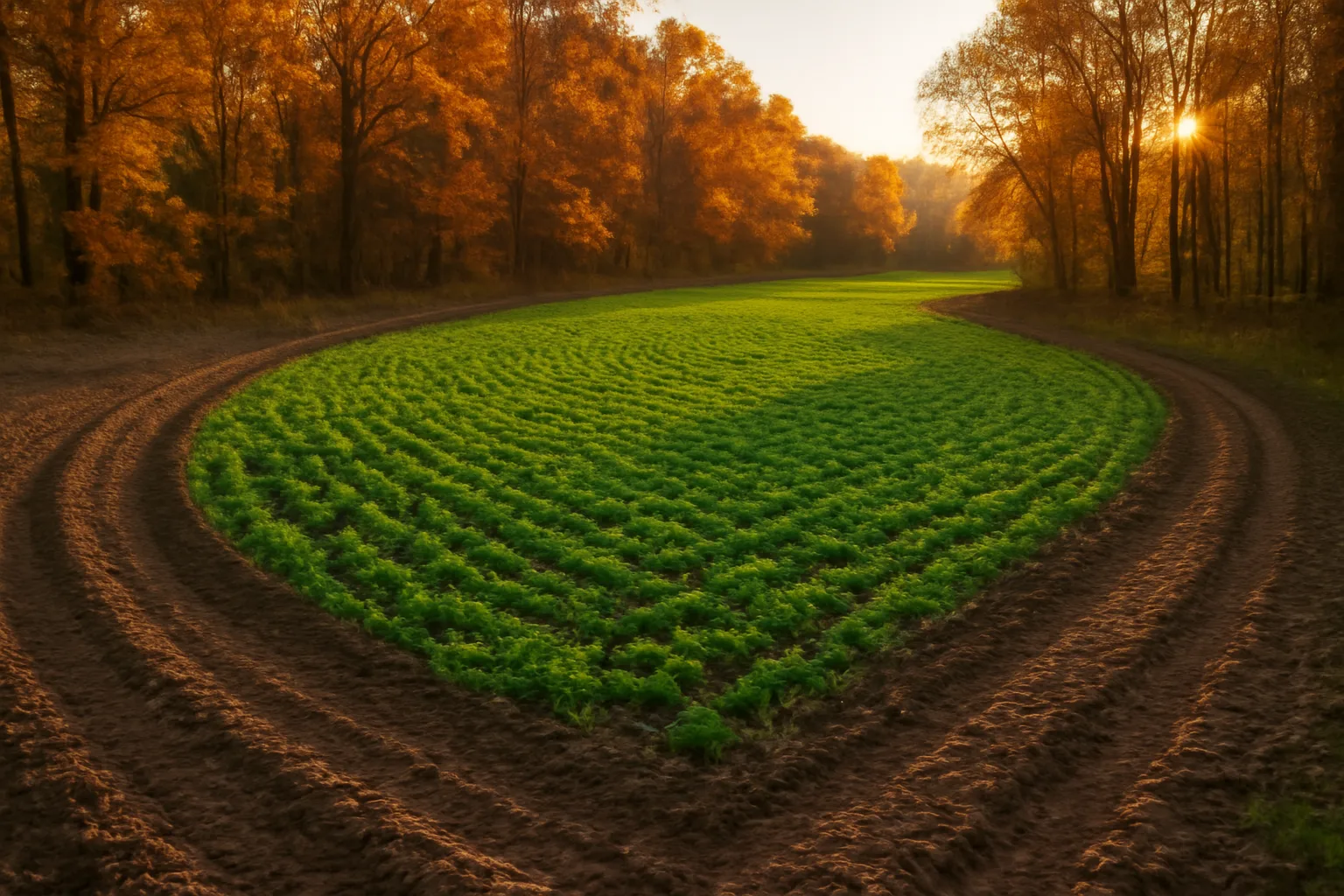
Size depends on the plot's job. Destination plots meant to hold and feed deer generally run 1 to 5 acres. Kill plots or transition plots tucked near bedding work better small, often 1/4 to 1/2 acre, because a tight plot gives deer confidence to enter in daylight without feeling exposed. Shape matters as much as size. Long, irregular, kidney-shaped plots with curves and pinch points create more edge and more comfortable entry points than a square or rectangle. Deer, like most prey animals, prefer moving along edges rather than crossing open ground in the middle of a field. A plot with two or three finger-like extensions into the surrounding timber gives bowhunters more usable entry and shooting lanes than one open block. Access and wind matter more than most first-time plotters expect. Plan entry and exit trails that let you get to a stand without walking through the plot or crossing a deer's likely approach. A beautifully designed plot that you can't access without spooking deer is a wasted plot.
Soil testing and fertility: the part that actually determines success
A soil test costs $10-20 through most university extension labs and takes 1-2 weeks to get results. It's the cheapest insurance in the entire food plot process, and it's the step most people skip. Most food plot species want a soil pH between 6.0 and 6.5. Below that, phosphorus becomes less available to plants regardless of how much fertilizer you spread, and legumes like clover struggle to fix nitrogen [3] [5]. If your test comes back at 5.2, no amount of extra fertilizer fixes that; you need lime, and lime needs months to move through the soil profile before it changes pH meaningfully. Your soil test report, not a blog article, is the real authority here. Labs give you specific lime and fertilizer rates in pounds per acre based on your field's actual chemistry, and those numbers can vary a lot between two fields a mile apart. Follow what your test says over any generic recommendation, including this one. If you've got a test in hand and want it turned into an actual seed and layout plan, that's the specific gap our $99 one-time Custom Food Plot Plan is built to fill. It takes your soil results, region, and plot goals and turns them into a concrete planting plan, but it's guidance, not a guarantee of deer activity or a harvest.
What equipment do you actually need to plant a food plot?
At minimum: a way to kill existing vegetation (herbicide and a sprayer, or tillage), a way to prepare seedbed (disc, tiller, or no-till drill), a way to spread seed (broadcast spreader, hand-crank for small plots), and a way to pack seed-to-soil contact (cultipacker or drag). You don't need a tractor to start. A UTV with a small disc and pull-behind spreader handles plots under 2 acres fine. For larger acreage or heavier clay soils, a compact tractor with a 3-point disc, box blade, and PTO spreader saves real time and lets you work ground that's too tough for ATV-scale equipment. No-till drills are worth renting or borrowing if your local co-op or conservation district has one, especially for small-seeded species like clover, since they get seed to the right depth (usually 1/4 inch) far more reliably than broadcasting alone.
Frequently asked questions
Do deer eat sorghum?
Yes, deer browse sorghum and eat the grain, but extension forage data ranks it below soybeans, clover, and corn in preference [6]. It's more useful as a drought-tolerant screening crop or blend component than as a standalone attractant plot.
Do deer eat clover?
Yes, clover is one of the highest-preference food plot forages available, often testing at 20-28% crude protein and used consistently from spring through fall [6]. White and red clover both perform well when soil pH is maintained at 6.0-6.5.
Do deer like clover more than other food plot options?
Clover generally ranks at or near the top for consistency across the whole growing season, though soybeans and cowpeas can outperform it during peak summer growth. Clover's advantage is that it's a perennial, so one good planting can feed deer for two or three years.
When should I plant food plots for deer?
Spring plots (clover, soybeans) go in after your last frost, typically April-May in the north and March in the Southeast. Fall plots (brassicas, oats) are timed backward from first frost: brassicas 80-100 days before, cereal grains 60-90 days before [4].
When is the best time to plant oats for deer?
Plant oats 6 to 10 weeks before your area's first fall frost, usually late August to mid-September across most whitetail range. Oats germinate fast and provide high-palatability forage right through hunting season, but they winterkill in hard freezes.
When should I plant turnips for deer food plots?
Plant turnips 80 to 100 days ahead of your first killing frost, typically late July to mid-August in most of the Midwest and Northeast [4]. Turnips need a hard frost to sweeten, so deer often ignore them until temperatures drop, which is normal.
What exactly is a food plot?
A food plot is a planted area on hunting land designed to feed deer and other wildlife while giving hunters a predictable place to hunt. It's treated by the USDA and state agencies as a wildlife habitat tool, distinct from commercial farming [1].
What is a deer's favorite food overall?
There's no single answer; it shifts by season. Acorns often outrank planted forage in fall when available. Among planted crops, soybeans, cowpeas, and clover consistently rank highest in preference and protein content across extension studies [6][8].
Do deer like honey?
Not in any real dietary sense. Deer don't seek out honey in the wild; confusion usually comes from honeysuckle (which deer browse heavily) or molasses-based mineral attractants. Honey has no functional role in food plot planning.
What soil pH is best for a deer food plot?
Most food plot species, including clover, brassicas, and cereal grains, do best between pH 6.0 and 6.5 [5][9]. Below that range, phosphorus availability drops and legumes struggle to fix nitrogen even with added fertilizer.
How big does a food plot need to be?
Destination plots meant to hold deer generally run 1 to 5 acres. Small kill plots or transition plots near bedding areas work better at 1/4 to 1/2 acre, since a tight footprint gives deer more confidence to enter in daylight.
How much does a soil test cost and how long does it take?
Most university extension soil labs charge $10-20 per sample, with results back in 1-2 weeks. It's the single cheapest step in food plot planning and determines your actual lime and fertilizer needs, which generic advice can't.
Can I plant a food plot without a tractor?
Yes, for plots under about 2 acres, a UTV pulling a small disc and a broadcast spreader handles most of the work. Larger acreage or heavy clay soil benefits from a compact tractor with a 3-point disc and PTO spreader.
Are there rules against baiting or feeding deer near a food plot?
Yes, and they vary a lot by state, especially in areas managing chronic wasting disease. Check your state wildlife agency's current regulations before using mineral licks, feeders, or supplemental attractants, since a legal food plot and illegal baiting can look similar but are regulated very differently [7].
Sources
- USDA National Agroforestry Center, Wildlife Habitat publications: Food plots are treated as a wildlife habitat tool distinct from commercial agriculture
- University of Tennessee Extension, Wildlife Food Plots: Recommended soil pH target of 6.0-6.5 for brassica and clover food plots
- Mississippi State University Extension, Establishing Wildlife Food Plots: Soil pH and lime timing requirements for legume and brassica establishment
- Noble Research Institute, Food Plots for White-tailed Deer: Forage species preference ranking and protein content comparisons for common food plot crops
- Clemson Cooperative Extension, Soil Testing and Plant Analysis: Soil test cost, turnaround time, and role in determining lime/fertilizer recommendations