Last updated 2026-07-25
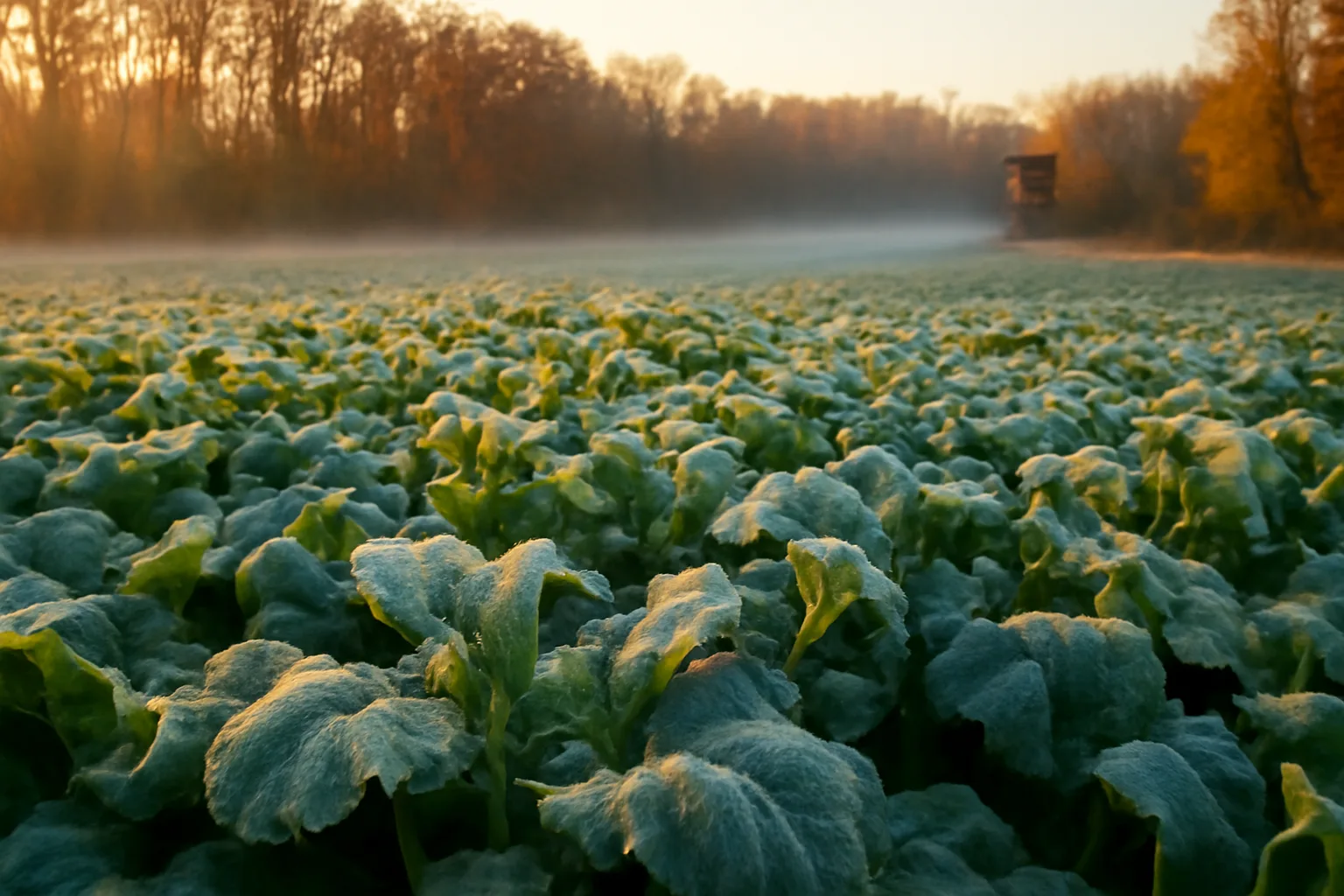
TL;DR
There's no single best fall food plot mix, but a cereal grain (oats or winter wheat) blended with a brassica (turnips or radish) and a perennial clover covers most whitetail ground. Plant 60 to 90 days before your first killing frost, get a soil test first, and match seed to your zone's frost dates.
what is a food plot, exactly
A food plot is a planted patch of forage, usually somewhere between a quarter acre and several acres, put in specifically to feed and hold deer or other wildlife on a property. It's not a garden and it's not a lawn. The goal is tonnage of digestible forage at the right time of year, and enough attraction to keep deer using the property during hunting season. Most plots fall into two buckets: annuals you replant every year (oats, brassicas, clover blends with an annual nurse crop) and perennials you plant once and maintain for three to five years (clover, chicory, alfalfa). Fall plots usually lean annual because you're chasing a specific window: the six to ten weeks before and during hunting season when deer need to pack on fat and protein before winter. The USDA Natural Resources Conservation Service's Environmental Quality Incentives Program supports wildlife habitat plantings on private land, and NRCS conservation practice standards call for matching plant materials to regional soil and climate conditions rather than using a one-size-fits-all mix [1]. That's the whole game: match the plant to your dirt and your frost date, not to whatever bag looks good at the farm store.
when to plant food plots for deer
For fall plots, the rule of thumb most extension agronomists use is 60 to 90 days before your area's average first killing frost. That gives brassicas time to bulb up and cereal grains time to establish a root system before cold weather slows growth. In practice that means late July through August in the Upper Midwest and Northeast (zones with first frost around late September to early October), and late August through mid-September in the Mid-South and southern Appalachians (first frost late October to November). Deep South food plotters in Alabama, Georgia, and Mississippi often wait until September or even early October, since their frost doesn't show up until November or later. Check your state's average first frost date rather than guessing. NOAA's National Centers for Environmental Information publishes 1991 to 2020 U.S. Climate Normals, including frost and freeze date data by station, and most land-grant extension offices publish a simplified frost date map for their state [2]. If you plant brassicas too early in hot weather, flea beetles can hammer seedlings before they establish. Plant too late and turnips never bulb, and clover never gets a real root system before winter dormancy. A practical planning shortcut: pick your local first frost date, count back 90 days for brassica-heavy mixes, count back 60 days for straight cereal grains like oats or wheat. That's your outer planting window, not the only day you can plant.
when to plant oats for deer
Oats for fall deer plots go in 60 to 75 days before first frost, which in most whitetail range lands somewhere between mid-August and mid-September. Oats germinate fast, usually within 7 to 10 days in warm soil, and they're one of the most reliably attractive early-season fall plantings because deer hit tender oat shoots almost as soon as they emerge. Oats aren't cold-hardy the way winter wheat or cereal rye is. A hard freeze in the low 20s will usually kill oats outright, so in northern zones they function as an early-to-mid season attractant rather than a food source that lasts into late winter. If you want forage standing into January, blend oats with winter wheat or cereal rye, both of which tolerate temperatures well below zero and will green back up in early spring. Seeding rate for oats alone runs 100 to 150 lbs per acre broadcast, per Kansas State University Extension guidance on small grain forage production [3]. Drilled rates can run lower, closer to 80 to 110 lbs per acre, because drilling gets better seed-to-soil contact than broadcasting.
when to plant turnips for deer
Turnips need 80 to 90 days before your first hard frost to bulb properly, which is longer than most hunters expect. Plant too late in September and you'll get leafy green growth deer will still eat, but the bulbs, which hold the sugar and starch deer crave after a few frosts convert starch to sugar, never fully develop. In zone 5 and 6 country (Iowa, southern Wisconsin, Pennsylvania, Ohio), that means turnips should go in the ground by early to mid-August. In zone 7 (Virginia, Tennessee, North Carolina piedmont), late August to early September works. Deep South plotters can push into mid-September. Turnip seeding rate alone runs 4 to 6 lbs per acre; in a blend with other brassicas like radish and rape, drop each species proportionally so total brassica seed stays in that same 4 to 6 lb range [4]. Turnips need a firm, shallow seedbed (a quarter inch deep or less) because the seed is tiny and easily buried too deep to emerge.
do deer eat sorghum
Yes, deer eat grain sorghum, both the standing seed heads and, to a lesser extent, the foliage, but it's not a top-tier fall food plot choice for most whitetail hunters. Sorghum is more commonly planted as a screening cover crop or a late-winter grain source than as a primary fall attractant. Whitetail deer will browse young sorghum shoots and will eat the grain heads once they mature, especially in late fall and winter when other food sources thin out. But sorghum's real value in a plot rotation is height and structure. Grain sorghum grows 4 to 7 feet tall, so it works well as a visual screen along property lines or as standing cover that holds deer during shooting light without spooking them off the whole field. If your goal is peak fall attraction, cereal grains, brassicas, and clover will outperform sorghum in most trials. If your goal is cover plus a late-season grain source, sorghum earns a spot in the rotation, particularly in the Southeast where it handles heat and drought better than most cool-season forages.
do deer like clover, and do they eat it
Yes. Clover is one of the most consistently preferred whitetail forages across nearly every region of the country, and it's the backbone of most perennial food plot programs. Deer eat clover from spring green-up through fall, and it stays palatable later into the season than most people assume, especially white clover varieties like Durana and Ladino. Clover's crude protein content typically runs 25 to 30 percent in vegetative growth, which puts it ahead of most brassicas and cereal grains for raw protein [5]. That protein matters most in spring and summer for antler growth and lactation, but clover keeps producing into fall as long as it isn't shaded out or overgrazed. The tradeoff: clover is a perennial, so it needs a real seedbed prep, a soil pH close to 6.0 to 6.5, and mowing or spraying to manage weed competition. It's not a plant-and-forget fall annual. Most hunters run clover as a spring-established perennial plot that then becomes part of the fall rotation alongside annual brassicas and grains planted in an adjacent field or in strips within the same field.
what's actually in the best fall food plot mix
| Oats | 60-75 | 100-150 | Low (dies in low 20s F) | Early to mid fall | |
|---|---|---|---|---|---|
| Winter wheat | 45-75 | 100-120 | High | Fall through spring | |
| Cereal rye | 45-90 | 90-120 | Very high | Fall through spring | |
| Turnips | 80-90 | 4-6 | Moderate (survives light frost, sweetens after) | Late fall/winter | |
| Radish (forage type) | 60-75 | 8-12 | Low to moderate | Early to mid fall | |
| White clover (perennial) | Spring establish, fall use | 6-8 | High once established | Spring through fall | Seeding rates and species tolerances above are drawn from land-grant extension forage publications; always check your own state's guide since rates shift for drilled vs. broadcast application [3] [4]. A workable blend for most of the Midwest and Northeast: 100 lbs oats + 40 lbs winter wheat + 5 lbs turnip + 3 lbs radish per acre, broadcast, culti-packed if you have the equipment. Add clover as a separate spring-planted perennial field if you want spring-through-fall forage in your rotation. For a deeper look at how these species compare side by side, see food plot whitetail and deer food plot seed. |
The honest answer: it depends on your soil, your zone, and how long you need the plot to hold deer. But most successful fall mixes across whitetail range combine three functional groups, more than one species. A cereal grain (oats, winter wheat, or cereal rye) gives you fast germination and early-season attraction. A brassica (turnips, radish, or a blend) gives you late-season tonnage that gets sweeter after frost. A legume (clover or a forage pea) adds protein and, in the case of clover, carries the plot into the following year if it's a perennial variety. Here's how the major categories stack up for a fall planting: | Species | Days to plant before frost | Seeding rate (broadcast, lbs/acre) | Cold tolerance | Peak attraction window |
what do deer actually prefer to eat in the fall
Deer preference shifts hard with the seasons and it's driven by energy needs, not habit. In fall, whitetails are shifting from a summer diet heavy in forbs and browse toward anything that helps them build fat reserves for the rut and winter: acorns, soybeans, standing corn, and the sugars in frosted brassicas. Acorns are the single biggest natural fall food source in most of whitetail range, and deer will often abandon a food plot entirely during a heavy acorn drop. Long-running deer research out of the University of Georgia's Warnell School of Forestry and Natural Resources, including work published in the Journal of Wildlife Management on white-tailed deer diet composition, has found that deer shift heavily toward acorns and other hard mast when a good mast crop is on the ground, often at the expense of other forage (Wentworth et al., Journal of Wildlife Management, 1992) [6]. That's not a plot failure, that's deer being efficient: acorns pack more fat calories per pound than nearly anything you can plant. Once acorns run out (usually by late November to December in most of the whitetail range), attention swings back hard to standing brassicas, clover, and cereal grains. This is why plotters who hunt frost-sweetened turnips in December often report much stronger deer activity than those same fields saw in October, when acorns were still falling.
do deer like honey (and other odd claims worth clearing up)
There's no wildlife research or extension data supporting the idea that deer are specifically attracted to honey, and it's not a legitimate food plot or attractant ingredient. Deer do have a documented preference for sugars, which is exactly why frost-sweetened brassicas and sugar beets pull deer in late season; the frost converts starches to simple sugars in the plant tissue. Some commercial deer attractant products use sugar-based additives (molasses, sweet feed) mixed into mineral or supplemental feed, but that's a different category than a food plot, and it runs into state baiting law fast. A lot of states classify any placed feed, mineral, or scent lure meant to attract deer to a specific spot as bait, and hunting over it during season is illegal in a growing number of jurisdictions. Before you add any mineral, scent, or supplemental feed component to a plot setup, check your state wildlife agency's baiting and feeding regulations directly. Rules vary a lot: some states ban baiting outright, some allow it outside a certain distance from a stand, some allow mineral but not grain. Don't assume last year's rule still applies; baiting and feeding restrictions in and near chronic wasting disease management zones change from year to year in several states, so verify the current-season rule with your state wildlife agency before hunting season opens.
how soil test results should change your fall mix
Your soil test is the single most useful piece of paper in your food plot planning process, and it should change what you plant, more than how much lime you add. Most brassicas and clovers want soil pH between 6.0 and 6.5. Below pH 5.5, nutrient availability drops hard, especially phosphorus, and no amount of fertilizer fixes a pH problem. Lime takes months to fully react in the soil, so if your test comes back at pH 5.0, you're not fixing that before this fall's planting. Cereal grains like oats, wheat, and rye are more pH-tolerant than clover or brassicas and will produce a usable stand down to pH 5.5 or even a bit lower, per Kansas State University Extension guidance on small grain forage tolerance [3]. So a low-pH field that hasn't been limed yet is often a better candidate for a straight cereal grain fall plot than for brassicas or clover, which will struggle and underperform until the lime has time to work. Your soil test lab is the authority on exact lime and fertilizer rates for your specific field; the numbers on the report account for your soil's buffer capacity, which varies by clay content and organic matter and can't be estimated from a mix bag label alone. Follow the lab's recommendation over any generic rate you find online, including this one. If you want a starting point pulled together for your specific zone and soil report, that's exactly what PlotSeason's $99 one-time Custom Food Plot Plan is built for: you upload your soil test and property details, and it maps out species, rates, and timing for your ground. It's general planning guidance built from your numbers, not a substitute for your soil lab's specific lime and fertilizer recommendation.
equipment and prep that actually make a fall mix work
The best seed mix in the world fails on a bad seedbed. Brassica seed especially is tiny and needs to sit within a quarter inch of the surface with real seed-to-soil contact, which means either a cultipacker pass after broadcasting or a no-till drill set shallow. Minimum viable setup for a small plot (under 2 acres): a broadcast spreader (even a handheld one works for small plots), a way to break up existing sod or weeds (disc, tiller, or a burn-down herbicide application 2 to 3 weeks ahead), and something to firm the seedbed after spreading, even if that's just driving an ATV tire over it or dragging a chain-link section. For larger plots, a no-till drill solves a lot of problems at once: it cuts through existing residue, places seed at a consistent depth, and firms the row behind it, all in one pass. If you're renting or borrowing equipment, a drill is worth the extra cost over broadcasting, particularly for cereal grains where depth control matters for even germination. Whichever method you use, don't skip a burn-down or tillage pass if the field has standing weeds or old crop residue. Seed that lands on top of thatch rarely germinates well, no matter how good the mix is. For more on matching seed selection to your setup, see deer food plots and food plot seed.
Frequently asked questions
Do deer eat sorghum?
Yes, deer eat both grain sorghum heads and young foliage, especially in late fall and winter. It's not a top fall attractant compared to brassicas or cereal grains, but it works well as tall screening cover or a late-winter grain source in the Southeast where it tolerates heat and drought.
Do deer eat clover, and do they like it?
Yes, clover is one of the most preferred whitetail forages nationwide. It runs 25 to 30 percent crude protein in vegetative growth and stays palatable from spring through fall. It's a perennial, so it needs real seedbed prep and pH near 6.0 to 6.5 to thrive.
When should I plant food plots for deer in the fall?
Plant 60 to 90 days before your area's average first killing frost. Cereal grains like oats need about 60 to 75 days; brassicas like turnips need closer to 80 to 90 days to bulb properly. Check NOAA frost date normals or your state extension office for your specific date.
When should I plant oats for deer?
Plant oats 60 to 75 days before your first hard frost, usually mid-August to mid-September across most whitetail range. Oats germinate in 7 to 10 days but aren't cold-hardy; a hard freeze in the low 20s kills them, so pair oats with winter wheat or rye if you want forage into winter.
When should I plant turnips for deer?
Plant turnips 80 to 90 days before your first hard frost so bulbs have time to develop. That's early to mid-August in zone 5 and 6 areas, late August to early September in zone 7, and mid-September or later in the Deep South.
What is a food plot?
A food plot is a planted area, typically a quarter acre to several acres, put in specifically to feed and attract deer or other wildlife. It's distinct from row-crop agriculture; the goal is forage quality and attraction timed to hunting season and seasonal deer nutrition needs.
What are deer's favorite foods in the fall?
Acorns top the list where available; deer will often abandon food plots during a heavy mast drop because acorns pack more fat calories per pound. Once acorns run out, usually by late November or December, deer shift heavily to standing brassicas, clover, and cereal grains.
Do deer like honey?
There's no wildlife research supporting honey as a deer attractant or food plot ingredient. Deer are drawn to sugars, which is why frost-sweetened brassicas work so well late season, but that's a plant chemistry effect, not evidence deer seek out honey itself.
What's the best fall food plot mix overall?
There's no single best mix; it depends on zone and soil. A blend of a cereal grain (oats or winter wheat), a brassica (turnips or radish), and a perennial clover covers early attraction, late-season tonnage, and spring-through-fall protein across most whitetail range.
How much seed do I need per acre for a fall brassica plot?
Turnips alone run 4 to 6 lbs per acre broadcast; in a blend with radish or rape, keep total brassica seed in that same range, dividing proportionally between species. Cereal grains like oats need a much higher rate, 100 to 150 lbs per acre broadcast.
Can I plant a fall food plot without a soil test?
You can, but you're guessing on pH and fertility, and a wrong pH guess can cost you an entire season of growth since lime takes months to fully react in soil. A soil test costs about $10 to $20 through most state extension labs and pays for itself in one planting decision.
Is it legal to add mineral or sweet feed to a food plot?
It depends on your state. Many states classify placed mineral, grain, or scent attractants as bait, and hunting over them during season can be illegal, especially in chronic wasting disease management zones. Check your state wildlife agency's current baiting and feeding regulations before adding anything beyond planted forage.
Sources
- USDA Natural Resources Conservation Service, Environmental Quality Incentives Program: Conservation program guidance treats food plot plantings as a wildlife habitat practice matched to regional soil and climate conditions
- NOAA National Centers for Environmental Information, U.S. Climate Normals 1991-2020: Average first frost dates by station used to time fall food plot planting windows
- Kansas State University Extension, Small Grain Forage Production Guide (MF3208): Seeding rate guidance for cereal grain forage plots including oats
- Mississippi State University Extension, Brassica Forages for Deer (Publication 2617): Turnip and brassica blend seeding rate and planting window guidance
- USDA Agricultural Research Service, National Nutrient Database entry for clover forage crude protein: Clover crude protein content in vegetative growth stage
- Wentworth, J.M. et al., "Seasonal Variation in Diets of White-tailed Deer," Journal of Wildlife Management: Deer preferentially select acorns and hard mast over other forage during heavy mast drop years