Last updated 2026-07-25
TL;DR
For a 1/4-acre plot, plan on 100 to 150 lbs of a balanced fertilizer like 19-19-19, or split applications of urea and potash, depending on species and your soil test results. Lime needs vary widely (0 to 1 ton per 1/4 acre) based on soil pH. Always let your actual soil test drive the final rates, not a generic chart.
How much fertilizer does a 1/4 acre food plot actually need
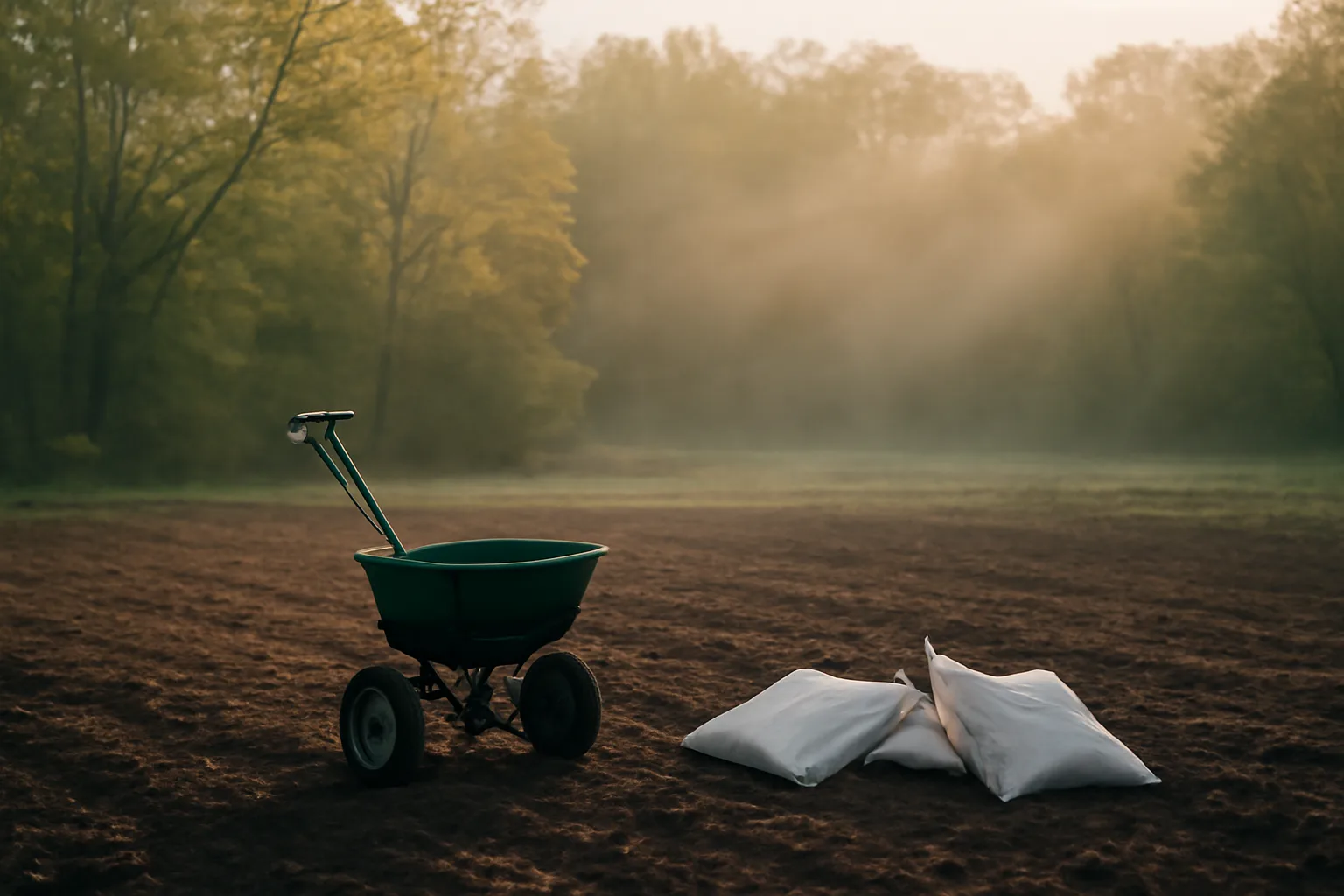
Most general fertilizer recommendations for food plots land around 400 to 600 lbs per acre of a balanced blend like 19-19-19, or a similar N-P-K ratio matched to the crop. Scale that down to a quarter acre and you're looking at 100 to 150 lbs total. That's roughly two to three standard 50-lb bags. But that number is a starting point, not a prescription. Extension agronomists are consistent on this point: fertilizer rates should come from a soil test, not a generic per-acre chart. Mississippi State University Extension recommends producers sample and test soil before applying lime or fertilizer, since the same field can need wildly different rates from one corner to the next depending on past land use [1]. A soil test costs $10 to $20 through most state land-grant labs and tells you exactly what your dirt is short on, which matters more on food plots than almost anywhere else because plot soil is often thin, compacted, or previously untested pasture or timber ground. If you don't have a test back yet and need to plant now, 100 to 150 lbs of 19-19-19 per quarter acre is a reasonable blind guess for a mixed brassica or clover plot. For legumes like clover, you'll want less nitrogen and more phosphorus and potassium, since clover fixes its own nitrogen once established. For heavy feeders like brassicas (turnips, radishes) or grain plots like corn, nitrogen needs run higher, sometimes calling for a second topdress of nitrogen mid-season [2].
How do I convert per-acre fertilizer rates to a 1/4 acre plot
| 300 lbs fertilizer | 75 lbs | 150 lbs | |
|---|---|---|---|
| 400 lbs fertilizer | 100 lbs | 200 lbs | |
| 600 lbs fertilizer | 150 lbs | 300 lbs | |
| 1 ton lime | 500 lbs | 1,000 lbs | |
| 2 tons lime | 1,000 lbs (1/2 ton) | 1 ton | A quarter acre is about 10,890 square feet, close to the size of a large suburban lot. If you're broadcasting by hand or with a small ATV spreader, weigh out your bags ahead of time and split the load into two passes (one north-south, one east-west) for even coverage. Uneven spreading is the number one reason plots green up in blotchy patches. |
The math is simple: whatever the per-acre rate is, divide by four. A 400 lb/acre recommendation becomes 100 lbs for a quarter acre. A 600 lb/acre rate becomes 150 lbs. Lime works the same way. If your soil test calls for 2 tons of lime per acre, you need 500 lbs, a quarter ton, for a quarter-acre plot. Here's a quick reference table for common per-acre rates converted down: | Per-acre rate | 1/4 acre amount | 1/2 acre amount |
Do I need lime, and how much for a small plot
Lime is often the more important input, and the one hunters skip. Most food plot crops, especially clover and brassicas, want soil pH between 6.0 and 7.0. Below that, plants can't use the fertilizer you just paid for. The University of Georgia Extension notes that as soil pH drops well below 6.0, the availability of phosphorus and other key nutrients drops sharply, meaning applied fertilizer goes further toward feeding weeds and leaching loss than toward the crop you planted [3]. Lime rates depend entirely on how acidic your soil starts out and its buffer capacity, which is why the soil test matters more here than for fertilizer. A plot at pH 5.0 might need 2 tons per acre, half a ton on a quarter-acre plot, while a plot already at pH 6.2 might need none. There's no honest way to guess this without a test. Pelletized lime reacts faster than ag lime and is easier to spread by hand or small spreader, but it costs more per ton of neutralizing value. One more wrinkle: lime takes months to fully react with soil. If you're planting this fall and your pH is low, get lime down as early as possible, even if that means liming before you know your exact fertilizer blend.
What is a food plot, exactly
A food plot is a planted patch of forage, grain, or browse, usually somewhere between a tenth of an acre and several acres, established specifically to feed and attract deer or other wildlife on hunting property. Plots range from small "kill plots" tucked near a stand, often a quarter acre or smaller, to large "destination" or agricultural-style plots of several acres meant to hold deer through the season. State wildlife agencies generally treat planted food plots differently from bait piles or feeders under baiting and feeding regulations, but the rules vary a lot by state. Before you assume a small plot near a stand is legal in every context, check your state wildlife agency's current baiting and feeding regulations, since some states restrict hunting over any supplemental feed, planted or not, in certain zones or seasons.
When should I plant food plots for deer
Timing depends on your USDA plant hardiness zone, your target species, and whether you're planting a spring/summer plot or a fall plot. Most whitetail food plots fall into two windows: late spring through early summer for warm-season annuals (soybeans, cowpeas, sorghum-type forages), and late summer through early fall for cool-season annuals and perennials (clover, brassicas, cereal grains). As a general rule, cool-season fall plots go in the ground 60 to 90 days before your area's first hard frost, giving brassicas and cereal grains time to establish before growth slows. Clover, whether planted in spring or fall, needs soil temperatures in the 50s to germinate well and benefits from a firm, well-prepared seedbed. The USDA NRCS plant guide for white clover notes it establishes best on firm, well-drained seedbeds with a pH of 6.0 or higher, and is commonly frost-seeded in late winter or planted in early fall in cool-season regions [4]. Check your local land-grant extension's planting date guide for your specific county, since a fall planting window in Alabama can run six to eight weeks later than one in Minnesota.
When should I plant oats for deer
Oats are a fall-planted cool-season cereal grain in most whitetail country, typically going in 4 to 8 weeks before your first expected frost. That gives the oats time to establish a leafy stand before cold weather, when deer often key in on them hardest, right after the first frosts sweeten the plant's sugars. In the Midwest and Upper South, that generally means a planting window from late August through mid-September. Further south, growers can push into October. Oats winterkill in most northern climates once temperatures drop into the teens for extended periods, so in cold zones oats function as an annual fall/early-winter attractant rather than a plant that carries deer through to spring. If you want spring forage too, pair oats with a cereal rye or a perennial clover in the same blend.
When should I plant turnips for deer
Turnips, like other brassicas, are planted in late summer, usually 90 to 100 days before your first fall frost, since they need a full season to bulb out and reach peak palatability. Deer often ignore turnip bulbs and tops early in the season and then hit them hard after a few frosts convert starches to sugars, which is why plot managers see turnip plots "turn on" in November and December in much of whitetail range. A typical Midwest planting window for turnips runs late July through mid-August. In the Deep South, growers can wait until early September. Turnips want a fairly fine seedbed and shallow planting depth, around a quarter to a half inch, since the seed is small. They also respond strongly to phosphorus and potassium, so a soil test matters as much here as anywhere, since underfed turnips produce small, woody bulbs deer won't touch.
Do deer eat sorghum
Yes, deer eat sorghum, both the grain heads and the foliage, though it's generally considered a secondary or filler food plot crop rather than a top-tier attractant. Sorghum (grain sorghum or forage sorghum types) is more commonly planted for its drought tolerance, its use as a summer screen or cover crop, or as a component in a wildlife blend rather than as the sole planting. Whitetails will browse young sorghum foliage and feed on mature grain heads, and it's also a strong food source for turkey, quail, and dove, which is part of why it shows up in a lot of multi-species wildlife mixes. If your goal is maximum deer draw on a small quarter-acre plot, sorghum usually isn't the first choice; clover, brassicas, soybeans, and cereal grains outperform it for whitetail preference in most comparisons. It earns a spot as a nurse crop or screen planting more often than as the headline species.
Do deer eat clover, and do deer actually like it
Yes, deer eat clover readily, and it's one of the most consistently preferred food plot forages across whitetail range. Clover is a perennial legume, meaning a well-maintained stand can produce forage for three to five years or more before needing replanting, and it fixes its own nitrogen, which cuts fertilizer costs over time. Deer favor clover because it's high in protein, often 20 to 30 percent crude protein in vegetative growth stages, and stays palatable through spring, summer, and fall in many climates. It's especially valuable during spring green-up and antler growth and again during lactation for does. On a quarter-acre plot, clover is a strong pick if you can maintain mowing and periodic fertilization, since neglected clover gets crowded out by grass and weeds within a couple seasons. If you want detail on specific clover varieties and blends, see food plot seed and deer food plot seed for variety-level comparisons.
What are deer's favorite foods, and do deer like honey
Deer preference shifts by season and region, but across food plot studies and extension observations, the consistently high-preference categories are soybeans and other legumes, clover, and, once frost hits, brassicas like turnips and radishes. In agricultural areas, standing corn and soybean fields often outcompete food plots entirely, since deer default to whatever's most calorie-dense and abundant nearby. As for honey: no, deer don't seek out honey in any meaningful wild foraging sense. Deer are herbivores with a rumen built to digest plant fiber, not a diet that includes concentrated sugars like honey. There's no established food plot or wildlife feeding practice built around honey, and it isn't part of any state wildlife agency's or extension's food plot forage recommendations. If you've seen this idea floating around hunting forums, treat it as internet noise rather than field-tested wildlife nutrition guidance.
A simple fertilizer plan for a 1/4 acre plot if you don't have a soil test yet
If you're stuck without a soil test and the planting window is closing, here's a reasonable, conservative starting point. It won't be as accurate as a lab result, but it beats guessing wildly or over-applying nitrogen that just washes off into runoff. For a clover or clover/chicory plot: apply 100 lbs of a lower-nitrogen blend like 0-20-20 or a low-N starter fertilizer per quarter acre at planting, then topdress with potash in following years as the clover fixes its own nitrogen. For a brassica plot (turnips, radishes, rape): apply 125 to 150 lbs of 19-19-19 per quarter acre at planting, and consider a light nitrogen topdress (urea, 46-0-0) 4 to 6 weeks in if leaf growth looks pale or stalled. For a cereal grain plot (oats, wheat, rye): 100 to 125 lbs of 19-19-19 per quarter acre at planting is a reasonable baseline. In every case, lime is the wildcard. If you truly don't know your pH, a moderate hedge of 250 to 500 lbs of pelletized lime per quarter acre (a half ton per acre) rarely hurts and often helps, but it's still a guess dressed up as a plan. Get the test in as soon as you can, even mid-season, so next year's application is dialed in instead of estimated. A soil test through your county extension office typically costs $10 to $20 and takes one to three weeks to turn around, cheap insurance against wasting $40 or $50 of fertilizer on the wrong blend. If you want a plan built around your specific results, species goals, and region rather than a generic range, that's exactly the gap a Custom Food Plot Plan is built to close, a one-time $99 plan that turns your soil test numbers into an actual seed, lime, and fertilizer plan instead of a chart you have to interpret yourself.
What equipment do I need to spread fertilizer on a small plot
For a quarter acre, you don't need a tractor-mounted spreader. A hand-crank broadcast spreader (the kind sold at any farm store for $30 to $60) covers a quarter acre in 15 to 20 minutes of walking and is accurate enough for most food plot work. An ATV or UTV tow-behind spreader speeds things up if you've already got the machine, but it's not a necessary purchase for a plot this size. Whatever you use, calibrate it. Weigh out your total fertilizer (say, 125 lbs), walk your plot boundary once to know your pace, and set the spreader gate opening based on the manufacturer's chart for your product's granule size. Most hand spreaders have a rough chart printed on the hopper or in the manual; use it as a starting point and adjust based on how much product you have left after covering half the plot. Running out of fertilizer a third of the way through means your gate's open too wide; having half a bag left at the end means it's too narrow. For broader background on plot types and where a quarter-acre plot fits into an overall property plan, see food plot whitetail and deer food plots.
Frequently asked questions
How much fertilizer does a 1/4 acre food plot need?
Generally 100 to 150 lbs of a balanced fertilizer like 19-19-19 per quarter acre, roughly two to three 50-lb bags. Exact rates depend on the crop and your soil test. Legumes like clover need less nitrogen; brassicas and grains need more. Always adjust based on lab results rather than a flat guess.
Do deer eat sorghum?
Yes, deer browse sorghum foliage and eat the grain heads, but it's usually a secondary food plot crop rather than a primary attractant. It's more valued for drought tolerance and as a component in multi-species wildlife blends that also feed turkey and quail.
Do deer eat clover, and do deer like clover?
Yes, clover is one of the most consistently preferred whitetail food plot forages. It's high in protein (often 20 to 30 percent crude protein), stays palatable across multiple seasons, and as a perennial legume can produce forage for three to five years with proper maintenance and periodic fertilization.
When should I plant food plots for deer?
Warm-season plots (soybeans, cowpeas) go in late spring through early summer. Cool-season plots (clover, brassicas, cereal grains) go in late summer through early fall, generally 60 to 90 days before your area's first hard frost. Exact windows vary by USDA hardiness zone and region, so check your county extension's planting date guide.
When should I plant oats for deer?
Plant oats 4 to 8 weeks before your area's first expected frost, generally late August through mid-September in the Midwest and Upper South, later into October further south. Oats typically winterkill in cold climates, so they function as a fall/early-winter attractant rather than a spring forage source.
When should I plant turnips for deer?
Plant turnips 90 to 100 days before your first fall frost, typically late July through mid-August in the Midwest and into early September in the Deep South. Turnips need a full season to bulb out, and deer often don't hit them hard until after a few frosts sweeten the plant.
What is a food plot?
A food plot is a planted area of forage, grain, or browse established on hunting land to feed and attract deer or other wildlife. Plots range from small quarter-acre 'kill plots' near a stand to multi-acre destination plots meant to hold deer through the season.
What are deer's favorite foods?
Across food plot research and extension observation, deer consistently prefer soybeans and other legumes, clover, and brassicas like turnips and radishes (especially after frost). In agricultural areas, standing corn and soybean fields often draw deer away from planted plots entirely, since deer favor whatever's most calorie-dense nearby.
Do deer like honey?
No. Deer are herbivores with a digestive system built for plant fiber, not concentrated sugars like honey. There's no wildlife agency or extension guidance recommending honey as deer forage, and it isn't part of any established food plot practice. Treat this claim as internet myth.
How much lime do I need for a 1/4 acre food plot?
It depends entirely on your soil's current pH and buffer capacity, ranging from 0 lbs (soil already near 6.0-7.0) up to 1,000 lbs (half a ton) or more per quarter acre on very acidic ground. A soil test is the only reliable way to know; guessing risks wasting money or under-liming.
Can I use a hand spreader on a 1/4 acre plot, or do I need a tractor?
A hand-crank broadcast spreader is plenty for a quarter acre and covers it in 15 to 20 minutes. An ATV tow-behind spreader speeds up the job if you already own one, but it's not a necessary purchase for a plot this size.
How much does a soil test cost before planting a food plot?
Most state land-grant extension labs charge $10 to $20 per sample, with results back in one to three weeks. It's cheap compared to the cost of guessing wrong on 100+ lbs of fertilizer, and it's the only way to get an accurate lime and fertilizer recommendation for your specific ground.
Sources
- Mississippi State University Extension Publication 2331, "Soil Testing for the Home Landscape or Garden": Fertilizer and lime rates should follow soil test recommendations rather than generic per-acre charts
- Oklahoma State University Extension PSS-2225, "Nitrogen Fertilization in Oklahoma": Grain and brassica food plots often require a nitrogen topdress mid-season for full growth
- University of Georgia Extension Circular 896, "Soil Testing for Home Lawns, Gardens and Wildlife Food Plots": As soil pH drops well below 6.0, availability of phosphorus and other key nutrients drops sharply
- Wisconsin Statutes section 29.328, "Baiting and feeding of wild animals": State law sets specific rules distinguishing baiting and feeding restrictions from other land uses, varying by state
- USDA NRCS Plant Guide, White Clover (Trifolium repens L.): Clover establishes best on firm, well-drained seedbeds at pH 6.0 or higher and is commonly frost-seeded or fall planted in cool-season regions
- Penn State Extension, "Forage Legumes": Clover establishment timing depends on regional soil temperature and frost-seeding windows