Last updated 2026-07-26
TL;DR
A food plot soil test costs roughly $8 to $20 through your state land-grant university lab and takes 1-3 weeks for results. It tells you soil pH, phosphorus, potassium, and organic matter so you know exactly how much lime and fertilizer to apply instead of guessing. Test every plot every 2-3 years, ideally in late summer or fall before planting.
What is a food plot soil test and why do you need one?
A food plot soil test is a lab analysis of a soil sample from your plot that measures pH, plant-available phosphorus and potassium, cation exchange capacity, and organic matter. Most state land-grant universities run these labs, and results come with lime and fertilizer recommendations tailored to whatever crop you tell them you're planting. Here's the blunt truth: most food plot failures trace back to soil chemistry, not seed choice or rain. If your soil pH sits at 5.0 and you're growing clover, which wants 6.0 to 7.0, you can dump all the fertilizer you want on it and the plants still won't take up the nutrients efficiently. Clemson Cooperative Extension's Soil-Testing Laboratory guidance explains that nutrient availability drops sharply as pH moves away from the optimal range for a given crop, which is why correcting pH is often the single biggest yield lever a food plotter has [1]. A soil test also stops you from wasting money. Broadcast fertilizer without a test and you're either underfeeding your plot (weak growth, poor tonnage) or overfeeding it (runoff, wasted cash, sometimes nutrient lockup). A basic soil test through a university lab runs about $7 to $20 per sample depending on the state. Compare that to a $40 bag of fertilizer applied blind, and the test pays for itself almost every time. What is a food plot itself, if you're new to this? It's a small planted area, usually somewhere between a quarter acre and a few acres, seeded with forage or grain specifically to attract and hold deer or other wildlife on your property. Food plots supplement natural browse, concentrate deer activity for observation or hunting, and can improve herd nutrition when done at scale across a property. For a broader rundown of what a plot needs to succeed beyond soil chemistry, see food plot whitetail.
When should you soil test a food plot?
Test your food plot soil at least 8 to 12 weeks before your planned planting date, which for most of the country means testing in late summer for fall plots and late winter or early spring for spring/summer plots. This gives lime time to react in the soil before seed goes in the ground. Lime is slow. Agricultural lime needs months to fully neutralize soil acidity, not days. Penn State Extension's guidance on soil acidity and agricultural liming notes that lime reactions raising soil pH move gradually through the soil profile as lime dissolves and reacts with acidic soil components, which is why timing lime well ahead of planting matters more than most people think [2]. A realistic annual test calendar for most food plotters: - Test in July or August for fall plantings (brassicas, cereal grains, clover establishment)
- Test in February or March for spring/summer plantings (soybeans, corn, warm-season annuals)
- Retest the same plot every 2 to 3 years once you've corrected pH and built fertility, since soil chemistry doesn't swing wildly year to year once it's balanced Don't test frozen ground or soil that's soaking wet from a recent rain. Wait a few days after rainfall so you're not diluting the sample or pulling mud.
How do you actually take a soil sample for a food plot?
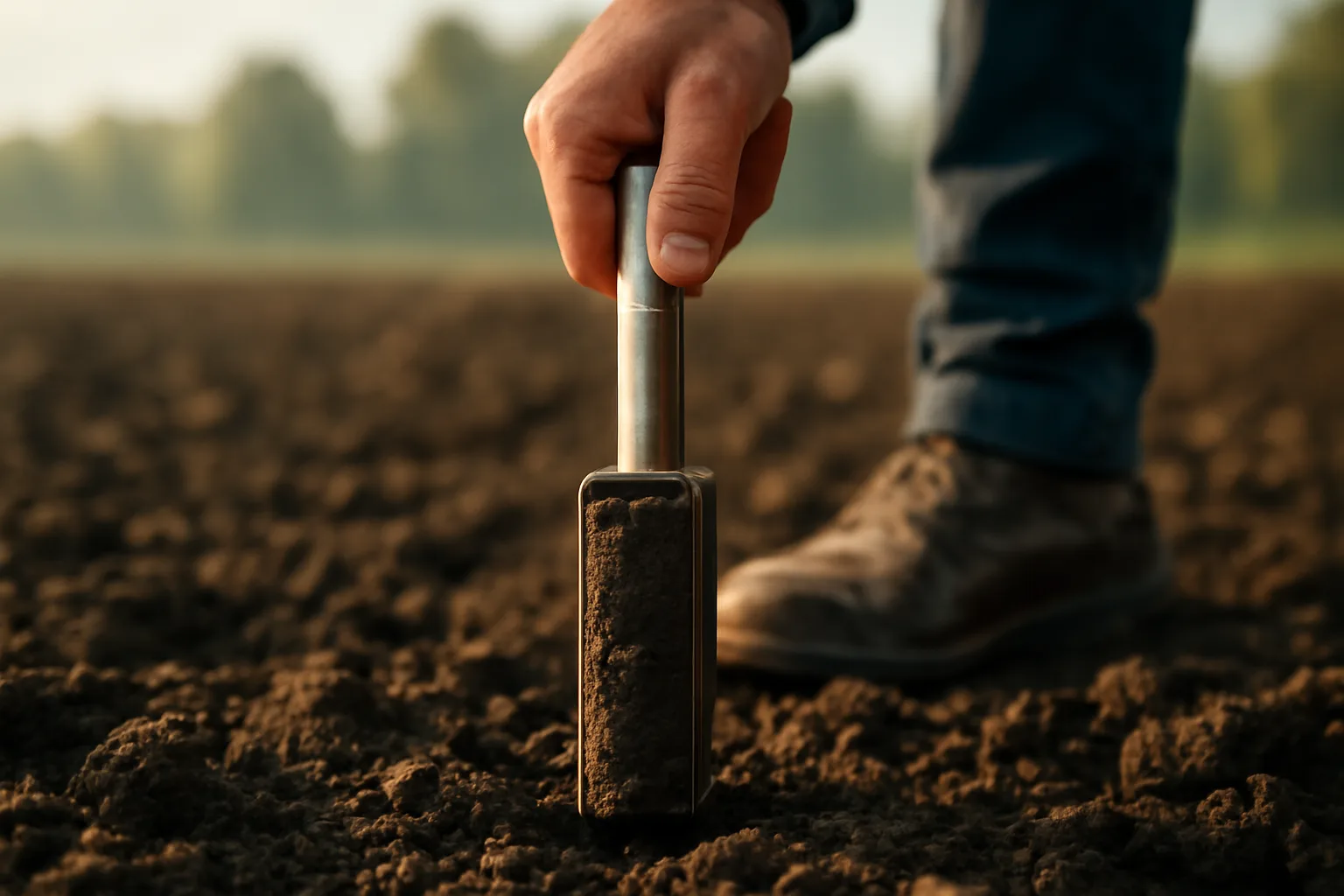
Pull 8 to 12 small cores from across the plot at a 4 to 6 inch depth, mix them together in a clean plastic bucket, and send in about a pint of the combined, air-dried soil as one composite sample. Never send a single scoop from one spot and call it representative. Use a soil probe if you have one, or a clean garden trowel or shovel if you don't. Avoid galvanized buckets or tools that can contaminate the sample with zinc, and skip areas within 50 feet of gravel roads, old fence lines, or field edges where lime or fertilizer history is inconsistent. University of Missouri Extension publication G9101 on soil testing recommends walking a zigzag pattern across the sampling area and pulling cores at regular intervals to build a representative composite sample [3]. If your plot is larger than 2 to 3 acres or has visibly different soil types (a wet low spot versus a dry ridge, for example), split it into separate samples for each zone rather than lumping everything together. Label each bag clearly with plot name and location so recommendations map back correctly. Let the sample air dry on a clean surface, out of direct sun, before boxing it up. Wet soil molds in the mail and can skew lab results.
Where do you send a food plot soil sample and what does it cost?
Send your sample to your state's land-grant university soil testing lab, accessible through your county cooperative extension office. Costs typically run $7 to $20 per basic sample, with turnaround of 1 to 3 weeks depending on the season (spring is their busy time, so expect it to run longer). Check your own state's extension website for exact current pricing, since fees and included tests vary by state and by whether you want the basic package or add-ons like micronutrients or organic matter. Mississippi State University Extension's soil testing program, for example, publishes its own fee schedule and sample submission instructions for producers and homeowners sending samples through the MSU Extension Soil Testing Lab. Private ag labs (like Waypoint Analytical or A&L Labs) also test soil and often turn results faster, usually for $15 to $30 per sample, which can be worth it if you're testing right before a tight planting window and can't wait on a university lab's queue. Whichever lab you use, tell them what you're planting. Recommendations for lime and fertilizer are crop-specific: a test that assumes you're growing corn will give you different fertilizer numbers than one that assumes clover, because the two crops pull different amounts of nitrogen, phosphorus, and potassium from soil.
How do you read a food plot soil test report?
| pH below 6.0 | Acidic soil, nutrient lockup risk | Apply lime per lab recommendation, months before planting | |
|---|---|---|---|
| pH 6.0-7.0 | Good range for most forages | No lime needed, focus on N-P-K | |
| P or K rated "low" or "very low" | Soil can't supply enough for strong growth | Apply recommended fertilizer blend | |
| P or K rated "high" or "very high" | Soil already has plenty | Skip or reduce that nutrient, save money | |
| CEC very low (below 5) | Sandy soil, holds nutrients poorly | Split fertilizer applications, consider more frequent smaller doses | Don't ignore the lime recommendation because it seems like a lot. Lime is cheap relative to fertilizer, usually $30 to $60 per ton delivered and spread depending on your region, and it's the single change most likely to make every other input you buy actually work. |
A standard report gives you soil pH, buffer pH (used to calculate lime rate), phosphorus (P), potassium (K), and often calcium, magnesium, and cation exchange capacity (CEC), followed by specific lime and fertilizer recommendations in pounds per acre. pH is the number to look at first. Most food plot forages want a pH between 6.0 and 7.0. Below 6.0, phosphorus and other nutrients become less available to plants even if soil test levels look adequate, per Clemson Extension's soil testing guidance [1]. If your test comes back at 5.2, expect a lime recommendation, often in the range of 1 to 3 tons per acre depending on your soil's buffer capacity and what you're planting. Here's a rough guide to reading the report: | Reading | What it means | Typical action |
When should you plant food plots for deer?
Food plot planting windows depend on your USDA plant hardiness zone and whether you're planting a cool-season or warm-season crop, but general guidance is: warm-season plots (soybeans, corn, sunflowers) go in after your last frost date in spring, while cool-season plots (clover, brassicas, cereal grains) go in 6 to 10 weeks before your first fall frost. Check your USDA Plant Hardiness Zone map to nail down your average frost dates [4]. In zone 5 (much of the upper Midwest and Northeast), that often means spring plots go in mid-May and fall plots go in mid-August to early September. In zone 7 (mid-South), spring planting can start in April and fall plots can wait until late September or even October. The biggest mistake plotters make is planting fall brassicas too late. Turnips, radishes, and other brassicas need real growing time to bulb up and produce tonnage before frost slows them down. Missing that window by even 2 to 3 weeks can cut yield significantly. For a full breakdown of species-specific windows across regions, check deer food plots and deer food plot seed for seed selection matched to your planting date.
When should you plant clover, oats, and turnips for deer?
Clover is typically planted in early spring (March to April in most zones) via frost seeding, or in late summer to early fall (August to September) alongside a fall seeding window. Oats for deer plots go in late summer, usually 60 to 90 days before your first hard frost, so they can reach the leafy, palatable stage before frost sets sugar content and drives deer attraction. Turnips need 80 to 100 days from planting to reach a hunt-ready bulb stage, which means most of the country should plant them between mid-July and mid-August for a fall/winter plot. Do deer like clover? Yes, and it's one of the most consistently used forages across food plot research and extension literature. Clover is a perennial legume, meaning it comes back year after year if maintained, and it fixes its own nitrogen from the air, which reduces your fertilizer bill over time. It also holds up to repeated grazing pressure better than most annuals, which matters if you've got a lot of deer hitting a small plot. Oats work well as both a standalone plot and a nurse crop mixed with clover, since the oats germinate fast and give deer something to eat while the slower clover establishes underneath. Turnips and other brassicas get sweeter after a hard frost because the cold triggers the plant to convert starches to sugars, which is why brassica plots often see their heaviest deer use in December and January rather than October. If you plant turnips too early in a hot climate, they can bolt or rot before that frost-sweetening ever happens. One thing all three of these species share: none of them forgive a low pH. Clover in particular struggles hard below pH 6.0 because the rhizobia bacteria that fix nitrogen for the plant slow down in acidic soil, according to University of Georgia Extension guidance on clover establishment [5].
What are deer's favorite foods, and does sorghum or honey fit in?
Deer show strong seasonal preferences rather than one single favorite food; research and state wildlife agency data point to acorns, soybeans, clover, and agricultural crops like corn as consistently high-preference foods across most of the whitetail's range. Preference shifts with season, availability, and regional habitat, so what tops a Georgia deer's diet in October won't match a Minnesota deer's diet in the same month. Do deer eat sorghum? Yes, deer will eat grain sorghum (milo), both the seed heads and the young plant growth, and it's sometimes planted as a food plot component for its drought tolerance and value as both forage and cover. It's not usually a deer's first choice compared to soybeans or corn, but it holds up in poor soil and dry conditions where other grain crops struggle, which makes it a practical choice in some regions of the Great Plains and Southwest. Do deer like honey? There's no real evidence deer forage on honey in the wild or that it's used in legitimate food plot science, and this question usually comes from confusion with mineral or attractant products marketed with "honey" or sweet scent additives, not actual honey. Deer are drawn to sugar and carbohydrates, which is part of why post-frost brassicas and ripening soybeans pull heavy deer traffic, but pouring honey in the woods isn't a food plot strategy, and in many states it may violate baiting regulations (more on that below). Acorns deserve a mention here because in years with a strong mast crop, deer will often ignore food plots entirely in favor of oaks. The Pennsylvania Game Commission's white-tailed deer management program describes this pattern, noting how mast availability shifts deer feeding behavior away from planted or supplemental food sources in heavy acorn years [6]. That's not a plot failure, it's just deer doing what deer do when free, high-fat food is scattered across the timber.
Do state baiting and feeding laws affect food plots?
Standing food plots are legal to hunt over in the overwhelming majority of states, but rules on baiting (piled or scattered feed, mineral, or supplemental feeding) vary widely by state and sometimes by county, so check your state wildlife agency's current regulations before hunting near any planted or supplemental food source. Many states draw a clear legal line between a growing food plot, which is generally treated as normal agricultural practice, and bait, which is typically defined as grain, salt, minerals, or other feed that's placed, exposed, deposited, distributed, or scattered to attract deer. Michigan's baiting and feeding rule under the Wildlife Conservation Order, part 4, defines bait as a substance placed to attract wildlife and separately addresses standing crops used in normal agricultural practice . Some states, including parts of the Midwest with chronic wasting disease concerns, restrict both baiting and supplemental feeding statewide or in specific management zones, and those rules change often as CWD response plans get updated. Before you plant a plot with hunting in mind, or before you set out any mineral or feed alongside it, pull up your state wildlife agency's current hunting digest or regulations page and read the baiting and feeding section directly. Don't rely on what a buddy in another state told you, and don't assume last year's rule still applies this year, especially in CWD-affected areas where regulations shift year to year.
How does a soil test change what you plant?
A soil test doesn't just tell you how much lime and fertilizer to apply, it can also steer which species make sense for your ground in the first place. Some crops tolerate lower pH and lower fertility better than others, and matching species to your actual dirt saves money and headaches. Brassicas and cereal grains like oats and wheat are more forgiving of a slightly lower pH (down to around 5.5) than clover or alfalfa, which really want to sit in that 6.0 to 7.0 band to thrive long term. If your test comes back at 5.5 and you don't want to lime heavily this year, a fall oats-and-brassica blend might make more sense than trying to establish clover that will just limp along. Sandy soils with low CEC (cation exchange capacity) hold onto fertilizer poorly, so if your test shows CEC under 5, consider splitting your fertilizer into two smaller applications instead of one big dose, since a lot of it will leach past the root zone before plants can use it in a single heavy application. High phosphorus soils, common on ground that's had years of chicken litter or heavy fertilizer history, might need zero added phosphorus even for a hungry crop like brassicas. Skipping unnecessary phosphorus based on your test not only saves money, it reduces runoff risk into nearby streams and ponds. EPA's agricultural nutrient pollution guidance identifies excess soil phosphorus from over-application as a direct contributor to runoff-driven water quality problems in farm country . If you want help translating a soil test into an actual planting plan for your specific ground, PlotSeason's Custom Food Plot Plan is a $99 one-time service that turns your soil test numbers and property details into a species and planting recommendation. Your soil test lab is still the final word on exact lime and fertilizer rates; the plan builds the planting strategy around those numbers.
How often should you retest food plot soil?
Retest every 2 to 3 years for established plots, or every year for a brand new plot you're actively correcting with heavy lime or fertilizer applications. Soil chemistry doesn't swing wildly season to season once it's in a good range, but it does drift, especially in plots that get hammered with nitrogen-hungry crops like corn or brassicas year after year. If you limed heavily two seasons ago based on a test showing pH 5.0, retest before assuming you're still good. Lime reactions can take 1 to 2 years to fully play out, and knowing where you've landed tells you whether you need a maintenance dose or whether you're set for a while. New plots, meaning ground you just cleared or converted from row crop or CRP, should get tested before that first planting no matter what. You have zero history to go on, and guessing on a brand new plot wastes an entire season if you get lime or fertilizer badly wrong. Keep your old soil test reports. Comparing this year's numbers to two or three years back tells you whether your fertility program is actually working or whether you're just repeating the same mistake annually.
What equipment do you need to take a good soil sample?
At minimum you need a clean digging tool (soil probe, trowel, or spade), a clean plastic bucket, sample bags or boxes from your testing lab, and a permanent marker to label everything. None of this requires expensive gear. A soil probe, which looks like a long hollow tube with a T-handle, makes pulling consistent-depth cores fast and easy, and a decent one costs $30 to $80. If you're only testing a plot or two a year, a garden trowel works fine, you just have to be more careful about pulling a consistent 4 to 6 inch depth core each time rather than a shallow scoop. Avoid brass, bronze, or galvanized tools if you're testing for micronutrients, since those metals can contaminate zinc or copper readings. For a standard pH/P/K/organic matter test this matters less, but it's a good habit regardless. Most university extension offices supply free sample bags and submission forms, sometimes downloadable online, sometimes only available in person at the county office. Call ahead before you show up so you know their current fee and submission process, since some labs have moved to online payment and mail-in only during busy spring testing season. For gear that goes beyond soil sampling into actual plot prep and planting, see food plot seed and domain food plot seed for species-specific seeding rates and equipment notes.
Frequently asked questions
Do deer eat sorghum?
Yes, deer eat both the grain heads and young growth of grain sorghum (milo), though it's usually a secondary choice compared to corn or soybeans. It's valued in food plot mixes for its drought tolerance and ability to grow in poorer soil, making it a practical option in dry regions like parts of the Great Plains and Southwest.
Do deer like clover?
Yes, clover is one of the most consistently preferred food plot forages across the whitetail's range. It's a perennial legume that comes back yearly, fixes its own nitrogen, and tolerates repeated grazing better than most annuals, which is why it shows up in nearly every food plot mix recommendation from state wildlife and extension agencies.
When should you plant food plots for deer?
Warm-season plots (corn, soybeans, sunflowers) go in after your last spring frost date. Cool-season plots (clover, brassicas, cereal grains) go in 6 to 10 weeks before your first fall frost. Exact timing depends on your USDA Plant Hardiness Zone, so check your zone's average frost dates before setting a planting date.
When should you plant oats for deer?
Plant oats for deer in late summer, roughly 60 to 90 days before your area's first hard frost, so the plants reach a leafy, palatable growth stage before cold weather slows them down. In most of the Midwest and Northeast this falls in August; in the mid-South it can extend into September.
When should you plant turnips for deer?
Plant turnips 80 to 100 days before you want them hunt-ready, which for most of the country means mid-July through mid-August. Turnips get sweeter and more attractive to deer after a hard frost converts plant starches to sugar, so plots often see heaviest use in December and January rather than at first planting.
What is a food plot?
A food plot is a small planted area, typically a quarter acre to a few acres, seeded with forage or grain crops to attract, hold, and provide nutrition for deer or other wildlife on a property. Plots supplement natural browse and can improve herd nutrition and hunting opportunity when planned around soil conditions and planting windows.
What are deer's favorite foods?
Deer don't have one universal favorite food; preference shifts by season and region, but acorns, soybeans, clover, and corn consistently rank as high-preference foods across most of the whitetail's range. In years with a heavy acorn crop, deer often favor mast over planted food plots entirely, a pattern well documented in state deer management reports.
Do deer like honey?
There's no real evidence deer forage on actual honey in the wild, and it's not part of legitimate food plot strategy. The confusion usually comes from scent or mineral products marketed with honey or sweet additives. Deer are drawn to sugar and carbs, which is part of why frost-sweetened brassicas and ripening soybeans attract heavy traffic.
How much does a food plot soil test cost?
A basic soil test through a state land-grant university extension lab typically costs $7 to $20 per sample. Private agricultural labs charge more, usually $15 to $30 per sample, but often turn results around faster. Exact pricing varies by state, so check your extension office's current fee schedule before mailing a sample.
How do I take a soil sample for a food plot?
Pull 8 to 12 cores from across the plot at 4 to 6 inches deep using a soil probe or clean trowel, mix them in a plastic bucket, let the soil air dry, and send about a pint of the combined sample to your extension lab. Avoid galvanized tools and sampling near roads or old fence lines.
How long does it take to get food plot soil test results back?
Most university extension labs return results in 1 to 3 weeks, though spring is their busiest season and can push turnaround longer. Private ag labs often turn results faster, sometimes within a few business days, which can matter if you're testing close to a planting deadline.
What soil pH is best for a food plot?
Most food plot forages, including clover, brassicas, and cereal grains, grow best in a soil pH between 6.0 and 7.0. Below 6.0, nutrients like phosphorus become less available to plants even when soil test levels look adequate, which is why correcting pH with lime is often the highest-impact fix a food plotter can make.
Can I hunt over a food plot or does it count as baiting?
Standing, growing food plots are legal to hunt over in nearly every state and are generally treated as normal agriculture, separate from baiting rules that cover piled or scattered feed, salt, or minerals. Baiting and feeding regulations vary by state and sometimes by county, so check your state wildlife agency's current hunting digest before hunting near any plot or supplemental feed.
Sources
- Clemson Cooperative Extension, Agricultural Service Laboratory Soil Testing: Soil pH affects nutrient availability, and correcting pH is often the biggest fertility lever available
- University of Missouri Extension, Soil Sampling Publication G9101: Sampling in a zigzag pattern across a plot gives a representative composite soil sample
- Mississippi State University Extension, Soil Testing: Mississippi State University's Extension Soil Testing Lab publishes its fee schedule and submission process
- University of Georgia Extension, Growing Clover in Georgia (Bulletin 1251): Legume nitrogen fixation via rhizobia bacteria slows in acidic, low-pH soil
- Pennsylvania Game Commission, White-tailed Deer Management: Heavy acorn mast years shift deer feeding away from planted food sources toward oak mast
- US EPA, Nutrient Pollution: Sources and Solutions (Agriculture): Excess soil phosphorus from over-fertilization contributes to agricultural runoff and water quality problems