Last updated 2026-07-26
TL;DR
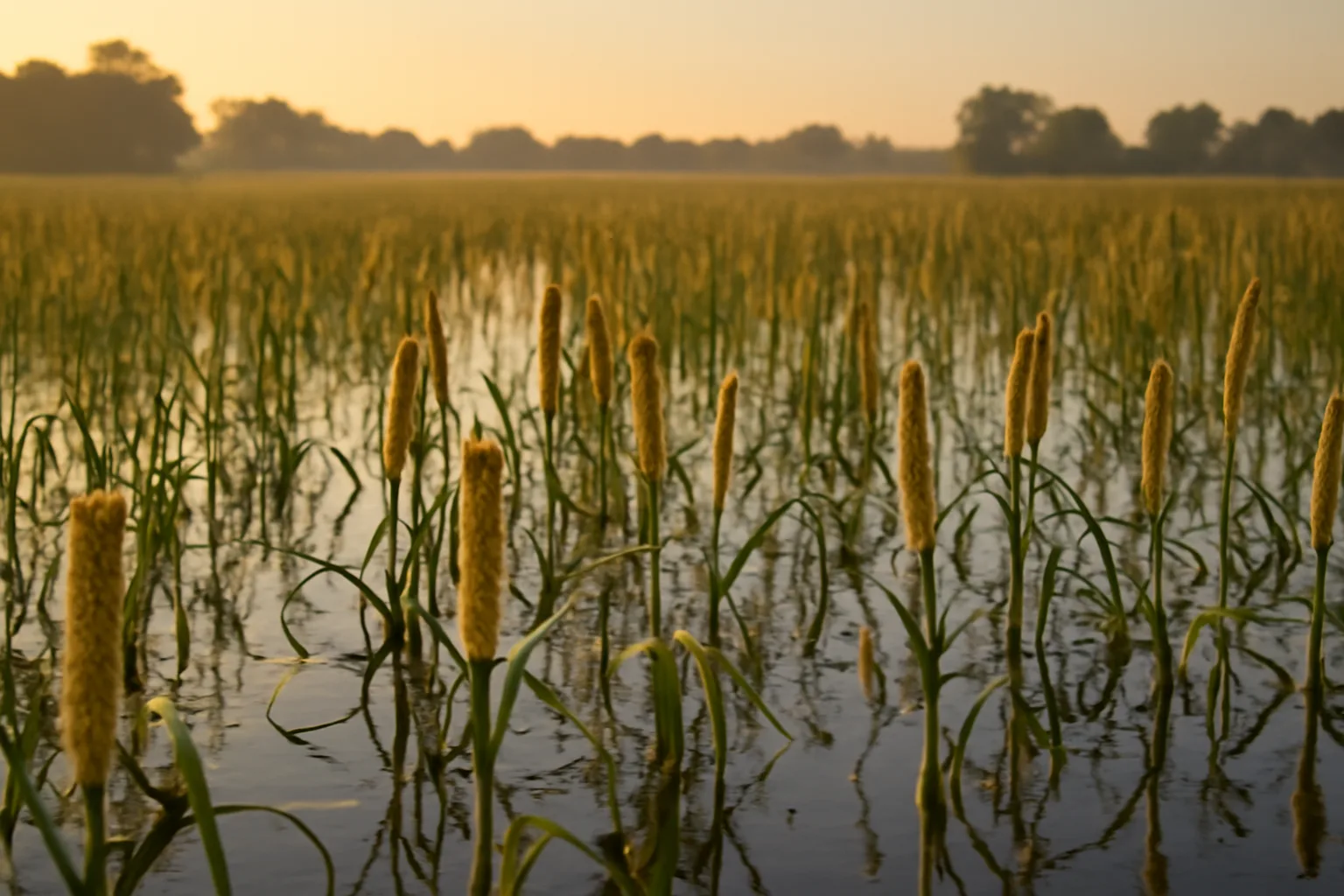
The best duck food plots use Japanese millet, smartweed, and standing corn in shallow, seasonally-flooded ground planted by early-to-mid summer (June through July in most zones). Ducks key on flooded seed heads and waste grain 2 to 18 inches deep. Moist-soil management (drawing down water to let native millets and smartweeds grow) often outperforms planted grain for cost and duck numbers.
What is a food plot, and how is a duck plot different from a deer plot?
A food plot is any planted or managed patch of ground designed to grow food for wildlife, usually to hold or attract animals during hunting season. For deer, that means standing forage like clover, brassicas, or beans in a dry field. For ducks, the whole game changes because ducks feed by dabbling or diving in shallow water, not grazing dry ground. A duck plot is really a moist-soil unit or shallow impoundment planted (or naturally seeded) with plants that produce seed ducks want, then flooded to a depth ducks can work, typically 4 to 12 inches for dabblers like mallards and teal [1]. The plant matters less than the water regime. You can have a perfect stand of millet and still get zero ducks if you flood it too deep, too early, or too late. The USDA Natural Resources Conservation Service treats this as a distinct practice, Wetland Wildlife Habitat Management (Code 644), separate from upland food plot work, because the hydrology (getting water on and off the field at the right times) drives success more than seed selection [1]. If you're coming from deer food plot work, the biggest mental shift is: think water management first, plant selection second. For context on dry-ground plots and species selection for whitetails, see food plot whitetail and deer food plots.
What do ducks actually like to eat?
| Smartweed (Polygonum spp.) | High energy seed, grows naturally on drawn-down mudflats | Often the top-producing native plant in moist-soil units [2] | |
|---|---|---|---|
| Japanese millet | Fast growing, heavy seed production, tolerates shallow flooding | Most common planted duck food in the South and Midwest | |
| Corn (flooded, standing or knocked down) | Very high energy density, easy for ducks to find | Popular with hunters but pricier and more labor than millet | |
| Wild millet / barnyard grass | Natural moist-soil producer | Comes in free if you draw down at the right time | |
| Sedges and other moist-soil seeds | Broad seed diversity, supports invertebrates too | Backbone of most managed wetland units | |
| Aquatic invertebrates | Protein source, critical in late winter/spring | Not planted, but flooded decaying vegetation feeds the food web | Ducks are not picky eaters by nature. They key on whatever is abundant, shallow enough to reach, and easy to process. That is why moist-soil management, letting natural plants like smartweed and wild millet come up on a drawn-down field, so often beats a planted monoculture for both cost and duck numbers [2]. |
Ducks are opportunistic, but dabbling ducks (mallards, wood ducks, teal, pintails) lean heavily on seeds, invertebrates, and aquatic vegetation. Studies of mallard diets in the Mississippi Alluvial Valley found moist-soil plant seeds and waste rice/corn make up the bulk of fall and winter energy intake, with invertebrates becoming more important during spring for egg production [2]. Top natural and planted foods, ranked by how consistently they show up in diet studies and management guides: | Food source | Why ducks use it | Notes |
Do deer eat sorghum, and does that matter for a duck plot?
Yes, deer do eat sorghum, especially the grain heads and young shoots, and it shows up on many deer food plot seed lists as a summer annual. But sorghum (grain sorghum or milo) is not a strong duck food. It is grown more as a dryland grain crop or deer/turkey attractant than a flooded waterfowl food. If you are running a mixed-use property, dryland sorghum can work as a screening or bedding-cover crop near a duck impoundment, or as a standalone deer plot elsewhere on the farm. It is not something to flood for ducks. Save sorghum for the deer side of your plan and stick with millet, smartweed, and corn for the water side. For deer-specific sorghum and grain mix guidance, check deer food plot seed.
Do deer eat clover, and do deer like clover?
Yes on both counts. Clover is one of the most consistently preferred deer forages across the whitetail's range, and extension research backs that up. White clover and red clover both rank as high-preference forages in deer feeding studies, often near the top of palatability rankings alongside other legumes [3]. Clover is not a duck food (it grows on dry ground and ducks are not built to graze it), so it has no place in a flooded waterfowl unit. But if you are managing a property for both deer and ducks, and most timbered river-bottom or ag-adjacent tracts support both, clover plots on the high ground and moist-soil units in the low ground is a common, effective split. Mississippi State University Extension notes clover's appeal comes from its digestibility and protein content, generally 15 to 25 percent crude protein depending on growth stage and variety, which is why deer return to it through spring and summer when good clover stands are managed with mowing and proper pH [3]. For a broader look at clover and other deer forages, see deer food plot seed.
Do deer like honey, or is 'honey hole' just a hunting term?
Deer don't eat honey in any meaningful dietary sense, and there is no wildlife management literature suggesting honey as a deer attractant. 'Honey hole' in hunting slang refers to a particularly productive spot, a bedding area, funnel, or plot that consistently produces sightings, not an actual food source. Some hunters have tried sugar-based or scent lures marketed with 'honey' in the name, but these are attractant products, not food plot inputs, and their effectiveness has not been documented in peer-reviewed wildlife research. If you're building a plot to attract deer or ducks, stick to actual forage species with documented preference data rather than novelty attractants.
When to plant food plots for deer vs. duck plots for waterfowl
Timing is where deer and duck plots diverge hardest. Deer food plots follow a spring/summer (warm-season, for beans, corn, sorghum) and late summer/fall (cool-season, for brassicas, clover, cereal grains) calendar tied to your first frost date. Duck plots follow a totally different clock built around summer planting and fall flooding. For deer plots specifically, general zone guidance runs like this: - Northern zones (Zone 1, first frost late September): cool-season plots (brassicas, clover, cereal grains) go in late July through August; warm-season plots (beans, peas) go in May.
- Transition zones (Zone 2, first frost mid-to-late October): cool-season plots late August through mid-September; warm-season in May.
- Southern zones (Zone 3, first frost November or later): cool-season plots September through October; warm-season April through May. Duck moist-soil units and millet plantings, by contrast, get planted in early summer (typically June, sometimes into early July depending on latitude and soil moisture) so the crop matures and produces seed before you flood in fall [1] [2]. Flooding usually starts in October or November as ducks migrate south and continues through the season, with fields drawn down again in spring to reset the moist-soil cycle. For a full zone-by-zone deer planting calendar, see deer food plots. If you want a plan built around your specific frost dates and soil test, that is exactly what a Custom Food Plot Plan is for, a $99 one-time plan that maps planting windows to your zip code and soil report rather than a generic regional guess.
When to plant turnips for deer
Turnips are a cool-season brassica and go in the ground 60 to 90 days before your average first frost, which usually lands in late July through early September depending on your zone [4]. Plant too early in hot, dry conditions and germination suffers; plant too late and the plants won't bulb up before cold weather locks in. Purdue Extension and most Midwest land-grant guides recommend a seeding rate around 4 to 6 pounds per acre for pure turnip stands, drilled a quarter-inch deep or broadcast into a firm, moist seedbed [4]. Turnips are a fall/winter deer food, not a duck food. They have zero role in a waterfowl plot and are strictly upland, dry-ground plantings. If you're pairing a fall deer brassica plot with a summer duck plot on the same property, the calendars don't overlap much, which actually makes logistics easier. Duck millet goes in during June, turnips and other brassicas go in during August, and you're not fighting for the same tractor time.
When to plant oats for deer
Oats are a cereal grain planted in the same late-summer to early-fall window as other cool-season deer plot species, generally 45 to 60 days before first frost so they establish before growth slows [5]. That puts oat planting anywhere from mid-August in northern zones to late September or October farther south. Oats are a favorite because deer hit them hard as soon as they emerge, often before other cool-season plants like brassicas even get going, so many blends use oats as a fast-germinating nurse crop mixed with clover or brassicas. University of Tennessee Extension recommends 60 to 100 pounds per acre for oats planted alone, less when blended with other species [5]. Like turnips, oats are strictly a deer/upland species. If you want a broader mix comparison for fall deer plantings, food plot seed covers blend options in more depth.
What are the best duck food plot plants to actually plant?
| Japanese millet | June | 60-90 | Low | Good | |
|---|---|---|---|---|---|
| Smartweed (natural) | N/A, managed via drawdown | Varies | Very low | Excellent | |
| Standing corn | April-May | 100-120+ | High | Excellent | |
| Wild millet/barnyard grass | N/A, managed via drawdown | Varies | Very low | Good | For a broader rundown on food plot seed choices in general (most of which applies to deer, not duck plots), see food plot seed and deer for food. |
If you're planting rather than relying purely on natural moist-soil regrowth, three species carry most of the weight in managed waterfowl impoundments across the South and Midwest. Japanese millet (Echinochloa esculenta) is the workhorse. It germinates fast, tolerates wet feet, and produces heavy seed heads within 60 to 90 days, which lines it up perfectly for a June planting and an October/November flood. Mississippi State University's waterfowl program lists it as one of the most reliable planted moist-soil crops for the region [2]. Smartweed is technically not planted in most cases, it comes up naturally when you draw down water on bare, disturbed mud in spring and let it grow through summer. Smartweed seed is extremely high in energy and one of the most preferred natural duck foods documented in Mississippi Alluvial Valley diet studies [2] [2]. If your unit already has a smartweed seed bank, moist-soil drawdown management often beats planting anything. Corn, either standing and later flooded or knocked down before flooding, delivers the highest energy density per acre of any common duck food, which is part of why it's a favorite for hunting clubs willing to spend on seed, fertilizer, and irrigation. It costs more to grow than millet and needs 100 to 120-plus growing days, so it has to go in earlier, typically April through May in warmer zones. A rough cost and effort comparison: | Crop | Planting window | Days to maturity | Relative cost/acre | Energy value to ducks |
How does moist-soil management work, and is it better than planting?
Moist-soil management means manipulating water levels, not planting a crop, to encourage natural wetland plants like smartweed, wild millet, and sedges to grow on their own. You draw the water down in spring, let the mudflat vegetate through summer, then reflood in fall for ducks. The USDA NRCS Wetland Wildlife Habitat Management standard describes this as maintaining or manipulating wetland hydrology and vegetation to benefit wildlife, and it explicitly includes moist-soil management as a core practice, more than planted crops [1]. Research summarized by Mississippi State University Extension has repeatedly found that well-managed moist-soil units can out-produce planted millet or corn on a cost-per-duck-use-day basis, because you skip the cost of seed, tillage, and fertilizer entirely [2]. The catch is that moist-soil management takes real water control infrastructure, levees, water control structures, and pumps or gravity flow, and it takes a few years to build a good seed bank in the soil if the field hasn't been managed that way before. If you've got a blank slate wet field with poor natural seed production, planting Japanese millet the first year or two while you build structure and manage water levels is a reasonable bridge strategy.
How deep should you flood a duck plot, and when should you flood it?
Dabbling ducks feed most efficiently in 4 to 12 inches of water, tipping up to reach seed on the bottom. Diving ducks need deeper water, but most food plot and moist-soil work targets dabblers like mallards, teal, wood ducks, and pintails [1]. Timing the flood matters as much as depth. Flood too early (August or early September in most flyways) and you risk drowning out standing crops before they finish seeding, or missing peak migration timing entirely. Flood too late and you miss early migrants moving through in October. Most managed waterfowl areas in the Mississippi Flyway begin flooding in October and build depth gradually through November and December as birds arrive, then hold water through the regular duck season before drawing down in late winter or early spring [2]. Check your state wildlife agency's migratory bird program page for local migration timing and any public or cost-share moist-soil management programs, many states run incentive programs for private wetland habitat work through their fish and wildlife agencies.
What are the baiting rules I need to know before hunting a duck plot?
This is the single most important legal issue in duck food plot work, and it trips up more hunters than any planting mistake. Federal law prohibits hunting waterfowl over bait, defined by U.S. Fish and Wildlife Service regulation as any area where salt, grain, or other feed has been placed to lure birds, if you knew or reasonably should have known bait was present [6]. Here's the part that saves hunters headaches: a properly planted and managed agricultural or moist-soil crop, planted using normal agricultural practices and left standing or manipulated in place (mowed, disked, flooded, rolled), is legal to hunt over under federal rule. The regulation specifically exempts 'standing crops or flooded standing crops, standing, flooded, or manipulated aquatic vegetation, or unharvested standing crops that have not been manipulated through the distribution of grain' [6]. The line gets crossed when grain is added to a field beyond what grew there, or when harvested grain is scattered back onto a field. Combining, then scattering the grain back out, is baiting. Leaving standing corn in place and flooding around it is not. States can layer additional restrictions on top of federal rules, so check your state wildlife agency's waterfowl hunting regulations before the season, rules on manipulation timing and allowable practices vary and enforcement is active. When in doubt, call your state agency's law enforcement division directly rather than guessing.
Do you need a soil test before planting a duck food plot?
Yes, and the same principles from dry-ground deer plots apply, just with different targets. Wetland soils tend to run more acidic or have different nutrient profiles than upland fields, and land-grant extension offices that handle regular ag soil tests can also test moist-soil unit ground [1] [2]. Your soil test lab is the authority on what lime or fertilizer your specific field needs. A general article like this one can tell you that Japanese millet tolerates a fairly wide pH range and responds well to nitrogen, but it can't tell you what your field actually needs without a test in hand. If you've already got a soil report sitting on your desk and want help turning it into an actual planting plan mapped to your zone and frost dates, that's the whole point of a Custom Food Plot Plan, a $99 one-time plan built from your soil test and location rather than a one-size-fits-all seed bag label.
Frequently asked questions
Do deer eat sorghum?
Yes. Deer eat sorghum grain heads and young shoots, and it's a common summer annual on deer food plot seed lists. It is a dryland crop, though, not a waterfowl food, so it has no place in a flooded duck plot. Use it for deer plots or as screening cover, not for ducks.
Do deer eat clover?
Yes, clover is one of the most preferred deer forages available, ranking near the top of palatability studies for both white and red clover varieties. Mississippi State University Extension notes clover's high protein content (roughly 15 to 25 percent crude protein) drives that preference. It's a dry-ground plant, though, with no role in duck-specific plots.
When to plant deer food plots?
It depends on your zone and whether you're planting warm-season or cool-season species. Warm-season plots (beans, sorghum) go in April through May. Cool-season plots (clover, brassicas, cereal grains) go in 45 to 90 days before your area's first frost date, roughly late July in northern zones through October in the deep South.
Do deer like clover?
Yes, strongly. Clover consistently ranks among the highest-preference forages in deer feeding studies, and well-maintained clover plots draw repeat deer traffic through spring and summer thanks to high digestibility and protein content. It needs proper pH and periodic mowing to stay productive and outcompete weeds.
When to plant oats for deer?
Plant oats 45 to 60 days before your first fall frost, which lands anywhere from mid-August in northern zones to late September or October farther south. University of Tennessee Extension recommends 60 to 100 pounds per acre planted alone, less when blended with clover or brassicas as a nurse crop.
When to plant food plots for deer?
Cool-season plots go in 45 to 90 days before your average first frost date, and warm-season plots go in during May in most zones. Exact timing depends heavily on your latitude, so check your local land-grant extension office's frost date data before locking in a planting calendar.
When to plant turnips for deer?
Plant turnips 60 to 90 days before your first expected fall frost. That's typically late July through early September depending on zone. Purdue Extension recommends seeding at 4 to 6 pounds per acre for a pure stand, drilled shallow into a firm, moist seedbed for best germination.
What is a food plot?
A food plot is a planted or actively managed area of ground designed to grow food that attracts and holds wildlife. For deer, that's usually a dry-ground planting of clover, brassicas, or beans. For ducks, it's typically a shallow, seasonally-flooded field growing millet, smartweed, or corn, managed around water levels as much as plant species.
What are deer's favorite foods?
Deer show strong, well-documented preference for legumes like clover and soybeans, along with acorns, cereal grains like oats, and brassicas such as turnips once cold weather sweetens the bulbs. Preference shifts seasonally: clover and beans dominate spring and summer, while acorns, brassicas, and cereal grains take over in fall and winter.
Do deer like honey?
No, deer don't eat honey as a meaningful food source, and there's no wildlife research supporting it as an attractant. 'Honey hole' is hunting slang for a consistently productive spot, not a reference to actual honey. Stick to documented forage species like clover, beans, and brassicas for real attraction.
What's the best duck food plot plant if I can only plant one thing?
Japanese millet is the most reliable single choice for most managed waterfowl units. It germinates fast, tolerates shallow flooding, and produces heavy seed within 60 to 90 days of a June planting, lining up well with a fall flood. Mississippi State University Extension lists it among the most dependable planted moist-soil crops in the region.
How deep should a duck plot be flooded?
Most dabbling ducks (mallards, teal, wood ducks, pintails) feed best in 4 to 12 inches of water where they can tip up and reach seed on the bottom. Deeper water suits diving ducks but isn't necessary for a typical millet or moist-soil unit built for dabbler traffic.
Is it legal to hunt ducks over a planted food plot?
Yes, if the crop is planted and managed using normal agricultural practices and left standing or manipulated in place (mowed, disked, flooded). Federal regulation exempts standing or flooded standing crops from the baiting definition. It becomes illegal baiting if grain is added beyond what grew there or scattered back onto the field after harvest.
Sources
- USDA NRCS, Conservation Practice Standard: Wetland Wildlife Habitat Management (Code 644): Duck feeding depth ranges and moist-soil/wetland management as a distinct conservation practice from upland food plots
- USGS/Mississippi Alluvial Valley waterfowl diet research summary (Mississippi State University Extension): Mallard diets rely on moist-soil seeds and waste grain in fall/winter, invertebrates in spring
- Mississippi State University Extension, Clover for Deer: Clover's protein content (15-25% crude protein) and high preference ranking among deer forages
- Purdue University Extension, Brassicas for Deer Food Plots: Turnip planting window (60-90 days before frost) and seeding rate (4-6 lbs/acre)
- University of Tennessee Extension, Establishing Wildlife Food Plots: Oat planting timing (45-60 days before frost) and seeding rate (60-100 lbs/acre)
- U.S. Fish and Wildlife Service, 50 CFR 20.21(i), Migratory Bird Hunting Regulations (baiting definition): Federal baiting definition and exemption for standing or flooded standing crops planted under normal agricultural practices