Last updated 2026-07-26
TL;DR
Sandy soil food plots struggle because water and nutrients drain through fast. Fix it with lime and split fertilizer applications, choose drought-tolerant species like sorghum, cowpeas, and certain clovers, and plant to catch rain windows rather than a fixed calendar date. A soil test is non-negotiable on sand.
What is a food plot, and why does sandy soil change the game?
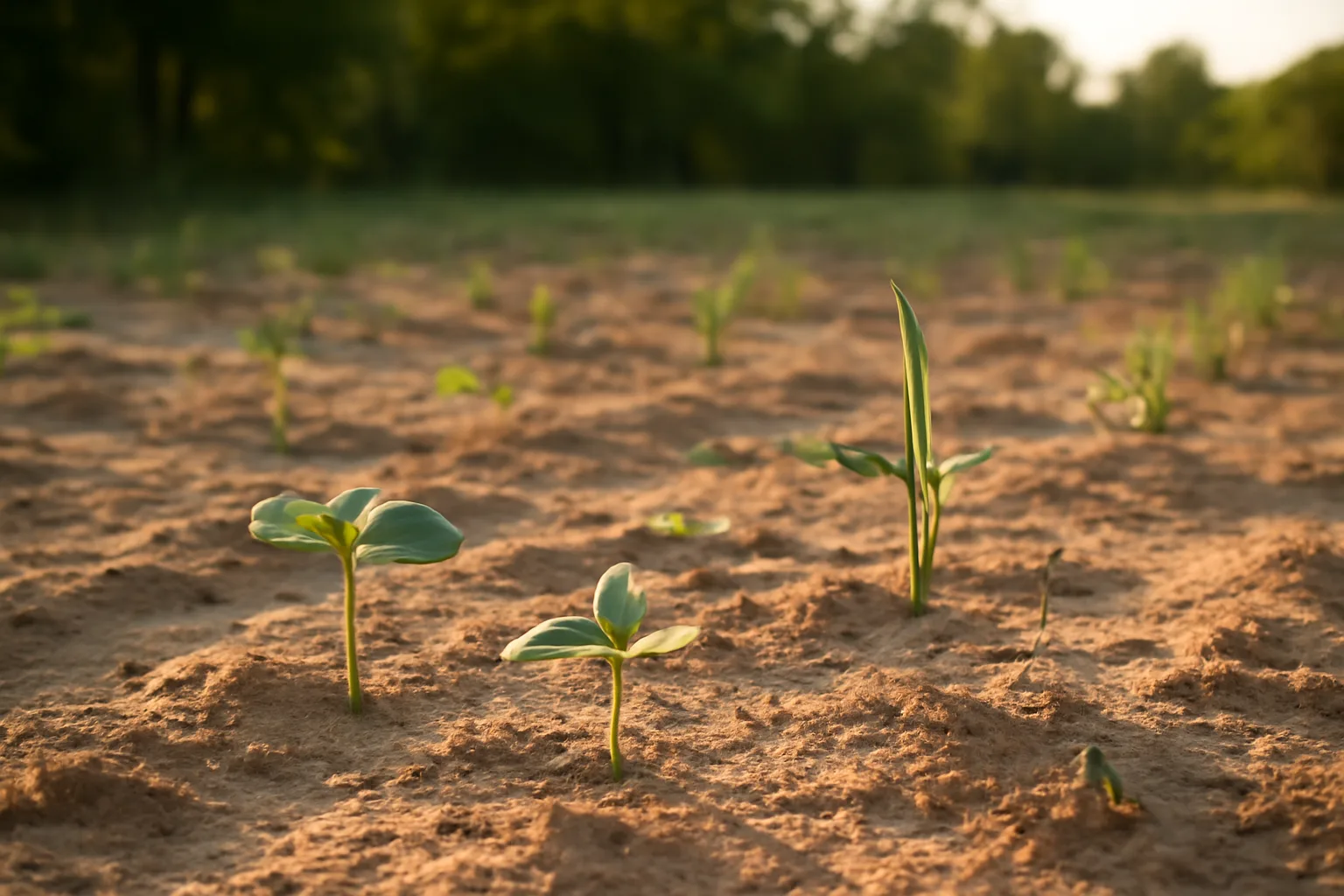
A food plot is a planted patch of forage on hunting land, meant to feed deer and other wildlife and, for hunters, to concentrate deer activity somewhere they can watch or hunt it. That's the whole concept. Most food plots run somewhere between a quarter acre and a few acres, planted in clover, brassicas, cereal grains, beans, or a mix of those. Sandy soil changes almost everything about how that plot behaves. Sand particles are large and the pore spaces between them are big, so water moves through fast instead of sticking around near plant roots. The USDA's official texture classification defines sand as soil with 85% or more sand-sized particles and very little clay or silt to hold things together [1]. That structure is great for drainage after a hard rain, but it's brutal in a dry stretch because there's nothing holding moisture where roots can use it. Nutrients wash through sandy soil the same way water does. Nitrogen especially leaches fast in sand, which is why university extension guidance on sandy soils almost always recommends splitting nitrogen into two or three smaller applications instead of dumping it all at planting [2]. Sandy ground also tends to run more acidic and hold less organic matter, both of which hurt fertility unless you're actively managing them. None of this means sandy soil can't grow a good plot. It means you plan differently: species selection matters more, fertility timing matters more, and rainfall timing matters more than it would on a loam or clay field.
How do you fix sandy soil for a food plot?
You don't really "fix" sandy soil into something else. You manage its two weak points, which are water-holding capacity and nutrient retention, and you pick species that tolerate both. Start with a soil test. This isn't optional advice, it's the actual first step, because sandy soil pH and nutrient levels vary a lot from field to field and even within a field. Your county extension office or a private ag lab will tell you exact lime and fertilizer rates for your dirt. Land-grant universities recommend testing pasture and forage ground every 2 to 3 years, more often on sandy soils where nutrients move faster. Follow whatever your lab report says over any generic number you read online, including in this article. Your soil test lab is the authority on your specific field. Organic matter is the single biggest lever you can pull on sandy ground. Compost, aged manure, or a cover crop turned under before planting adds organic material that acts like a sponge, holding water and nutrients that would otherwise leach straight through. It takes time and it's not glamorous, but it's the difference between a plot that survives a two-week dry spell and one that burns up. Lime matters more on sand than people expect, because sandy soils often run acidic and because lime doesn't stay in the root zone as long as it does in heavier soil. If your test calls for lime, get it applied early, ideally months before planting, since pelletized lime especially needs time and moisture to react and raise pH [3]. Fertilizer strategy on sand should lean toward split applications: less nitrogen up front, then a follow-up dose 3 to 5 weeks into growth once the crop is established and root systems are pulling more water and nutrients from a wider area. This cuts down on how much you're basically feeding to the water table.
What food plot species actually work in sandy soil?
Some species tolerate sandy, drought-prone ground far better than others. If you're planting in sand, lean toward these before you reach for anything that needs consistent moisture. Cowpeas (also called iron and clay peas) handle sandy, droughty soil well and fix their own nitrogen, which helps offset how fast sand leaches nitrogen you apply. They're also one of the most palatable summer legumes for deer. Sorghum, including grain sorghum and forage sorghum types, is genuinely drought-tolerant and does fine in sandy fields where corn would struggle without irrigation. It needs less water than corn to produce a crop. Buckwheat grows fast, tolerates poor and sandy soil, and works well as a short-season cover or nurse crop ahead of a fall planting. Certain clovers, particularly arrowleaf clover and crimson clover, tolerate sandy soil better than ladino or white clover, which prefer more moisture-retentive ground. Arrowleaf in particular is known for handling sandy, well-drained soils in the Southeast. Brassicas like forage radish or turnips do reasonably well in sand if fertility is managed, since their taproots can push down looking for moisture other roots can't reach. They're less forgiving of nutrient-starved sand than legumes, though, since they don't fix their own nitrogen. What struggles: ladino white clover, alfalfa without irrigation, and corn without supplemental water all tend to disappoint on straight sand. They're not impossible, they just need more inputs and more rainfall luck than a hunter leasing ground can usually count on. If you want species options laid out side by side before you settle on a mix, food plot seed and deer food plot seed both break down what's in common blends and why.
Do deer eat sorghum?
Yes, deer eat sorghum, both the grain heads and the young green forage, though it's usually a secondary food source rather than their first choice. Deer will browse young sorghum plants and will eat the grain once heads mature and dry down, especially in late fall and winter when other food is scarcer. Sorghum's real value in a sandy-soil plot isn't that deer go crazy for it above everything else. It's that sorghum survives dry spells that would kill corn or wipe out a clover stand, giving you a fall standing crop even in a rough rain year. Many hunters plant it as part of a mix with cowpeas or soybeans rather than as a monoculture, since the legume component pulls deer in during summer and the sorghum holds through fall.
Do deer eat clover, and do they actually like it?
Yes, deer eat clover heavily, and it's one of the most consistently preferred food plot forages across whitetail range. Clover is high in protein, typically 20 to 25% crude protein in good stands, and stays palatable through most of the growing season if it's mowed or grazed to keep it from getting stemmy [4]. Do deer like clover specifically compared to other plot options? Generally yes. It ranks among the top perennial food plot choices in most regional preference observations, alongside soybeans and alfalfa. That said, on sandy soil you need to pick the right clover. Arrowleaf and crimson clover handle drought and sandy drainage far better than ladino white clover, which wants more consistent moisture. Planting ladino on pure sand without irrigation is a common way to watch a clover plot thin out by August. Clover also needs decent soil pH, generally 6.0 to 6.5, to fix nitrogen efficiently through its root nodules, which is another reason a soil test and lime program matter before you plant on acidic sandy ground [5].
When to plant food plots for deer, and how does sandy soil change the calendar?
Food plot timing splits into two windows almost everywhere in whitetail range: a spring/summer planting for warm-season annuals and perennials, and a late summer/early fall planting for cool-season annuals like brassicas, cereal grains, and clover. Spring plantings (cowpeas, soybeans, sorghum, buckwheat) generally go in after your last frost date, which varies widely by region. Fall plantings (brassicas, oats, wheat, clover) usually go in 6 to 10 weeks before your average first fall frost, giving cool-season plants time to establish before growth slows. On sandy soil, the calendar matters less than the rain forecast. A sandy field planted into dry soil with no rain in the ten-day forecast is a wasted bag of seed, because there's no moisture reserve to carry seedlings through germination. Loam and clay soils have more buffer; sand doesn't. Watch weather models and plant right before or right after a rain event rather than locking into a fixed date on the calendar. For a deeper regional breakdown by zone, food plot whitetail and deer food plots both cover planting windows by USDA hardiness zone in more detail.
When to plant oats for deer?
Oats generally go in during late summer to early fall, roughly August through September in northern states and September through October farther south, timed so plants establish before the first hard frost. Oats are a fast-germinating cool-season cereal grain that deer hit hard in fall, especially in the first few weeks after emergence when the forage is tender. On sandy soil, oats do reasonably well because they germinate fast and don't need deep, sustained moisture the way a slower-establishing perennial does. The catch is they'll still burn through a dry sandy field quickly if there's no rain right after planting, so timing around a rain event beats timing around a date on a calendar. Oats are also a common nurse crop mixed with clover, since the oats come up fast and provide cover and early browse while the clover establishes underneath.
When to plant turnips for deer, and do they work in sand?
Turnips are typically planted 60 to 90 days before your first expected fall frost, since they need that window to bulb out before cold weather and to become sweet and palatable, which happens after a frost converts starches to sugars in the plant. In most of the Midwest and Upper South that lands somewhere in late July through August; farther north it can be earlier, farther south into September works. Turnips in sandy soil are a mixed bag. Their taproots can dig down looking for moisture, which is an advantage over shallow-rooted forages. But turnips need decent fertility to bulb out well, and since they don't fix their own nitrogen the way a legume does, they're more dependent on what you put down and what leaches away. A split nitrogen application, with some at planting and a follow-up dose 3 to 4 weeks later, helps a lot on sand. Deer often ignore turnip tops early in the season and hit the bulbs hard after a hard frost sweetens them, so don't judge a turnip plot's success in October if you're hunting it in December.
What are deer's favorite foods, and does that change on sandy ground?
Deer preference studies and decades of extension observation point to a fairly consistent list: acorns (especially white oak family acorns, which are lower in tannins and more palatable than red oak acorns), soybeans, clover, and, seasonally, agricultural crops like corn and standing beans. Regional forage preference work from state wildlife agencies and universities consistently ranks legumes and soft mast near the top of deer diet studies . Sandy soil doesn't change what deer prefer, it changes what you can realistically grow well enough to compete with natural browse and neighboring ag fields. A thin, stressed clover plot on unfertilized sand won't out-compete a healthy soybean field down the road, no matter how much deer theoretically like clover. The species that wins on sandy ground is the one that actually thrives there, not the one that ranks highest on a general preference list. This is also where a lot of hunters overspend on seed blends built for loam soil and wonder why the stand looks rough by July. Matching species to your actual dirt beats chasing whatever blend worked for someone three counties over on different ground.
Do deer like honey, and is it worth using on a sandy soil plot?
There's no real evidence deer specifically seek out honey, and it's not a practical food plot or attractant strategy. Deer are drawn to sugar and carbohydrate-dense foods generally, which is part of why they hit brassicas hard after a frost sweetens the bulbs, and why fruit and mast crops pull deer in the fall. But honey itself isn't a documented deer attractant in wildlife research, and pouring it out is more likely to draw ants, bears, or raccoons than deer. If you're trying to boost a sandy-soil plot's draw, the better move is a real forage species deer already prefer, planted where fertility and moisture support it, not a novelty attractant. Check your state's baiting and feeding regulations before using any supplemental attractant near a plot or stand, since rules vary a lot by state and some define baiting broadly enough to include mineral or scent products, more than food.
How much does fertilizer and lime cost for a sandy food plot, and is it worth it?
| Nitrogen strategy | Split into 2-3 applications | Often one application works | |
|---|---|---|---|
| Lime timing | Apply months ahead, retest more often | Standard timing usually fine | |
| Drought risk | High, plant around rain events | Lower, more buffer in soil | |
| Best species | Cowpeas, sorghum, arrowleaf/crimson clover, buckwheat | Wider range including ladino clover, alfalfa, corn | |
| Organic matter need | High priority, add compost/cover crops | Helpful but less urgent | If you'd rather not guess at rates and timing on your specific dirt, a $99 one-time Custom Food Plot Plan through plot-plan-builder walks through your soil test numbers, region, and goals and builds out a species and fertility plan around them. It's general guidance built from your inputs, not a site visit or a substitute for what your soil test lab tells you about your exact field. |
Costs vary by region and by how far your soil test numbers are from target, but generally hunters on sandy ground should budget more for lime and split fertilizer applications than they would on better soil, simply because sand needs repeat applications to keep nutrients in the root zone. A basic soil test through a university extension lab typically costs somewhere in the $10 to $20 range per sample, and most extension services recommend testing every field or plot area separately since nutrient levels and pH can vary a lot even across a few acres. That's a small cost against a bag of seed and a season's fertilizer, and it's the only way to know your actual lime requirement instead of guessing. Here's a rough comparison of how sandy soil management differs from loam soil management for a typical annual plot: | Factor | Sandy soil | Loam soil |
What planting mistakes are most common on sandy food plots?
The single biggest mistake is planting on a fixed calendar date instead of watching soil moisture and the forecast. A perfect fall-planting date on paper means nothing if the sandy field is bone dry and no rain is coming for two weeks. The second most common mistake is skipping the soil test and guessing at lime and fertilizer rates. Sandy soil pH and nutrient levels swing more than people expect, and generic bag-of-seed instructions aren't written for your specific field. Third is choosing species built for loam soil, most often ladino white clover or corn without irrigation, and being surprised when they thin out or fail by midsummer. Sandy ground rewards drought-tolerant species and punishes moisture-hungry ones fast. Last, a lot of hunters apply all their nitrogen at once out of convenience. On sand, that's close to paying to fertilize the groundwater. Splitting nitrogen into two or three smaller doses through the season keeps more of it available to the plant instead of leaching past the root zone.
Frequently asked questions
Do deer eat sorghum in food plots?
Yes. Deer browse young sorghum forage and eat mature grain heads, especially in late fall and winter. It's usually a secondary preference behind legumes like soybeans or cowpeas, but its real value on sandy soil is drought tolerance, since it survives dry stretches that would kill corn or thin out clover.
Do deer like clover more than other food plot forages?
Clover ranks among the most preferred food plot forages in most regional observations, alongside soybeans and alfalfa, largely because of its high protein content (often 20-25% crude protein). On sandy soil, choose arrowleaf or crimson clover over ladino white clover, which needs more consistent moisture than sand can hold.
When should I plant food plots for deer?
Warm-season plots (soybeans, cowpeas, sorghum) generally go in after your last spring frost; cool-season plots (brassicas, clover, cereal grains) go in 6 to 10 weeks before your first fall frost. On sandy soil, prioritize planting right before or after a forecasted rain over hitting an exact calendar date.
When is the best time to plant oats for deer?
Oats are typically planted late summer to early fall, roughly August in northern states and into September or October farther south, so they establish before the first hard frost. They germinate fast, which helps on sandy soil, but still need a rain event soon after planting to avoid drying out.
When should I plant turnips for deer food plots?
Plant turnips 60 to 90 days before your area's first expected fall frost, usually late July through August in much of the Midwest and Upper South. Turnips need frost to sweeten the bulbs and become more palatable, so deer often hit them hardest in late fall and early winter rather than right after planting.
What exactly is a food plot?
A food plot is a planted area of forage, typically a quarter acre to several acres, established specifically to feed deer or other wildlife and to give hunters a predictable place to observe or hunt animal activity. Common plantings include clover, brassicas, cereal grains, soybeans, and cowpeas.
What are deer's overall favorite foods?
Acorns, especially from white oak family trees, soybeans, and clover consistently rank at the top of deer diet and preference research from universities and state wildlife agencies. On sandy soil, though, the food that actually thrives on your dirt often outperforms a theoretically more preferred species that struggles in drought-prone ground.
Do deer like honey as an attractant?
There's no solid research showing deer specifically seek out honey, and it's not a practical attractant strategy. Deer are drawn to sugar-dense natural foods like frost-sweetened brassica bulbs and soft mast, not honey itself, which is more likely to attract insects, raccoons, or bears near your plot.
What food plot species work best in sandy soil?
Cowpeas, forage or grain sorghum, buckwheat, and arrowleaf or crimson clover all tolerate sandy, drought-prone soil well. Ladino white clover, alfalfa without irrigation, and corn generally struggle on straight sand because they need more consistent moisture than sandy soil retains.
Do I need to add lime to sandy food plot soil?
Most likely yes, since sandy soils commonly run acidic, but the exact rate depends entirely on your soil test results. Apply lime months before planting when possible, since it needs time and moisture to raise pH, and retest every 2 to 3 years since nutrients and pH shift faster in sandy ground than in loam or clay.
How often should I fertilize a food plot on sandy soil?
Split nitrogen applications work better than one large dose, since sandy soil leaches nitrogen quickly. A common approach is applying part of the recommended rate at planting and a follow-up dose 3 to 5 weeks later once the crop is established and pulling nutrients from a wider root zone.
Can you grow a good clover plot on pure sand?
Yes, but species choice matters. Arrowleaf and crimson clover handle sandy, well-drained soil far better than ladino white clover. You'll also need adequate soil pH (generally 6.0-6.5) for nitrogen fixation to work well, and adding organic matter through compost or cover crops helps the sand hold moisture longer.
Sources
- USDA Natural Resources Conservation Service, Soil Texture Calculator: Sand is defined as soil with 85% or more sand-sized particles and minimal clay or silt
- University of Florida IFAS Extension, Nutrient Management for Vegetable and Agronomic Crops in Florida: Nitrogen leaches quickly in sandy soils, supporting split application recommendations
- University of Georgia Extension, Circular 816, Soil Acidity and Liming for Agronomic Crops: Lime needs time and moisture to react and raise soil pH before planting
- USDA Natural Resources Conservation Service, Plant Guide: White Clover (Trifolium repens): Clover forage commonly tests in the 20-25% crude protein range when actively growing
- Oklahoma State University Extension, PSS-2207, Soil pH and Liming: Clover requires soil pH near 6.0 to 6.5 for effective nitrogen fixation