Last updated 2026-07-26
TL;DR
Clover food plots need phosphorus and potassium, not nitrogen, because clover fixes its own nitrogen once inoculated rhizobia bacteria are established. A soil test typically calls for 0-20-20 or similar, plus lime to hit pH 6.0-7.0. Skip high-nitrogen blends; they just feed weeds and waste money.
what fertilizer should you actually use on a clover food plot
For an established clover plot, look for a blend heavy on phosphorus (P) and potassium (K) and light or zero on nitrogen (N). Something like 0-20-20 or 6-24-24 is the typical starting point, but the real answer comes from a soil test, not a bag label at the farm store. Clover is a legume. Once its roots are colonized by the right rhizobium bacteria (which happens through inoculated seed or bacteria already present in soil that's grown clover before), the plant pulls nitrogen straight out of the air and fixes it in root nodules. Add a bunch of nitrogen fertilizer on top of that and you're not helping the clover much. You're mostly feeding grass and broadleaf weeds that would otherwise lose the competition. Penn State Extension puts it plainly: "Nitrogen fertilization is not recommended for established stands of clover because it can stimulate weed and grass competition". That's the whole argument in one sentence. If your clover looks pale or thin, the fix is almost never more nitrogen. It's usually pH, or potassium, or the stand is just old and thinning out from age or overgrazing. Where nitrogen does earn a spot: a small starter dose (maybe 20-30 lbs N per acre) at seeding time on a brand new plot, especially if you're planting a clover/oats or clover/brassica mix and want the companion grain to get up fast while the clover nodulates. After that first year, back off nitrogen almost entirely.
why does a soil test matter more than the fertilizer bag
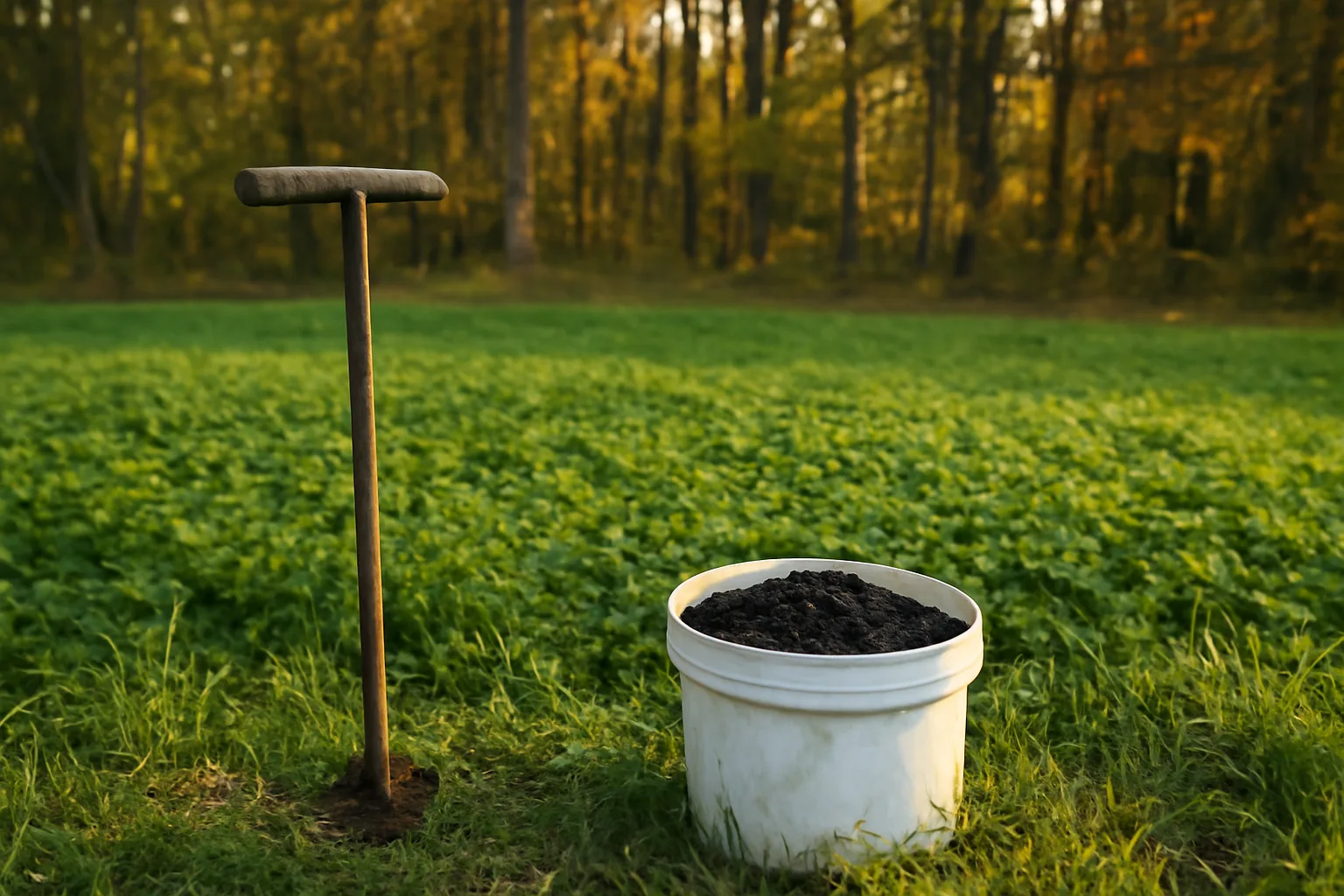
A soil test tells you your actual pH and nutrient levels, and without it you're guessing at rates that could be way off in either direction. University extension soil labs (Penn State, Mississippi State, Auburn, and most land-grant universities run these) typically charge $10 to $20 per sample and turn results around in one to two weeks [1] [2]. The test report gives you three things you need: current pH, current phosphorus and potassium levels (often reported in lbs/acre or ppm), and a recommendation in actual pounds of N-P-K per acre for your specific crop and yield goal. That last part matters. A blanket "clover needs 0-20-20" answer ignores the fact that some fields already have plenty of K in the soil and need almost none added, while others are so K-deficient they need double a normal rate. Clemson Extension recommends soil testing every 2 to 3 years for perennial forages like clover, since nutrient levels drift over multiple growing seasons even without any additions [3]. If you've never tested a plot that's been in clover for three-plus years, that's the first move before buying any fertilizer at all. Your soil test lab is the actual authority here. Their recommendation, calibrated to your state's soil chemistry and your specific sample, should override any generic rate mentioned in an article like this one, including this one.
what pH does clover need and how much lime does that take
Clover wants a soil pH between 6.0 and 7.0, and most extension guides call 6.5 the sweet spot [3]. Below pH 6.0, phosphorus becomes less available to the plant even if it's technically in the soil, so lime is often the highest-return input you can buy for an acidic plot. Lime doesn't work overnight. Ag lime needs three to six months of soil contact and moisture to fully react and shift pH, according to University of Missouri Extension guidance on liming [4]. That's why fall soil testing for a spring planting (or the reverse) gives lime time to actually do its job before the clover goes in the ground. Rates vary hard by soil type. A sandy soil might need 1 to 2 tons of lime per acre to move pH a full point, while a heavy clay soil with more buffering capacity might need 3 tons or more for the same shift [4]. This is exactly why a soil test recommendation beats a flat "just add 2 tons per acre" rule of thumb. Guessing on lime either wastes money on lime you didn't need, or leaves you a full point short of where clover performs best. If your plot already sits at pH 6.5 or better, skip the lime and save the money for fertilizer or seed instead.
how much phosphorus and potassium does an acre of clover actually need
| 0-20-20 | 6 bags (300 lbs) | 0-60-60 lbs | |
|---|---|---|---|
| 6-24-24 | 5 bags (250 lbs) | 15-60-60 lbs | |
| Triple super phosphate (0-46-0) + potash (0-0-60) | 3 bags TSP + 4 bags potash | roughly 0-60-120 lbs | These numbers are illustrative, not a recommendation for your dirt. Use them to sanity-check what a fertilizer dealer quotes you, not as a substitute for your own soil test. One more practical note: potassium is the nutrient most plot owners underestimate. Clover pulls a lot of K out of the soil every year, and low K shows up as clover that looks fine early then thins and yellows at the leaf edges by midsummer. If your plot has been in clover for years without a potash top-dress, K deficiency is a common culprit. |
Typical extension recommendations for established clover run somewhere in the range of 40-80 lbs of P2O5 and 80-150 lbs of K2O per acre annually, though the honest answer is "it depends on your test results," because soils that already run high in K need little to none added . Here's roughly how the math plays out for common fertilizer blends, assuming a soil test calls for about 60 lbs P2O5 and 120 lbs K2O per acre: | Fertilizer blend | Bags needed per acre (50 lb bags) | Approx. N-P-K delivered |
do deer like clover
Yes, and it's one of the most consistently preferred forages in whitetail research. Clover shows up near the top of preference studies across multiple states, and it stays palatable through spring, summer, and into fall in a way that few other food plot options manage . Part of the appeal is protein. Good clover stands run 20-25% crude protein during active growth, which lines up well with lactating does in early summer and antler growth in bucks. It's also just available for a long stretch of the year, unlike a brassica plot that peaks after the first hard frost or a grain plot that's done once it's grazed off or matured. The tradeoff is clover needs more upkeep than annual grain plots: mowing a few times a season to knock back weeds and stimulate new growth, plus the fertility and lime maintenance already covered above. Plots that get planted and ignored for three years tend to grass over and lose a lot of their draw, not because deer stopped liking clover, but because the clover got out-competed.
what is a food plot and why does soil prep matter this much
A food plot is a planted area, usually somewhere between a quarter acre and a few acres, established specifically to grow forage that attracts and feeds deer (and often other wildlife) beyond what natural browse in the woods provides. Plots range from small hidden "kill plots" tucked into timber to larger destination fields meant to hold deer through a season. Soil prep matters because a food plot is really just farming at a small scale, and the same agronomy rules apply. Skip the lime and fertility work, and you'll grow a thin, weedy stand no matter how good the seed is. Get the pH and nutrients right, and even a modest seed budget produces a plot that competes with weeds and holds up for years, especially with perennials like clover. If you want a structured starting point instead of piecing this together field by field, PlotSeason's $99 one-time Custom Food Plot Plan builds a species and fertility game plan around your region and plot size. It's general guidance built to work alongside your soil test results, not a replacement for what your test recommends on lime and fertilizer rates.
when to plant food plots for deer
Timing splits into two windows depending on what you're planting: spring plots (roughly April through June depending on latitude) for warm-season perennials like clover and summer annuals, and late summer to early fall plots (roughly late July through September) for cool-season annuals like brassicas, cereal grains, and fall clover establishment . Clover specifically can go in either window. Spring plantings let clover establish through a full growing season before facing winter, while late-summer plantings (roughly 60-90 days before your first hard frost) work in many regions too, as long as there's enough soil moisture to get germination going. Check your state extension's planting date guide, since a spring window in Wisconsin looks nothing like one in Georgia . For a broader breakdown of species-by-species timing, see food plot whitetail and deer food plot seed for seed selection matched to your planting window.
when to plant oats for deer
Oats are a fall annual in most whitetail country, planted roughly 60 to 90 days before the first expected frost, which lands somewhere in August through early September across most of the Midwest and Northeast, and can run into late September or even October in the Deep South . Oats germinate fast, often within a week under decent moisture, and they're one of the few cereal grains that deer will hit hard as soon as it's a few inches tall, well before other grains reach the same palatability. They don't handle deep winter cold as well as winter wheat or rye, so in northern climates oats often get grazed down or winterkill by mid-winter, which is fine if the goal is early bow season and gun season attraction rather than a plot that lasts through February.
when to plant turnips for deer
Turnips go in during the same late-summer window as other brassicas, generally 70 to 90 days before your area's first hard frost, which usually means late July through August in the North and can push into early September in the South . Turnips need that runway because deer often ignore the tops until after a hard freeze sweetens the leaves and bulbs by converting starches to sugars. Plant too late and you get small bulbs and thin tops with no time left before winter locks up the ground. Turnips also want a fairly fine, firm seedbed since the seed is tiny, so drilling too deep is the most common planting mistake.
do deer eat sorghum
Yes, deer will eat grain sorghum (milo), and it's more commonly used as a cover crop, wildlife food plot component, or a food source that stands up standing through winter than as a primary attractant crop on its own. It's often mixed with other species in a blend rather than planted as a monoculture, largely because deer tend to prefer other grains and legumes when given a choice. Sorghum's real strength is drought tolerance and standing winter cover that also feeds turkey and other birds. If your main goal is maximum deer attraction, sorghum isn't going to outperform clover, oats, or brassicas, but it has a place in a diverse plot design, especially in dry or sandy ground where other species struggle.
what are deer's favorite foods
Preference studies and decades of extension research point to a fairly consistent short list: acorns (especially white oak acorns, which are lower in tannins and more palatable than red oak), clover, soybeans, and various browse species make up the core of what whitetail deer prefer when given options . Preference shifts seasonally and regionally, and it also depends heavily on what's locally available and how nutritionally stressed the deer population is. Among planted food plot species, clover and soybeans consistently rank at or near the top in forage preference trials, with brassicas and cereal grains filling in strong secondary and seasonal roles (brassicas especially after a frost) . There's no single universal "favorite" that holds true in every state and season, but clover shows up on nearly every list.
do deer like honey
There's no research or extension guidance suggesting deer seek out honey, and this isn't a real forage question in the food plot world, it's more likely confusion with "honeysuckle," which deer absolutely do browse heavily, or "honey locust" pods, which deer also eat readily where the trees grow. If you're trying to attract deer with an actual planted or natural food source, honeysuckle browse and honey locust pods are legitimate, but jarred honey itself isn't part of deer diet or food plot planning.
one more thing on baiting and feeding rules before you plant
Fertilizer and a properly planted food plot are legal in every state as normal agricultural practice, but mineral licks, feeders, and supplemental feeding rules vary a lot state to state, and some states classify certain food plot practices differently than baiting. Check your state wildlife agency's current regulations before adding any supplemental feed, mineral, or attractant beyond the planted crop itself, since rules change and enforcement varies by state and even by county in a few places. For species and seed selection to pair with your fertility plan, see deer food plot seed, deer food plots, and food plot seed.
Frequently asked questions
What fertilizer is best for clover food plots?
A phosphorus and potassium heavy blend like 0-20-20 or 6-24-24 is typical, with rates set by a soil test rather than a flat number. Nitrogen isn't needed on established clover since the plant fixes its own once rhizobia bacteria colonize the roots.
Do deer eat sorghum?
Yes, deer eat grain sorghum, but it's usually planted as a secondary blend component or winter cover crop rather than a primary attractant, since deer generally prefer clover, soybeans, and other grains when given a choice.
Do deer like clover?
Yes, clover is one of the most preferred whitetail forages in wildlife research, offering 20-25% crude protein during active growth and staying palatable through spring, summer, and fall, longer than most other food plot options.
When should you plant food plots for deer?
Spring (roughly April through June) works for clover and warm-season plots, while late summer through early fall (roughly late July to September) fits cool-season annuals like brassicas, oats, and fall clover seeding. Exact dates shift by latitude and frost timing.
When should you plant oats for deer?
Plant oats roughly 60 to 90 days before your area's first hard frost, usually August through early September in the Midwest and Northeast, and into late September or October in the Deep South.
When should you plant turnips for deer?
Plant turnips 70 to 90 days before the expected first hard frost, generally late July through August in northern regions and into early September further south. The frost is what sweetens the bulbs and tops.
What is a food plot?
A food plot is a planted area, usually a quarter acre to several acres, established to grow forage that attracts and feeds deer beyond natural woodland browse. It ranges from small hidden kill plots to larger destination fields.
What is a deer's favorite food?
Research points to white oak acorns, clover, and soybeans as consistent top preferences, though it shifts by season and region. Among planted food plot species, clover and soybeans rank highest in most preference studies.
Do deer like honey?
No real evidence supports deer seeking out honey specifically. This is likely confused with honeysuckle, which deer browse heavily, or honey locust pods, which deer readily eat. Neither involves jarred honey as an actual food source.
Should you use nitrogen fertilizer on clover?
Not on established stands. Clover fixes its own nitrogen through root nodule bacteria, and added nitrogen mostly feeds weed and grass competition instead. A small starter dose at initial seeding alongside a companion grain is the main exception.
How often should you soil test a clover plot?
Every 2 to 3 years is the standard extension recommendation for perennial forages like clover, since pH and nutrient levels drift over multiple seasons even without any new additions. Test sooner if the stand looks thin or pale.
What pH does clover need?
Clover grows best between pH 6.0 and 7.0, with 6.5 often cited as the target. Below pH 6.0, phosphorus becomes less available to the plant even when soil test levels look adequate, which is why lime often matters more than fertilizer.
Sources
- Penn State Agricultural Analytical Services Laboratory, Soil Testing Fees: Typical cost range for a standard soil fertility test through a university lab
- Clemson Cooperative Extension, Soil Testing: Recommended frequency of soil testing every 2 to 3 years for perennial forage stands
- University of Missouri Extension, Soil pH and Liming: Target pH range for clover and legume forage production
- USDA Forest Service, Wildlife Habitat Management for White-tailed Deer: Acorn preference and role of mast crops in whitetail deer diet
- University of Georgia Extension: Recommended pH and lime application rates for establishing clover food plots