Last updated 2026-07-26
TL;DR
There's no single best fertilizer for every food plot. It's whatever your soil test recommends for your specific soil and crop, usually a blend supplying nitrogen, phosphorus, and potassium (NPK) plus lime to fix pH. A $10 to $20 soil test from your state land-grant extension office beats any bag guess you'll make standing in a farm store aisle.
What is a food plot, and why does fertilizer matter so much?
A food plot is a planted area, usually somewhere from a quarter acre to a few acres, seeded with forage or grain to attract and hold deer on a property and give them better nutrition than what the surrounding woods offer. Landowners plant clover, brassicas, cereal grains, chicory, and beans in patterns that fit hunting season timing and deer travel routes. Fertilizer matters because most food plot ground isn't farm ground. It's often been logged, sat fallow, or never carried anything but native grass and brush. Soil pH on these sites frequently sits low, in the 4.5 to 5.5 range, which locks up nutrients no matter how much fertilizer you dump on it [1]. Cooperative extension soil testing programs consistently find that wildlife food plots are among the most under-limed, under-fertilized plantings landowners attempt, because people buy a bag of seed and a bag of general-purpose fertilizer and call it done. The truth is unglamorous: the best fertilizer for your plot is the one matched to what your specific dirt is missing, and you find that out with a $10 to $20 soil test, not a guess. If you want help translating a soil test result into an actual seed and fertilizer plan for your ground, that's exactly the kind of thing a Custom Food Plot Plan is built to do. Your soil test lab is still the authority on the lime and fertilizer numbers; the plan turns that into a workable seasonal blueprint.
How do I read a soil test to pick the right fertilizer?
A standard soil test reports pH, buffer pH (used to calculate lime needs), and levels of phosphorus (P), potassium (K), calcium, magnesium, and sometimes sulfur and micronutrients. Most land-grant labs, like those run by Penn State, Mississippi State, or Auburn, return recommendations in pounds per acre of actual N-P-K needed, more than raw percentages [2]. Here's the part people skip: the report usually gives you a target crop. If you tell the lab you're planting clover versus corn versus brassicas, the P and K recommendation changes, because different crops pull different amounts from the soil. A clover/chicory perennial mix typically needs less nitrogen but more phosphorus and potassium than a nitrogen-hungry brassica or cereal grain plot. pH is the first fix, always. Extension agronomists at Mississippi State University note that when soil pH drops below about 5.5, aluminum and manganese become more soluble and can become toxic to plant roots, and phosphorus becomes less available to the plant regardless of how much you've applied [1]. That means a $300 fertilizer bill on a plot sitting at pH 5.0 is partly wasted money until lime brings that number up. Ag lime takes months to fully react in the soil, which is why extension programs recommend applying it in fall for a spring planting whenever possible [2].
What NPK ratio is best for a deer food plot?
| Clover / chicory (perennial) | 0-20-20 or similar at planting, then annual maintenance | Low | Needs inoculant on seed, not nitrogen | |
|---|---|---|---|---|
| Brassicas (turnips, radish, rape) | 19-19-19 or 34-0-0 topdress | High | Split application helps: some at planting, more 3-4 weeks in | |
| Oats / wheat / rye (cereal grains) | 46-0-0 (urea) topdress after emergence | High | Nitrogen drives tonnage and protein | |
| Soybeans / cowpeas (annual legumes) | Starter P and K only | Low | Inoculate seed; avoid heavy nitrogen | This table is a starting point, not a substitute for your soil test result. If your test comes back showing phosphorus already in the "high" category, adding more P is a waste of money and, on some soils, an environmental problem, since excess phosphorus can run off into waterways [3]. The USDA Natural Resources Conservation Service publishes nutrient management standards specifically because over-application is common and costly [3]. |
There's no universal ratio, but there are common patterns extension programs and seed companies point to. Clover and alfalfa, being legumes, fix their own nitrogen from the air once inoculated properly, so they need little to no added nitrogen but do need phosphorus and potassium to establish and persist. Brassicas (turnips, radishes, rape) and cereal grains (oats, wheat, rye) are heavy nitrogen feeders and respond strongly to nitrogen applications, especially oats and wheat which are true grasses. A rough field guide, assuming your soil test doesn't tell you otherwise: | Plot type | Typical starting blend | Nitrogen need | Notes |
When should I fertilize, and does timing change the type I use?
Timing changes what nutrient you emphasize, even if the total NPK stays similar. At planting, most plots get a balanced or P/K-heavy starter fertilizer worked into the seedbed, because phosphorus especially needs root contact to be useful; it doesn't move through soil the way nitrogen does. For nitrogen-hungry crops like brassicas, oats, or wheat, a topdress application of straight nitrogen (often urea, 46-0-0, or ammonium nitrate where legal) three to five weeks after emergence gives a second push right when the plant is bulking up leaf mass. Skipping this step is one of the most common reasons a brassica plot looks thin by October. Perennial clover plots need a different rhythm: an annual maintenance application, usually in late winter or early spring, of phosphorus and potassium (little to no nitrogen) keeps the stand thick for years. Mississippi State University Extension recommends soil testing perennial clover plots at least every two to three years, since established stands slowly draw down P and K even without annual tillage [1].
When to plant food plots for deer?
Planting dates split into two windows almost everywhere in whitetail country: spring plots (May through June in most of the Midwest and South, later in the North) for warm-season annuals like soybeans, cowpeas, and corn, and late-summer to fall plots (mid-August through September in the North, into October in the Deep South) for cool-season annuals like brassicas, cereal grains, and clover. Exact dates depend heavily on your first and last frost, so your state's extension frost date charts or your local cooperative extension office are the real source, not a national blanket rule. As a rough anchor, most fall food plot species (clover, brassicas, wheat) go in the ground 45 to 90 days before your area's average first hard frost, since brassicas in particular need that runway to bulb out or reach full leaf size before frost sweetens them up. If you're planning a full-property rotation across plot-types like food plot whitetail or want a seed-specific breakdown, check deer food plot seed for species-by-species planting windows.
When to plant oats for deer?
Oats are planted in late summer to early fall for a fall/winter food plot, typically 6 to 8 weeks before your first expected frost, which in most of the whitetail range lands somewhere between mid-August and late September. Oats germinate fast, often in 5 to 7 days in warm soil, and provide some of the earliest green attraction of any fall plot planting. Oats can also go in as a spring planting in northern climates for early-season grazing, but the fall window is by far the more common and more productive use for hunting purposes, since oats hold sweetness and palatability better in cooler fall temperatures. A light nitrogen topdress a few weeks after emergence noticeably thickens oat plots, since oats, like all cereal grains, are heavy nitrogen users.
When to plant turnips for deer?
Turnips go in the ground roughly 60 to 90 days before your area's first hard frost, which typically means late July through early September across most of the whitetail range, earlier in the North and later in the South. Turnips need that long runway because the bulb takes time to size up, and a hard frost actually improves palatability by converting starches to sugars in the plant. A common mistake is planting turnips too late, chasing a "just in time for gun season" date. If they go in too close to frost, you get leafy green growth with tiny, underdeveloped bulbs, and deer will hammer the greens early and leave little tuber behind for late season. Turnips also want a fairly fertile, well-drained soil with pH corrected to at least 6.0, and they respond strongly to nitrogen, similar to other brassicas.
Do deer eat sorghum?
Yes, deer will eat grain sorghum, both the seed heads and, to a lesser degree, the young plant, though it's more commonly planted as a dove field or wildlife grain crop than a dedicated deer attractant. Sorghum tolerates drought and poor soil better than corn, which makes it a reasonable choice on marginal ground, but it's rarely anyone's first-choice deer plot species when clover, brassicas, or beans are options. Where sorghum earns its place is in wildlife food plot blends aimed at multiple species (dove, turkey, deer) or on drought-prone fields where corn would fail. If deer are your only target and your soil will support better options, sorghum is a secondary pick, not a primary one.
Do deer eat clover, and do deer like clover?
Yes, and clover is widely considered one of the most reliable, high-value food plot plantings available. White clover and red clover both rank consistently high in deer preference studies and extension forage guides, and clover provides season-long grazing from spring through fall once established, unlike an annual that gets consumed or matures out in a matter of weeks. Clover's crude protein content commonly runs in the 25 to 30 percent range when well-fertilized and actively growing, which is a major reason it's a staple of perennial food plot programs across the whitetail range [4]. It's also relatively low-cost to maintain year over year compared to replanting an annual plot from scratch, provided you keep weeds in check and maintain soil fertility. The tradeoff: clover takes longer to establish, needs decent soil drainage (it struggles in wet, heavy clay that stays saturated), and needs that pH corrected above 6.0 to really thrive. For species comparisons and blend options, see deer food plots and food plot seed.
What are deer's favorite foods, and do deer like honey?
Deer preference shifts by season and region, but extension research and browse studies consistently rank acorns, soybeans, clover, and native forbs among the highest-preference whitetail foods, with agricultural crops like corn and soybeans drawing heavy use where available [5]. In fall, acorns from white oak species are often preferred over red oak acorns because they have lower tannin content and taste less bitter. Honey is not a natural or practical deer food and isn't something wildlife food plot programs use; deer aren't drawn to raw honey as a forage source, and pouring it out on the ground does nothing but attract insects. If you've seen "deer candy" or scent/attractant products branded around sweet flavors, those are different products entirely from honey itself, usually molasses-based mineral or grain attractants, and their use is regulated as bait or supplemental feed in many states. That regulatory point matters more than people think. Baiting and supplemental feeding rules vary enormously by state; some states allow it outright, some ban it statewide, and some restrict it only in certain deer management units due to chronic wasting disease concerns. Always check your state wildlife agency's current regulations before using any mineral, grain, or scented attractant product, since a food plot is generally treated differently under law than a bait pile, but the line varies by state.
Should I use a starter fertilizer, granular blend, or liquid fertilizer?
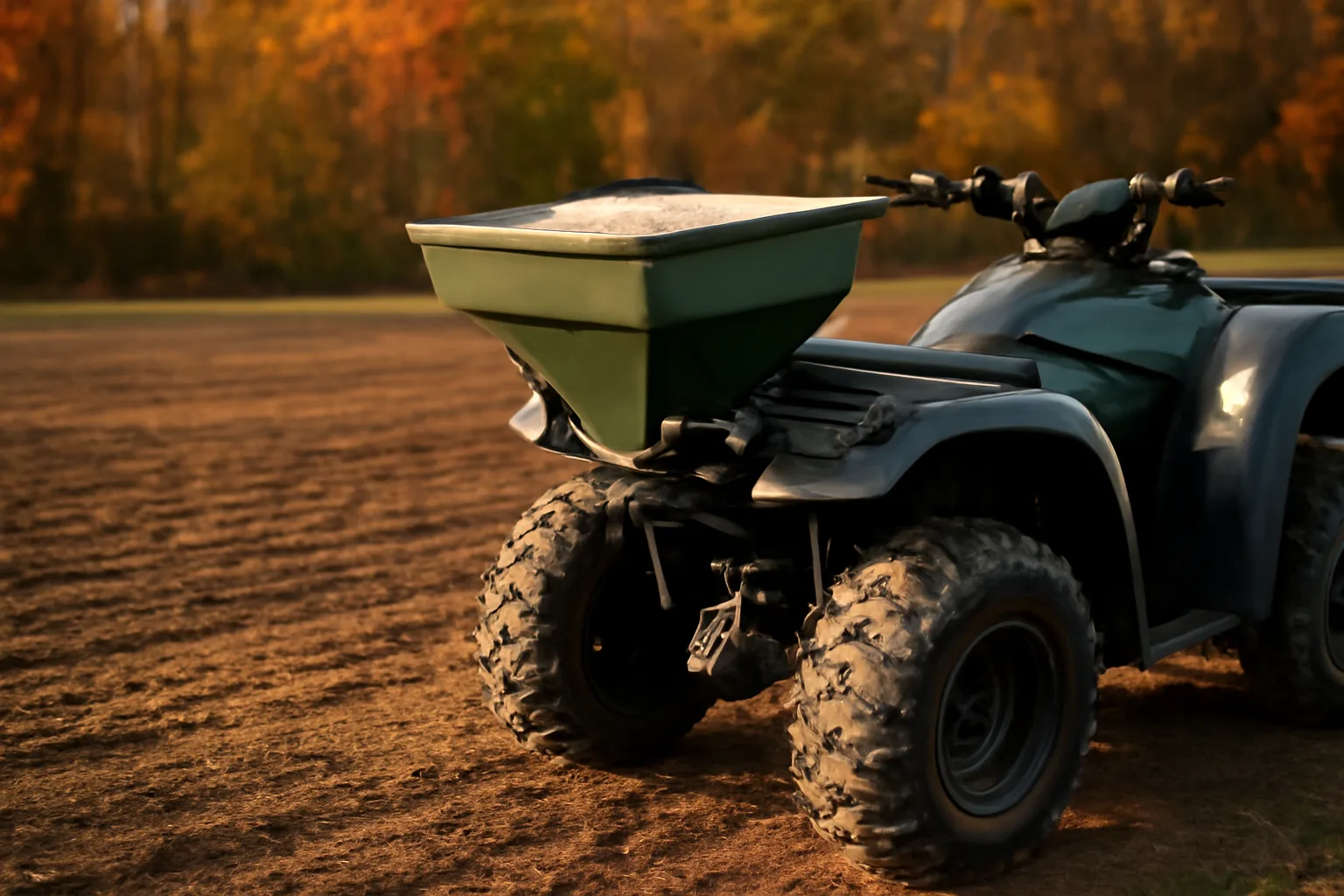
For most food plots under a few acres, a granular blended fertilizer applied with a broadcast spreader (either a handheld/backpack unit or a tow-behind ATV spreader) is the practical, cost-effective choice. Granular blends are widely available at farm and co-op stores, store easily, and are simple to calibrate against your soil test's pounds-per-acre recommendation. Liquid fertilizers have a place, mainly for foliar feeding a struggling stand mid-season or for precise micronutrient correction, but they're generally more expensive per pound of actual nutrient delivered and require sprayer equipment most food plotters don't already own for this purpose. For a first-time plot or a small acreage program, don't overthink this: granular fertilizer, applied at the rate your soil test recommends, split between a pre-plant application and a topdress for nitrogen-hungry crops, covers the vast majority of situations. Cost-wise, expect bagged granular fertilizer to run somewhere in the range of $15 to $30 per 50-pound bag depending on the blend and your region, with actual per-acre cost depending entirely on the rate your soil test calls for. Lime is comparatively cheap per ton but expensive to move and spread, which is why many landowners have it delivered and spread by a local ag co-op rather than hauling bags themselves.
How much fertilizer does a food plot actually need, and what does that cost?
Costs swing widely based on soil test results, plot size, and whether lime is needed. A soil that's already near neutral pH with moderate P and K might need very little added fertilizer, maybe $20 to $40 worth per acre for a maintenance application. A raw, acidic, low-fertility plot starting from scratch might need 1 to 2 tons of lime per acre (commonly quoted around $30 to $60 per ton delivered and spread, though this varies a lot by region and hauling distance) plus a full NPK application running another $50 to $100 per acre [1]. The honest answer is that fertilizer cost is not a fixed number, it's a function of your specific test results, and that's exactly why guessing wastes money in both directions: either under-fertilizing and getting a weak stand, or over-applying nutrients your soil already has plenty of.
Frequently asked questions
Do deer eat sorghum?
Yes, deer eat grain sorghum, especially the seed heads, though it's more often planted for dove fields or mixed wildlife plots than as a top deer attractant. On drought-prone or marginal soil it's a reasonable secondary option, but clover, brassicas, and beans typically outperform it for deer specifically.
Do deer eat clover?
Yes, clover is one of the most consistently preferred food plot forages for whitetail deer, providing crude protein commonly in the 25 to 30 percent range when well-fertilized [6]. It offers season-long grazing from spring through fall once established, unlike most annual plantings.
Do deer like clover?
Yes, extension forage research and hunter experience both rank white and red clover among the top food plot preferences for whitetail deer. Clover's high protein content and long grazing window (spring through fall) make it a staple perennial choice across most of the whitetail range.
When to plant deer food plots?
Warm-season annuals (soybeans, cowpeas, corn) go in May through June in most regions. Cool-season annuals (brassicas, cereal grains, clover) go in mid-August through October, roughly 45 to 90 days before your area's average first hard frost. Exact dates depend on your local frost date, so check your state extension office's charts.
When to plant oats for deer?
Oats are typically planted 6 to 8 weeks before the first expected frost, usually mid-August to late September across most whitetail range, for fall and winter attraction. They germinate quickly, often in 5 to 7 days, and respond well to a nitrogen topdress after emergence.
When to plant turnips for deer?
Plant turnips roughly 60 to 90 days before your area's first hard frost, generally late July through early September. That runway lets the bulb size up before frost sweetens the plant. Planting too late produces leafy growth with small, underdeveloped bulbs.
What is a food plot?
A food plot is a planted area, usually a quarter acre to several acres, seeded with forage crops like clover, brassicas, or cereal grains specifically to attract and nutritionally support deer or other wildlife on a property, typically timed around hunting seasons.
What are deer's favorite foods?
Preference shifts seasonally, but acorns (especially white oak), soybeans, clover, and native forbs consistently rank among the highest-preference whitetail foods in extension browse studies [7]. Agricultural crops like corn and soybeans also draw heavy use where available.
Do deer like honey?
No, honey isn't a natural deer food or a practical food plot input. Deer aren't drawn to raw honey as forage. Sweet-smelling 'deer candy' products are usually molasses-based grain or mineral attractants, not honey, and their use may be regulated as bait in your state.
What's the best fertilizer for clover food plots?
There's no single best blend; it depends on your soil test. Most established clover stands need little added nitrogen (clover fixes its own via inoculant) but respond strongly to phosphorus and potassium, often applied as an annual maintenance treatment in late winter or early spring.
Do I need to lime my food plot before fertilizing?
If your soil test shows pH below about 5.5, yes, lime first. Extension research shows nutrients like phosphorus become far less available to plants at low pH, so fertilizer applied before correcting pH is partly wasted money [1]. Lime also takes months to fully react, so apply it ahead of planting when possible.
How often should I soil test my food plot?
Extension guidance generally recommends testing every 2 to 3 years for established perennial plots like clover, and every year or two for annually-tilled plots, since nutrient levels and pH shift over time even without visible problems [1].
Sources
- Mississippi State University Extension, Establishing Wildlife Food Plots: low soil pH makes nutrients like phosphorus less available and can make aluminum/manganese toxic to roots; recommends periodic soil testing
- Auburn University Extension, Soil Testing and Fertilizer Recommendations: lime application timing and reaction time; recommends applying lime ahead of planting
- USDA Natural Resources Conservation Service, Nutrient Management (Code 590): nutrient management standards exist because over-application of phosphorus can cause runoff and water quality problems
- University of Tennessee Extension, Forages for Wildlife: clover crude protein content commonly in the 25 to 30 percent range when actively growing
- USDA Forest Service, Wildlife Habitat Management for White-tailed Deer: acorns, particularly white oak, are a high-preference whitetail deer food due to lower tannin content