Last updated 2026-07-25
TL;DR
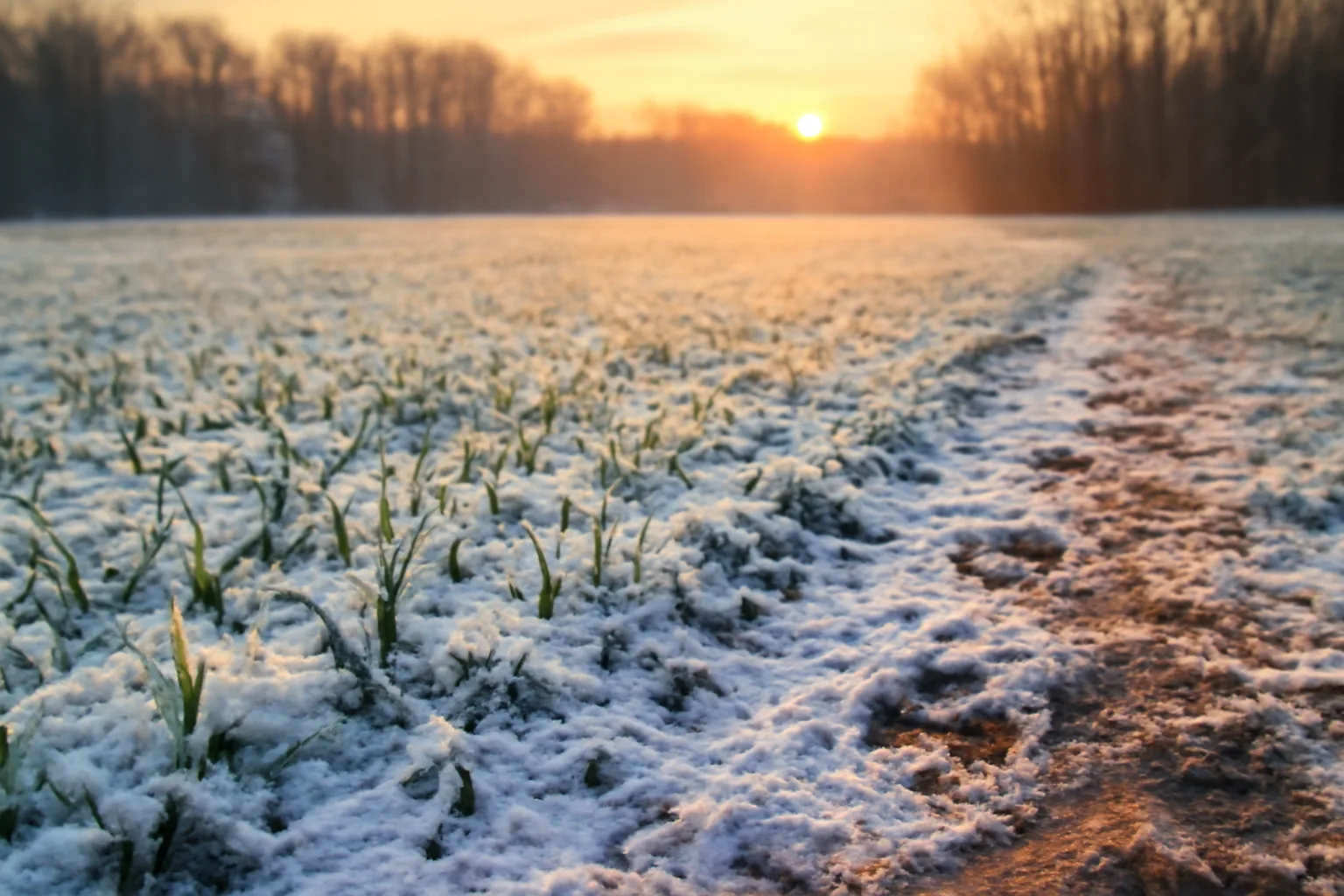
Winter wheat is a cheap, cold-hardy grain that deer hit hard from first frost through green-up. Plant 60-120 lbs/acre, 6-8 weeks before your area's first killing frost, at 1-1.5 inches deep. It tolerates poor soil and low pH better than clover, making it a solid standalone plot or a nurse crop mixed with brassicas and clover.
What is a food plot, and where does winter wheat fit in?
A food plot is a planted area on hunting land, usually a half-acre to several acres, seeded with forage that draws deer and other wildlife and gives them nutrition they can't always get from natural browse. Plots range from small hidden "kill plots" tucked near stand sites to large field-scale destination plots meant to hold deer through winter. Most state wildlife agencies and university extensions treat food plots as a wildlife habitat management practice, not a form of baiting. But that line is defined by state law, and it varies a lot from state to state, so check your own state wildlife agency's regulations before you assume your plot is treated the same way everywhere [1]. Winter wheat (Triticum aestivum) is a cool-season cereal grain, the same crop grown for flour and animal feed across the Great Plains and Midwest. In a food plot context it's one of the most reliable fall grains you can plant. It germinates fast, tolerates cold better than oats, and keeps growing (slowly) under snow cover in a lot of zones. Where it really fits is as a cold-season carbohydrate and green-forage source from October through spring green-up, exactly the window when deer are shifting from summer forage to fat reserves and then to whatever is left standing after a hard winter. Compared to brassicas or clover, wheat isn't the plant deer will beat a path to at first frost. But it's the plant still standing and still green in February when everything else is gone. That's the real argument for it: durability, not glamour.
Do deer actually eat wheat, or is it just filler?
Deer eat winter wheat readily, especially the tender green shoots in fall and again in early spring when it resumes growth. It's a lower-preference forage than clover or brassica tops in a side-by-side choice test, but it's high in carbohydrates and digestible energy, which matters a lot in cold weather when deer need calories to maintain body temperature. Wheat also has an advantage clover and brassicas don't: it holds up to grazing pressure. Deer can hammer a wheat plot hard in October and it will still be green and growing in December, because wheat has a strong tillering habit. It sends up new shoots from the crown even after the leaves get bitten off. That regrowth capacity is why a lot of experienced plotters use wheat as the "insurance" part of a plot mix rather than the headline attraction. University forage trials consistently rank cereal grains like wheat, oats, and rye as moderate-preference, high-tonnage forages. They're useful for total pounds of food produced per acre even if deer would pick clover first given the choice [2].
Do deer like clover more than wheat?
Yes. In head-to-head preference, deer generally choose clover over wheat when both are available and actively growing. Clover (white clover, red clover, or ladino) is higher in crude protein, often 25-30% on a dry matter basis for well-fertilized stands, and it stays palatable through most of the growing season, more than a few cold months. The tradeoff is durability and season length. Clover needs decent soil pH (most extension guides recommend 6.0-6.5) and it goes dormant or gets grazed to the dirt under heavy pressure. Wheat tolerates lower pH, poorer soil, and heavier browsing, and it's a true annual, so you're not managing a perennial stand for years. A lot of plot plans use both: clover as the spring-through-fall protein source, wheat as the fall-planted grain that carries deer through the coldest stretch and gets tilled under or overseeded the next year. If you're deciding between the two for a single plot, ask what season you're hunting. Early bow season favors clover and beans. Late season and post-rut favor wheat, rye, and brassicas.
When should you plant winter wheat for deer, by zone?
| 3-4 | Northern MN, ND, upper WI | Mid-August to early September | |
|---|---|---|---|
| 5 | Southern WI, IA, PA | Late August to mid-September | |
| 6 | KY, VA, MO, southern OH | Mid-September to early October | |
| 7 | TN, NC, AR, OK | Late September to late October | |
| 8+ | Deep South, TX | Mid-October to November | These dates line up closely with USDA hardiness zone data and typical winter wheat planting recommendations published by land-grant universities in the wheat belt [4]. If you plant too early in warm zones, wheat can head out and go to seed before winter, wasting its value as a grazing crop. Plant too late and seedlings won't have enough root development to survive a hard freeze. |
Winter wheat is planted in late summer to early fall, timed so seedlings establish before the ground freezes but ideally before the first hard frost hits so plants get several weeks of growth. As a rule of thumb, extension agronomists recommend seeding winter wheat 6 to 8 weeks before the average first killing frost date in your area [3]. Here's a rough planting window by USDA hardiness zone. Adjust for your specific county's frost dates. | Zone | Region example | Winter wheat planting window |
When should you plant food plots for deer overall?
Food plot timing splits into two seasons. Spring plots (clover, chicory, soybeans, cowpeas) go in after your last frost date, typically April through June depending on latitude. Fall plots (wheat, oats, rye, brassicas, cereal grain blends) go in 60-90 days before your first fall frost so plants establish before cold shuts down growth. Soil temperature matters more than the calendar date. Cereal grains like wheat germinate reliably once soil temps are consistently in the 55-75°F range at planting depth, and they'll keep growing (slower) into the 40s. A practical fall planting checklist: 1. Pull a soil test 8-10 weeks out. 2. Apply lime per your test results as soon as you get them back. 3. Spray or till to kill existing vegetation 2-3 weeks before seeding. 4. Broadcast or drill seed 6-8 weeks before your first expected frost. 5. Apply starter fertilizer at or near planting based on your soil test recommendation. For a full breakdown of seasonal plot calendars by species, see when to plant food plots for deer.
When should you plant oats for deer, and how does that compare to wheat?
Oats are planted on roughly the same fall schedule as wheat, about 6-10 weeks before your first killing frost, though oats are less cold-hardy than wheat and will winterkill in colder zones (typically zone 5 and colder) once temperatures drop into the low teens or below for extended periods . Many food plot mixes actually favor oats specifically for that reason: they're extremely palatable and high-preference in early fall, and once they die back after a hard freeze, they leave the plot open for the wheat or brassicas planted alongside them to take over. So the real comparison isn't wheat versus oats. It's what job each one does. Oats bring immediate, high-preference forage in September and October. Wheat brings cold tolerance and late-season persistence. A lot of proven fall blends run both together: oats for the early pull, wheat for the long game, sometimes with a brassica like turnips or radish mixed in for tonnage and a nitrogen boost from the tubers breaking down.
When should you plant turnips for deer, and do they pair with wheat?
Turnips are planted in the same general fall window as winter wheat and oats, generally 80-100 days before your first hard frost since turnips need more time to bulb up than cereal grains need to establish. That puts most turnip planting in the mid-July to mid-August range across zones 5-7, a bit earlier than straight wheat plantings. Deer often ignore turnip tops and bulbs early in fall, then switch hard to them after the first few frosts convert starches to sugars, making the plant sweeter. That's the classic "deer won't touch it till November" pattern turnip growers see every year. Because turnips and wheat have overlapping fall establishment windows, they're commonly planted together, turnips for the sugar-sweetened late-season pull, wheat filling in the green groundcover and continuing to grow after turnip tops get grazed off or die back. A simple wheat-turnip-radish blend, something like 50 lbs wheat, 3-4 lbs turnip, and 2-3 lbs radish per acre, is one of the most common and cost-effective fall mixes food plotters plant, and it covers both early and late season browsing patterns in a single planting.
How much winter wheat seed do you need per acre, and what does it cost?
Recommended seeding rates for winter wheat food plots run 60-120 lbs per acre depending on method. Drilled wheat (seed placed at consistent depth with a grain drill) needs less seed, typically 60-90 lbs/acre, because germination rates are higher with good seed-to-soil contact. Broadcast wheat, where you spread seed on the surface and drag or cultipack it in, usually needs the higher end, 90-120 lbs/acre, to account for lower and less even germination . Cost-wise, winter wheat seed is one of the cheapest food plot options going. Bulk wheat seed (not treated, ag-grade) commonly runs $10-20 per 50-lb bag depending on your region and the year's grain markets, putting a full acre planting in the $15-40 range for seed alone. That's dramatically cheaper than most blended food plot bags that run $3-5 per pound. This price difference is a big reason wheat shows up as a filler or base crop in so many DIY plot mixes. If you're buying a bagged food plot product marketed specifically for deer plots, expect to pay more per acre because you're paying for the blend, the bag, and the marketing, more than the wheat itself.
Does winter wheat need lime or fertilizer, and what's a reasonable soil target?
Winter wheat tolerates lower soil pH than clover or alfalfa, and it can produce a usable crop down to around pH 5.5, though yields improve as pH climbs toward the 6.0-7.0 range most extension agronomy guides recommend for small grains . That tolerance is one of wheat's real advantages for food plotters working marginal, acidic ground that hasn't been limed in years, or ever. Nitrogen is the nutrient wheat responds to most. A typical fall application for a wheat food plot is a modest starter rate, something like 20-30 lbs of actual nitrogen per acre at planting, since heavy fall nitrogen can push excess top growth that's more vulnerable to winter injury. Extension programs generally recommend saving heavier nitrogen applications for a spring topdress if you want the wheat to keep producing green forage into green-up. Your soil test is the real authority here, not a blanket number in an article. Pull a test, send it to your state's soil testing lab or a private ag lab, and follow their specific lime and fertilizer recommendations for your exact field and pH reading. Guidance in an article like this is general; your lab report is site-specific.
Do deer eat sorghum, and how does it compare to wheat in a plot?
Yes, deer eat sorghum, particularly grain sorghum heads and the tender leaves, though it's typically used more as cover and a late-season grain source than a primary attractant crop. Sorghum is a warm-season crop, planted in late spring like corn, so it doesn't compete directly with winter wheat on the calendar. They fill different seasonal roles entirely. Where sorghum earns its place in a plot rotation is as standing cover through hunting season and a grain source that holds up well into winter, similar in concept to standing corn but on a smaller scale and often at lower cost. If your goal is specifically a cold-season grain that deer graze as green forage, more than seed heads, winter wheat does that job better and cheaper. If you want standing cover plus a grain source that persists into deep winter in warmer zones, sorghum has a place. Most whitetail managers run them in separate plots or plantings rather than mixing them, since their planting windows don't overlap.
Do deer like honey, or is that a food plot myth?
There's no real evidence deer seek out honey as a food source, and it's not a recognized food plot or attractant ingredient in any university extension or wildlife agency literature. Deer are herbivores built around a rumen digestive system suited to browse, forbs, and grasses, not the concentrated sugars in honey. The honey question usually comes up because of commercial deer attractant sprays and "sweet feed" products marketed with vague claims about sugar attraction, sometimes literally naming honey as an ingredient. Those products are a different category entirely from food plot seed. They're often legally treated as bait or supplemental feed, and many states restrict or flat-out ban baiting and supplemental feeding for deer, particularly in areas managing chronic wasting disease. Rules vary a lot by state, so check your state wildlife agency's regulations before using any scent, mineral, or feed product, and before assuming a food plot itself falls outside baiting definitions where you hunt.
What are deer's favorite foods, and where does wheat rank?
Deer preference studies and field observation consistently put a handful of forages at the top: native forbs and browse in season, acorns (especially white oak group acorns, which are lower in tannins and more palatable than red oak group acorns), soybeans, and clover typically rank as the highest-preference cultivated and natural foods available to whitetails. Brassica tops and turnip bulbs rank high in late fall once frost sweetens them. Cereal grains like wheat, oats, and rye rank in the middle of most preference charts, below clover and beans, but well above woody browse in the dead of winter when there's nothing green left standing. Wheat's real value isn't top-tier preference. It's availability and tonnage during the exact stretch of the year when almost nothing else is growing. A well-designed plot program layers these together instead of chasing a single "best" species: soybeans or clover for growing season protein, brassicas and wheat for fall and winter carbs, and native habitat work to support the acorn and browse component you can't plant your way into. If you want a start-to-finish species and acreage plan built around your specific property and hunting goals, that's exactly the kind of question a Custom Food Plot Plan is built to answer for $99, one time, no subscription.
How do you actually plant a winter wheat food plot, step by step?
Start with a soil test pulled at least 8-10 weeks before your planting date. This gives you time to apply and let lime work into the soil before seeding. Send it to your state extension soil lab or a private agronomy lab and follow their specific lime and fertilizer recommendation, not a generic number from an article. Kill or clear existing vegetation 2-3 weeks before planting, either with a broad-spectrum herbicide like glyphosate or through tillage, depending on your equipment and whether you're working a no-till or conventional plot. Wheat competes poorly against established grass and weeds in its first few weeks, so a clean seedbed matters more than almost anything else you'll do. Plant 60-90 lbs/acre if drilling, 90-120 lbs/acre if broadcasting, at a depth of 1 to 1.5 inches. If broadcasting, drag a section harrow, chain harrow, or cultipacker over the plot afterward to work seed into the soil. Wheat left sitting on bare dirt germinates poorly and is easy pickings for birds. Apply your starter fertilizer at or near planting per your soil test. Then wait: you should see green shoots in 7-10 days under decent soil moisture and temperature. For readers comparing wheat against a full lineup of other food plot seed options and blends, deer food plot seed and food plot seed break down more species side by side.
Frequently asked questions
Do deer eat sorghum in a food plot setting?
Yes, deer eat sorghum leaves and grain heads, though it's a warm-season crop planted in late spring, unlike winter wheat. It's used more for late-season standing grain and cover than as a top preference attractant. Deer will graze it, but most managers pair it with other plantings rather than relying on it alone.
Do deer like clover better than wheat?
Generally yes. Clover runs higher in crude protein (often 25-30% dry matter) and ranks above wheat in most deer preference observations. Wheat's advantage is cold tolerance and durability under heavy browsing pressure, making it the better choice for late fall and winter forage when clover has gone dormant or been grazed down.
When is the best time to plant deer food plots?
It depends on the species. Spring plots (clover, beans, chicory) go in after your last frost date. Fall plots (wheat, oats, brassicas) go in 6-10 weeks before your area's average first killing frost, so plants establish before cold weather stops growth.
Do deer actually like clover as a food source?
Yes, clover is consistently one of deer's most preferred cultivated forages, ranking near the top in university preference studies alongside soybeans. It's high in protein and stays palatable through most of the growing season when soil pH and fertility are maintained around 6.0-6.5.
When should you plant oats for a deer food plot?
Plant oats 6-10 weeks before your area's first killing frost, similar to wheat. Oats are less cold-hardy and often winterkill in zone 5 and colder once temperatures drop into the low teens for extended stretches, so they're best used for early fall forage rather than season-long persistence.
When should you plant food plots for deer overall?
Fall plots go in 60-90 days before your first fall frost; spring plots go in after your last spring frost. Exact timing depends on your USDA hardiness zone and the species, cereal grains and brassicas need a longer runway than fast-germinating clover or chicory.
When should you plant turnips for deer food plots?
Plant turnips roughly 80-100 days before your first hard frost, generally mid-July to mid-August in zones 5-7, earlier than straight wheat plantings. Turnips need that extra time to bulb up before deer start hitting them hard after the first few frosts sweeten the sugars.
What exactly is a food plot?
A food plot is a planted patch of forage on hunting or managed land meant to supplement natural deer browse, usually ranging from a quarter-acre hidden plot near a stand to multi-acre destination fields. Common species include clover, brassicas, cereal grains like wheat and oats, and soybeans.
What are deer's favorite foods overall?
Preference studies and field data generally rank white oak acorns, soybeans, and clover at the top, with brassica tops and turnip bulbs close behind once frost sweetens them. Cereal grains like wheat rank in the middle, valuable more for winter availability than top-tier preference.
Do deer like honey or sweet attractant products?
There's no credible evidence deer specifically seek out honey; it's not part of their natural forage base. Products marketed with honey or sugar as attractants are a separate category from food plot seed, and many fall under state baiting or supplemental feeding rules, which vary and should be checked before use.
How much winter wheat seed do you need per acre?
Plan on 60-90 lbs/acre if drilling and 90-120 lbs/acre if broadcasting. The higher broadcast rate compensates for lower and less consistent germination compared to seed placed at a controlled depth with a drill.
Does winter wheat need a specific soil pH to grow well?
Winter wheat tolerates pH as low as 5.5 and still produces usable forage, though yields improve in the 6.0-7.0 range most extension guides recommend. It handles acidic, marginal soil better than clover or alfalfa, making it a solid choice for ground that hasn't been limed recently.
Can you plant winter wheat and turnips together in the same plot?
Yes, this is one of the most common fall food plot combinations. Turnips provide a late-season sugar-sweetened bulb and top forage, while wheat fills in green groundcover and keeps producing after turnip tops get grazed down or die back from repeated hard frosts.
Sources
- USDA NRCS, Plant Fact Sheet: Winter Wheat: Cereal grains like wheat, oats, and rye are moderate-preference, high-tonnage forages for deer
- Kansas State University Research and Extension, Wheat Production Handbook (C-529): Winter wheat is recommended for planting 6-8 weeks before the average first killing frost date
- University of Wisconsin-Madison Extension, Cool-Season Cover Crops for Wisconsin (A4147): Oats are less winter-hardy than wheat and typically winterkill in colder USDA zones
- University of Missouri Extension, Food Plots for Deer and Turkey (G9421): Broadcast seeding requires a higher seeding rate than drilled seeding due to lower germination consistency
- Oklahoma State University Extension, Soil pH and Wheat Production (PSS-2225): Winter wheat can produce a usable crop at pH as low as 5.5, with better yields at 6.0-7.0