Last updated 2026-07-25
TL;DR
Plant brassica radishes for deer 60 to 90 days before your area's first killing frost, roughly mid-July in the far north down to early September in the mid-South. Soil temps between 50 and 85 degrees F work, but the real driver is frost timing, since radishes need cool fall weather to build sugar content and pull deer in.
When should you plant radishes for deer?
| Upper Midwest / Northeast | Late July to mid-August | Late Sept to mid-Oct | |
|---|---|---|---|
| Mid-Atlantic / Transition zone | Mid-Aug to early Sept | Mid to late Oct | |
| Mid-South | Late Aug to mid-Sept | Late Oct to early Nov | |
| Deep South | Sept to early Oct | Nov to early Dec | These are starting points, not gospel. Check your county's average first frost date through your state climate office or extension service before you set a date on the calendar. |
The short answer: count backward 60 to 90 days from your area's average first frost date. Radishes (usually forage or tillage types like Groundhog or Daikon) need that window to build a bulb and top growth before cold weather hits, and they actually get sweeter and more attractive after a frost or two hits the leaves and converts starches to sugar. In zone terms, that means late July through mid-August in the Upper Midwest and Northeast, mid-August through early September in the transition zone (Kentucky, Missouri, Virginia), and late August into September in the mid-South. Wait too long and you get small bulbs and thin leaf mass going into winter. Plant too early into summer heat and drought and germination suffers, plus you risk the plot bolting or getting hammered by deer before it ever matures. The USDA National Agricultural Library's plant hardiness zone map is the standard reference for matching planting windows to your location, and most extension food plot guides build their calendars off local frost date data rather than the zone map alone, since frost dates vary more than temperature zones would suggest. Here's a rough planting window by region: | Region | Planting window | Typical first frost |
What soil temperature do radishes need to germinate?
Radish seed germinates in soil temps as low as 45 degrees F but comes up fastest and most evenly between 50 and 85 degrees F, according to university vegetable production guides that cover Raphanus sativus germination ranges [1]. For food plot purposes, don't obsess over a soil thermometer. If you're planting in that mid-to-late summer window and the ground isn't baked dry, you're in the zone. Moisture matters more than exact temperature for a food plot radish planting. Radish seed is small and needs to be planted shallow, about a quarter to half inch deep, and shallow seed dries out fast in August heat. If you're staring at a ten-day forecast with no rain, it's worth waiting a week rather than dumping seed into dust. A lot of failed radish plots aren't a timing problem at all, they're a moisture problem.
When do you plant turnips for deer, and is it different from radishes?
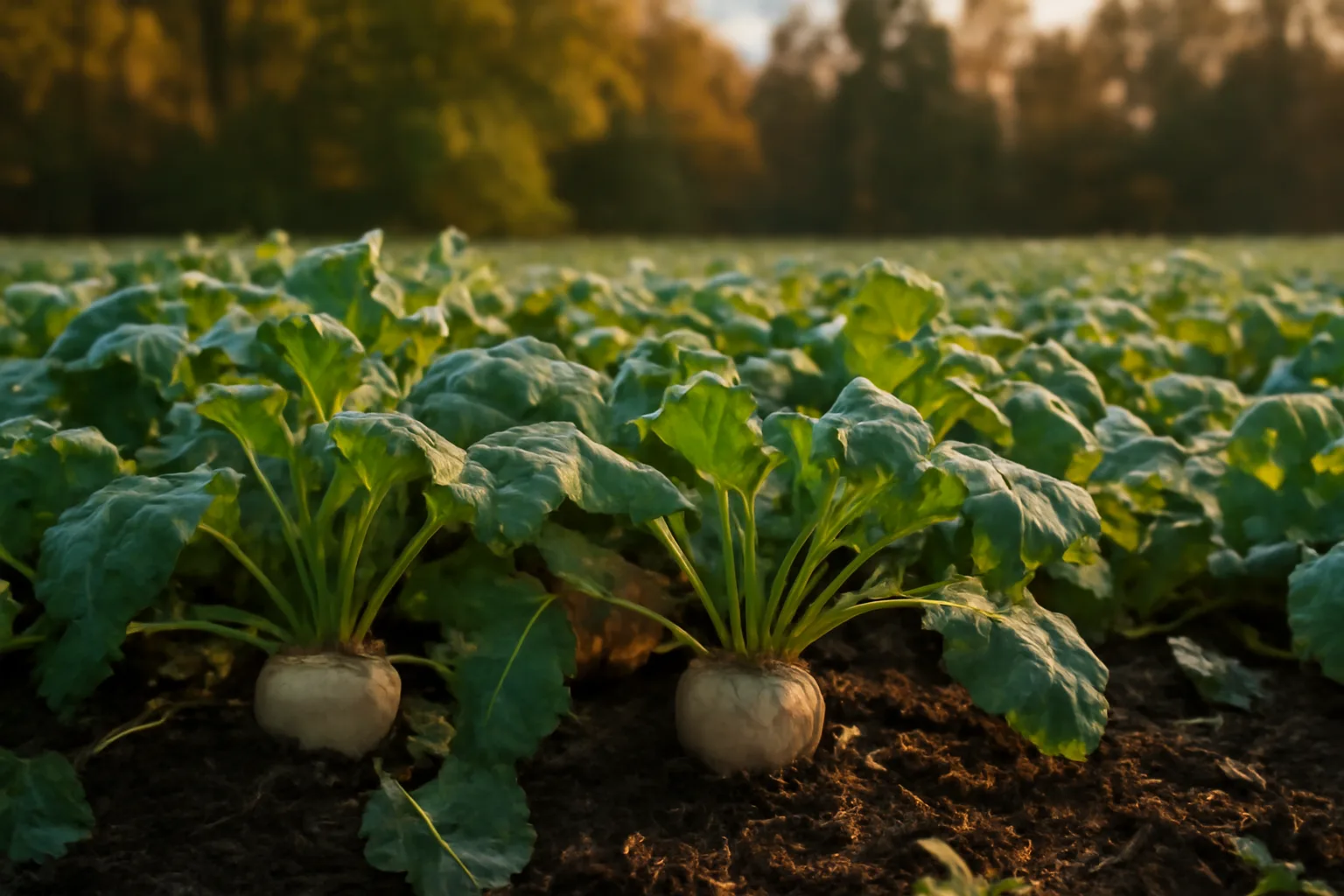
Turnip planting timing runs on almost the same calendar as radishes: 60 to 90 days before first frost, generally late July through early September depending on your zone. Both are brassicas, both like cool soil to finish out, and both actually improve in palatability after a frost converts starches to sugars. The practical difference is in the plant, not the calendar. Turnips put more energy into the bulb and deer often hit the bulbs hard in mid to late winter once other food is gone, digging them out of frozen ground. Radishes, especially tillage/daicon types, put more energy into a long taproot that breaks up compacted soil and often gets consumed leaves-first in fall before deer bother much with the root. Many food plot blends mix the two along with clover or brassica greens like kale specifically because they stagger the feeding pattern: leafy growth gets hit first, then bulbs and roots later in winter when deer need calories most. If you're already reading about food plot seed blends, most brassica mixes for deer bundle turnips and radishes together for exactly this reason.
When do you plant food plots for deer overall?
Food plot timing splits into two seasons: spring/summer plots (clover, chicory, soybeans, corn) and late-summer/fall plots (brassicas, radishes, turnips, cereal grains). Spring plots generally go in April through June depending on your frost-free date. Fall plots, which includes radishes and turnips, go in from mid-July through September, counting backward from first frost as covered above. A lot of hunters try to do both radishes and something like clover in the same plot in the same season, and that doesn't really work, since clover is a perennial planted in spring or very early fall and radishes are an annual planted for fall/winter tonnage. If you want both, you're usually looking at separate plots or a rotation, not one seeding. Cooperative extension food plot guidance consistently frames the calendar around frost dates rather than calendar months, because a mid-August planting in Minnesota and a mid-August planting in Georgia are on completely different clocks [2]. If you want plot-specific timing instead of a regional guess, that's the kind of thing a Custom Food Plot Plan from PlotSeason is built to nail down using your zip code, soil test, and target species. It's a $99 one-time plan, and it's built for exactly this problem: matching planting windows to your actual property instead of a national average.
When should you plant oats for deer?
Oats go in during the same fall window as radishes and turnips in most of the country, roughly 45 to 60 days before first frost, since oats grow faster than brassicas and don't need quite as long a runway. In the transition zone and mid-South, that's typically late August through mid-September. In colder zones, early to mid-August. Oats have one big advantage over radishes: they green up fast (often visible in 5 to 7 days under good moisture) and give deer something to eat almost immediately, which is part of why so many fall blends pair cereal grains with brassicas. The oats feed early, the radishes and turnips take over once cold weather sweetens them up. Oats do not survive hard winter cold like winter wheat or cereal rye can. In zones with brutal winters, oats will winterkill, which is sometimes exactly what you want if you're rotating that ground to something else in spring.
What is a food plot, exactly?
A food plot is a planted area, usually somewhere from a quarter acre to several acres, on hunting land specifically to grow forage that attracts and holds deer, along with supplementing their natural diet. It's not the same as agricultural farming for yield or profit; the goal is deer nutrition, deer attraction, and sometimes deer health during stress periods like late winter or antler growth in spring and summer. Most food plots fall into a few categories: annual clovers and brassicas for fall/winter, warm-season annuals like soybeans and corn for summer, and perennial clover/chicory blends that can produce for 3 to 5 years with good management. State wildlife agencies generally regulate food plots the same as other agricultural plantings on private land, though baiting and feeding rules (which restrict things like piling loose corn or minerals) are separate from food plot rules in most states and vary widely, so it's worth checking your state wildlife agency's regulations before assuming a planted plot and a bait pile are treated the same under the law [3]. If you're new to the concept entirely, food plot whitetail basics and deer food plots planning fundamentals are a good next stop before you commit acreage.
Do deer eat sorghum?
Yes, deer eat sorghum, both the grain heads and, to a lesser extent, the foliage, though it's not typically planted as a primary deer attractant the way corn or soybeans are. Sorghum (grain sorghum, also called milo) shows up more often as a drought-tolerant summer forage or as a component in dove field and wildlife blends than as a dedicated deer plot seed. Whitetail deer diet studies consistently show that deer are highly selective, opportunistic browsers, and grain crops like sorghum get used when available but aren't preferred forage the way legumes and forbs are [4]. If sorghum is already growing on adjacent farm ground, deer will use it. As a standalone food plot choice, most food plot managers rank it behind corn, soybeans, and brassicas for deer-specific plots.
Do deer eat clover, and do deer like clover?
Yes, and clover is arguably the most consistently preferred food plot forage across whitetail range. Both white clover (Trifolium repens) varieties like Ladino and red clover (Trifolium pratense) show up as top choices in extension forage guides and deer nutrition research because of high protein content, often in the 25 to 30 percent crude protein range in vegetative growth stages, and because deer will hit clover hard from spring green-up through fall. Clover's real advantage over an annual like radishes is longevity. A well-managed perennial clover plot can produce for 3 to 5 years before you need to reseed, versus replanting radishes every single year. The tradeoff is clover needs more consistent mowing and weed management through the growing season, and it doesn't have the winter cold tolerance or late-season sugar spike that makes brassicas so useful in December and January. Many food plot programs use both: clover for spring/summer/early fall protein, brassicas and radishes for late fall/winter tonnage when deer need calories most and other forage is dying back.
What are deer's favorite foods?
There's no single universal answer, because whitetail deer diet shifts by season, region, and what's locally available, but research consistently shows deer strongly prefer soft mast (acorns especially), legumes (clover, soybeans), and forbs over grasses and woody browse when given the choice. Acorns in particular are a preferred fall food because of their high fat content, and deer will often bypass a food plot entirely during a good acorn drop. In food plot terms, soybeans and clover consistently rank as the highest-preference planted forages in most regional studies, followed by brassicas (turnips, radishes) especially in late fall and winter once other options are gone. Corn is heavily used but more for the grain/energy value in late season than as a preferred browse. A useful mental model: think of favorite foods less as a fixed list and more as whatever gives deer the best protein-to-effort or energy-to-effort ratio at that specific point in the year. That's why radish plots get hammered in November and mostly ignored in August. If you want a broader rundown on species selection beyond radishes, deer food plot seed covers the tradeoffs across clover, brassicas, cereal grains, and legumes in more depth.
Do deer like honey?
There's no real research or practical use case behind deer and honey as a food source or attractant. Deer are herbivorous browsers and honey isn't part of their natural diet in any meaningful way; it's not a forage crop, and it's not something planted in a food plot. If you've seen this question paired with radishes or food plots, it's likely confusion with sweet feed or molasses-based mineral licks, which are a different product entirely, and which fall under baiting/feeding regulations in a lot of states depending on how they're used [3]. If you're trying to add attraction to a plot, a mineral site or a genuinely sweet forage like brassicas post-frost does far more than anything honey-related, and it keeps you inside normal food plot rules rather than baiting rules.
How do you plant a radish food plot step by step?
Start with a soil test. Radishes tolerate a wider pH range than clover, but they still perform best in the 6.0 to 6.5 range, and your soil test results (not a generic guide) should be the final word on lime and fertilizer rates for your specific dirt [5]. Once you've got lime and fertilizer worked in based on that test, till or disk the seedbed lightly, since radishes don't need a fine seedbed the way clover does. Broadcast seed at 6 to 10 pounds per acre if planting radish alone, or follow the blend rate on the bag if you're mixing with turnips, oats, or other brassicas. Cover lightly, a quarter to half inch is plenty; radish seed buried too deep won't come up. A light cultipack or drag after broadcasting helps seed-to-soil contact, which matters more for germination success than almost anything else in that first two weeks. If you're working ground you've never planted before, deer food plot seed and food plot seed selection guides can help you figure out whether straight radish or a blend fits your soil and goals better.
Frequently asked questions
How many weeks before frost should I plant radishes for deer?
Plant 8 to 12 weeks (roughly 60 to 90 days) before your area's average first frost date. This gives radishes enough time to establish leaf growth and bulb before cold weather hits, and lets that first frost sweeten the plant right when deer need calories most in late fall and winter.
Can you plant radishes and clover together?
Not really, in one seeding. Clover is a perennial usually planted spring or very early fall at a different rate and depth than radish, an annual planted mid to late summer. Most managers keep them as separate plots or plant clover first, then follow with a fall brassica planting the next year in rotation.
What's the best temperature to plant radishes for deer?
Soil temps between 50 and 85 degrees F support germination, per university vegetable production data on Raphanus sativus, but for food plots, frost date matters more than exact soil temperature. Aim for the mid-to-late summer planting window specific to your zone rather than chasing a precise thermometer reading.
Do deer prefer radishes or turnips?
It varies by plot and season. Deer often hit radish and turnip leaves first in fall, then dig up turnip bulbs in mid to late winter once other food is scarce. Radish taproots are less commonly eaten than turnip bulbs. Most blends include both so deer have options across the whole fall/winter window.
What is the ideal seeding rate for radishes in a deer plot?
Straight radish plantings typically run 6 to 10 pounds of seed per acre broadcast. If you're using a blend with turnips, oats, or clover, follow the bag's specific rate, since blends adjust each component down to avoid overcrowding and competition between species.
Do deer eat sorghum in food plots?
Yes, deer eat sorghum grain and some foliage when it's available, but it's not typically planted as a primary deer food plot species. It shows up more in dove fields and mixed wildlife plantings. Corn, soybeans, and brassicas rank higher in most food plot preference comparisons.
Is it too late to plant radishes in September?
Depends on your zone and frost date. In the mid-South and further south, September is often right on schedule. In the Upper Midwest and Northeast, September planting is usually too late for radishes to fully mature, since first frost often hits by late September or early October in those zones.
Do radishes need to be frost-killed to attract deer?
Not exactly killed, but a light frost helps. Frost converts starches in the leaves and bulb to sugars, which makes the plant noticeably more palatable and often triggers deer to hit a radish plot much harder than they did in the weeks before frost.
When is the best time to plant food plots for deer overall?
There are two windows: spring/summer (April through June) for clover, soybeans, and corn, and late summer (mid-July through September, counting back from first frost) for brassicas, radishes, turnips, and cereal grains like oats. Your exact dates depend on your zone's frost timing, not the calendar month alone.
Do deer like clover better than radishes?
Deer generally use clover more consistently across spring, summer, and early fall because of its protein content, while radishes get heavy use specifically in late fall and winter after frost sweetens the plant. They're not really competing for the same season, so many plots include both.
What's the difference between a food plot and baiting?
A food plot is a planted forage crop deer feed on naturally in the ground; baiting typically refers to piling loose feed like corn, or setting out minerals, to attract deer to a specific spot. States regulate these differently, and rules on baiting/feeding vary widely, so check your state wildlife agency's current regulations before assuming a plot and a bait pile are treated the same.
Can you plant oats and radishes together?
Yes, this is a common fall blend. Oats germinate and green up faster (5 to 7 days), giving deer early forage, while radishes take longer to mature and become more attractive after frost. Together they stagger feeding across the whole fall and winter window rather than peaking all at once.
Sources
- University of Georgia Extension, Home Garden Radishes: Radish seed germination temperature range and shallow planting depth requirements
- Mississippi State University Extension, Establishing Wildlife Food Plots: Food plot planting calendars are built around frost dates rather than fixed calendar months
- Michigan Department of Natural Resources, Baiting and Feeding Regulations: State wildlife agencies regulate baiting and feeding separately from general food plot planting, and rules vary by state
- USDA Forest Service, Southern Research Station, White-tailed Deer Food Habits: Whitetail deer diet is selective and opportunistic, with grain crops used when available but not consistently preferred over legumes and forbs
- University of Kentucky Cooperative Extension, Establishing and Managing Wildlife Food Plots: Radish and brassica food plots perform best in a soil pH range of roughly 6.0 to 6.5, with soil test results guiding lime and fertilizer rates