Last updated 2026-07-25
TL;DR
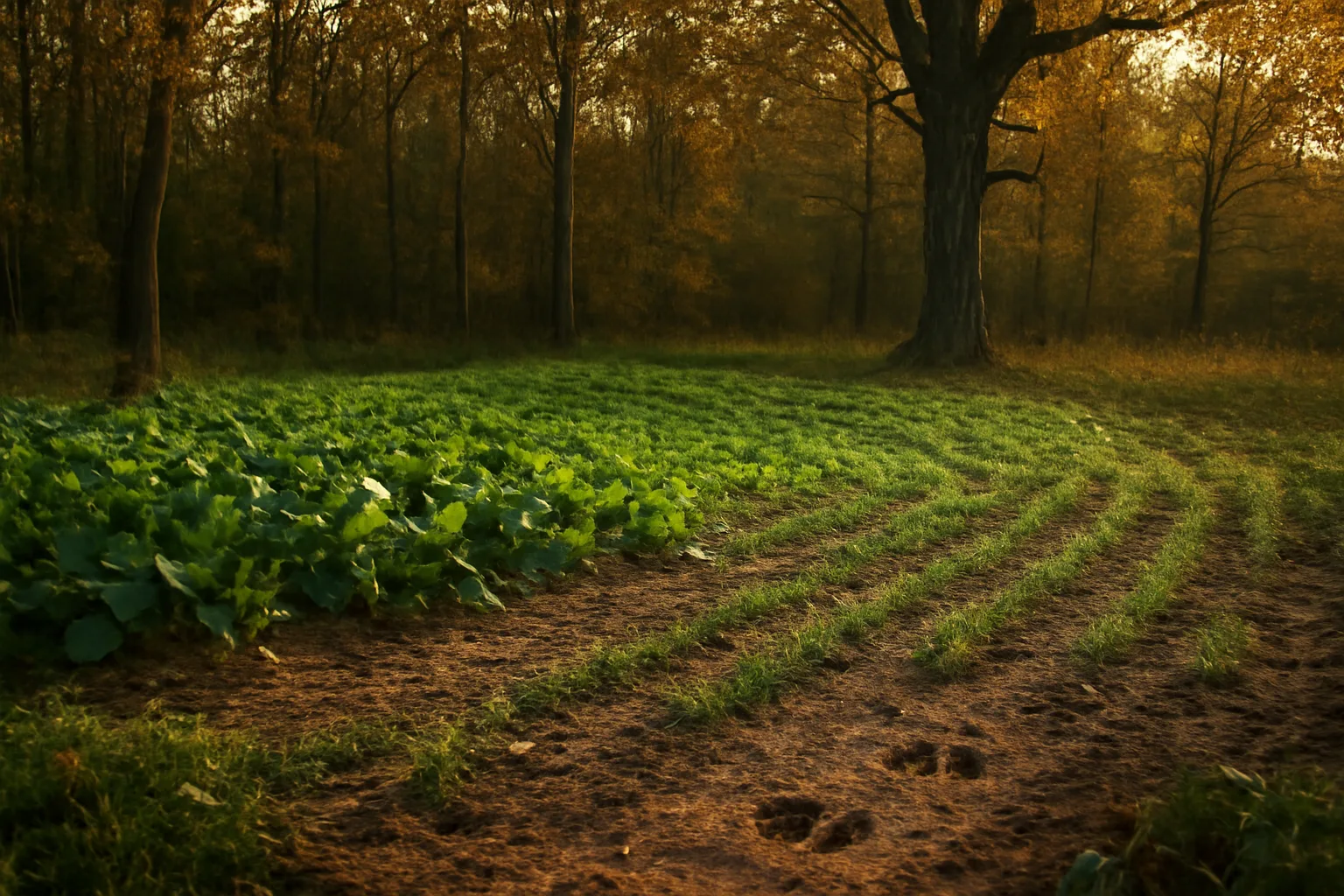
A kill plot is a small, hidden food plot planted specifically to draw deer into bow or gun range, usually 1/4 to 1 acre. Brassicas (turnips, radish), cereal grains (oats, wheat) and clover are the standard seed choices. Plant brassicas and oats 60-90 days before your first hard frost so they mature right when hunting season opens.
What is a food plot, and how is a kill plot different?
A food plot is any planted area on hunting ground meant to feed deer, whether that's a 5-acre soybean field or a quarter-acre clover patch tucked in the timber. The term covers everything from large-scale agriculture-style plantings to tiny hidden plots. Cooperative extension programs generally define food plots as supplemental forage plantings that improve nutrition and concentrate animal use on a property, distinct from natural browse [1]. A kill plot is a specific kind of food plot built for one job: putting a deer in range of your stand at the right time of day, not necessarily feeding the whole herd all season. Kill plots run small on purpose, often under an acre, tucked close to bedding cover with a tight approach and exit route. Big destination plots pull deer from a distance and get hit hard in daylight during summer. Kill plots work because they're close, quiet, and planted with something deer want badly enough to move on right at dusk. The seed choice matters less than the setup. A kill plot planted with the wrong access, wind, or stand placement fails no matter what you drilled into the ground. But given good setup, brassicas, cereal grains, and clover are the three seed categories that do the actual work of pulling deer in during shooting light. If you haven't planned your property layout yet, start with the basics on food plot whitetail strategy before picking seed.
When to plant food plots for deer?
| Upper Midwest/Northeast | Late July - Aug 15 | Late April - May | |
|---|---|---|---|
| Mid-South | Aug 15 - Sept 15 | Mid March - April | |
| Deep South | Sept 1 - Oct 15 | Late Feb - March | For a full season-by-season breakdown by zone, see our deer food plots planning guide. |
Timing splits into two windows: spring/summer plantings (clover, chicory, soybeans, warm-season annuals) and late-summer/fall plantings (brassicas, cereal grains, winter peas). For a kill plot meant to peak during hunting season, you're almost always working the fall window. General rule from most land-grant extension guides: plant fall annuals 60 to 90 days before your area's average first hard frost date, so the plants have time to establish a root system and reach palatable maturity right as temperatures drop and deer shift into fall feeding patterns [2]. In the Upper Midwest and Northeast, that often means seeding in late July through August. In the mid-South and Southeast, you can push into September, sometimes early October. Spring plantings (perennial clover, alfalfa) go in after your last frost date, typically April through May in northern zones, March in the South, once soil temps hit around 50°F for good germination. Here's a rough planting window table. Always confirm against your local extension office and your specific frost dates, because "zone" charts oversimplify a lot of local variation. | Region | Fall annuals (brassica/cereal) | Spring perennials (clover) |
When to plant turnips for deer?
Turnips go in the ground 60 to 90 days before your first expected hard frost, same window as other brassicas. That usually lands in late July to mid-August up north, and August into September farther south. Turnips need that runway because the bulb takes time to size up, and the plant needs a hard frost or two to convert starches to sugars, which is what makes the leaves and bulbs suddenly more attractive to deer in late fall and early winter. Plant too late and you get small, unpalatable plants right when you need them most. Plant too early in hot, dry conditions and germination suffers. Seeding rate for turnips alone runs about 4-6 lbs per acre when broadcast, according to university forage guides, though most kill plot mixes blend turnips with radish and cereal grain at lower individual rates [3]. Turnips do best on a firm, well-drained seedbed with a shallow planting depth, no more than a quarter to half inch. Broadcasting and lightly dragging or cultipacking works better than drilling deep.
When to plant oats for deer?
Oats go in the same fall window as brassicas, roughly 60 to 90 days before your first hard frost, so the plant reaches a leafy, tender growth stage right when bow season opens. Oats are a cool-season annual cereal grain that germinates fast (often 5-7 days in warm soil) and produces highly palatable forage while it's young and before it heads out. Oats tend to lose some appeal once mature stalks get tough and seed heads form, so many hunters seed a second, smaller planting in early fall specifically to have fresh young growth during the peak of season. Extension forage trial data shows oats planted in early September in the transition zone stayed in a vegetative, high-crude-protein stage through October, which lines up well with archery season in a lot of states [4]. Oats pair well in a mix with brassicas because the grain gives quick, early cover and forage while the turnips and radish bulk up underground. A common kill plot blend is 50-60 lbs/acre oats with 3-4 lbs/acre brassica seed, though exact rates vary by product and should follow the bag label.
Do deer eat sorghum?
Yes, deer eat grain sorghum, but it's more of a late-season and winter food source than a kill plot staple. Sorghum (milo) produces a seed head deer will hit hard once it dries down and other food sources thin out, similar to how they use standing corn. Sorghum isn't typically the first choice for a hidden kill plot because it's a warm-season crop planted in late spring, matures over a long season, and stands tall, which can actually block your shooting lanes rather than concentrating deer in an open kill zone. It works better as a large destination or standing-crop plot for late-season hunts than a small, tucked-away bow spot. If you're building out a bigger field alongside your kill plots, sorghum belongs in that conversation. For a hidden one-acre plot 30 yards from your stand, brassicas and cereal grains do the job with far less hassle.
Do deer eat clover, and do deer like it?
Yes. Clover is one of the most consistently used forages in whitetail food plot research and one of the most planted species nationwide. White clover and red clover both show up repeatedly in deer diet studies as heavily selected forage, especially spring through fall when it's actively growing [5]. Clover isn't usually the star of a fall kill plot on its own, because growth slows way down once temperatures drop, and a hard freeze can knock leaf production back hard. Where clover shines in a kill plot rotation is as a spring and summer draw, then you overseed brassicas or cereal grain into or beside it heading into fall so you've got a plot working across more of the year. A lot of hunters run clover as the backbone plot near a stand and use a second small brassica or oat plot nearby for the fall push. That combo covers both the growing season and the hunting season without replanting the whole area every few months. Details on species pairing are in our deer food plot seed breakdown.
What are deer's favorite foods, according to research?
There's no single universal favorite, deer diet studies consistently show forage preference shifts by season, region, and what's available. That said, a few patterns hold up across multiple state wildlife agency and university studies. Acorns are consistently ranked as a top natural fall food where oaks are present, because of the fat and carbohydrate content deer need heading into winter [6]. In planted forage, soybeans and clover routinely rank at the top of preference trials during the growing season, while brassicas and cereal grains take over as preferred late-season foods once frost sweetens them [5]. Agricultural crops like corn and soybeans, where legal to hunt over, are heavily used whenever available, which is exactly why kill plots try to mimic that concentrated, easy-calorie appeal in a smaller footprint tucked closer to bedding. Deer are opportunistic, not brand-loyal. What's most attractive changes week to week based on what's sweetest, most digestible, and easiest to find, which is why a lot of serious plotters run more than one species per plot.
Do deer like honey, and does it matter for food plots?
There's no research support for deer seeking out honey as a food source, and it has nothing to do with food plot planning. Deer are herbivores built around a rumen digestive system suited to browse, forbs, mast, and grain, not sugars in that form [7]. Whatever you've heard about honey and deer attractants is folk claim, not documented behavior, and it's not something worth building any part of a food plot strategy around. Where this question probably comes from is confusion with commercial mineral and molasses-based attractant products marketed for deer, which do use sugar and salt to draw deer to a site. Those are a different category from food plots entirely, and their legality varies by state. A lot of states classify supplemental feed, minerals, and attractants under baiting rules that are separate from planted food plot rules, so check your state wildlife agency's regulations before using anything beyond seed in the ground [8].
How much seed and space does a kill plot actually need?
Most kill plots run 1/4 acre to 1 acre. Smaller than that and you don't hold enough deer attention or forage to matter. Bigger than roughly 2 acres and you start pulling deer in during daylight from a distance, which works against the whole point of a tight, close-range setup. Seeding rates depend on species and whether you're broadcasting or drilling. As a rough reference: brassica blends run 4-8 lbs/acre broadcast, oats run 50-100 lbs/acre, and clover runs 6-12 lbs/acre, based on typical university extension forage seeding tables [3]. Always check the specific bag label for your product blend, since coated seed and mixes change the math. Soil testing before you plant matters more than seed choice. A $99 basic soil test from a university ag lab or private lab will tell you your pH and nutrient levels, and your lab's recommendations are the authority on how much lime and fertilizer to apply, not a generic online chart. If you want a starting layout for species, timing, and rough fertility targets specific to your property's zone and soil test, that's exactly what a $99 Custom Food Plot Plan is built to hand you before you buy seed.
Soil prep and fertility basics for kill plots
Kill plots get neglected on soil prep more than any other plot type, mostly because they're small and hunters want them done fast. That's a mistake. A tiny plot with bad pH or low fertility produces stunted, unattractive forage no matter what seed goes in. USDA and land-grant extension guidance consistently points to soil pH around 6.0 to 7.0 as the sweet spot for most food plot species including clover, brassicas, and cereal grains, since nutrient availability drops off sharply in more acidic soil [9]. If your soil test comes back below 6.0, lime takes months to fully react in the soil, so apply it as early as you can, ideally the season before planting if you can swing it. Nitrogen needs vary by species. Brassicas and cereal grains are nitrogen-hungry and respond well to 40-80 lbs of actual nitrogen per acre depending on your soil test, while legumes like clover fix their own nitrogen and need far less, sometimes none, once established [10]. Your soil test report is the real authority here, follow its specific lime and fertilizer recommendation over any generic per-acre number you find online, since soil chemistry varies field to field.
Which seed mix actually works best for a kill plot?
| Brassica (turnip/radish) | 60-90 days pre-frost | Post-frost, late fall | 4-8 lbs/acre | |
|---|---|---|---|---|
| Oats | 60-90 days pre-frost | Early-mid fall (vegetative stage) | 50-100 lbs/acre | |
| Clover (white/red) | Spring, after last frost | Spring through fall | 6-12 lbs/acre | |
| Winter wheat | 60-90 days pre-frost | Fall through winter | 60-120 lbs/acre | A lot of hunters run a two-plot system: perennial clover for the growing season near one stand, and a brassica/oat mix in a separate hidden plot for the fall kill push. That way you're not relying on one species to do every job across ten months. For seed comparisons by brand and blend, our food plot seed and domain food plot seed pages break down specific products. |
There's no single best answer, it depends on your region, your hunting season dates, and what your deer already have access to nearby. That said, a few combos come up again and again as reliable kill plot performers based on extension forage data and common field practice. Brassica/cereal grain blends (turnips, radish, oats or winter wheat) are probably the most common fall kill plot mix, because you get fast early cover from the grain and a sweetening, high-attraction bulb crop by late fall. Straight clover works well where you want a plot that's productive from spring through the start of season, especially in areas with milder winters where clover keeps some green growth later into fall. | Seed type | Best planting window | Peak attraction timing | Typical seeding rate |
What mistakes wreck most kill plots?
Planting too late is the most common one. If you seed brassicas or oats less than 60 days before frost, the plants don't have time to mature and you end up with thin, unappealing growth right when you need it to peak. Skipping the soil test is second. A cheap $10-20 soil test through your county extension office or a private ag lab tells you exactly what your dirt needs, and guessing on lime and fertilizer wastes money on seed that never reaches full potential. Extension programs in most states offer soil testing services directly, often for a modest fee, through the same office that handles agricultural testing for farmers [11]. Third: overbuilding access. A kill plot only works if you can get in and out without blowing your entrance and exit route past bedding cover. Great seed choice on a plot deer smell you walking to every time is wasted seed. Wind direction, entry trail, and stand placement matter as much as species selection, arguably more.
Frequently asked questions
What is a kill plot in deer hunting?
A kill plot is a small food plot, usually 1/4 to 1 acre, planted close to bedding cover and hidden from open sightlines. Its job is to draw a deer into bow or gun range during shooting light, not to feed the whole herd. Brassicas, oats, and clover are the most common seed choices, planted so peak attraction lines up with hunting season.
Do deer eat sorghum?
Yes, deer eat grain sorghum (milo), especially once the seed head dries down in late fall and winter. It's more useful as a standing late-season food source in a larger field than as a small hidden kill plot, since it's a tall, long-season warm-weather crop that can block shooting lanes in a tight bow setup.
Do deer eat clover and do deer like it?
Yes, clover is one of the most heavily used forages in deer diet studies, especially spring through fall during active growth. Growth slows sharply after hard frost, so most hunters pair clover with a fall brassica or cereal grain plot to keep something attractive on the ground once temperatures drop.
When should you plant food plots for deer?
Fall annuals like brassicas and cereal grains go in 60 to 90 days before your area's first hard frost, often late July through September depending on region. Spring perennials like clover go in after your last frost date, typically April-May up north and February-March in the Deep South, once soil hits about 50°F.
When should you plant turnips for deer?
Plant turnips 60 to 90 days before your first hard frost, since the bulb needs that time to size up and the plant needs frost exposure to convert starches to sugar, which is what makes it attractive late in the season. That's typically late July to mid-August in northern states, August-September farther south.
When should you plant oats for deer?
Oats go in the same 60-90 day pre-frost window as brassicas. They germinate fast, often in 5-7 days, and stay palatable while young and leafy, before the seed head hardens off. Many hunters do a second, smaller oat seeding in early fall to have tender fresh growth during peak season.
What is a food plot?
A food plot is a planted area, anywhere from a quarter acre to several acres, seeded with forage crops specifically to supplement deer nutrition and concentrate their use of a property. It ranges from large agricultural-style destination fields to small hidden kill plots tucked near bedding cover for hunting access.
What are deer's favorite foods?
There's no single universal favorite. Acorns rank as a top natural fall food where oaks are present, due to fat and carbohydrate content. In planted forage, soybeans and clover top preference during the growing season, while brassicas and cereal grains take over as preferred foods once frost sweetens them in late fall.
Do deer like honey?
There's no research supporting deer seeking out honey as a food source. Deer are herbivores with a rumen digestive system built around browse, forbs, mast, and grain, not sugar in that form. This has nothing to do with food plot planning; it's likely confused with commercial mineral or molasses-based attractants, which are a separate, often regulated category.
How big should a kill plot be?
Most kill plots run 1/4 acre to 1 acre. Smaller plots don't hold enough forage or attention to matter, while plots over roughly 2 acres start pulling deer in from a distance during daylight, which works against the tight, close-range setup a kill plot is built for.
Do you need a soil test before planting a kill plot?
Yes. A basic soil test, often $10-20 through a county extension office, tells you pH and nutrient levels so you apply the right lime and fertilizer instead of guessing. Skipping this step is one of the most common reasons kill plots underperform, since even good seed struggles in acidic or nutrient-poor soil.
Can you plant a kill plot with just one seed type?
You can, but most experienced planters run at least two species, like oats with brassicas, or clover with a fall overseed, so the plot has something attractive across more of the season. A single species works fine if your timing and region line up well with that plant's peak attraction window.
Sources
- University of Tennessee Extension, Food Plots for Wildlife: definition and purpose of food plots as supplemental forage plantings
- Mississippi State University Extension, Establishing Fall Food Plots: 60-90 day pre-frost planting window for fall annuals
- University of Georgia Extension, Wildlife Food Plot Establishment: seeding rates for turnips, oats, and clover in food plot mixes
- University of Kentucky Extension, Annual Ryegrass and Small Grain Forages: oats stay in a vegetative, high-protein growth stage into fall when planted in early September
- Mississippi State University Extension, White-tailed Deer Food Habits: clover ranks among most heavily selected deer forages during growing season
- USDA Forest Service, Acorns and White-tailed Deer: acorns rank as a top natural fall food source for deer where oaks are present
- USDA Forest Service, White-tailed Deer Ecology: deer digestive system (rumen) is built for browse, forbs, mast, and grain rather than sugars like honey
- Pennsylvania Game Commission, Baiting and Feeding Regulations: supplemental feed and attractant use is regulated separately from planted food plots and varies by state
- USDA NRCS, Soil pH and Nutrient Availability: soil pH 6.0-7.0 range for optimal nutrient availability in most forage species
- Oklahoma State University Extension, Nitrogen Fixation by Legumes: legumes like clover fix their own nitrogen and require little to no added nitrogen fertilizer
- Clemson University Cooperative Extension, Soil Testing Services: county extension offices commonly offer low-cost soil testing services