Last updated 2026-07-26
TL;DR
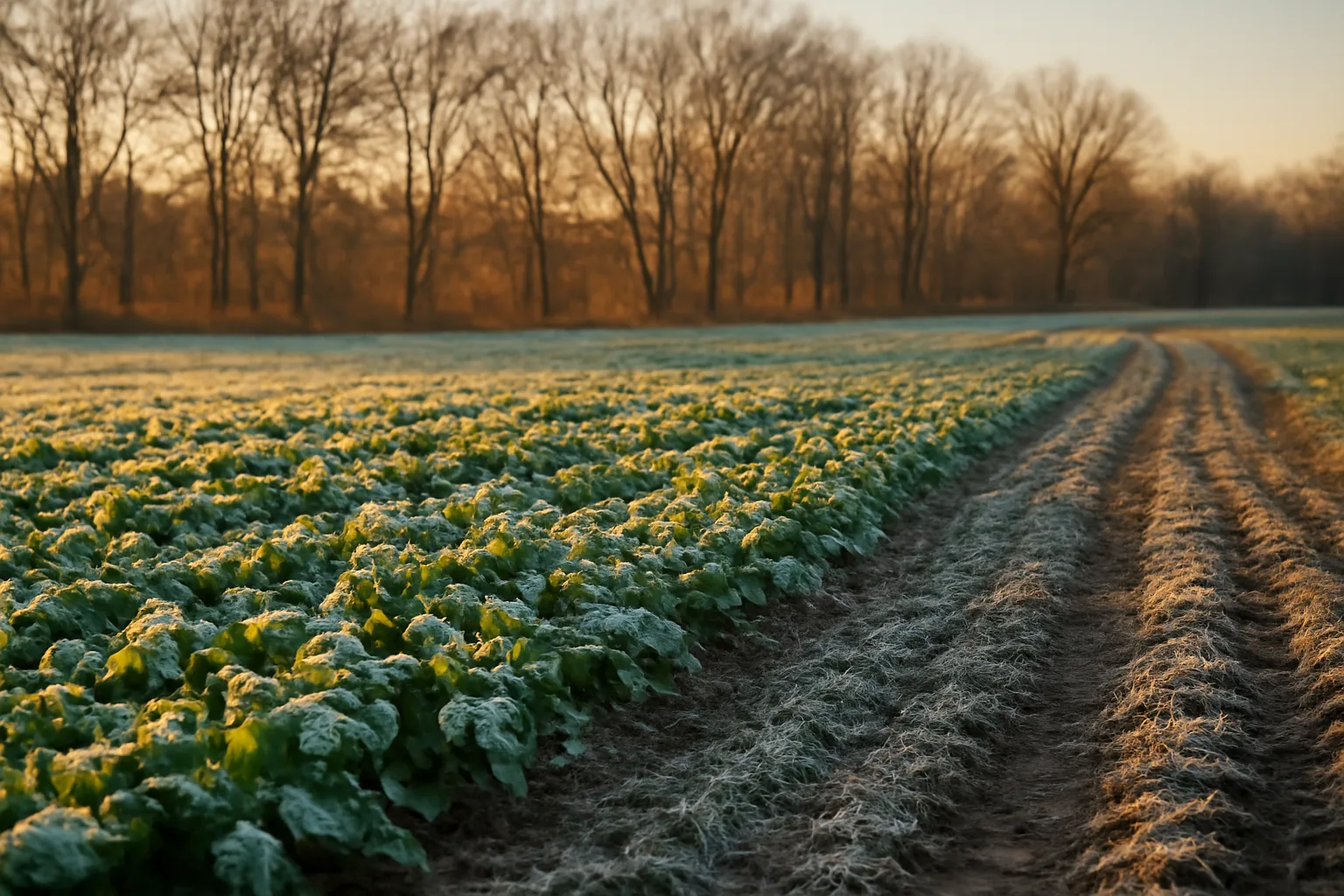
Late season food plot planting means getting brassicas, cereal grains, or clover in the ground with enough time to establish before frost stops growth, usually 60-90 days out. In most of the whitetail range that's late July through early September. Miss that window and you're better off waiting for spring than wasting seed on cold, dormant soil.
what is a food plot, exactly
A food plot is a planted area, usually somewhere between a quarter acre and several acres, designed to give deer and other wildlife a concentrated food source and to give hunters a place to observe or hunt over. It's not the same as a wildlife opening or a fallow field that just grew up in weeds. A real food plot involves soil testing, seed selection, and some amount of equipment, even if that equipment is just a hand seeder and an ATV drag. The USDA Natural Resources Conservation Service treats food plots as a wildlife habitat practice under its conservation programs, and many state wildlife agencies publish their own guides on plot design because the practice is common enough on private land to warrant official guidance [1]. The basic idea hasn't changed in decades: match the seed to your soil, your climate, and your hunting goals, then manage it like a small farm field, because that's what it is. For background on plot categories and how to pick one that fits your ground, see food plot whitetail and deer food plots.
when to plant food plots for deer
| Upper Midwest / Northeast | late July - mid Aug | mid Aug - early Sept | April - May or late Aug | |
|---|---|---|---|---|
| Mid-South / Transition zone | mid Aug - mid Sept | late Aug - Sept | March - April or Sept | |
| Deep South | Sept - early Oct | Sept - Oct | Oct - Nov | These windows are general. Your local extension office or state wildlife agency almost always has a county-specific planting guide, and that's worth five minutes of searching before you buy seed. |
Timing splits into two seasons: spring/summer plots (usually clover, chicory, soybeans, or warm-season annuals) and late summer plots aimed at fall and winter hunting (brassicas, cereal grains, and some clover blends). The question people actually mean when they ask about late season planting is the second one. Cooperative extension programs generally recommend planting brassicas and cereal grains 60 to 90 days before your area's first hard frost, which lets the plants reach a mature, palatable stage right as hunting season opens and deer nutritional needs increase [2]. In the Upper Midwest and Northeast that often means late July through mid-August. In the Mid-South and southern Appalachians you can push into September. In the Deep South, October plantings for cool-season annuals are common because summer heat is still too intense earlier. A rough planting calendar by region: | Region | Brassicas/turnips | Cereal grains (oats, wheat, rye) | Clover |
when to plant turnips for deer
Turnips need roughly 80 to 90 days from planting to full maturity, including bulb development, so extension guidance points to planting them 90 days before your first expected killing frost [2]. Plant too late and you get leafy growth with no bulb; plant too early in hot weather and germination suffers or the plants bolt before fall. Most of the whitetail range falls into a late July to early September window for turnips, depending on latitude and elevation. Turnips are frost-tolerant once established. In fact a hard frost sweetens the bulbs and leaves by converting starches to sugars, which is exactly why deer often ignore a turnip plot in October and hammer it in December. Seeding rate for turnips alone usually runs 4 to 6 pounds per acre broadcast, shallow-covered or cultipacked. Most hunters run them in a blend with other brassicas (rape, radish) rather than a monoculture, because a blend spreads out palatability and reduces the risk of one component failing.
when to plant oats for deer
Oats are one of the most forgiving late season plantings because they establish fast, tolerate a wide pH range, and deer hit them hard as soon as they emerge. Plant oats 60 to 75 days before your first frost so they reach 6 to 10 inches of leafy growth before the ground freezes [2]. In the Midwest and Northeast that's typically August. In the transition zone and mid-South, oats can go in from late August through September. Oats don't survive extreme cold as well as winter wheat or cereal rye, so in the northern half of the whitetail range they act more as an early-to-mid fall attractant than a winter food source. If you want green forage into January or February, blend oats with winter wheat or cereal rye, both of which are far more cold-hardy and will often green back up in late winter thaws. Seeding rate for oats is generally 2 to 3 bushels (roughly 64 to 96 pounds) per acre drilled, or a bit higher if broadcast, per land-grant agronomy guides on small grain forage seeding [3].
do deer eat sorghum
Yes, deer eat grain sorghum, and it's a legitimate late season food source, but it works differently than a brassica or clover plot. Sorghum is typically planted in late spring to early summer (soil temps above 60 degrees F) and left standing through fall and winter as a grain source, similar to how hunters use standing corn. Deer will browse young sorghum shoots some, but the real value comes from the grain heads once they mature and dry down, which deer and a long list of other wildlife (turkey, quail, waterfowl) will feed on into winter. Because sorghum is planted in early summer, not late summer, it isn't a "late season planting" crop in the way brassicas and cereal grains are. Instead, it's a late season food source, something you plant months ahead and let stand. One practical note: sorghum matures over a fairly wide window depending on variety (roughly 90 to 120 days), and some hunters specifically pick later-maturing varieties so the grain is still available deep into winter rather than drying out and dropping earlier in fall.
do deer eat clover, and do deer like clover
Deer eat clover readily, and most whitetail biologists rank it among the most consistently used food plot forages available, especially in spring and summer. Clover regrowth after grazing is high in crude protein, commonly cited in the 25 to 30 percent range for young clover forage in university forage testing, which matters most during antler growth and lactation [4]. Where clover gets tricky for "late season" planning is dormancy. Clover goes dormant with hard frost in most of the whitetail range and doesn't offer much standing forage in January the way a frost-sweetened brassica does. That said, a well-established clover stand, especially one seeded the previous spring or in a late summer frost-seeding window, still provides some green forage into early winter in milder climates, and it greens up first thing in spring, which makes it valuable for post-rut recovery even if it's not the December/January star performer. Most experienced plotters treat clover as a spring/summer anchor and brassicas or cereal grains as the late season complement, rather than picking one or the other. For seed blend options, see deer food plot seed and food plot seed.
what are deer's favorite foods
There's no single ranked list that holds true everywhere, because preference shifts by region, season, and what's naturally available. But across state agency and extension research, a few patterns repeat consistently. Acorns are usually at or near the top wherever oaks are present; deer will bypass planted forage for a good acorn drop almost every time in fall. Soybeans and clover top most warm-season preference studies for planted forage. In cold months, brassicas (especially turnip and radish bulbs and leaves after a frost), winter wheat, and cereal rye are heavily used because they stay green and palatable when native browse is dormant or buried in snow. Agricultural crops like corn and soybeans, where legally accessible, are typically preferred over most planted plot species simply due to caloric density, which is part of why plots near ag fields sometimes get less pressure than isolated plots deep in timber. State wildlife agency deer management pages generally describe whitetail diet as opportunistic browse: woody stems, forbs, mast, and agricultural crops make up the bulk of it, with food plots supplementing rather than replacing natural forage [5].
do deer like honey
This one comes up a lot, and the honest answer is: not really, and it's not something you'd plant or use in a food plot context anyway. Deer are herbivores that browse woody plants, forbs, grasses, mast, and agricultural crops. Honey isn't part of natural whitetail diet and there's no wildlife agency or extension guidance recommending it as an attractant. What people are probably thinking of is honeysuckle, which deer do browse readily (both Japanese and native honeysuckle species show up on browse studies), or mineral/attractant products that sometimes use molasses or sugar-based additives. Molasses-based mineral licks are legal in some states and considered baiting in others, so check your state wildlife agency's baiting and feeding regulations before using any sugar or scent-based attractant near a plot . Sticking to a planted forage plot sidesteps that question entirely.
how do you plan a late season plot from a soil test
Every late season plot starts the same way regardless of species: pull a soil sample, send it to a lab, and follow the lime and fertilizer recommendations that come back. Extension soil testing labs typically report pH, phosphorus, potassium, and organic matter, along with specific lime (tons per acre) and fertilizer (N-P-K) recommendations tailored to the crop you tell them you're planting. Brassicas and cereal grains both prefer a soil pH in the 6.0 to 6.8 range. Most food plot failures in acidic soil (common in a lot of whitetail country, especially in the Southeast and parts of the Appalachians) trace back to skipping lime. Lime takes months to fully react with soil, so if your test comes back needing 2 tons per acre and you're planting in three weeks, you won't see the full benefit this season, but it still helps and sets up next year's plot. Your soil test lab is the authority on exact lime and fertilizer rates for your dirt; nobody writing a general planting guide, including this one, can tell you precise application numbers for your specific field. If you want a starting framework that turns a soil test and your region into an actual planting plan (species picks, seeding rate, timing), the $99 one-time Plot Plan Builder is built around exactly that gap between generic advice and site-specific dirt.
what equipment do you actually need for a late season plot
You don't need a tractor to plant a good late season plot, but you do need a way to control weeds, get seed-to-soil contact, and, for brassicas especially, avoid planting too deep. For a plot under an acre, a lot of hunters get by with a sprayer (backpack or ATV-mounted) for burndown, a hand-crank or ATV broadcast spreader for seed, and a drag (a section of chain-link fence or a homemade drag harrow works fine) to lightly incorporate seed. Brassica and clover seed is tiny and should go no deeper than a quarter inch; cereal grains like oats and wheat do better drilled or covered slightly deeper, around half an inch to an inch. For plots over a couple acres, a disk or field cultivator and a broadcast spreader towed behind a tractor or ATV speeds things up considerably and gives more even seed depth. Renting equipment for a weekend is usually cheaper than buying if you're only planting one or two small plots a year. For a broader rundown of tools by plot size, see equipment and methods content on the site.
what if you're too late to plant this season
If you're past the 60 to 90 day window for your region and species, planting anyway is usually a waste of seed and money. Brassicas planted too late won't bulb up before frost. Cereal grains planted too late may germinate but won't put on enough growth to survive hard freezes or provide meaningful tonnage. In that situation, a few options actually make sense. Standing crops (if you have access to ag fields or planted corn/soybeans nearby) will carry deer through winter regardless of your plot timing. A late-season mineral or supplemental feeding program, where legal, can help, though as noted above, baiting and feeding rules vary a lot by state and sometimes by season, so check your state wildlife agency's regulations before doing anything with feed, mineral, or attractant products . The other honest answer: mark your calendar for next year, get a soil test done now while you're thinking about it, and plant clover or a summer annual blend in spring instead. A late plot done wrong is often worse than no plot at all, because it burns money and doesn't hold deer any better than the surrounding cover.
late season blends vs single species: what actually works better
| Pure brassica | $15-$30 | 60-90 days | High once frosted, degrades by late winter | |
|---|---|---|---|---|
| Pure cereal grain | $15-$40 | 30-45 days | Moderate to high (rye/wheat > oats) | |
| Brassica + cereal blend | $25-$50 | 30-45 days for grain, 60-90 for brassica | High through most of winter | These are rough seed-cost ranges based on typical per-acre rates and current seed pricing, not a guarantee; check current pricing from your seed supplier since brassica and cereal seed costs shift year to year. For a look at how blended seed products are formulated for this purpose, see domain food plot seed and deer for food. |
Single-species plots (pure turnips, pure oats) are cheaper and simpler, but blends generally outperform them for late season hunting because they hedge against one component failing and they extend the window of palatability. A common and well-tested combination is a brassica blend (turnip, radish, rape) planted alongside a cereal grain (oats or winter wheat). The cereal grain germinates and greens up fast, giving deer something to eat while the brassica bulbs are still developing. By the time frost hits, the brassica leaves and bulbs sweeten and become the main draw, while the cereal grain (especially wheat or rye) keeps producing green forage into late winter. | Approach | Cost per acre (seed only, rough) | Time to first use | Winter durability |
Frequently asked questions
Do deer eat sorghum?
Yes. Deer browse young sorghum shoots and eat the mature grain heads, which makes standing sorghum a good late season and winter food source. It's planted in late spring to early summer, not late summer, since it needs 90 to 120 days to mature and is typically left standing through fall and winter.
Do deer eat clover, and do deer like clover?
Deer eat clover readily and it's one of the most consistently used food plot forages, especially spring through fall. Young clover regrowth commonly tests in the 25-30 percent crude protein range. Clover goes dormant after hard frost though, so it's less useful as a true late-season winter food than brassicas or cereal grains.
When should I plant food plots for deer?
It depends on the plot type. Spring/summer plots (clover, soybeans, warm-season annuals) generally go in April through June depending on region. Late season plots (brassicas, cereal grains) go in 60-90 days before your area's first hard frost, usually late July through September across most of the whitetail range.
When should I plant turnips for deer?
Turnips need about 80-90 days to fully mature, including bulb development, so plant them roughly 90 days before your first expected killing frost. For most of the whitetail range that's a late July to early September window. A hard frost afterward sweetens the bulbs and leaves, which is often when deer use hits hardest.
When should I plant oats for deer?
Plant oats 60-75 days before your first fall frost so they reach 6-10 inches of growth before hard freezes. In the Midwest and Northeast that's typically August; in the mid-South, late August through September works. Oats aren't as cold-hardy as winter wheat or cereal rye, so blend them if you want forage into deep winter.
What is a food plot?
A food plot is a planted area, from a quarter acre to several acres, established specifically to provide concentrated forage for deer and other wildlife and to give hunters a place to hunt or observe. It requires soil testing, species selection, and basic field management, similar to a small farm field.
What are deer's favorite foods?
Acorns typically rank at the top wherever oaks are present. Among planted forages, soybeans and clover lead most warm-season preference data, while brassicas, winter wheat, and cereal rye are heavily used in cold months. Agricultural crops like standing corn or soybeans are often preferred over plot species due to caloric density.
Do deer like honey?
Not really, and it isn't part of natural whitetail diet. People are usually thinking of honeysuckle, which deer do browse heavily, or molasses-based mineral and attractant products. Sugar-based attractants can count as baiting in some states, so check your state wildlife agency's regulations before using them.
How late is too late to plant a food plot?
If you're past 60-90 days before your area's first hard frost, brassicas and cereal grains likely won't establish enough to be useful. Planting past that window usually wastes seed and money. In that case, standing ag crops or waiting for a spring planting are better uses of your time.
Should I plant a single species or a blend for late season plots?
Blends generally outperform single-species plots for late season hunting. A brassica (turnip, radish, rape) plus cereal grain (oats, wheat, or rye) blend gives fast green-up from the grain while the brassica bulbs and leaves mature and sweeten after frost, extending usable forage further into winter.
Does frost actually make brassicas taste better to deer?
Yes. A hard frost converts starches in brassica bulbs and leaves to sugars, which is why deer often ignore a turnip plot in early fall and hit it hard in December and January. This is a well-documented physiological response in cool-season brassica crops, more than hunter folklore.
What soil pH do late season food plot species need?
Both brassicas and cereal grains generally prefer a soil pH between 6.0 and 6.8. A lot of food plot failures, especially in naturally acidic soils common across the Southeast and Appalachians, trace back to skipping lime. Your soil test lab will give exact lime tons per acre needed for your specific field.
Sources
- USDA Natural Resources Conservation Service, Wildlife Habitat Management practice standards: Food plots are recognized as a wildlife habitat conservation practice supported through USDA programs
- University of Kentucky Cooperative Extension, Cereal Grain Forage Establishment: Oat and small grain seeding rates for forage typically run 2-3 bushels per acre drilled
- University of Georgia Extension, Clover and Forage Legumes for Wildlife: Young clover forage regrowth commonly tests in the 25-30 percent crude protein range
- Pennsylvania Game Commission, White-tailed Deer Biology and Management: Whitetail diet is described as opportunistic browse of woody stems, forbs, mast, and agricultural crops with food plots as supplemental forage
- Michigan Department of Natural Resources, Baiting and Feeding Regulations: Baiting and feeding regulations, including use of scent or sugar-based attractants, vary by state and must be checked before use