Last updated 2026-07-26
TL;DR
Starting a food plot means testing your soil, clearing and prepping ground, liming and fertilizing based on that test, choosing species suited to your region and sunlight, and planting on the calendar window for your zone (spring for warm-season, late summer for fall brassicas and cereals). Most first-year failures trace back to skipped soil tests or bad timing, not seed choice.
what is a food plot, exactly
A food plot is a planted area, usually somewhere between a quarter acre and a few acres, seeded with forage that deer and other wildlife will eat. It's not a garden and it's not a lawn. The goal is either to feed deer through a tough season (a nutrition plot) or to pull them into shooting range during hunting season (a hunting or attraction plot). Some plots try to do both. Most food plots sit on private or leased land, cut out of a field edge, a logging deck, a powerline right-of-way, or an old farm field. The USDA Natural Resources Conservation Service and state wildlife agencies both treat food plots as a wildlife habitat practice, similar in concept to planting a pollinator strip, just aimed at deer, turkey, and other game instead [1]. A plot is only as good as the ground under it. That's the part first-timers skip. You can buy the best seed blend on the shelf, but if your soil pH sits at 5.0 and you never lime it, clover will struggle and brassicas will look yellow and stunted by August. Starting a food plot really starts with dirt, not seed.
how do you actually start a food plot, step by step
Here's the order that actually works, in the field, year after year. 1. Pick the spot. Look for at least a half day of sun, decent drainage, and access that doesn't blow out the whole property every time you check it. Interior clearings often hold deer better than plots visible from the road. 2. Pull a soil test. Cooperative extension offices in nearly every state offer this for somewhere around $8 to $20 per sample, and it's the single best money you'll spend on a plot. Your test tells you exact pH and pounds of lime needed, plus phosphorus and potassium levels. 3. Clear and kill existing vegetation. Mow it low, then spray with glyphosate if you're going the herbicide route, or till it under if you're working ground that hasn't been broken. Give a burndown spray 7 to 14 days to work before planting. 4. Lime and fertilize based on the soil test, not the bag's generic rate. Lime takes months to fully adjust pH, so apply it as early as you can, ideally the fall before you plant, though many hunters lime and plant the same season and still see gains the following year. 5. Work the seedbed. A light disking or dragging a drag harrow gets you a workable seedbed. You don't need it perfectly smooth, just loose enough that seed makes soil contact. 6. Plant at the right depth and the right calendar window for your species and zone (more on that below). Depth matters more than people think. Clover and brassica seed is tiny and wants to sit at 1/4 inch or less; cereal grains want closer to 1 inch. 7. Cultipack or drag lightly to firm the seedbed and close seed-to-soil gaps. 8. Walk away and let it grow. Check back in 3 to 4 weeks for weed pressure and browse pressure. A brand new plot in a low-food area can get hit hard right out of the gate; a temporary exclusion fence or a second, larger plot can spread pressure out. If you want help turning your soil test numbers and property details into an actual planting plan instead of guessing, PlotSeason's $99 one-time Custom Food Plot Plan builds a species and timing plan around your specific test results and zone. It's general guidance built from your numbers, not a replacement for your soil lab's specific lime and fertilizer recommendation, which stays the final word on your dirt.
when to plant food plots for deer
Timing splits into two windows: spring planting for warm-season plots and summer-to-early-fall planting for cool-season plots. Which window applies depends entirely on what you're planting. Warm-season annuals and perennials (soybeans, corn, some clovers, chicory) go in after your last frost date, generally April through June depending on latitude. Cool-season plots (brassicas, cereal grains, most clover establishment, winter peas) go in during late summer, roughly mid-July through early September in northern states and August into early October further south. The practical rule extension agronomists give: match soil temperature and days-to-maturity backward from your first expected hard frost. Brassicas like turnips need 80 to 90 days to bulb up properly, so if your first hard frost lands around October 15, you're planting by late July to mid-August in a lot of the Midwest and Northeast [2]. Cereal grains like oats and wheat germinate fast and can go in later, sometimes into September, because you're not waiting on a bulb or tuber to size up. Your local land-grant extension office publishes a frost date table for your county, and that's the actual starting point, not a national blanket date. Zone charts online are a reasonable first guess, but a frost date specific to your county beats a national calendar every time.
when to plant oats for deer
Oats are a fall cool-season planting in most of the whitetail range, going in the ground anywhere from mid-August in the upper Midwest and Northeast down to late September or even October in the South. Oats germinate quickly, often in 5 to 10 days with decent soil moisture, and deer hit young oat shoots hard because the sugar content in fresh growth is high. Oats aren't a great choice in the Deep South or anywhere winters run consistently mild and wet, because they can get leggy and lodge over. They shine in a straight planting or mixed with brassicas and winter peas, where the oats come up fast and give the slower brassicas some cover from early browse pressure while they establish. One caveat: oats winterkill in a lot of the northern tier once temperatures drop into the teens and below for extended stretches, unlike winter wheat or cereal rye, which survive hard freezes and green back up in spring. If you want a plot that carries deer through late winter into spring, pair oats with a hardier cereal grain or rely on wheat or rye instead.
when to plant turnips for deer
Turnips go in as a cool-season planting, timed backward from your first killing frost since they need that frost to convert starches to sugars and become genuinely palatable. In most of the whitetail range that means planting between mid-July and mid-August in northern states, and into early September in the transition zone and parts of the South [2]. Turnips need 80 to 90 days from seed to a mature bulb, and deer often ignore the bulbs early on, hitting the tops first, then switching hard to the bulbs once a few frosts sweeten them up. That's normal. Don't panic if a turnip plot looks untouched in September; the real action usually comes in November and December. Seeding rate matters here more than people expect. Turnip seed is tiny (roughly 175,000 seeds per pound), and overseeding leads to spindly plants that never bulb properly. Most extension guidance and seed tag rates land around 4 to 6 pounds per acre when broadcast alone, less if mixed with other brassicas or cereal grains [3].
do deer eat sorghum
Yes, deer eat sorghum, both the grain heads and the young plant, though it's not typically a first-choice forage compared to soybeans, corn, or clover. Sorghum shows up more often as a wildlife food plot component in the South and parts of the Midwest, where its drought tolerance makes it a more reliable summer standing crop than corn on marginal or dry soils. Grain sorghum planted as a summer annual gives deer a starchy fall and winter food source once seed heads mature and dry down, similar in role to corn but generally cheaper to establish and more forgiving of poor soil. Some hunters plant sorghum specifically for its standing cover value through winter, since the stalks hold up well and give deer a place to bed or feed while staying somewhat hidden. It's not a plot you build a whole property strategy around by itself. Sorghum works best as one piece of a mix, or as a standalone block on ground too poor or dry for corn or soybeans.
do deer eat clover, and do deer like clover
Yes, and clover is one of the most reliable, most heavily used food plot forages across the whitetail's range. Deer eat clover from spring green-up straight through fall, and it's high enough in protein (extension trials commonly report 25 to 30 percent crude protein in well-managed clover stands) to matter for antler growth and lactating does [4]. Do deer like clover more than other options? In a lot of regions, yes, especially in spring and early summer when it's one of the only tender, high-protein green options available. Clover's real advantage is that it's a perennial. A well-established clover stand, properly limed and mowed, can produce for 3 to 5 years before you need to reseed, which makes it cheaper per year of use than annual replanting even though the seed itself often costs more upfront. The tradeoff: clover is slow to establish, sensitive to low pH (it wants soil pH above 6.0, ideally 6.5 to 7.0), and gets outcompeted by weeds in the first year if you don't mow or spray to keep it clean. It's also one of the pickiest species about soil test results. If your lime recommendation says 2 tons per acre and you skip it, don't expect much from clover no matter how good the seed blend is. For readers comparing clover against annual options for a specific plot, food plot whitetail and deer food plot seed both break down species tradeoffs in more depth.
what are deer's favorite foods
Deer are opportunistic browsers, and their favorite food shifts by season, region, and what's available, but a few things show up again and again in browse studies and food plot use data. Acorns are consistently ranked as a top natural fall food across most of the whitetail's range because of their fat content, which matters heavily going into winter [5]. Among planted forages, soybeans, clover, and standing corn tend to top most preference rankings, with brassicas (turnips, radishes, rape) close behind once frost sweetens them. In spring and summer, deer lean heavily on forbs, clover, and soft mast like berries. In late fall and winter, they shift toward higher-energy foods: acorns, corn, and standing soybeans if any are left in the field. There's no single universal favorite food for deer nationwide, because availability drives a lot of the behavior. A deer herd in the Southeast without much mast will lean harder on planted forage than a herd sitting under a white oak ridge in a mast year. That's part of why a soil-test-driven, region-specific plan tends to outperform a generic "deer's favorite food" seed bag bought off a shelf.
do deer like honey
There's no real evidence deer specifically seek out honey, and it's not a practical or legal food plot or attractant strategy in most states anyway. Deer are occasionally documented eating or investigating sweet substances opportunistically, but honey isn't a forage crop, it's not something you plant, and using it as bait runs straight into state baiting and feeding regulations that vary widely by state. Some states ban baiting outright, some allow it with restrictions on distance from a stand or blind, and some allow supplemental feeding but not "aiding the take" of game over bait. Michigan, for example, prohibits baiting deer in the Lower Peninsula in most circumstances under its Wildlife Conservation Order, while other states like Texas allow baiting under specific conditions [6]. Before using any attractant, sweet, mineral, or otherwise, check your state wildlife agency's current regulations, since these rules change from year to year and get enforced seriously.
how much does it cost to start a food plot
| Soil test | $8 to $20 per sample | One sample can represent up to a few acres of uniform soil | |
|---|---|---|---|
| Lime | $30 to $60 per ton, 1 to 3 tons/acre typical | Based on soil test buffer pH, not guesswork | |
| Seed | $30 to $120 | Cereal grains and brassicas cheaper; clover, chicory blends pricier | |
| Fertilizer | $30 to $80 | Rate depends on soil test P and K levels | |
| Herbicide (burndown) | $15 to $30 | Glyphosate-based products, generic pricing | A half-acre first plot with a soil test, lime, seed, and fertilizer often lands somewhere between $150 and $400 all-in for the first year, with perennial clover plots costing more upfront but less in following years since you're not reseeding annually. |
Costs vary a lot based on acreage, whether you own or rent equipment, and how much lime your soil test calls for. Rough per-acre ranges hunters commonly report: seed runs $30 to $120 per acre depending on species (cereal grains and brassicas are cheap, clover and chicory blends cost more), lime runs $30 to $60 per ton delivered and spread, with many plots needing 1 to 3 tons per acre based on soil test results, and fertilizer runs another $30 to $80 per acre depending on N-P-K needs. | Cost item | Typical range per acre | Notes |
do you need equipment to start a food plot, or can you do it by hand
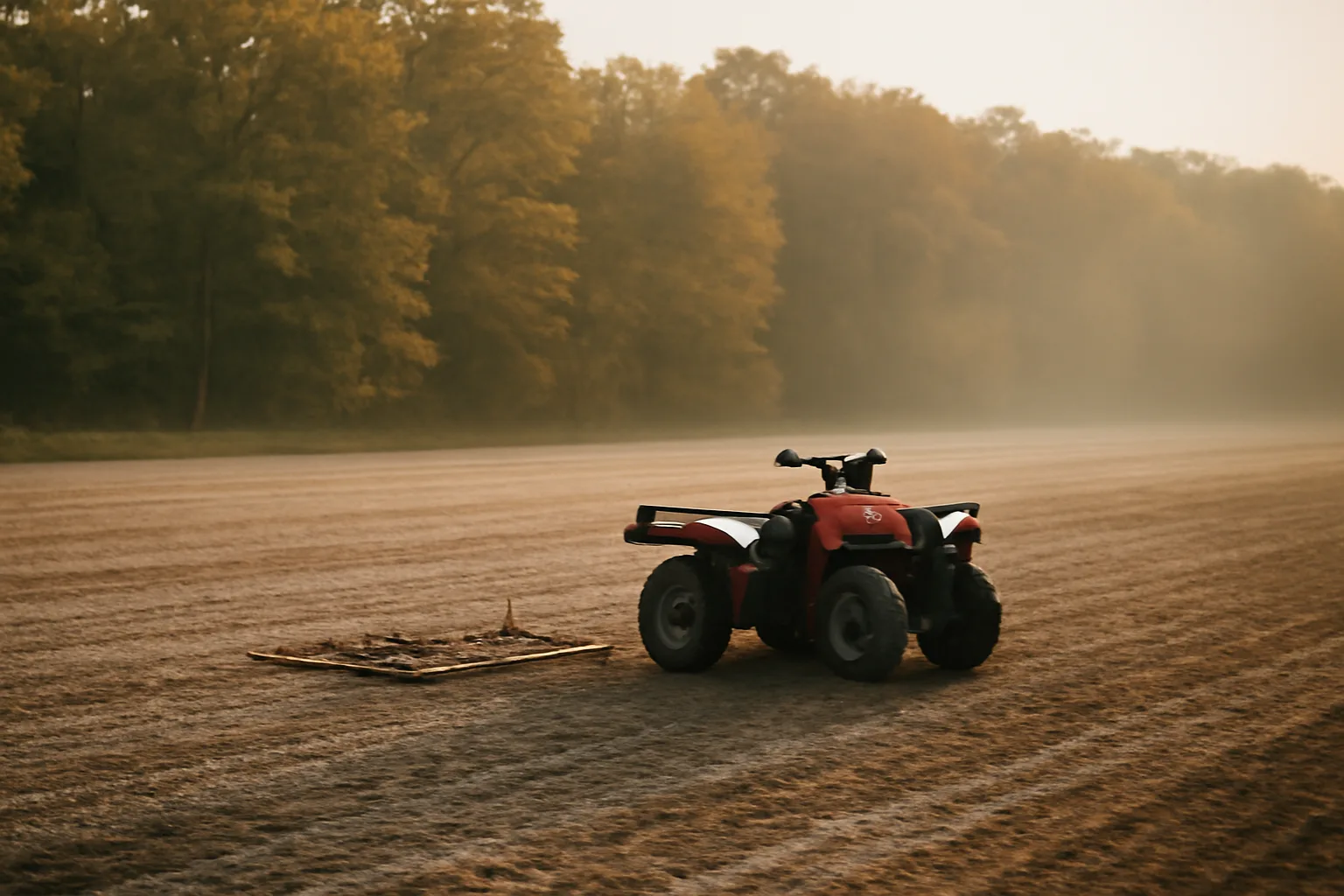
You don't need a tractor to plant a small plot, but you do need some way to break ground, spread lime and seed, and firm the seedbed. A quarter-acre to half-acre plot is genuinely doable with an ATV or UTV, a small disk or cultipacker attachment, and a hand-crank broadcast spreader. For larger plots, a compact tractor with a disk, box blade or drag harrow, and a PTO spreader speeds things up enormously and lets you handle multiple plots in a weekend instead of a week. Renting equipment from a local farm supply store is a reasonable option for a one-time or occasional plot if buying doesn't make sense yet. The part people underestimate is spreader calibration. A cheap handheld spreader set wrong can put down double or half the seed rate the tag calls for, which either wastes money or leaves gaps that weeds fill in. Walk a measured 100 feet, weigh what comes out, and adjust before you spread the whole bag across your plot.
what's the easiest food plot to start for a beginner
For a first-timer with average soil and no serious weed problems, a cereal grain and brassica mix planted in late summer is about as forgiving as it gets. Oats or wheat come up fast, cover bare soil quickly (which chokes out a lot of weed competition on their own), and brassicas like turnips or radishes fill in the fall and winter window once frost hits. Clover is a great long-term plot but it's a worse first plot, because it's slow, fussy about pH, and easy to lose to weeds in year one if you're not watching it closely. Save clover for year two once you've got a feel for your ground and a soil test history to work from. Whichever species you pick, the soil test result matters more than the seed bag. Two identical bags of the same blend, planted on a pH 5.2 field versus a limed pH 6.5 field, will look like two different products by October. If you want a starting point tailored to your actual soil numbers and zone instead of a generic beginner mix, that's exactly what PlotSeason's Custom Food Plot Plan is built to do for $99, one time, no subscription. For more on picking between species and understanding tradeoffs, deer food plots and food plot seed go deeper on comparing blends for different goals.
Frequently asked questions
What is a food plot in simple terms?
A food plot is a planted area, usually a quarter acre to several acres, seeded with forage crops like clover, brassicas, or cereal grains specifically to feed or attract deer and other wildlife. It's planted like a small farm field but managed for wildlife nutrition and hunting access instead of harvest for sale.
When should I plant food plots for deer?
It depends on species. Warm-season plots (soybeans, corn) go in after your last spring frost, typically April through June. Cool-season plots (brassicas, cereal grains, clover establishment) go in mid-July through September, timed backward from your area's first fall frost date, which your local extension office publishes by county.
Do deer eat sorghum?
Yes, deer eat both sorghum grain heads and young plants, though it usually ranks below soybeans, corn, and clover in preference. It's most useful as a drought-tolerant standing crop in the South and parts of the Midwest, often planted as one component of a larger food plot mix rather than alone.
Do deer like clover, and is it worth planting?
Yes, clover is one of the most reliably used food plot forages, often reaching 25 to 30 percent crude protein in well-managed stands. It's a perennial that can produce for 3 to 5 years once established, but it needs soil pH above 6.0 and consistent mowing to compete with weeds in its first year.
When do you plant oats for deer food plots?
Oats are typically planted as a fall cool-season crop, from mid-August in the northern whitetail range down to late September or October in the South. Oats germinate in 5 to 10 days with decent moisture but winterkill in hard, sustained cold, unlike wheat or cereal rye.
When should I plant turnips for a deer food plot?
Plant turnips mid-July through mid-August in northern areas, into early September further south, counting back 80 to 90 days from your first expected hard frost. Turnips need that frost to convert starches to sugar, so deer often ignore them early and switch hard to the bulbs in November and December.
What do deer like to eat most?
There's no single universal favorite; it shifts by season and region. Acorns rank consistently high in fall for their fat content, while soybeans, clover, and standing corn top most planted-forage preference lists, with brassicas becoming attractive after frost sweetens them.
Do deer eat honey or are sweet attractants effective?
There's no solid evidence deer specifically seek out honey, and it isn't a forage crop or planting option. Using any sweet substance as bait runs into state baiting and feeding laws, which vary significantly; some states ban baiting outright while others allow it with restrictions, so check your state wildlife agency's current rules first.
How big should a first food plot be?
A quarter acre to half acre is a reasonable, manageable size for a first plot, especially if you're working by hand or with an ATV instead of a tractor. It's small enough to establish well and monitor closely, but large enough to actually hold deer without getting wiped out by browse pressure in the first few weeks.
Do I really need a soil test before planting a food plot?
Yes. A soil test, usually $8 to $20 through your local cooperative extension office, tells you exact lime and fertilizer needs instead of guessing. Skipping it is the single most common reason first-year food plots underperform, especially for pH-sensitive species like clover.
What's the cheapest way to start a food plot?
Cereal grains like oats or wheat are the cheapest seed option, often $30 to $50 per acre, and they establish fast with minimal equipment: a hand spreader, a disk or harrow pass, and a cultipacker or drag to firm the seedbed. Skipping lime to save money usually costs more in poor yield than it saves.
Can I start a food plot without a tractor?
Yes, for plots under an acre. An ATV or UTV with a small disk attachment, a hand-crank broadcast spreader, and a drag harrow (even a section of chain-link fence weighted down works) can handle prep and planting on a small plot without a tractor.
Sources
- USDA Natural Resources Conservation Service, Wildlife Habitat Practices: Food plots are treated as a wildlife habitat practice similar to other NRCS-supported plantings
- University of Tennessee Extension, Wildlife Food Plots: Brassica and cool-season planting windows timed to first frost date and days-to-maturity
- Mississippi State University Extension, Brassicas for Deer: Turnip seeding rates and seed count per pound
- University of Georgia Extension, Clover for Wildlife Food Plots: Crude protein levels in well-managed clover stands
- Mississippi State University Extension, Deer Nutrition and Food Habits: Acorns rank as a top fall food source due to fat content
- Michigan DNR, Wildlife Conservation Order: Michigan restricts deer baiting and feeding in most of the Lower Peninsula