Last updated 2026-07-26
TL;DR
Setting up a deer food plot means testing soil, clearing and preparing ground, choosing species suited to your zone and season (clover, brassicas, cereal grains, sorghum), fertilizing per the soil test, and planting on the calendar for your region. Most first-year failures trace back to skipped soil tests or wrong planting dates, not bad seed.
What is a food plot, exactly?
A food plot is a planted patch of forage, usually somewhere between a quarter acre and several acres, put in on hunting land specifically to feed and hold deer. It is not a garden and it is not a lawn. Think of it as a small farm field with one customer: whitetail deer, plus whatever turkeys, rabbits, and other critters show up uninvited. Most plots fall into two buckets. Annual plots get replanted every year with things like brassicas, cereal grains, or sorghum, and they usually deliver a fast, heavy flush of forage timed to hunting season. Perennial plots, mainly clover and chicory blends, get planted once and then mowed and fertilized for three to five years before they need to be renovated. The USDA's National Agroforestry Center and most state wildlife agencies treat food plots as one tool in a larger habitat plan, not a replacement for natural browse, mast, and cover. A plot with no bedding cover nearby, or one dropped into deep shade, usually underperforms no matter how good the seed is. If you want a broader look at plot types before you commit acreage, the food plot whitetail overview breaks down the categories in more depth.
When to plant food plots for deer?
Planting dates depend entirely on your zone, your species, and whether you're planting a spring/summer plot or a fall plot. There is no single national date. Cooperative extension offices publish frost-date maps and planting windows specific to each state, and those numbers should override anything generic you read online, including this article. As a rough framework: spring and summer plots (soybeans, cowpeas, clover establishment) go in after the last frost, typically April through June depending on latitude. Fall plots (brassicas, cereal grains, clover overseed) get planted 60 to 90 days before your area's first hard frost, which for most of the whitetail range lands somewhere between late July and early September. The Mississippi State University Extension recommends planting fall brassica blends 60 to 90 days ahead of the first killing frost so plants have time to bulb and mature before deer start browsing them hard [1]. Plant too early in hot, dry August conditions in the South and you risk losing the stand to heat stress before it ever gets going. Plant too late in the North and an early frost can stop growth before tubers or leaf mass build up. Check your local extension's frost date tool and work backward from there. Land-grant universities like Penn State, University of Tennessee, and University of Wisconsin all publish state-specific plot calendars worth cross-referencing [2].
Do deer like clover, and how does it fit a plot rotation?
Yes, deer readily eat clover, and it is one of the most reliable perennial forages in the food plot world. White clover (Trifolium repens) and red clover both show up constantly in university deer forage studies as high-preference, high-protein browse, often tested above 25 percent crude protein in the vegetative stage [3]. Clover's real strength is duration. Once established, a well-limed, well-fertilized clover stand can produce spring through fall forage for three to five years with just mowing and a maintenance fertilizer pass, according to Mississippi State University Extension's food plot forage guide [1]. That is a lot less annual labor than replanting brassicas or cereal grains every single year. The catch is establishment. Clover needs a fine, firm seedbed, correct pH (most extensions recommend 6.0 to 6.5), and shallow planting depth of a quarter inch or less because the seed is tiny. Skip the lime and clover will struggle no matter how good the seed bag looks. This is exactly the kind of decision a soil test settles, not a guess. For species comparisons across annuals and perennials, see deer food plot seed and food plot seed.
When to plant oats for deer?
Oats are a fall cool-season cereal grain, and most extension guidance puts planting 6 to 8 weeks before the first expected frost, generally late August through mid-September across much of the whitetail range, with earlier windows in the northern Midwest and later windows in the Deep South [1]. Oats germinate fast, often within a week under good moisture, and deer hit young oat shoots hard, which makes them a strong early-season draw plot. The tradeoff is winter survival. Oats are less cold-hardy than winter wheat or rye and can die back completely after a hard freeze, which is fine if your goal is October and November attraction and not a plot that needs to carry into February. Mixing oats with a cereal rye or wheat and a brassica like turnips is common practice, because the oats provide immediate palatability while the rye or wheat holds up through winter. The University of Tennessee Extension's wildlife food plot publication lists oat-brassica-cereal rye blends as one of the more forgiving fall combinations for mixed hunting pressure and browse needs [2].
When to plant turnips for deer?
Turnips are a brassica and go in the ground in late summer, roughly 80 to 90 days before your first killing frost, which lands most of the whitetail range somewhere between late July and early August [1]. Turnips need that long runway to build both leaf mass and a bulb worth eating. Here's the part a lot of first-time planters miss: deer usually ignore turnip bulbs and even the leaves for the first month or two after a hard frost. Freezing temperatures convert starches to sugars in the bulb and leaves, which is what actually triggers heavy deer use. That means a turnip plot planted in early August often does not get hammered until November or December, well after the leaves have matured and cold has hit it a few times. If your goal is a late-season food source for the tail end of gun season or muzzleloader season, turnips timed for a post-frost sweetening are one of the better tools available. If you need forage that deer eat immediately in September, turnips alone are the wrong call; pair them with oats or clover for early attraction.
Do deer eat sorghum?
Yes, deer eat sorghum, both the grain heads and the young forage growth, though it is more commonly planted as a summer annual for browse, screening cover, and seed production than as a primary attractant crop. Grain sorghum (milo) produces a seed head deer and turkeys both use, especially into fall and winter once the plant dries down. Sorghum is a warm-season crop, planted after soil temperatures hit roughly 60 degrees Fahrenheit, similar timing to corn, generally late spring through early summer depending on latitude. It tolerates drought and poor soil better than corn, which makes it a reasonable choice on marginal ground where corn would struggle. One real caution: sorghum and sudangrass relatives can produce prussic acid (cyanide) compounds in young, stressed, or frost-damaged growth. This is a documented livestock feeding risk tracked by university agronomy extensions, and while deer browsing patterns and rumen exposure differ from cattle, it is worth knowing before planting large stands purely as a forage crop rather than a grain/cover crop [4]. Most food plotters use sorghum more for screening and grain than as the primary browse species for this reason.
Do deer like honey (food plots or attractants)?
Deer are not drawn to honey the way people sometimes assume from marketing around 'honey hole' plots or scented attractant products. Deer taste preference research and extension forage palatability studies focus on plant sugars, protein content, and tannin levels, not honey as a standalone food source, and there is no credible wildlife research showing honey itself functions as a deer attractant or feed [3]. What probably drives the honey question is confusion with commercial mineral and molasses-based attractant products, some of which include sugar sources deer do find palatable in small amounts. Straight honey is not a practical or economical food plot input, and it is not backed by any extension forage guide as a plot ingredient. If you're chasing sugar content deer actually respond to, that is the frost-triggered starch-to-sugar conversion in brassicas covered above, not a poured or sprayed sweetener.
What are deer's favorite foods overall?
Deer preference shifts by season, region, and what is locally available, but a few crops show up again and again in university forage studies as high-preference, high-nutrition choices: white clover, soybeans (especially in the vegetative stage), chicory, and brassicas like turnips and radishes after frost [1] [3]. Acorns and other hard mast (natural forage rather than a planted crop) often outrank planted food plots in raw preference when available, which is a big reason plots near oak stands or paired with natural mast tend to hold deer better than plots dropped in open fields with nothing else around. Whitetail Deer forage studies out of Mississippi State and other land-grant programs consistently rank soybean and clover crude protein content above most cereal grains, often in the 20 to 30 percent range during the growing season [1] [3]. There is no single 'best' food plot species. The honest answer is that the best plot matches your region's growing season, your soil's limitations, and the time of year you actually plan to hunt over it. A perfect clover stand does you no good if your season closes in October and the deer aren't using it hard until spring green-up.
How do you test and prepare the soil before planting?
Start with a soil test, full stop. This is the single most skipped step and the most common reason plots underperform. A basic soil test through your state land-grant extension office, usually $10 to $20 per sample, tells you exact pH and nutrient levels instead of forcing a guess [5]. Most food plot species want a pH between 6.0 and 7.0. Below that, lime becomes almost mandatory, because in acidic soil, applied fertilizer becomes less available to the plant regardless of how much you spread. Agricultural lime takes months to fully react in the soil, so applying it the fall before a spring planting, or as early as possible before a fall planting, matters more than the exact product you buy. Your soil test report will list specific lime and fertilizer recommendations in pounds per acre for your target crop. That report, not a blog post, not a bag label, and not this article, is the actual authority on how much lime and fertilizer your specific field needs. Soil varies field to field and even within a single field, and a lab result based on your actual dirt beats generic advice every time. Once you have the test back, basic seedbed prep follows a simple order: clear existing vegetation (mow, spray, or disc), work the lime and fertilizer into the top few inches, then plant at the depth the seed tag specifies. For species-specific seed selection once your soil plan is set, see deer food plots and domain food plot seed.
What equipment do you actually need to set up a plot?
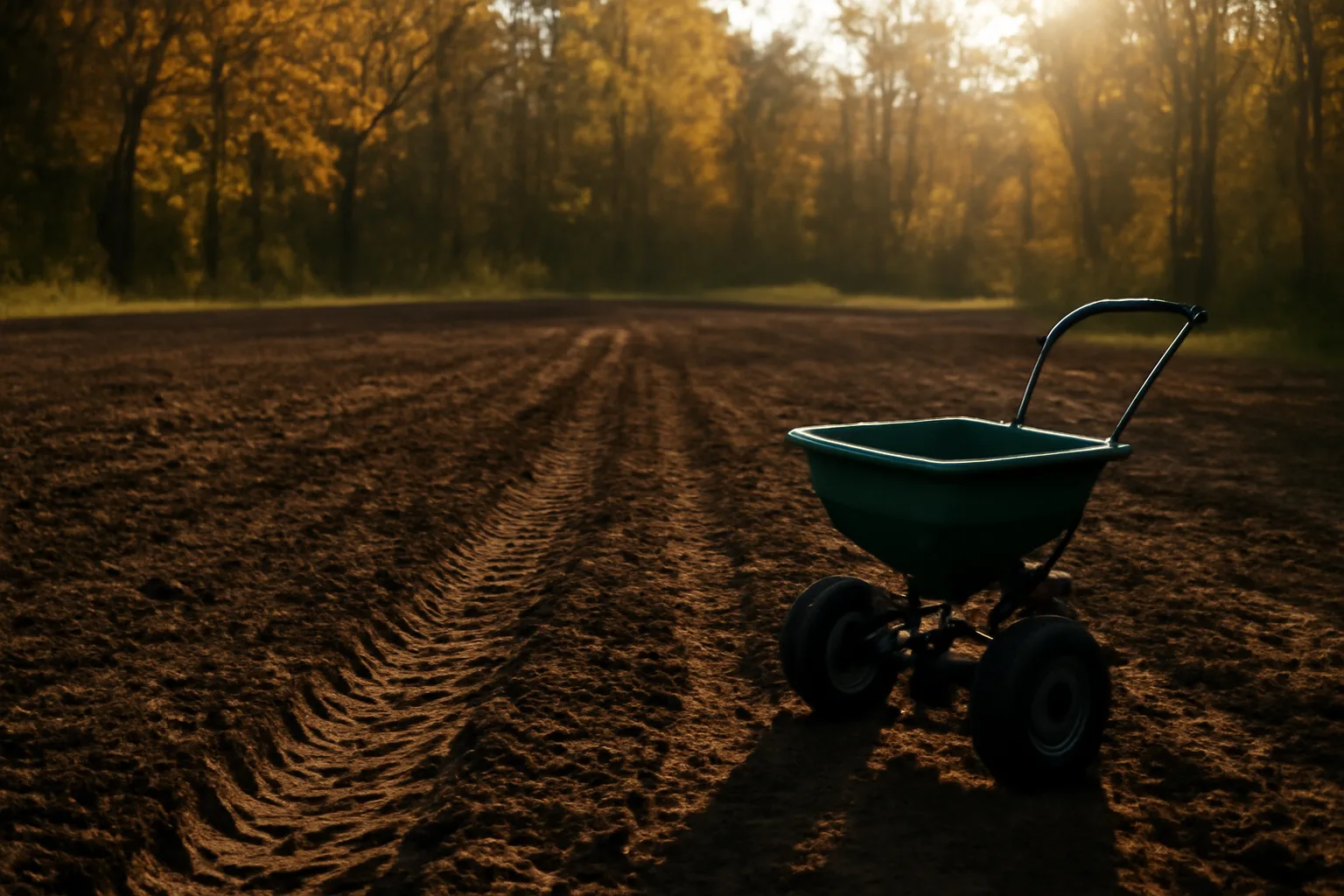
You do not need a tractor to plant a good food plot, though it makes bigger acreage a lot faster. Plenty of half-acre and quarter-acre plots get planted every year with an ATV, a pull-behind disc or cultipacker, and a hand or ATV-mounted broadcast spreader. Minimum viable setup for a small plot: a way to kill or knock down existing vegetation (mower, sprayer, or both), a way to disturb the soil surface (disc, tiller, or hand rake for tiny plots), a broadcast spreader for seed and fertilizer, and something to firm the seed into contact with soil (cultipacker, roller, or even driving an ATV over it works in a pinch for small seed). For larger acreage, a compact tractor in the 25 to 45 horsepower range with a disc, box blade, and PTO spreader covers most food plot jobs without needing full row-crop farm equipment. Renting or borrowing equipment for a weekend is common and often cheaper than owning gear you use twice a year. Getting the sequence right matters as much as the equipment itself: clear, test, lime and fertilize, plant, cultipack, and if it's a fall plot, plan your planting date backward from your local first frost date rather than a fixed calendar day.
How do you plan a rotation across the season?
A one-plot property usually needs to pick a lane: early season attraction, late season food, or perennial habitat anchor. A multi-plot property can stack all three and cover the whole season. A simple two-plot rotation that shows up often in extension guidance: one perennial clover plot for spring through fall browse and turkey use, and one annual fall plot mixing a cereal grain (oats or winter wheat) with a brassica (turnips or radishes) for October through winter hunting [1] [2]. The clover plot needs almost no annual replanting once established. The annual plot gets reworked every year but gives you flexibility to change species based on how the last season performed. If you're building this out for a specific piece of ground, this is exactly the kind of planning where a $99 Custom Food Plot Plan through plot-plan-builder can save a lot of trial and error, mapping species and planting windows to your acreage and region. It is general planning guidance built around your inputs, not a substitute for your soil test lab's specific lime and fertilizer recommendations, which should always be the final word on your field's exact numbers.
What legal or regulatory issues should you check before planting?
Food plots themselves are legal planting activity almost everywhere, but baiting and supplemental feeding rules vary heavily by state and can affect how you hunt over certain plot setups, especially anything involving piled feed, mineral stations, or feeders rather than a standing planted crop. Some states draw a legal line between a growing food plot (generally legal to hunt over) and bait placed on the ground (often restricted or banned) [6]. State wildlife agencies publish these rules directly, and they change. Check your state's specific hunting regulations page before combining plots with mineral sites, feeders, or any supplemental feed, since a plot that is perfectly legal in one state can cross into an illegal baiting definition in a neighboring state under similar-looking setups [6] [7]. Chronic wasting disease response has also pushed several states to restrict feeding and baiting more heavily in recent years, sometimes in specific counties rather than statewide, so a state-level rule from a few years ago may no longer match the current county-by-county map.
Frequently asked questions
Do deer eat sorghum?
Yes. Deer browse young sorghum growth and eat the grain heads, especially in fall and winter. It is more commonly planted for grain, screening cover, and drought tolerance than as a primary browse crop, and stressed or frost-damaged young growth can carry prussic acid risk worth understanding before large plantings.
Do deer like clover?
Yes, clover is one of the most preferred and most planted food plot forages available. White and red clover test high in crude protein, often above 25 percent in the vegetative stage, and a well-maintained stand can produce forage for three to five years before needing renovation.
When should you plant food plots for deer?
It depends on species and region. Spring/summer plots go in after the last frost, typically April through June. Fall plots go in 60 to 90 days before your local first frost, generally late July through early September across most of the whitetail range. Always check your state land-grant extension's frost date tool.
When should you plant oats for deer?
Plant oats 6 to 8 weeks before your area's first expected frost, generally late August through mid-September for much of the whitetail range. Oats germinate fast and get hit hard early, but they are less winter-hardy than wheat or rye and often die back after a hard freeze.
When should you plant turnips for deer?
Plant turnips 80 to 90 days before your first killing frost, usually late July through early August for most regions. Deer often ignore turnip bulbs and leaves until after a few hard frosts convert starches to sugars, so heavy use typically starts in November or December.
What is a food plot?
A food plot is a planted patch of forage, typically a quarter acre to several acres, established on hunting land to feed and hold deer. Plots are either annuals (replanted yearly, like brassicas or cereal grains) or perennials (clover, chicory) that persist three to five years with maintenance.
What are deer's favorite foods?
White clover, soybeans, chicory, and frost-sweetened brassicas like turnips consistently rank as high-preference, high-protein forages in university studies. Natural hard mast, especially acorns, often outranks any planted crop when available, which is why plots near oak cover tend to perform better.
Do deer like honey?
No credible wildlife research shows honey functions as a deer attractant or food source. The confusion likely stems from commercial molasses or sugar-based mineral attractants. Straight honey is not used or recommended in any extension food plot guidance.
How big should a food plot be?
There is no fixed rule; extension guidance varies by goal. Quarter-acre to half-acre plots work well as hunting plots tucked in cover, while multi-acre plots serve more as nutrition or destination fields. Smaller plots near bedding cover often produce better hunting setups than large open fields far from cover.
Do you need a tractor to plant a food plot?
No. Small plots (under an acre) are commonly planted with an ATV, a pull-behind disc or cultipacker, and a broadcast spreader. A compact 25 to 45 horsepower tractor makes larger acreage faster but is not required for a first plot.
How much does a soil test cost for a food plot?
Most state land-grant extension soil testing labs charge roughly $10 to $20 per sample for a basic pH and nutrient test. This is the cheapest, most reliable step in the entire planting process and directly determines your lime and fertilizer needs.
Is it legal to hunt over a food plot?
Generally yes; a standing planted crop is treated differently from piled bait in most states, but rules vary and some states restrict feeders, minerals, or CWD-related feeding bans by county. Always confirm current rules on your state wildlife agency's regulations page before combining plots with feed or mineral sites.
Sources
- Mississippi State University Extension, Establishing and Managing Wildlife Food Plots: Fall brassica blends should be planted 60 to 90 days ahead of first killing frost; clover stands can persist three to five years with maintenance; oat planting windows and protein comparisons for clover and soybeans.
- University of Tennessee Extension, Wildlife Food Plots: Oat-brassica-cereal rye blends are a recommended fall mix for varied hunting pressure and browse timing.
- Mississippi State University Extension Deer Forage Research: White clover and soybean crude protein levels commonly test in the 20 to 30 percent range during the growing season.
- University of Nebraska-Lincoln Extension, Prussic Acid Poisoning: Sorghum and sudangrass relatives can produce prussic acid (cyanide) compounds in young, stressed, or frost-damaged growth.
- University of Missouri Extension, Soil Testing: Basic soil tests through land-grant extension labs typically cost roughly $10 to $20 per sample and provide specific pH and nutrient recommendations.
- Michigan Department of Natural Resources, Baiting and Feeding Regulations: States distinguish legally between hunting over a standing planted crop and hunting over placed bait, with rules varying by state and sometimes by county due to CWD management.
- Wisconsin DNR, Baiting and Feeding Regulations: Baiting and feeding restrictions can be enacted at the county level in response to chronic wasting disease detections.