Last updated 2026-07-25
TL;DR
There's no single best food plot seed. Clover and chicory give the best long-term perennial value, brassicas and oats win late season, and beans or soybeans deliver the most tonnage where deer density and browse pressure allow it. Match species to your soil test, region, and hunting goals rather than chasing a bag with a deer on it.
What is a food plot, exactly?
A food plot is a planted area on hunting land, usually somewhere between a quarter acre and several acres, seeded with forage that deer and other wildlife will eat. That's it. It's not a garden and it's not a lawn, though it gets treated like both depending on who you ask. Most state wildlife agencies and extension services describe food plots as a wildlife habitat management tool, not a guarantee of more deer or bigger antlers. The USDA Natural Resources Conservation Service and land-grant universities have published food plot guidance for decades as part of broader wildlife habitat programs, treating plots as supplemental forage that fits into a property's overall habitat, not a replacement for natural browse [1]. Plots generally fall into two buckets: annuals (planted fresh each year, examples are oats, brassicas, soybeans) and perennials (clover, chicory, alfalfa) that come back for two to five years with maintenance. Annuals cost more in labor every season but let you time tonnage to hunting season. Perennials cost more up front in lime and starter fertilizer but spread that cost over several years. Before any seed choice, a soil test is the actual first step. Extension soil labs (your state land-grant university runs one) will tell you pH, phosphorus, potassium, and often organic matter. Whitetail forages, especially clover and alfalfa, want a pH in the 6.0 to 7.0 range, and most food plot failures trace back to skipping lime rather than picking the wrong seed [2]. If you want a plan that maps species to your specific soil test numbers and acreage, that's exactly what a Custom Food Plot Plan is built to do, but the soil test itself always comes from your local lab, not from us.
What are deer's favorite foods, really?
Deer are opportunistic browsers, and their preferences shift by season, region, and what's available naturally. There's no single food that wins everywhere, but research and decades of field observation point to a consistent short list: acorns, soybeans, clover, and other legumes rank at or near the top almost everywhere whitetails live. Acorns are the heavyweight. Studies out of the University of Georgia and Mississippi State have documented deer shifting almost entirely to acorns when mast crops are heavy, sometimes at the expense of planted forages nearby [3]. That's a big reason a food plot next to a good white oak flat can look ignored in a mast year and mobbed in a poor mast year. Among planted forages, soybeans and cowpeas are the preferred summer legumes, clover is the preferred spring and fall perennial, and brassicas (turnips, radishes, rape) become a magnet once frost sweetens the leaves and bulbs in late fall. Corn is eaten but it's a low-protein energy food, better thought of as a fall/winter carbohydrate source than a nutrition powerhouse. Protein content matters more than most people think. Clover and alfalfa commonly run 20 to 25 percent crude protein, soybeans similar, while corn sits around 8 to 9 percent. For antler growth and lactation, the legumes do more work than the grain does.
Do deer eat clover, and do they actually like it?
Yes, unequivocally. Clover is one of the most consistently preferred food plot forages across whitetail range, and it's the seed most extension wildlife programs recommend as a base perennial planting [4]. White clover (Ladino types) and red clover both work, with white clover generally more shade and traffic tolerant and red clover often more heat and drought tolerant depending on variety. Clover regrows fast after grazing, which is exactly why deer hit it hard and keep coming back through the growing season, unlike a lot of annuals that get grazed out once and don't recover. Clover stands typically last three to five years before grass and weed competition force a replant, according to multiple university extension forage guides, and mowing two to four times a season to keep it in a vegetative (leafy, non-flowering) stage keeps protein content and palatability high. A well-maintained clover plot, limed to the right pH, is close to the highest return-on-effort planting most hunters can make. The catch: clover is slow to establish (often 60 to 90 days to a solid stand) and it can't handle standing water or heavy shade. It also gets hammered hard by young stands in high deer density areas, sometimes too hard to ever get established. If you're planting a small plot in a high-pressure area, consider a nurse crop of oats with the clover to protect young seedlings.
Do deer eat sorghum, and is it worth planting?
Deer will eat sorghum, but it's not a top-tier choice for whitetail food plots and most wildlife managers treat it as a secondary or filler crop rather than a primary planting. Grain sorghum (milo) produces seed heads deer and turkey will use in fall and winter, and forage-type sorghum-sudangrass is sometimes used as a quick-growing summer screen or biomass crop. The practical issue is competition. Deer generally prefer soybeans, corn, and legumes over sorghum when given a choice, and sorghum is more commonly grown for dove fields and general wildlife (quail, turkey, songbirds) than as a dedicated deer attractant [5]. It does have real upside as a screening crop, growing 5 to 8 feet tall to block sightlines into a plot or stand, and as a drought-tolerant option on sandy or marginal ground where beans would struggle. If your goal is deer nutrition or hunting attraction specifically, sorghum is a background player, not a headliner. Use it for cover and screening value, or in a wildlife blend aimed at multiple species, not as your main deer plot.
When should you plant food plots for deer?
Timing depends entirely on your USDA plant hardiness zone, your last and first frost dates, and whether you're planting a cool-season or warm-season crop. There is no single national planting date, and the biggest mistake first-time planters make is copying a date they saw online without checking their own frost dates. As a general framework: warm-season plots (soybeans, cowpeas, corn, sorghum) go in after your last spring frost, typically April in the Deep South through late May or early June in the upper Midwest and Northeast. Cool-season plots (clover, brassicas, cereal grains) go in during late summer to early fall, usually 60 to 90 days before your first killing frost, so the plants mature into their peak palatability window right as hunting season opens. Your state extension service publishes exact frost date tables and planting calendars by county, and that's a better source than a generic bag label because it accounts for your actual climate zone [6]. As a rough national spread: Deep South and Gulf Coast cool-season plantings often run September into October, the Midwest and mid-South run August into September, and the northern tier (Minnesota, Wisconsin, Maine, Michigan) often need to get cool-season seed in by mid-to-late August to get enough growth before frost locks things down. For a planting calendar built around your specific zip code and frost dates rather than a regional guess, that's the kind of detail a Custom Food Plot Plan works out for you, but the frost date data itself always traces back to NOAA and your extension service.
When should you plant oats for deer?
Oats are a cool-season cereal grain, and they go in the ground in early fall, generally 6 to 10 weeks before your area's first hard frost, so the same August-to-September planting window that applies to brassicas and clover overseeding applies to oats. Oats germinate fast, often in 5 to 7 days in good soil moisture, and they green up quickly, which makes them a favorite for hunters who want visible plot activity within a few weeks of planting rather than months. They're also one of the most cold-tolerant cereal grains for grazing, staying palatable and green well into and sometimes through moderate winters in the mid-South and transition zone, though hard freezes in the northern tier will eventually kill them back or push deer to brassicas and standing beans instead [7]. A common and effective combo is oats plus clover, where the oats act as a nurse crop, shading the soil and suppressing weeds while the slower clover establishes underneath. By the second year the oats are gone and you've got a clean clover stand. Oats are also cheap. Seed costs are usually a fraction of specialty brassica blends per acre, which makes them a good low-risk fill-in crop for beginners or for a plot that didn't get planted in time for something else.
When should you plant turnips for deer, and do deer like them?
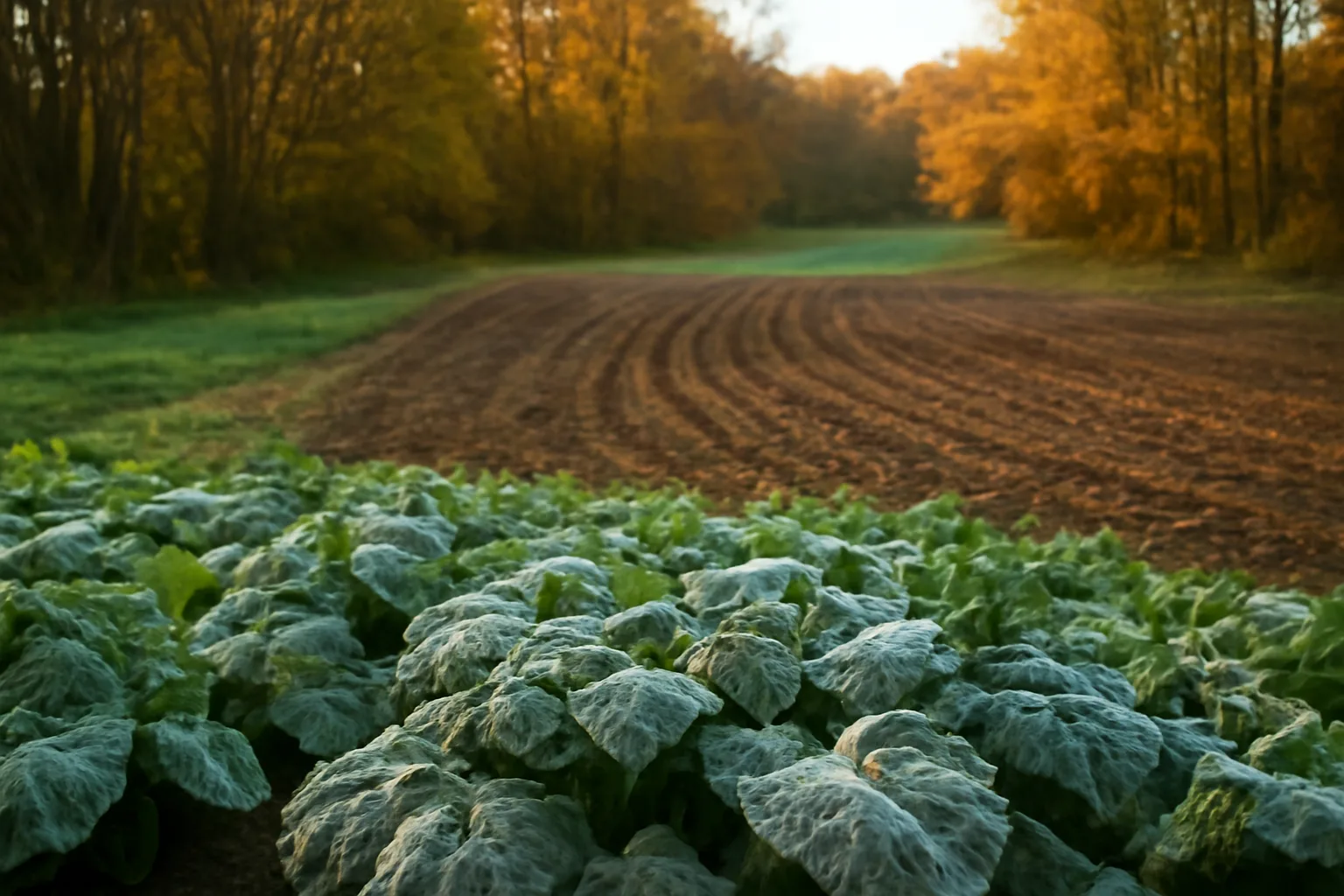
Turnips, like other brassicas (radishes, rape, kale, swede), are planted in late summer, typically 90 to 100 days before your first expected frost, because they need that full growing window to bulb out and reach peak sugar content by the time deer start hitting them hard. Here's the part that trips up a lot of first-year planters: deer often ignore brassicas early in the fall and hammer them after the first hard frost. That's not random. Frost converts starches in the leaves and bulbs into sugars, which is why turnip plots that look untouched in October can be grazed to dirt by December. If you're hunting early season over a turnip plot and nothing shows up, that's often normal, not a failed planting. Brassica seed is tiny and needs to be broadcast shallow, roughly a quarter inch deep or less, into a firm, weed-free seedbed. Planting too deep is the single most common brassica failure. A firm seedbed (you should be able to walk across it and leave only a shallow footprint) matters more for brassicas than for almost any other food plot seed because of how small and shallow the seed goes. Many hunters blend turnips with oats or cereal rye, getting fast green growth from the grain early and the sugar-loaded bulbs and leaves later in the season for that late-season punch.
Do deer like honey, and does it belong in a food plot?
No, honey has no real place in a food plot, and deer don't seek it out as a natural forage. This question usually comes up because of "honey hole" language hunters use for a great spot, or because of mineral and attractant products that use molasses or sweeteners, which is a different thing entirely from actual honey. Deer are herbivores built to digest cellulose from plants through a four-chambered rumen system, and there's no wildlife research or extension guidance recommending honey as deer forage or attractant. Sweet liquid attractants and mineral licks are a separate product category from food plots, and many states restrict or outright ban baiting and supplemental feeding, so check your state wildlife agency's regulations before using any concentrated attractant, syrup, or mineral product, since rules vary widely by state and sometimes by county due to chronic wasting disease concerns. If you're trying to boost mineral intake for antler and lactation demands, that's a mineral supplementation question, not a food plot seed question, and it's governed by different state rules than planting a legume field.
Which food plot seed fits which goal?
| White/red clover | Cool, perennial | 60-90 days | 3-5 years | Spring/summer/fall base forage, high protein | |
|---|---|---|---|---|---|
| Chicory | Cool, perennial | 60-90 days | 3-5 years | Drought tolerant clover companion, deep taproot | |
| Brassicas (turnip, radish) | Cool, annual | 80-100 days to peak | 1 season | Late-season, post-frost sugar spike | |
| Oats | Cool, annual | 5-7 days germ | 1 season, dies at hard freeze | Fast cover, nurse crop, cheap fill-in [7] | |
| Winter wheat/rye | Cool, annual | 7-10 days germ | 1 season | Cold-hardiest cereal grain, late winter green | |
| Soybeans | Warm, annual | 60-70 days to maturity | 1 season | High tonnage, high protein, needs low deer density to establish | |
| Cowpeas (iron clay) | Warm, annual | 60-70 days | 1 season | More browse-tolerant than beans, still high protein | |
| Corn | Warm, annual | 90-120 days | 1 season | Fall/winter carb source and screening, low protein | |
| Sorghum | Warm, annual | 60-90 days | 1 season | Screening, drought tolerant filler, secondary deer draw [5] | The biggest planning mistake is picking one seed type and expecting it to do every job. A property with a clover perennial for spring through fall, a brassica plot for the late season sugar spike, and maybe a soybean field if deer density allows it, covers far more of the calendar than any single seed does alone. |
Different seeds solve different problems. Here's how the major categories stack up against each other on the things that actually matter when you're picking seed for your ground. | Seed type | Season | Establishment time | Stand life | Best use |
How does soil testing change your seed choice?
Soil test results should come before seed selection, not after. Your state land-grant extension soil lab (Penn State, Mississippi State, Iowa State, and most other land-grants run affordable public soil testing programs, often 15 to 20 dollars per sample) will report pH, phosphorus, potassium, and organic matter, and that report is the actual authority on what your dirt needs, not a seed bag label [2]. Clover and alfalfa are the pickiest about pH, generally wanting 6.5 to 7.0 for peak nitrogen fixation from the rhizobium bacteria in their root nodules. Below pH 6.0, that nitrogen-fixing relationship breaks down and clover struggles no matter how good the seed genetics are. Brassicas and cereal grains are more forgiving, tolerating pH down into the high 5s without collapsing, which is part of why they're a good first-year crop on ground you haven't limed yet. Lime takes time to work, often 6 to 12 months to fully react through the soil profile, so a fall soil test result calling for 2 tons of lime per acre isn't something you fix the week before planting. This is the single most common cause of food plot failure across extension literature: hunters buy premium seed, skip or under-apply lime, and blame the seed when the real problem was soil chemistry [2]. Your soil lab's recommendation is always the final word for your specific field. A general seed guide, including this one, can tell you what most clover wants; only your test result can tell you what your clover needs.
What equipment do you actually need for these seeds?
Seed type drives equipment more than most people expect. Small, light seeds like clover and brassicas need shallow, firm seedbeds and are usually broadcast, then cultipacked or dragged lightly, not drilled deep. Large seeds like beans, peas, corn, and cereal grains want to go into the ground an inch to two inches deep and do better with a drill or planter, or at minimum a disk pass followed by cultipacking after broadcasting. A basic starter setup for a food plot under 2 acres is a broadcast spreader (handheld or ATV-mounted), a disk or tiller for seedbed prep, and a cultipacker or drag for seed-to-soil contact. Above that acreage, a no-till drill starts paying for itself in labor time and in far better germination rates on grain and legume crops, since drilling gets seed to consistent depth instead of leaving it exposed on the surface where birds and drying wind take a toll. Whichever equipment you're running, the seed choice and the equipment choice have to match. Buying premium soybean seed and broadcasting it on the surface with no coverage is a common way to lose half your germination to birds, sun, and uneven moisture.
What's a realistic seed selection strategy for a whole property?
Think in terms of a rotation across the season and across your acreage, not one plot doing everything. A common, well-tested approach among wildlife managers is roughly a third perennial clover or clover/chicory blend for spring through fall base forage, a third brassica or brassica/cereal grain blend for the late-season push, and if deer density and plot size allow it, a warm-season soybean or cowpea field for summer protein and early bow season activity. Property size and deer density change this math fast. On small acreage (under 5 total food plot acres) in high deer density areas, soybeans and other warm-season legumes often get grazed to the ground before they mature, so brassicas, oats, and clover (which regrow after grazing) tend to be the more reliable bet. On larger properties or lower deer density ground, beans and corn become realistic and add serious tonnage and protein. This is where a lot of hunters either overspend on seed blends that don't fit their soil or deer density, or underspend by planting the same single crop every year regardless of what the ground and the calendar actually call for. If you want species and a planting calendar matched specifically to your soil test, zone, and acreage rather than a generic regional guess, a Custom Food Plot Plan is a one-time 99 dollar way to get that mapped out; either way, treat your soil lab's fertility recommendation as the final word and check your state wildlife agency's baiting and feeding rules before adding any mineral or attractant product to the mix. For deeper reading on specific plot types and setups, see food plot whitetail, deer food plots, deer food plot seed, and food plot seed for species-specific breakdowns.
Frequently asked questions
Do deer eat sorghum?
Yes, deer eat sorghum seed heads and will browse young sorghum-sudangrass forage, but it's a secondary choice compared to soybeans, corn, and legumes. It's more useful as a drought-tolerant screening crop or dove/wildlife field component than as a primary deer attractant planting.
Do deer like clover?
Yes. Clover is one of the most consistently preferred whitetail forages, high in protein (often 20-25 percent crude protein) and palatable through most of the growing season because it regrows quickly after grazing, unlike many annuals that get eaten once and don't recover.
When is the best time to plant food plots for deer?
It depends on your zone and the crop. Warm-season plots (beans, corn) go in after the last spring frost; cool-season plots (clover, brassicas, oats) go in 60-100 days before the first fall frost. Check your state extension service's frost date tables for your county rather than a generic online date.
When should you plant oats for deer?
Plant oats in late summer to early fall, roughly 6-10 weeks before your area's first hard frost. Oats germinate fast (5-7 days) and work well alone as a quick, cheap plot or mixed with clover as a nurse crop that protects young clover seedlings.
When should you plant turnips for deer?
Plant turnips about 90-100 days before your expected first frost, in late summer. Deer often ignore turnips until after a hard frost converts the leaf and bulb starches to sugar, so don't panic if a turnip plot looks untouched in early fall.
What is a food plot?
A food plot is a planted area on hunting or wildlife land, seeded with forage crops like clover, brassicas, or soybeans, meant to supplement natural browse for deer and other wildlife. It's a habitat management tool, not a guaranteed way to hold or grow bigger deer.
What are deer's favorite foods overall?
Acorns top the list when available, since deer will shift almost entirely to mast in a heavy acorn year. Among planted forages, soybeans, clover, and other legumes rank highest for preference and nutrition, with brassicas becoming a strong draw specifically after frost.
Do deer like honey?
No. Deer don't seek out honey as forage; it has no real place in food plot planning. Confusion often comes from unrelated sweet mineral or attractant products, which are a separate category from planted forage and are restricted or banned in some states as a form of baiting.
What's the difference between annual and perennial food plot seed?
Annuals (oats, brassicas, soybeans, corn) are planted fresh each year and die off or get consumed within one season. Perennials (clover, chicory, alfalfa) regrow for 3-5 years with mowing and maintenance, costing more upfront in lime and fertilizer but less in year-over-year labor.
How much does a soil test cost for a food plot?
Most state land-grant university extension soil labs charge roughly 15 to 20 dollars per sample, though prices vary by state and by the level of testing requested. It's the cheapest, highest-impact step in food plot planning and should happen before you buy any seed.
Can you plant clover and brassicas together?
Not typically in the same seeding, since clover is a slow-establishing perennial and brassicas are fast annuals with different depth and competition needs. A more common combo is oats with clover (oats as a nurse crop) or oats with brassicas for a fast-growing, late-season blend.
Why isn't my food plot getting hit even though I planted good seed?
The most common cause traced by extension research is soil pH and fertility, not seed quality. Skipping lime when a soil test calls for it, planting brassica seed too deep, or planting outside your region's frost-date window will all suppress a plot regardless of the seed brand.
Sources
- USDA Natural Resources Conservation Service, Wildlife Habitat Management: Food plots are treated as a supplemental wildlife habitat tool within broader habitat management, not a standalone guarantee
- Mississippi State University Extension, Soil Testing for Wildlife Food Plots: Soil pH target range for clover/legume food plots and the role of lime and soil test recommendations
- University of Georgia, Warnell School of Forestry and Natural Resources, Deer Nutrition and Acorns: Deer shift heavily toward acorns in high mast years, sometimes reducing use of planted forages
- University of Tennessee Extension, Establishing Wildlife Food Plots: Clover is a widely recommended base perennial forage in wildlife food plot guidance
- Mississippi State University Extension, Wildlife Food Plots for Deer and Turkey: Sorghum's role as secondary wildlife forage and screening crop compared to soybeans and corn
- NOAA National Centers for Environmental Information, Frost/Freeze Data: First and last frost date data used to time regional food plot planting windows
- University of Kentucky Extension, Fall Food Plots for Deer: Oats' fast germination window and cold tolerance as a fall food plot cereal grain