Last updated 2026-07-25
TL;DR
The best late season food plots combine a brassica (turnips, radish) or winter wheat/oats with a standing energy source like corn or grain sorghum. Brassicas get sweeter after frost, cereal grains stay green under snow, and standing grain supplies the carbs deer need in January cold. Plant brassicas 90-100 days before your first hard frost and cereal grains 6-8 weeks before it.
what is a food plot, exactly
A food plot is a planted patch of forage, usually somewhere between a quarter acre and several acres, put in specifically to feed and attract deer or other wildlife. That's it. No secret formula, no magic seed blend required. Most hunters plant food plots for two different jobs. A "hunting plot" is small, tucked near bedding or a stand site, meant to pull a deer into range during shooting hours. A "destination" or "nutrition" plot is bigger, planted in a field or opening, meant to hold deer on the property and get them through the year, especially the stress periods of late winter and antler/fawn growth in summer. Late season plots serve a third, narrower job: keep high-energy food available after the first hard frosts have killed off native browse and ag fields have been picked clean. That means different species than your early season clover or September brassica plot, timed differently too. The USDA Natural Resources Conservation Service maintains a national conservation practice standard for Upland Wildlife Habitat Management (Code 645), which covers planted food plots when they're part of a cost-shared wildlife habitat plan [1]. For a broader rundown on plot categories and how they fit a whole-property plan, see food plot whitetail.
what makes a food plot good for late season specifically
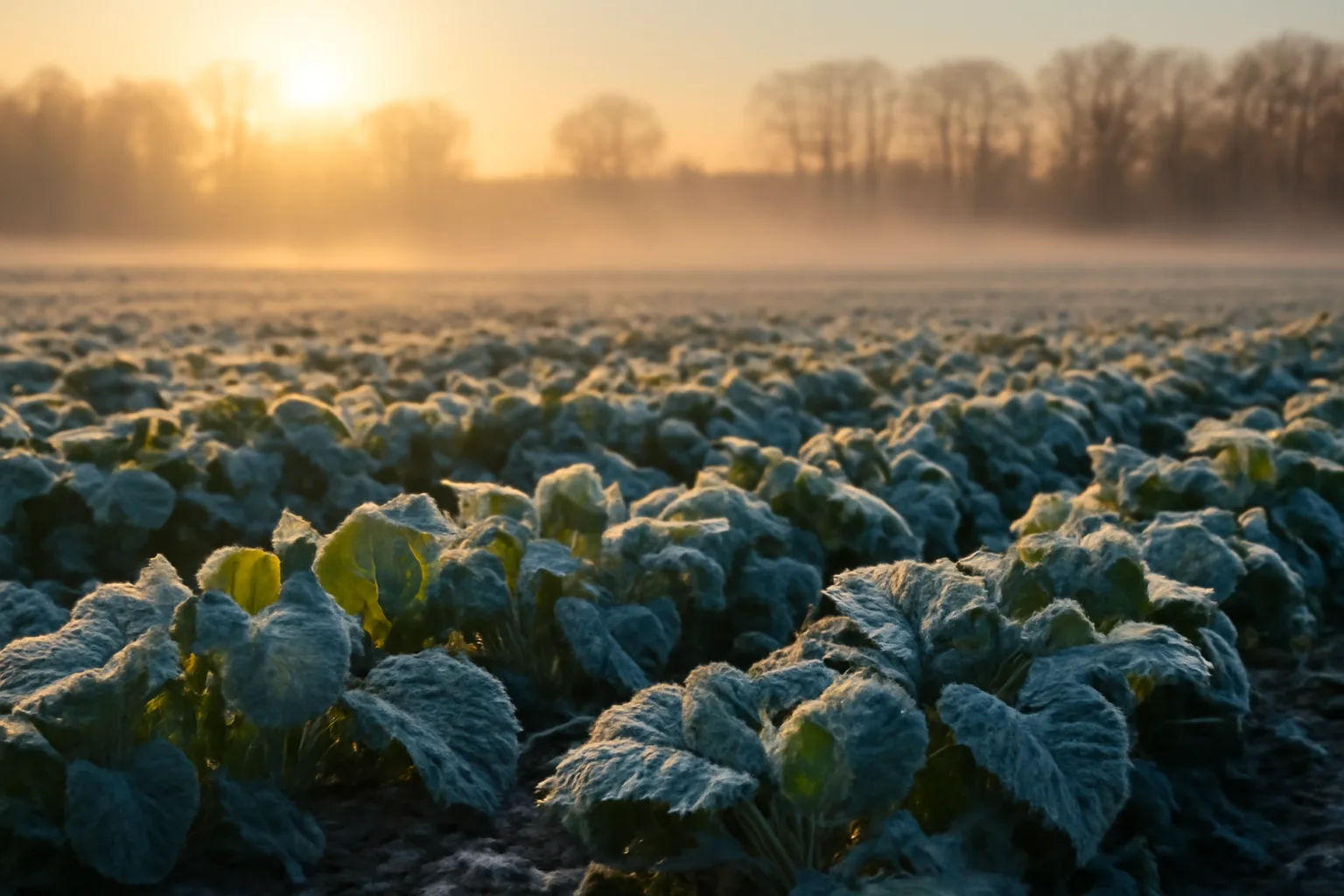
A good late season plot needs to do two things a September plot doesn't: survive freezing temperatures and deliver a lot of digestible energy per acre. Deer shift their nutritional priorities as winter sets in. Whitetail nutrition research has documented that deer increase intake of carbohydrate-dense foods (corn, acorns, soybeans) heading into winter, because building and holding fat reserves becomes the priority over the summer growth demands of lactation and antler development [2]. That means a straight clover plot, while great in spring and summer, usually isn't your best late season play on its own. Clover growth slows hard once soil temps drop below the mid-40s Fahrenheit, and by December in the Midwest or North a pure clover field is mostly dormant, brown, and low-value. The species that hold up: - Brassicas (turnips, radish, rape, canola/kale hybrids) get more palatable after a hard frost because the plant converts starches to sugars as a cold-tolerance mechanism. That's not folklore, it's basic plant physiology, and it's why deer often ignore a turnip plot in October and hammer it in December.
- Cereal grains (winter wheat, winter rye, oats) stay green and growing under snow cover in many zones and provide carbs plus some protein.
- Standing corn or grain sorghum left unharvested is the heavyweight: extremely high in carbohydrates, plus it provides thermal cover in a way low-growing plots can't. A one-species plot works, but the combination of a brassica/cereal grain blend planted next to (or with strips of) standing corn is about as complete a late season setup as you can build without owning a grain bin.
do deer eat sorghum
Yes. Grain sorghum (milo) is a legitimate late season deer food, especially in the southern Great Plains and parts of the Midwest where corn is harder to grow or more expensive to leave standing. Deer eat both the grain heads and, to a lesser extent, the foliage. Sorghum's advantage is drought tolerance. Kansas State University Research and Extension's grain sorghum production guidance notes the crop's deep root system and waxy leaf coating give it better drought tolerance than corn, which matters a lot in western hunting states where corn plots can fail in a dry August [3]. The downside: sorghum matures later than most people expect and can be vulnerable to bird pressure (blackbirds, in particular, can strip a field before deer season even opens in some regions). It's also not as universally preferred by deer as standing corn where corn grows well. If you're in true corn country, corn is usually the better carb source. If you're in a marginal-rainfall zone, sorghum is a smart substitute worth planting.
do deer eat clover, and do deer like clover
Deer absolutely eat clover, and it's one of the most preferred cool-season forages there is, but it's a spring-through-fall food more than a hard late season food. Clover (white clover varieties like Durana and Ladino are the common food plot picks, plus red clover) is high in protein, often in the 20-25% crude protein range during vegetative growth, which is why it's the backbone of most spring and summer plot programs [4]. The catch for late season hunters: clover growth is driven by soil temperature and day length. Once nighttime temps consistently drop into the 20s and 30s Fahrenheit, clover mostly stops growing and deer preference shifts to higher-energy options. In the Deep South and parts of the Southeast, clover can stay green and gettable well into winter because frosts are lighter and less frequent. In Zone 5 and north, don't count on clover alone to be your December card. The smart use of clover for a late season strategy is as a perennial base plot elsewhere on the property (spring/summer nutrition, early bow season attraction) while your dedicated late season acreage goes to brassicas, cereal grain, or standing grain. For seed selection across clover and other species, deer food plot seed breaks down varieties in more detail.
when to plant turnips for deer (and other brassicas)
| Deep South (Zone 8-9) | Mid-August to mid-September | |
|---|---|---|
| Mid-South / Transition (Zone 7) | Early August to early September | |
| Midwest / Mid-Atlantic (Zone 6) | Late July to late August | |
| Upper Midwest / North (Zone 4-5) | Mid-July to mid-August | These windows are general guidance, not a guarantee, and your local cooperative extension office will have a frost-date table specific to your county. Purdue University's Forestry and Natural Resources extension publication on food plots for deer and turkey recommends brassica plantings timed to reach maturity around the first killing frost, generally 80 to 100 days from planting depending on the variety [5]. Don't plant brassicas too early. A July planting in a zone with September frosts can bolt, get woody, and lose palatability before deer season even opens. Too late, and the plant never bulbs up and frost just kills it outright with nothing to show for it. |
Plant turnips and other brassicas roughly 90 to 100 days before your area's average first hard frost. That timing matters more with brassicas than almost any other food plot species, because the whole point is bulb and leaf development finishing right as frost hits, triggering that sugar conversion deer key in on. In practical terms, that's usually mid-July through mid-August across most of the whitetail's range, adjusted for your zone: | Zone (approx.) | Turnip/brassica planting window |
when to plant oats for deer, and other cereal grains
| Oats | Late August to mid-September (northern), September (southern) | Low, killed by hard freeze | |
|---|---|---|---|
| Winter wheat | September to early October | High, regrows after thaw | |
| Winter rye (cereal rye) | September through October, latest planting window of the three | Highest, tolerates the coldest soils | Cereal rye in particular can be planted later than almost anything else in the plot world and still establish, which makes it a good insurance seed if you're behind schedule. |
Plant oats and other cereal grains (wheat, rye, triticale) about 6 to 8 weeks before your first expected frost, which is later than brassica timing and earlier than most people assume. Oats germinate fast (5-7 days in warm soil) and can be grazed within a month of planting, which makes them a good fast-growing companion in a blend. The tradeoff: standard oats aren't very winter-hardy. A hard freeze can kill oats back to the ground in northern zones, though the plant matter itself often stays somewhat palatable even after it browns. Winter wheat and winter rye, by contrast, are bred to survive freezing and will often green back up after a thaw, which is why a lot of late season blends lean on wheat or rye as the frost-survivor and oats as the fast, early-attraction component. General windows: | Grain | Typical planting window | Frost tolerance |
when to plant food plots for deer (full-season overview)
| Spring | Clover, chicory, alfalfa | April-May (after last frost) | |
|---|---|---|---|
| Summer | Soybeans, cowpeas, sunflowers | Late May-June | |
| Late summer / early fall | Brassicas | July-August (90-100 days before frost) | |
| Fall | Cereal grains (oats, wheat, rye) | August-October (6-8 weeks before frost) | For a zone-by-zone breakdown with specific month ranges, a Custom Food Plot Plan built for your county's frost dates and soil test takes the guesswork out of this, but the logic above works fine if you're planning it yourself with your local extension's frost data in hand. |
There's no single "when to plant food plots" answer because it depends entirely on what you're planting and what job that plot is doing. Spring/summer plots (clover, chicory, soybeans, cowpeas) go in after your last frost date, typically April through June depending on zone. Fall/late season plots (brassicas, cereal grains, standing corn) go in during summer, timed backward from first frost as covered above. The one universal rule: work backward from frost date, not forward from "whenever I have a free weekend." Pull your average first frost date from your state climatologist or NOAA data, subtract the days-to-maturity for your chosen species, and that's your planting deadline, not your ideal planting day, your absolute latest one. A rough national planting calendar: | Season | Species | General window |
what are deer's favorite food, really
There's no single favorite, deer preference shifts by season, region, and what's available, but research consistently ranks a short list at the top: acorns (especially white oak family acorns, which are lower in tannins and more palatable than red oak group acorns), soybeans, and native/agricultural forbs and browse. Research on white-tailed deer feeding ecology has long shown deer preferentially select white oak group acorns over red oak group acorns when both are available, largely because white oak acorns have lower tannin concentrations and germinate the same fall they drop, while red oak acorns carry more tannins and stay bitter into winter [6]. When acorns aren't available or a mast crop fails (which oak researchers describe happening in cycles of several years apart depending on species and region), deer shift hard to agricultural foods, standing corn and soybeans especially, and to planted brassicas once frost hits. In food plot terms, soybeans get the closest thing to a "favorite" label among planted forages, since deer will hit a soybean field hard from the moment it emerges (sometimes too hard, small plots get grazed to nothing) straight through pod-drop in fall. But "favorite" changes by the week. A deer eating clover in June and hammering standing corn in January isn't contradicting itself, it's just following energy needs and availability, exactly what the nutrition research would predict.
do deer like honey (and does it belong in a food plot)
Deer don't eat honey in any meaningful sense and it has no legitimate place in a food plot plan. This question comes up because of "honey hole" terminology and because some mineral/attractant products use sweet, sticky bait additives that people associate with honey, but there's no wildlife nutrition research or extension guidance recommending honey as a deer food or attractant. More relevant: many states restrict or ban baiting and feeding of deer entirely, and the rules vary a lot by state and sometimes by county (often tied to Chronic Wasting Disease management zones). Michigan's game laws give the Natural Resources Commission authority to regulate baiting and feeding of deer and elk, and the current statewide rules (including narrower exceptions and additional restrictions in counties affected by bovine TB or CWD) are set out in the Michigan Wildlife Conservation Order under the authority of Michigan Compiled Laws section 324.40113a, and hunters need to check the current order each season since it's amended often . Wisconsin's baiting and feeding statute similarly restricts baiting in counties affected by Chronic Wasting Disease, under Wis. Stat. section 29.885, with the state's rules updated as new counties get added to the affected list . Before you add any attractant, mineral lick, or supplemental feed (honey-based or otherwise) to your plot setup, check your state wildlife agency's current baiting and feeding regulations, because a legitimate food plot (a planted crop) is treated completely differently under the law than a bait pile or feeder in most states, and the line between the two matters for legal hunting.
how big should a late season food plot be
Size depends on plot type and deer density more than any fixed rule, but a few working numbers from extension and habitat programs give you a starting point. Destination/nutrition plots aimed at holding deer through winter are typically recommended in the half-acre to multi-acre range, while hunting plots tucked near stands work fine at a quarter acre or smaller. Extension wildlife habitat guides commonly suggest food plots make up a small share of total property acreage, often cited in the range of roughly 1 to 5% for a property-wide program, spread across multiple smaller plots rather than one big field, which spreads deer use out and reduces the odds of one plot getting hammered to bare dirt by December . For late season specifically, bigger tends to help, because you're trying to carry a herd through the toughest nutritional stretch of the year and a quarter-acre brassica patch can get grazed down to nothing by mid-December in areas with real deer density. If you've only got a small parcel, prioritize standing corn or a thick cereal grain stand over a small brassica plot, since tonnage per acre matters more than variety when deer numbers are high relative to plot acreage.
soil testing and fertility for late season plots
Late season species aren't magic, they still need the same fertility groundwork as any other plot, and soil pH is usually the first thing holding a plot back. Brassicas and cereal grains both do best in a pH range of roughly 6.0 to 7.0, and low soil pH is one of the most common limiting factors extension soil test labs flag when a plot underperforms. Lime takes months to fully react in soil, which is exactly why extension soil fertility guidance pushes testing done a full season ahead, not the week before planting. If your test comes back at a pH of 5.5, broadcasting lime in August won't fix that before your late September planting, it'll help next year's plot, not this one's. University of Tennessee Extension soil fertility guidance for lime application notes that agricultural lime reacts slowly and needs to be applied and incorporated well ahead of planting to raise soil pH into the target range for the crop . Your soil test lab's specific lime and fertilizer recommendations are the real authority here, not a blog post, because rates depend on your exact soil type, buffer pH, and crop. A general food plot plan (species picks, planting windows, seeding rates) is useful for the big-picture strategy, but it can't replace a lab report pulled from your actual dirt. If you've already got that report in hand and want the planting side worked out around it, that's exactly the gap a Custom Food Plot Plan is built to fill for $99, though the lime and fertilizer numbers on the report itself should always come from your test lab, not a general guide. For more on matching seed choices to what your soil test shows, see food plot seed and deer food plots.
standing corn vs. brassicas vs. cereal grain: which wins in January
| Energy density | Very high (carbs) | Moderate, rises after frost (sugars) | Moderate | |
|---|---|---|---|---|
| Cold/snow tolerance | High (stalk holds grain above snow) | Moderate (leaves die back, bulbs persist in ground) | High (regrows after thaw) | |
| Thermal/security cover | Excellent | None | Low | |
| Cost per acre | Highest (seed, sometimes herbicide/fungicide) | Moderate | Lowest | |
| Deer draw timing | Peaks after other food sources are gone | Peaks right after first hard frosts | Steady, especially under snow | If you can only plant one thing and you're in real corn country, standing corn left unharvested is the single best late season card, because it delivers cover and carbs when deer need both most. If budget or acreage is tight, a brassica/cereal grain blend gets you 80% of the benefit for a fraction of the cost and effort. |
None of them "wins" outright, they solve different problems, which is why the best late season setups combine at least two. Here's how they stack up on the factors that actually matter in January cold. | Factor | Standing corn | Brassicas (turnip/radish) | Cereal grain (wheat/rye) |
Frequently asked questions
Do deer eat sorghum?
Yes, deer eat grain sorghum (milo) heads and foliage, and it's a solid corn substitute in drier regions like the western Great Plains where corn struggles. It matures later than most hunters expect and can lose grain to blackbird flocks before season, so plant it early enough and expect some bird competition.
Do deer eat clover, and do deer like clover?
Yes, clover is a top-preference forage, often 20-25% crude protein, and deer hit it hard spring through fall. It mostly stops growing once nights drop into the 20s-30s Fahrenheit, so in northern zones it's a spring/summer food plot staple, not your primary late season plan.
When to plant food plots for deer?
It depends on species. Spring/summer plots (clover, soybeans) go in after last frost, April through June. Fall/late season plots (brassicas, cereal grains) go in summer, timed backward from your area's first frost date, roughly 90-100 days ahead for brassicas and 6-8 weeks ahead for cereal grains.
When to plant turnips for deer?
Plant turnips and other brassicas about 90 to 100 days before your area's average first hard frost, generally mid-July through mid-September depending on zone. That timing lets the bulb and leaf fully develop before frost triggers the starch-to-sugar conversion deer key in on.
When to plant oats for deer?
Plant oats roughly 6 to 8 weeks before your first frost, usually late August to mid-September in northern zones and September in southern zones. Oats germinate fast and get grazed within a month, but they have low winter hardiness, so pair them with winter wheat or rye if you need late-winter persistence.
What is a food plot?
A food plot is a planted patch of forage, from a quarter acre to several acres, established specifically to feed and attract deer or other wildlife. The USDA NRCS covers planted food plots under conservation practice standards like Upland Wildlife Habitat Management (Code 645) when they're part of a cost-shared habitat plan.
What are deer's favorite foods?
There's no single favorite; preference shifts by season. White oak acorns rank at the top when available due to high fat and low tannins, soybeans are the top preferred planted forage through summer and fall, and standing corn or brassicas take over once frost hits and acorns run out.
Do deer like honey?
Not really, and honey has no place in a legitimate food plot plan. There's no nutrition research supporting honey as deer food. Many states also restrict baiting and feeding, sometimes tied to Chronic Wasting Disease management zones, so check your state wildlife agency's current rules before using any attractant.
What's the best late season food plot if I can only plant one thing?
In true corn-growing regions, standing corn left unharvested is the strongest single option, delivering both high carbohydrate energy and thermal/security cover. Where corn is a poor fit (dry climates, small acreage, tight budget), a brassica and cereal grain blend gets most of the benefit for far less cost.
How cold does it need to get before brassicas taste better to deer?
A hard frost, typically the first freeze in the upper 20s Fahrenheit or below, triggers the starch-to-sugar conversion in brassica leaves and bulbs that makes them more palatable. This is a real plant physiological response to cold stress, which is why deer use of a turnip plot often jumps noticeably right after the first freeze.
Can I plant a late season food plot in a food plot that already has standing crops nearby?
Yes, and it's a strong strategy. Planting a brassica or cereal grain plot adjacent to or within reach of standing corn or beans gives deer both the cover/carb source and the frost-sweetened forage in one area, which tends to concentrate use better than either planted alone.
Do late season food plots need different fertilizer than summer plots?
Not fundamentally, brassicas and cereal grains both prefer soil pH around 6.0-7.0 like most plot species, but nitrogen needs can be higher for leafy brassica growth. Your soil test lab's specific lime and fertilizer rate recommendations, not a generic guide, should drive your actual application rates.
Sources
- Jacobson, H.A. and Griffin, W.L., "Nutritional Management of White-Tailed Deer," Mississippi State University Extension review of deer nutrition research: Deer shift toward carbohydrate-dense foods in winter for energy balance and fat reserves
- Kansas State University Research and Extension, Grain Sorghum Production Handbook (C-687): Grain sorghum tolerates dry conditions and poorer soils better than corn
- USDA NRCS Plant Fact Sheet, White Clover (Trifolium repens): White clover crude protein content and use as forage
- Purdue University Forestry and Natural Resources Extension, Food Plots for Deer and Turkey (FNR-486-W): Brassica food plots should be timed so bulb and leaf maturity coincides with the first killing frost
- USDA Forest Service, Fire Effects Information System, species review of Quercus alba (white oak): White oak acorns are preferred over red oak acorns due to lower tannin content and faster germination
- University of Tennessee Extension, Lime and Fertilizer Recommendations (W 344): Soil pH between 6.0 and 7.0 is recommended for most food plot species, and lime needs time to react before it changes soil pH