Last updated 2026-07-25
TL;DR
There's no single best liquid fertilizer for food plots; it depends on what your soil test says you're missing. Liquid works well for foliar micronutrient correction and fast-acting nitrogen on brassicas or cereal grains, but it can't replace granular fertilizer for building phosphorus and potassium in the soil. Pull a soil test first.
is liquid fertilizer actually better than granular for food plots
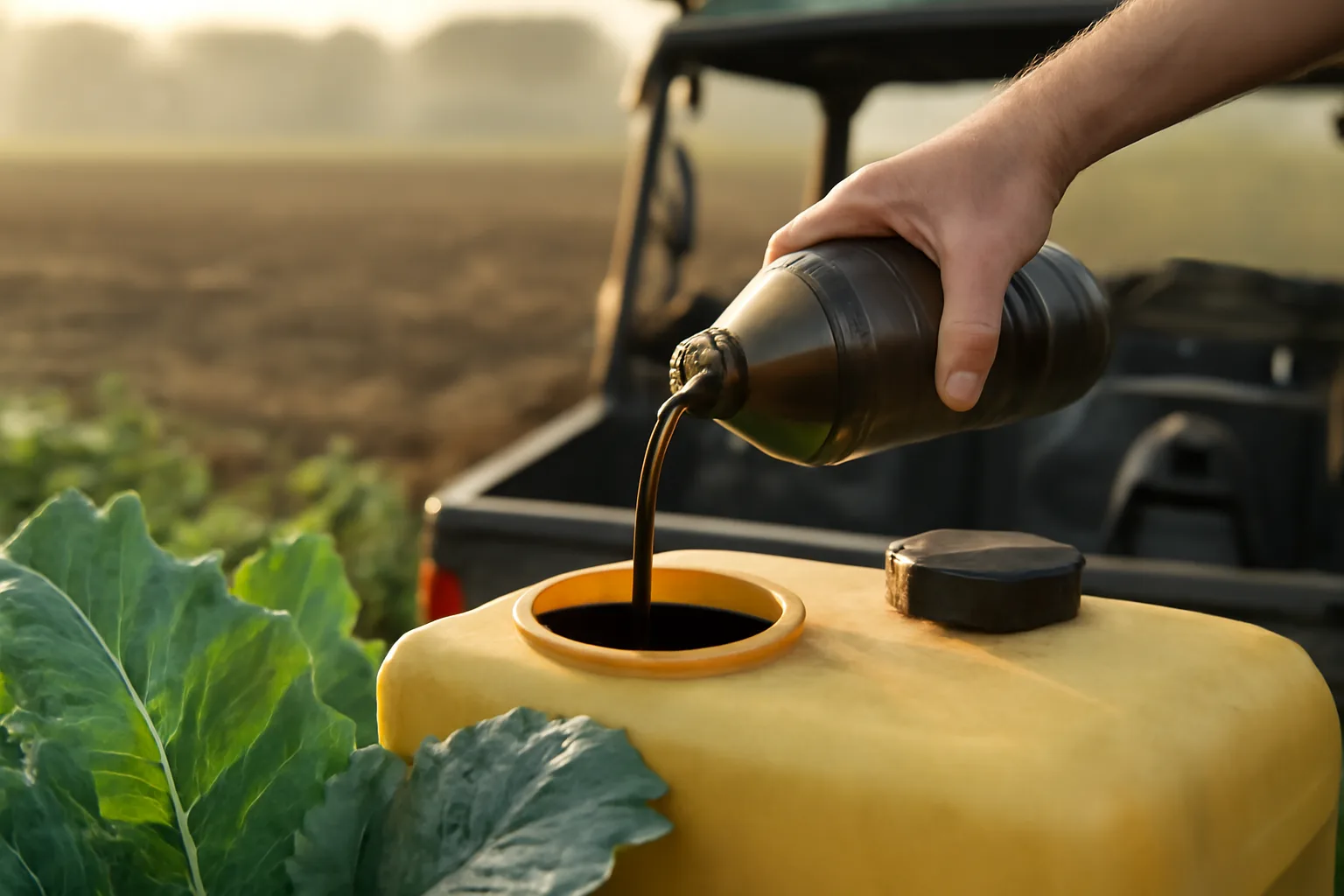
No, not as a blanket rule. Liquid fertilizer isn't superior to granular, it's a different tool for a different job. Granular fertilizer (like 19-19-19 or diammonium phosphate) is cheaper per pound of actual nutrient and it's how you build phosphorus and potassium reserves in the soil over years. Liquid fertilizer moves faster into the plant, especially through foliar application, but it costs more per unit of nitrogen, phosphorus, or potassium and it doesn't stick around in the soil the way granular P and K do. University of Missouri Extension explains that foliar feeding "can be a useful tool for correcting nutrient deficiencies quickly," particularly for micronutrients like zinc, manganese, and boron, but notes it's a supplement to soil fertility, not a replacement for it [1]. That's the honest answer. If your soil test shows P and K in the low range, no amount of liquid spraying fixes that economically. You need granular or a starter blend incorporated into the soil. Where liquid genuinely wins: quick micronutrient correction on a crop that's already showing deficiency symptoms, a fast nitrogen boost on brassicas mid-season, or as a starter fertilizer run through a drill or planter in-furrow with the seed. That last use case, in-furrow liquid starter, is probably the single best application of liquid fertilizer for a food plot grower. It gets a small, concentrated dose of phosphorus right where the germinating seedling's root can find it, which matters a lot in cold soil in early spring or in phosphorus-tied-up acidic ground. For most plots, though, your fertility program should be built around a soil test and granular or pelletized lime and fertilizer, with liquid as an accent, not the entree.
what's actually in the best liquid fertilizers for food plots
The liquid products that show up most often in food plot circles fall into three buckets: liquid nitrogen (usually 28-32% UAN, urea ammonium nitrate), liquid starter blends (something like 6-24-6 or 9-18-9 with micronutrients), and liquid micronutrient packages (boron, zinc, manganese, sulfur, sometimes molybdenum). UAN (urea ammonium nitrate solution) is a real, common agricultural product, it's roughly half urea and half ammonium nitrate in solution, typically sold at 28% or 32% nitrogen. The Mosaic Company's nutrient source documentation and most land-grant agronomy guides describe UAN the same way: a stable liquid nitrogen source that farmers apply as a foliar or soil-applied nitrogen source on corn and wheat all the time [2]. For food plots it works the same way: quick nitrogen for brassicas, clover, or cereal grains, applied with a boom sprayer or even a backpack sprayer on small plots. Liquid starter blends matter most on brassicas (turnips, radish) and on clover establishment, where a shot of available phosphorus at planting helps the seedling root system develop before winter dormancy or before the plant needs to bulb up. Purdue Extension notes that starter fertilizers placed near the seed row can boost early growth substantially in cold or wet soils where root uptake of soil phosphorus is naturally slow [3]. Micronutrient liquids matter more than most plot owners realize on brassica and clover ground specifically. Boron deficiency in turnips and rape shows up as hollow stems and poor bulb development, and it's a documented issue on sandy, low organic matter soils, according to university brassica variety trial and production research. If your soil test flags low boron, a liquid boron product (often 10% boron solution) applied as a foliar spray is the standard fix, not a full granular reapplication.
how do you pick a liquid fertilizer without a specific soil test recommendation
Start with your soil test, not the fertilizer aisle. A basic soil test through Penn State Extension's Ag Analytical Services Lab costs about 10 to 20 dollars per sample as of 2023, and it tells you pH, phosphorus, potassium, and often micronutrient levels [4]. That report is the only thing that should be driving your NPK ratio decision, liquid or granular. Once you have the test back, match the deficiency to the product. Low pH means lime first, full stop; no liquid fertilizer fixes acidic soil, and pouring nitrogen onto ground below pH 6.0 wastes money because nutrient uptake efficiency drops hard in acidic conditions. If P and K read low, you need pounds of actual nutrient on the ground, which almost always means granular unless you're willing to spray liquid multiple times at higher cost. If everything reads fine except a micronutrient flag (boron, zinc, sulfur), that's exactly when a targeted liquid application earns its keep. One genuinely useful shortcut: if you don't want to guess at ratios and rates yourself, a service like the $99 Custom Food Plot Plan takes your soil test results and plot goals and builds a specific seed and fertility plan around them. It's general guidance built from your numbers, not a substitute for what your soil test lab tells you about lime and fertilizer rates, but it saves the guesswork on species and timing. Your state wildlife agency's food plot guidance is also worth checking before you plant anything, since some states have baiting and supplemental feeding restrictions that can affect how food plots are managed near stands. Rules vary by state, so check with your state fish and wildlife agency before you plant or fertilize near an area you plan to hunt.
what is a food plot
A food plot is a planted area, usually somewhere between a quarter acre and several acres, established specifically to provide forage for deer and other wildlife. It's not a garden and it's not a crop field grown for harvest and sale, it's a managed planting meant to attract and hold deer, provide nutrition through stress periods, or both. Most food plots fall into two rough categories: annual plots (brassicas, cereal grains, annual clovers) replanted every year, and perennial plots (red or white clover, chicory, alfalfa) that persist for 3 to 5 years with proper maintenance. State wildlife agencies and university extension programs generally treat food plots as a habitat management tool, similar to prescribed burning or timber stand improvement, rather than as agriculture [5]. Size and shape matter more than most new plot owners expect. A long, narrow plot (irregular, following a natural opening) tends to get used differently than a large square field, and a lot of the plot-type decision comes down to whether you're building a destination food source, a screening/security plot, or a hunting plot meant to be watched from a stand. If you're still deciding what kind of plot fits your ground, the food plot whitetail guide and the deer food plots overview both walk through the main plot-type decisions.
when to plant food plots for deer
| Deep South | March-April | September-October | |
|---|---|---|---|
| Mid-South / Transition | March-May | August-September | |
| Midwest | April-May | Late July-August | |
| Northeast / Upper Midwest | May-June | Late July-mid August | If you want a state-specific breakdown, your county extension office almost always publishes a local planting calendar, and that's a more reliable source than any generic national chart. |
Timing splits into two seasons: spring plots and fall plots, and the right window depends heavily on your state and USDA plant hardiness zone. Spring plots (clover, chicory, soybeans, cowpeas) generally go in after the last frost date, typically April through May in the Midwest and Northeast, earlier in the South. Fall plots (brassicas, cereal grains, annual clovers) are usually planted 6 to 10 weeks before your area's first frost date, which gives most fall forage crops enough time to establish before deer season and before growth slows with cold. The USDA's plant hardiness zone map is the standard reference for figuring out your frost dates and growing season length, and most seed bag labels reference it or a similar frost-date range for planting windows . As a rough rule, brassicas need roughly 80 to 90 days from planting to maturity, so a fall plot planted too late in August in a northern zone may not bulb out or reach full tonnage before a hard freeze. Here's a general planting window table by region (always confirm against your local extension office, since microclimates and elevation shift these dates): | Region | Spring plot window | Fall plot window |
when to plant oats for deer
Oats go in during the same window as other fall cereal grains, generally late summer through early fall, roughly 6 to 8 weeks before your first expected frost. In much of the Midwest that's late August into early September; in the Deep South it can stretch into October. Oats germinate fast, often within 5 to 7 days in warm soil, and they're one of the more cold-tolerant cereal grains for early fall grazing pressure, though a hard freeze will eventually kill the plant back (unlike winter wheat or rye, which can survive and regrow in spring in many zones). That makes oats a strong choice for a fall-only attraction plot, but a weaker choice if you want the plot to carry into late winter or regrow the following spring. Oats can also be planted in early spring in cooler regions as a quick-growing spring forage, though this is less common for hunting-focused plots since spring oats mature and decline before hunting season arrives.
when to plant turnips for deer
Turnips are a fall brassica, planted roughly 80 to 100 days before your first hard frost, which in most of the whitetail's range lands somewhere between late July and mid-August. Plant too late and the bulbs won't size up before the ground freezes; plant too early in warm, dry conditions and germination can be poor or flea beetle pressure can hammer young seedlings. Turnips need a firm, well-prepared seedbed and shallow planting depth, generally a quarter inch or less, since the seed is small. University extension brassica variety trial guides consistently note that a hard frost actually improves palatability of turnip bulbs and tops, because cold converts starches to sugars in the plant, which is part of why deer often ignore turnip plots in September and hammer them in December. If boron is low on your soil test, this is one of the clearer cases for a liquid boron foliar application, since boron deficiency in brassicas shows up as hollow, cracked bulbs and stunted tops.
do deer eat clover, and do they actually like it
Yes, deer eat clover readily and it's one of the most consistently preferred food plot forages across the whitetail's range. Clover (white clover, red clover, or ladino varieties) offers 20 to 25% crude protein in vegetative growth stages, which lines up well with a deer's protein needs during spring green-up, lactation, and antler growth . Clover's biggest advantage over annuals is duration. A well-maintained perennial clover stand can produce quality forage for 3 to 5 years with proper mowing, weed control, and periodic fertilization, versus replanting an annual plot every single year. The tradeoff is that clover needs decent soil pH (most varieties want 6.0 to 6.5) and moderate fertility to persist, so it's a poor fit for acidic, poorly limed ground unless you're willing to lime heavily up front. Deer preference research and grazing pressure observations from multiple state agencies consistently rank clover among the top few preferred food plot species, alongside soybeans and certain brassica tops, though actual preference shifts seasonally and by region depending on what native browse is available . If clover fits your plan, the deer food plot seed guide breaks down variety selection and seeding rates in more depth.
do deer eat sorghum
Deer will eat sorghum, particularly the grain heads and young leaves, but it's rarely a primary food plot species on its own. Sorghum (grain sorghum or forage sorghum) shows up in food plots more often as a screening or cover crop, planted for its height and density, with deer browsing it opportunistically rather than as a targeted attractant. Where sorghum earns a spot in a plot mix is as a nurse crop or structural component alongside a legume blend, or as standing cover near a bedding area. It's drought-tolerant and grows fast in hot weather, which makes it useful in the Deep South and parts of the Midwest where summer annual options are limited. But if your goal is maximum attraction and tonnage of preferred forage, soybeans, clover, or brassicas generally outperform sorghum for that specific purpose.
what are deer's favorite foods, and do they like honey
There's no single scientifically ranked "favorite food" list for deer, preference shifts by region, season, and what's locally available, but forage studies and state agency browse surveys consistently put soft mast (acorns, apples, persimmons), soybeans, clover, and certain brassica tops near the top for food plot species specifically. Acorns in particular are heavily preferred in fall because of their fat content, which matters for winter fat reserves . As for honey: no, honey isn't a natural or recommended deer attractant, and it's not something deer forage on in the wild. Deer are herbivores that browse plants, forbs, mast, and agricultural crops; they don't seek out honey the way a bear does. Anecdotal claims about honey or sugar-based sprays as attractants aren't supported by any wildlife agency or extension research, and in many states scent or feed-based attractants near a hunting area may run into baiting regulations depending on how your state defines bait. Check your state wildlife agency's baiting and feeding rules before using any additive, liquid or otherwise, near a stand.
how do you apply liquid fertilizer correctly on a food plot
Application method matters more with liquid than with granular, because liquid can burn foliage or get wasted through runoff if it's applied wrong. For foliar micronutrient or nitrogen sprays, apply during cooler parts of the day (early morning or evening) to reduce leaf burn risk, and avoid spraying right before a heavy rain since it washes the product off before uptake. For in-furrow starter application, the liquid goes down with the seed through a drill or planter attachment, placed close to but not directly on the seed to avoid salt injury to the germinating seedling. Most food plotters running small equipment use a boom sprayer or boomless nozzle setup on an ATV or UTV, and calibration matters: spraying too much liquid nitrogen on brassicas can push excess leaf growth at the expense of root and bulb development. A tank mix of UAN with a herbicide is common in row-crop agriculture and works on food plots too, since it saves a pass, but always check herbicide label compatibility with your specific liquid fertilizer before mixing, since some combinations reduce herbicide efficacy or increase crop injury risk.
is liquid fertilizer worth the extra cost for a small food plot
For a small plot (under 2 acres), the labor savings of a single spray pass sometimes justifies the higher per-pound nutrient cost of liquid, especially if you already own a sprayer and don't want to haul and spread granular bags by hand. For anything larger, granular fertilizer applied with a broadcast spreader is almost always the cheaper option per pound of actual N-P-K delivered. The real decision point is what your soil test says you need. If it's a broad NPK correction, buy granular. If it's a targeted micronutrient fix or a starter boost for brassicas and clover establishment, liquid earns its cost. Mixing both, granular for the base fertility program and liquid for foliar touch-ups, is what most experienced plot managers actually do, rather than picking one exclusively.
Frequently asked questions
Do deer eat sorghum in food plots?
Yes, but usually as secondary browse. Deer eat the grain heads and young leaves of sorghum, but it's more commonly planted for cover, screening, or as a drought-tolerant filler in a plot mix rather than as a primary attractant like soybeans or clover.
Do deer eat clover, and is it a good food plot choice?
Yes, clover is one of the most preferred food plot forages, offering 20-25% crude protein in vegetative growth [9]. It's a strong perennial choice if soil pH is 6.0-6.5 or higher, since clover struggles in acidic, unlimed ground.
When should I plant food plots for deer?
Spring plots (clover, soybeans, chicory) go in after your last frost, typically April-May in most of the whitetail's range. Fall plots (brassicas, cereal grains) go in 6-10 weeks before your first frost, usually late July through September depending on region.
Do deer like clover better than other forages?
Clover ranks near the top of preferred food plot species in most state agency and extension observations, especially during spring green-up and antler growth, but actual preference shifts by season and region based on what native browse is available.
When should I plant oats for deer plots?
Plant oats 6-8 weeks before your first fall frost, generally late August into September in most of the Midwest, later in the Deep South. Oats germinate fast (5-7 days) but don't survive hard freezes like winter wheat or rye do.
When is the best time to plant food plots overall?
There are two windows: spring (after last frost, for clover and warm-season annuals) and fall (6-10 weeks before first frost, for brassicas and cereal grains). Exact dates depend on your USDA hardiness zone and local frost dates [8].
When should turnips be planted for deer?
Plant turnips 80-100 days before your first hard frost, usually late July to mid-August across most of the whitetail's range. A hard frost actually sweetens the bulbs and tops by converting starches to sugars, which is why deer often hit turnip plots harder in December than October.
What exactly is a food plot?
A food plot is a planted area, typically a quarter acre to several acres, established to provide forage for deer and other wildlife rather than for commercial harvest. Plots are either annual (replanted yearly) or perennial (lasting 3-5 years), and are treated by most wildlife agencies as a habitat management tool.
What are deer's favorite foods?
There's no single ranked list, preference varies by region and season, but acorns, soybeans, clover, and brassica tops consistently rank high in state agency browse surveys. Acorns are especially preferred in fall due to their fat content ahead of winter.
Do deer like honey as bait or attractant?
No, honey isn't a natural deer food and isn't supported by any wildlife agency or extension research as an effective attractant. Deer are browsers that eat plants, mast, and forage crops. Check your state's baiting rules before using any additive near a stand, since definitions of bait vary by state.
Is liquid or granular fertilizer better for a food plot?
Neither is universally better, they serve different roles. Granular builds soil phosphorus and potassium reserves cheaply and is the base of most fertility programs; liquid works best for fast foliar micronutrient correction or as an in-furrow starter at planting.
Can I use liquid fertilizer without a soil test?
You can, but you're guessing. A soil test (10-20 dollars through most land-grant extension labs) tells you exactly what's deficient, and applying liquid nitrogen or micronutrients without that data risks wasting money on nutrients your soil already has enough of.
Sources
- University of Missouri Extension, Foliar Fertilization: Foliar feeding corrects nutrient deficiencies quickly but supplements rather than replaces soil fertility
- Purdue University Extension, Starter Fertilizer: Starter fertilizer placed near the seed row boosts early growth in cold or wet soils
- University of Georgia Extension, Brassica Crops for Winter Grazing: Boron deficiency causes hollow stems and poor bulb development in brassicas, especially on sandy soils, and frost improves palatability by converting starches to sugars
- University of Georgia Extension, Soil pH and Nutrient Availability: Nutrient uptake efficiency drops significantly in acidic soil conditions below pH 6.0
- USDA Forest Service, Fire Effects Information System: White Oak (Quercus alba): Acorns are heavily preferred fall forage for deer due to fat content important for winter reserves