Last updated 2026-07-24
TL;DR
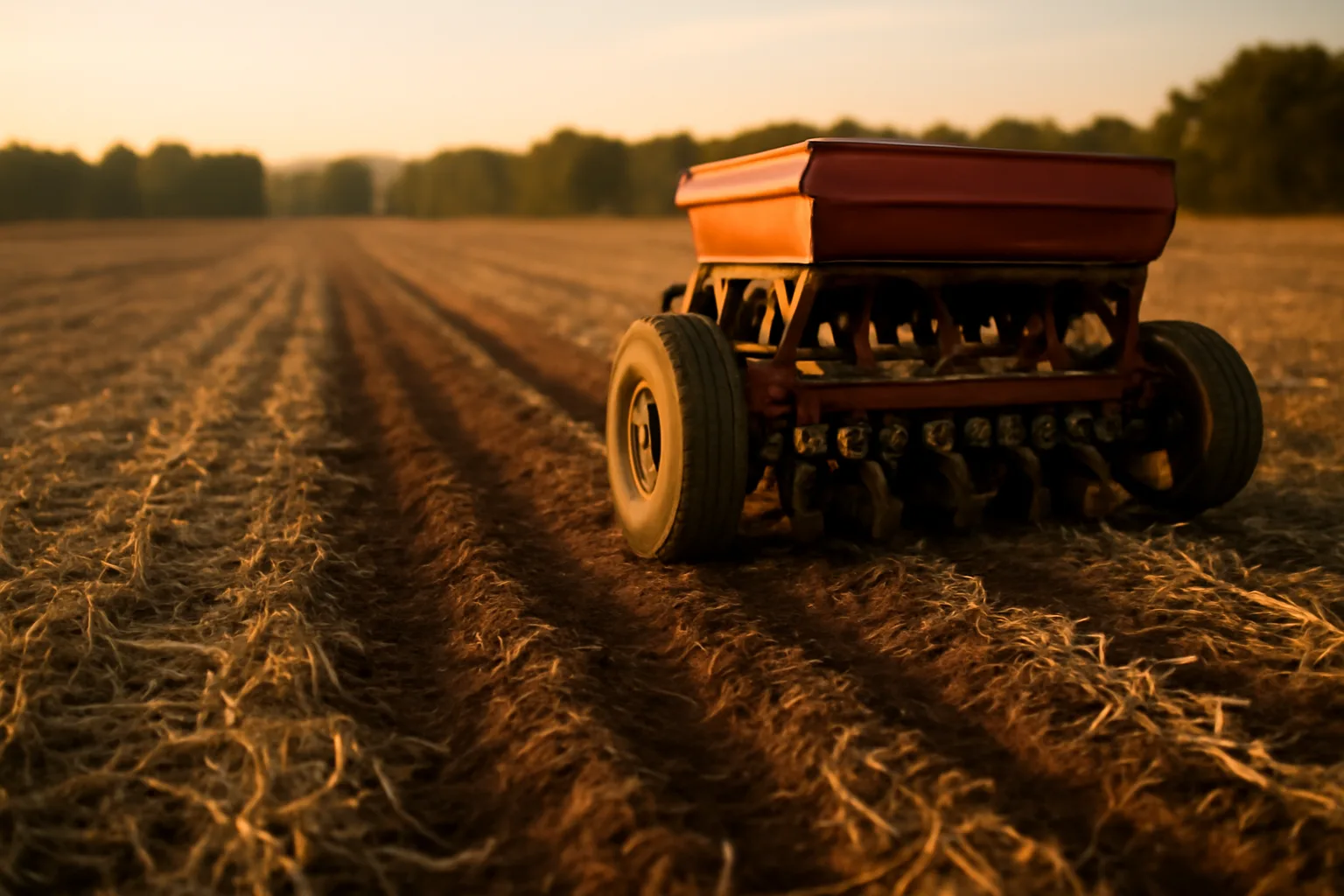
A no-till food plot uses herbicide burndown, a drill or broadcast-and-cultipack method, and standing residue instead of plowing. It saves time and fuel, protects soil structure, and works well for clover, oats, and brassicas. Most plots still need a soil test, some lime or fertilizer, and the right planting window for your zone.
What is a food plot, and how is a no-till plot different?
A food plot is a planted area, usually somewhere between a quarter acre and a few acres, meant to feed deer and other wildlife and give hunters a place to watch or hunt over. Most plots run clover, brassicas, cereal grains, or a mix, planted on ag ground, a logging clearcut, or a cleared patch inside timber. A no-till plot skips the plow, disc, and tiller. Instead you kill existing vegetation with herbicide (usually glyphosate), then plant directly into the dead residue using a no-till drill, or by broadcasting seed and running a cultipacker or roller over it to get seed-to-soil contact. The old growth acts like a mulch layer instead of getting turned under. The idea isn't new. Row-crop farmers have used no-till and reduced-till systems for decades because tillage burns diesel, dries out topsoil, and speeds up erosion. USDA's National Institute of Food and Agriculture and the Natural Resources Conservation Service have both funded and promoted no-till and cover cropping research for exactly those reasons: keeping soil covered and undisturbed builds organic matter and water infiltration over time [1]. Food plotters borrowed the same logic, just at a smaller scale with a UTV or compact tractor instead of a 40-foot planter. If you've got a food plot on food plot whitetail ground already established in perennial clover, no-till is often the only sane way to maintain it anyway, since you don't want to destroy the stand to replant it.
Why plant a no-till food plot instead of tilling?
The honest answer is time, fuel, and soil health, in roughly that order for most hunters. Tillage takes multiple passes: disc, maybe a second disc pass, then a cultipacker or drag before you even plant. On a half-acre plot that's not a big deal. On three or four acres of scattered plots on leased ground, it's a full day burned just prepping dirt, plus wear on equipment that may already be twenty years old and held together with baling wire. No-till cuts that to one or two passes: spray, then plant. You still need a way to get seed in the ground (drill, or broadcast plus cultipack), but you're not moving soil around first. Less diesel, less time, less compaction from repeated equipment passes. There's a soil-health argument too. Every time you till, you expose buried weed seed to light (triggering germination), oxidize organic matter faster, and break down soil aggregate structure. On sloped or erodible ground, tilled soil washes or blows away faster than no-till ground with dead residue holding it in place. A long-term tillage trial published by the USDA Agricultural Research Service and Purdue University found that no-till systems reduced soil erosion and increased water infiltration compared to conventional moldboard plowing over multiple decades of continuous cropping [2]. For food plots on hillsides or sandy soil, that matters more than people think. The tradeoff: no-till depends on a good herbicide kill. If your burndown is weak or your timing is off, you're planting into competition, and germination suffers. It also demands decent seed-to-soil contact, which is harder to get without tillage loosening the top inch of soil. A no-till drill solves that problem directly; broadcast-and-cultipack is the budget workaround and works fine for small-seeded species like clover and brassicas, less well for something like corn.
When should you plant food plots for deer?
Timing splits into two windows almost everywhere in whitetail country: spring plots (roughly April through June) and fall plots (roughly late July through September), with exact dates shifting by 3 to 6 weeks depending on your latitude and first/last frost dates. Spring plantings target warm-season annuals and perennials: clover, chicory, soybeans, cowpeas, corn. You want soil temps consistently above 50-55°F and your last frost date behind you. Extension offices generally recommend waiting until 2 weeks after your average last frost for warm-season legumes to avoid a cold snap wiping out young seedlings. Fall plantings target cool-season annuals and biennials: brassicas (turnips, radish, rape), cereal grains (oats, wheat, rye), and clover overseeding. These need to go in early enough to establish before the first hard frost but late enough that they're still tender and attractive when hunting season opens. That's the classic tension in food plot planning. Your state land-grant extension office is the best source for exact local dates, since a plot in northern Minnesota and one in central Alabama are on completely different calendars. Penn State Extension, for example, recommends planting fall brassica blends in that state between mid-July and mid-August so they mature by the September-October hunting season [3]. Mississippi State University Extension recommends fall plot establishment there generally from September through October, later than the mid-Atlantic and Midwest because of the milder climate [4]. If you want a start-to-finish calendar broken out by zone and species, see deer food plots for the fuller planting schedule.
When to plant oats for deer
Oats are a fall cool-season annual, and most of the whitetail range plants them 6 to 10 weeks before the first expected hard frost, so the plants have time to establish a leafy base before frost and cold slow growth. That generally lands in the August to early September window across the Midwest and Northeast, and can push into September or even early October in the Deep South. Oats germinate fast, often in 5 to 10 days with adequate moisture, and they're one of the most palatable cool-season grains available, frequently getting hit harder than wheat or rye in side-by-side plots. The catch: oats aren't as cold-hardy as wheat, rye, or triticale. A hard freeze below roughly 20°F can kill them outright, so in far-north climates oats work better as an early-fall attractant that dies back by winter rather than a plant you expect to feed deer in January. If you want late-winter tonnage, blend oats with a hardier cereal grain or with brassicas. Oats also work as a nurse crop, germinating quickly to hold soil and suppress weeds while a slower perennial like clover establishes underneath.
When to plant turnips for deer
Turnips go in as a fall brassica, typically 60 to 90 days before your first expected hard frost, which usually means late July through August in the northern half of the whitetail's range and into September in the South. Turnips need that lead time because deer generally ignore the bulb and leaves until after a hard frost converts starches to sugars, making the plant sweeter and more attractive. Plant too late and you get small, underdeveloped bulbs that never reach that palatable stage before the season ends. Plant too early in warm soil and you risk flea beetle damage and bolting. Most turnip and brassica blends recommend a seeding rate around 2 to 5 lbs per acre when drilled, higher when broadcast, and a shallow planting depth of about a quarter inch, since turnip seed is tiny and buried too deep, it won't emerge. Extension guidance from Mississippi State and other southern land-grant programs generally lists brassicas among the higher-tonnage cool-season options for deer plots, often outproducing cereal grains on a pounds-per-acre forage basis when soil fertility is adequate [4].
Do deer eat sorghum?
Yes, deer eat grain sorghum, both the standing grain heads and, to a lesser extent, the leaves, but it's more commonly planted as a screening and bedding cover crop or a late-season standing grain source than as a primary attractant crop. Sorghum is drought-tolerant and grows well on marginal soil where corn struggles, which makes it popular in the southern Plains and parts of the Southeast. Deer will browse young sorghum shoots some, but the real value comes in fall and winter when the grain heads mature and dry down, offering a high-carbohydrate food source similar to corn but at lower input cost and with less fertilizer demand. It's not usually anyone's first choice for a dedicated food plot species aimed purely at deer nutrition. Whitetail nutrition research, including long-running work out of the Mississippi State University Deer Lab, generally ranks legumes like soybeans and cowpeas, along with clover, above grain crops for protein content during the growing season, since deer need diets in the range of 13-20% crude protein for antler and body growth depending on age and season, a level grain crops don't come close to matching [4].
Do deer eat clover, and do deer like clover?
Yes, deer eat clover readily and it's consistently one of the most reliable food plot species across the whitetail's range. White clover and red clover both show up repeatedly in state extension and university food plot trial data as high-preference, high-protein forage. Clover offers crude protein commonly in the 20-30% range depending on variety, growth stage, and soil fertility, well above what deer get from grain crops, and it stays available spring through fall once established, unlike an annual that's finished after a few months. That's why clover anchors so many perennial plot plans: plant it once, mow and fertilize it, and get 3 to 5 years of use out of one planting if weed pressure and soil fertility are managed. The reason clover fits no-till so well is durability. A mature clover stand tolerates spraying with a grass-selective herbicide to knock back competition without killing the clover itself, and it doesn't need annual replanting, which is exactly the maintenance profile no-till equipment handles best. Frost-seeding clover into an existing thin stand, broadcasting seed onto frozen or thawing ground in late winter, is a classic no-till trick that works because freeze-thaw cycles walk the seed into the soil surface without any equipment at all. For seed selection and blend comparisons, deer food plot seed breaks down clover varieties against brassicas and cereal grains side by side.
What are deer's favorite foods, really?
There's no single universal answer, because deer preference shifts by season, region, and what's naturally available, but research and extension data point to a consistent short list: acorns and other hard mast, soybeans and other legumes, clover, and, seasonally, browse like honeysuckle and greenbrier. Acorns are frequently cited as the single most important fall food source across most of the whitetail range, both for raw abundance and fat content, and deer will often abandon a food plot entirely in a heavy mast year. That's not a food plot failure, it's just deer doing what deer do when free calories are lying on the ground. Among planted crops, soybeans rank high during the growing season for protein, and standing beans left un-harvested into fall and winter provide both protein-rich leaves early and a carbohydrate-dense grain later. Clover is the most consistent spring-through-fall forage. Brassicas and cereal grains take over as the preferred late-fall and winter food once frost sweetens them and other options thin out. The honest caveat: there's no rigorous ranked "favorite food" list backed by controlled feeding trials that applies everywhere, because local mast crops, ag field proximity, and regional forage availability change the calculus every year. Anyone selling you a definitive top-5 list nationwide is guessing.
Do deer like honey, and should you use it as an attractant?
There's no real evidence deer are drawn to honey specifically, and it's not a recommended or commonly used food plot or attractant additive in any wildlife extension literature. Deer are drawn to sugar and salt more generally, which is part of why molasses-based mineral licks and sweetened feed products exist commercially, but plain honey isn't a standard tool foodplotters or wildlife biologists use. More relevant: many states regulate or ban baiting and supplemental feeding for deer hunting outright, and rules vary sharply by state and even by county or wildlife management unit within a state. Michigan, for example, restricts baiting statewide with limited exceptions and specific volume and area rules set by the Department of Natural Resources under its baiting and feeding order [5]. Before you put out anything, syrup, mineral, corn, or otherwise, check your state wildlife agency's current regulations, since a planted food plot is treated very differently under most state laws than a bait pile, but the legal line differs by state and changes periodically.
How do you actually plant a no-till food plot, step by step?
The core sequence is the same whether you're working a quarter acre or ten: test the soil, kill what's growing, plant into the residue, and manage weed and deer pressure after emergence. 1. Pull a soil sample first, ideally 60-90 days before planting. Your state extension soil lab (most land-grant universities run one for $10-20 a sample) will tell you pH and nutrient levels and give you a lime and fertilizer recommendation specific to your dirt. This is the one step people skip and regret; a $15 test can save a $300 seed and fertilizer bill from going to waste on a plot that's too acidic to grow anything. 2. Spray a burndown herbicide 2-3 weeks before your planting date. Glyphosate is standard for killing existing grass and broadleaf growth ahead of a no-till planting; rate and timing depend on what you're killing and label instructions, and a decent burndown needs actively growing weeds, not dormant or stressed ones. 3. Apply lime if your soil test calls for it. Lime takes months to fully react and change soil pH, so if your test shows you're below the target pH (most food plot species want somewhere around 6.0-6.5, though clover and alfalfa prefer closer to 6.5-7.0), get lime down as early as you can, even a full season ahead if possible. 4. Plant with a no-till drill if you have access to one, since it cuts a slot through the dead residue, drops seed at a controlled depth, and closes the slot in one pass. If you're broadcasting instead, spread the seed then run a cultipacker, ATV tire drag, or even a chain-link section to press seed into contact with soil. Broadcasting without any press step is the single biggest cause of thin, patchy no-till plots, since seed sitting on top of residue with no soil contact just doesn't germinate well. 5. Apply fertilizer per your soil test, either before or at planting depending on your equipment's capability to band it. 6. Manage after emergence: mow clover to control weeds and encourage lateral growth, spray a grass-selective herbicide on established perennial stands if grass pressure builds, and watch for early browse pressure that can wipe out a small plot before it establishes, particularly brassicas and beans in high-deer-density areas. For equipment options at different budget levels, from ATV-mounted sprayers and spreaders to compact no-till drills, food plot seed and deer for food both cover gear tradeoffs in more depth.
What equipment do you actually need for no-till planting?
At minimum you need a way to kill vegetation, a way to plant seed at the right depth, and a way to press seed into soil contact. That's it. Everything else is a convenience upgrade. On the low end, a UTV or ATV with a boom sprayer or a backpack sprayer for smaller plots handles burndown. A hand-crank broadcast spreader or a tow-behind spreader handles seeding. A cultipacker, or even a section of chain-link fence or an old bed frame dragged behind an ATV, presses seed in. Total cost for that setup, if you're buying used and building some of it yourself, can run under $1,000, and a lot of it doubles as maintenance gear for existing perennial plots. On the higher end, a compact no-till drill (3-point hitch, pulled behind a subcompact tractor) costs anywhere from roughly $3,000 for a basic used unit to $15,000+ new for a quality small-plot drill, and it does the killing-residue-penetration and seed-depth job in one pass with far better consistency than broadcast-and-cultipack, especially for larger seed like beans or corn. Many state wildlife agencies and conservation districts also rent out no-till drills to landowners at low daily rates specifically for food plot and cover crop use, which is worth checking before you buy one outright. The honest budget advice: if you're running one or two small plots under an acre each, skip the drill and do broadcast-and-cultipack. If you're managing multiple plots across leased or owned acreage, a used no-till drill pays for itself in saved time within a few seasons.
Where does a Custom Food Plot Plan fit into all this?
A soil test tells you what your dirt needs. A planting calendar tells you when to plant. Neither one tells you which species mix, seeding rate, and plot layout make sense for your specific property, herd density, and hunting setup, and that's the gap a written plan is meant to close. PlotSeason's $99 one-time Custom Food Plot Plan takes your soil test results, your zone, and your goals (attraction plot versus nutrition plot versus a screening/bedding combo) and turns them into a specific species and seeding plan you can hand to a seed dealer or just follow yourself. It's general guidance built from your inputs, not a site visit or a substitute for your soil-test lab's specific lime and fertilizer recommendations, which remain the final word on what your ground actually needs. If you've already got a soil test back and you're staring at three different clover blends and two brassica mixes wondering which one fits your no-till setup, that's exactly the decision the plan is built to shortcut. Start at /plot-plan-builder.
What mistakes wreck a first-time no-till plot?
Weak burndown is the most common one. If you spray too early (weeds not actively growing, or a frost right after application) or use too low a rate, you get partial kill, and your new seedlings fight established weeds for light and moisture from day one. A thin, weedy plot at 6 weeks is almost always a burndown problem, not a fertility problem. No seed-to-soil contact is second. Broadcasting seed onto thick, matted residue without pressing it in leaves seed sitting exposed to birds, wind, and drying out. If you don't have a drill, don't skip the cultipacking step; it's not optional. Skipping the soil test is third, and it's the most expensive mistake because it's invisible until the plot underperforms and you can't figure out why. Acidic soil locks up nutrients regardless of how much fertilizer you dump on it; a soil test and lime application fix that at the root instead of masking it. Planting too early or too late for your zone rounds out the list. Oats planted too early in warm soil in the Deep South can bolt and lose palatability before season; brassicas planted too late in the North never bulb up before frost ends the growing window. Local extension planting calendars exist for a reason; use them over generic national advice, including this article's general windows.
Frequently asked questions
What is a food plot?
A food plot is a planted patch, typically a quarter acre to several acres, established specifically to feed deer and other wildlife and give hunters a place to hunt or observe animals. Common plantings include clover, brassicas, cereal grains, and legumes like soybeans, chosen based on season, soil type, and whether the goal is spring nutrition or fall hunting attraction.
Do deer eat sorghum?
Yes, deer eat sorghum grain and, to a lesser degree, browse the leaves, though it's more often planted for screening cover and standing winter grain than as a primary nutrition crop. Soybeans, cowpeas, and clover generally rank higher for protein content during the growing season.
Do deer eat clover, and do deer like clover?
Yes, clover is one of the most reliably preferred food plot species, offering crude protein commonly in the 20-30% range and staying available from spring through fall once established. It's a foundation species for perennial plot plans because a mature stand can last 3 to 5 years with proper mowing and fertility management.
When should you plant food plots for deer?
Most regions split into a spring window (roughly April through June, for warm-season legumes and perennials) and a fall window (roughly late July through September, for brassicas and cereal grains), with exact dates shifting by 3-6 weeks based on latitude. Check your state land-grant extension office for local frost dates and recommended windows.
When to plant oats for deer?
Plant oats 6 to 10 weeks before your area's first expected hard frost, generally August into early September across most of the whitetail range, later in the Deep South. Oats germinate fast, often in 5-10 days, but aren't very cold-hardy, so they work best as an early-fall attractant rather than a food source meant to last through a hard winter.
When to plant turnips for deer?
Plant turnips 60 to 90 days before your first expected hard frost, generally late July through August in the northern whitetail range and into September farther south. Deer typically ignore turnip bulbs and leaves until after frost converts starches to sugars, so timing needs to line up with your hunting season, more than your growing season.
When to plant food plots for deer in general?
Spring plots go in after your last frost date, usually April through June depending on zone. Fall plots go in 6-10 weeks before your area's first hard frost, usually late July through September. Your state extension office publishes exact local dates, which vary more than most national planting charts account for.
Do deer like honey?
There's no solid evidence deer specifically seek out honey, and it isn't a standard food plot or attractant tool in wildlife extension literature. Deer respond to sugar and salt more broadly. Check your state wildlife agency's baiting and feeding regulations before using any supplemental attractant, since rules and legal definitions vary widely by state.
What are deer's favorite foods?
There's no single universal answer since preference shifts by region and season, but acorns and hard mast, soybeans and other legumes, clover, and seasonal browse consistently rank as top choices in research and extension observations. In a heavy acorn year, deer often ignore food plots entirely in favor of mast on the ground.
Is a no-till food plot better than a tilled one?
No-till saves fuel, time, and equipment wear, and long-term tillage trials show it reduces erosion and preserves soil structure compared to repeated tillage passes. The tradeoff is it depends heavily on a thorough herbicide burndown and good seed-to-soil contact, so a weak spray job or broadcasting without cultipacking hurts results more in a no-till system than a tilled one.
Do I need a special drill for no-till food plots?
Not necessarily. A no-till drill gives the most consistent results, especially for larger seed like beans or corn, but broadcasting seed and pressing it in with a cultipacker, ATV tire drag, or chain-link section works fine for small-seeded species like clover and brassicas. Many conservation districts and state agencies rent no-till drills at low daily rates if you don't want to buy one.
How much does it cost to plant a no-till food plot?
A basic no-till setup (sprayer, spreader, cultipacker or drag, seed, lime, fertilizer) for a small plot can run a few hundred dollars if you're buying used equipment and already have an ATV or UTV. A dedicated compact no-till drill adds $3,000 to $15,000+ depending on size and condition, new versus used.
Sources
- USDA National Institute of Food and Agriculture, Soil Health and Sustainable Agriculture program overview: USDA-funded research and extension programming on no-till and cover cropping links reduced soil disturbance to improved organic matter and water infiltration over time.
- USDA Agricultural Research Service, long-term tillage and cropping systems research (National Soil Erosion Research Laboratory): Long-term tillage trials comparing no-till to conventional plowing found reduced erosion and improved water infiltration under continuous no-till management.
- Mississippi State University Extension, Deer and Food Plot Management publications: Fall plot establishment guidance and forage/protein comparisons among legumes, brassicas, and grain crops for deer nutrition.
- Michigan Department of Natural Resources, Baiting and Feeding Order: State-specific restrictions and exceptions on baiting and supplemental feeding of deer in Michigan.
- National Deer Association, Deer Nutrition and Habitat resources: Crude protein requirements for whitetail deer growth and antler development fall roughly in the 13-20% range depending on age, sex, and season.
- University of Tennessee Extension, Establishing and Managing Wildlife Food Plots: Soil pH targets of roughly 6.0-6.5 for most food plot species, with clover and alfalfa preferring closer to 6.5-7.0, along with soil test-based lime and fertilizer recommendations.