Last updated 2026-07-25
TL;DR
Alfalfa is a perennial legume that feeds deer from spring green-up through fall, running 20-25% protein and lasting 4-5 years in the right soil. It needs pH 6.5-7.0, full sun, and well-drained ground. It costs more upfront than clover but pays off over years if your soil and drainage check out.
what is a food plot and where does alfalfa fit in
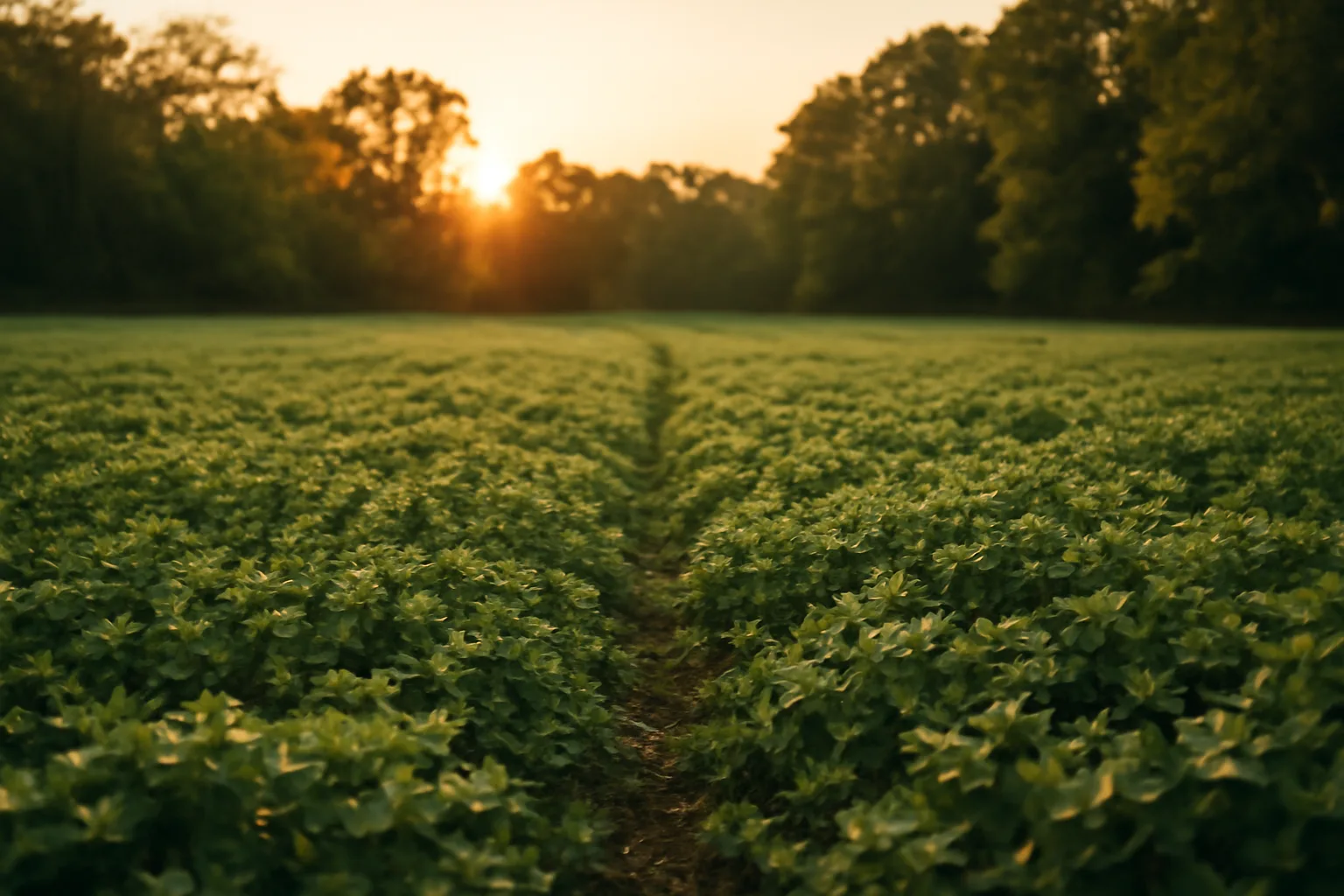
A food plot is a planted area on hunting land meant to attract and feed deer (and often other wildlife), usually seeded with forages, grains, or brassicas that deer prefer over what's naturally available. Plots range from quarter-acre kill plots tucked in timber to multi-acre agricultural fields planted specifically for herd health and hunting opportunity. Alfalfa (Medicago sativa) is one of the highest-protein perennial options you can put in the ground for deer, commonly testing 20-25% crude protein in vegetative growth stages according to forage quality data from university agronomy programs. It's not a quick fall attractant plot. It's a long-term investment, a hay-field-grade perennial that, once established, can produce for 4 to 5 years or longer with good management. Compared to annual plots like brassicas or cereal grains, alfalfa asks more of you up front. It wants better soil, better drainage, more patience during establishment. But it pays dividends deer plots planted every year just can't match, because it's feeding does through lactation in June and bucks growing antlers in July, more than filling a fall food gap. If you're weighing alfalfa against clover, brassicas, or a grain, it helps to see the tradeoffs side by side before you commit acreage. For a broader look at how alfalfa stacks up against other perennial and annual choices, the food plot whitetail overview covers plot types at a higher level.
do deer like alfalfa and how does it compare to clover
Yes, deer readily eat alfalfa, and in agricultural regions of the Midwest it's often one of the most heavily browsed crops available to them. Deer browsing pressure on alfalfa is well documented enough that it's a recognized wildlife-damage issue for hay producers near timber cover, as noted in University of Nebraska-Lincoln Extension guidance on deer damage to field crops [1]. Deer favor alfalfa especially in spring and early summer when it's tender and high in protein, tapering off some in high summer as the plant gets stemmy between cuttings. Do deer like clover? Also yes. For a lot of food plotters clover is the more practical choice. Clover (white or red) tolerates wetter soil, mowing neglect, and lower pH better than alfalfa does. It's cheaper seed, forgives mistakes, and still delivers roughly 15-25% crude protein depending on variety and stage of growth. Alfalfa's edge is total tonnage and protein density in good soil. On a well-drained, high-pH field, alfalfa can out-yield clover by a wide margin, with alfalfa hay yields commonly running 4-8 tons per acre in prime growing regions per USDA crop production reporting [2]. Clover typically runs lower per acre in food plot conditions, but it works almost everywhere, including ground alfalfa specialists would call marginal. Honest take: if your soil test comes back with a pH under 6.5, or your plot holds water after a hard rain, plant clover instead of fighting alfalfa's drainage and lime demands every year. Alfalfa rewards good ground. It punishes bad ground with thin stands and winterkill.
when to plant food plots for deer, alfalfa included
| Upper Midwest / North | Late April - late May | Mid-July - mid-August | |
|---|---|---|---|
| Transition zone (KY, VA, MO) | Mid-March - April | Mid-August - mid-September | |
| Deep South | February - March | September - October | These windows are general guidance, not gospel. Local frost dates and your specific soil temperature matter more than a calendar date. Check your state extension office's frost date tables before committing seed to the ground. |
Timing depends on your zone and the crop. For alfalfa specifically, spring planting (April to May in the northern half of the whitetail range) or late summer planting (mid-August through early September) both work, with spring giving the stand a full season to establish roots before winter. University of Wisconsin Extension guidance on alfalfa establishment notes that late-summer seedings need enough growing time before a killing frost to build adequate root reserves, generally putting the cutoff 6 to 8 weeks ahead of that frost date [3]. For food plots generally, timing splits into three windows. Spring perennials (clover, alfalfa) go in April through May once soil temps hit the mid-50s. Summer annuals (soybeans, cowpeas, sorghum) go in late May through June after frost risk passes. Fall annuals (brassicas, cereal grains, oats) go in from mid-July through September depending on latitude, timed so they mature right as hunting season opens. A rough zone-based framework: | Region | Alfalfa spring window | Alfalfa fall window |
when to plant oats for deer
Plant oats for deer in late summer to early fall, generally 6 to 8 weeks before your area's first hard frost, so the plant reaches good leafy growth right as hunting season opens. In much of the whitetail range that lands between mid-August and mid-September. Oats germinate fast, often in about a week in warm soil, and deer hit young oat shoots hard, making them a favorite for early-season attraction plots. They don't survive hard winters like winter wheat or rye do, so oats are typically a fall-only annual unless you're in a milder climate. A lot of food plotters blend oats with brassicas or clover. The oats come up fast and give deer something to eat while the slower brassicas bulb up, then the oats die back with frost and the brassicas take over as the winter food source.
when to plant turnips for deer
Turnips go in the ground 80 to 100 days before your first expected hard frost, which for most of the whitetail range means late July through mid-August. Turnips need that runway to bulb out properly; plant them too late and you get leafy tops with no bulb, which is still edible but loses the calorie-dense root deer key in on after a few frosts sweeten the starches into sugars. Deer often ignore turnip bulbs early in the season and hammer them in December and January, once repeated freezes convert starches to sugars. Turnips are a fall annual, not a perennial like alfalfa. You're replanting every year, and it's cheap, fast-growing insurance for late-season food when everything else is dormant or grazed down.
do deer eat sorghum and is it worth planting
Deer do eat sorghum, particularly grain sorghum heads and the leaves of forage-type sorghum, but it's rarely a first-choice deer plot crop compared to soybeans, corn, or brassicas. Sorghum's main food plot value is as a screening crop or a late-season standing grain option in regions where corn struggles with heat or drought, since grain sorghum is generally more drought-tolerant than corn as a row crop [2]. Most food plotters who plant sorghum for deer are doing it as much for cover (tall, dense stalks that block sightlines and hold deer through daylight) as for food. If pure attraction and tonnage is your goal, soybeans or corn will out-produce sorghum as a deer food source in most conditions. Sorghum earns its spot in mixed plots or as a border planting more than as a standalone deer food plot crop.
do deer like honey (and does it matter for food plots)
This one shows up in search a lot, and the honest answer is: it's not really a food plot question. Deer are herbivores that browse forbs, browse, mast, and agricultural crops. There's no established use of honey as a deer attractant or feed additive in any wildlife agency or extension guidance. Search interest here is likely confused with mineral/attractant products or with beekeeping questions, not deer nutrition. If you're trying to boost plot attraction, the actual levers that matter are protein content, digestibility, and tonnage per acre, not sweeteners. Deer are drawn to alfalfa, clover, and soybeans because those crops deliver high protein during antler growth and lactation, not because of sugar content.
how do you plant alfalfa for deer step by step
Start with a soil test. This is non-negotiable for alfalfa specifically, because it's far less tolerant of low pH and poor drainage than clover or brassicas. Alfalfa performs best at a soil pH of 6.5 to 7.0, and yields drop sharply below pH 6.0 according to Iowa State University Extension guidance on alfalfa soil fertility [4]. Your soil test lab is the authority here, not a generic online chart; follow their specific lime and fertilizer recommendations for your field, because soil chemistry varies by county and even by corner of a field. Here's the general sequence: 1. Test soil 4 to 6 months ahead if possible, since lime takes months to fully adjust pH. 2. Apply lime per your soil test results; alfalfa on acidic ground with no lime correction is close to a wasted planting. 3. Work the seedbed to a fine, firm finish. Alfalfa seed is tiny and needs good seed-to-soil contact; a rough, cloddy seedbed kills germination rates. 4. Inoculate seed with the correct Rhizobium meliloti inoculant if it's not pre-inoculated. Alfalfa fixes its own nitrogen through this bacterial relationship, and skipping inoculation on new ground can badly stunt the stand. 5. Seed at 15 to 20 lbs per acre for a pure stand, drilled a quarter to half inch deep, per University of Wisconsin Extension seeding guidance [3]. 6. Apply phosphorus and potassium per soil test; alfalfa is a heavy P and K user, more so than most food plot crops. 7. Mow weeds during establishment year if needed, keeping the mower height above the young alfalfa crowns. Mistakes that kill alfalfa stands: planting too deep, skipping the lime, planting on ground that holds standing water after rain (alfalfa hates wet feet and will thin out fast in poorly drained soil), and hunting or driving equipment over young stands before roots are established.
how much does an alfalfa food plot cost to establish
| Alfalfa | 4-5 years | $60-$160 | 6.5-7.0 | |
|---|---|---|---|---|
| White/red clover | 3-5 years | $20-$50 | 6.0-6.5 | |
| Brassicas (turnip/radish) | 1 year | $15-$30 | 6.0-7.5 | |
| Oats | 1 year | $10-$20 | 5.5-7.0 | These are broad ranges; actual pricing varies by region, seed dealer, and year. Check current pricing from a local seed supplier before budgeting a specific plot. |
Alfalfa seed typically runs somewhere in the range of $4 to $8 per pound depending on variety and inoculation, and at a 15-20 lb per acre seeding rate that puts raw seed cost around $60 to $160 per acre before lime, fertilizer, or equipment time [3]. Lime, if your soil test calls for a full correction, can add another $30 to $80 per acre or more depending on how far off your pH is and local lime pricing. Compare that to clover, which often seeds at 6-10 lbs per acre with seed costing less per pound, putting most clover plantings well under $50 per acre in seed alone. Alfalfa costs more going in. But if it holds for 4-5 years without replanting, the per-year cost often ends up lower than annually replanted brassica or grain plots. Here's a rough comparison: | Crop | Typical stand life | Approx. seed cost/acre | Best soil pH |
how do you maintain an established alfalfa stand for deer
Alfalfa needs mowing or grazing pressure to stay in a vegetative, high-protein state; left alone it goes reproductive, gets stemmy, and loses digestibility. Food plotters can mimic a hay-cutting schedule by mowing sections on rotation so deer always have some fresh regrowth available. Fertility maintenance matters more with alfalfa than with most food plot crops, because it's a heavy potassium feeder and repeated cuttings pull nutrients out of the soil fast. Retest soil every 1 to 2 years and follow your lab's specific P and K recommendations. Alfalfa fields that don't get maintenance fertilizer typically thin out and lose stand density within 2 to 3 years even in otherwise good soil [4]. Weed pressure and winterkill are the two things that end an alfalfa stand early. Weedy competition during establishment year is the most common killer of first-year stands, so mowing weeds above the crown height during the seeding year matters more than most people expect. Winterkill risk goes up on poorly drained soil, in fields cut too late in fall (don't take a cutting within about 4-6 weeks of your first hard frost, since the plant needs that window to store root carbohydrates for winter), and in older stands past their productive years.
where should you plant alfalfa on your property
Full sun, well-drained soil, and enough acreage to survive grazing pressure without getting hammered to the dirt. Alfalfa in a quarter-acre plot in a heavy deer area can get browsed down to nothing fast, especially in the seeding year before roots are established. If deer density is high, plan for at least an acre or more, or fence a section during establishment to let roots take hold before opening it to full grazing. Avoid low spots that hold water, shaded field edges, and heavy clay ground unless you're prepared to invest in drainage work or raised beds. If your only available ground is wet or acidic, you're generally better off putting effort into clover or a brassica/grain rotation instead of forcing alfalfa onto ground it doesn't want. A soil test is genuinely the starting point for all of this; it tells you your actual pH, phosphorus, and potassium levels rather than guessing. If you want a planting plan mapped to your specific soil test results and property layout, a Custom Food Plot Plan for $99 turns that data into a straightforward planting and fertility plan instead of you cross-referencing five extension PDFs on a Sunday night.
what are deer's favorite foods and where does alfalfa rank
There's no single universal answer here because deer preference shifts by season, region, and what's locally available. Forage preference and palatability data compiled by extension programs consistently put legumes (clover, alfalfa, soybeans) and acorns near the top, alongside agricultural crops like corn and soybeans where deer have access to them [1]. Alfalfa consistently ranks as a highly preferred forage in agricultural regions, sometimes preferred enough that farmers report measurable deer damage to hay fields near timber cover [1]. In food plot specific terms, soybeans (as a summer annual) and clover (as a low-maintenance perennial) tend to get named most often as go-to plantings, with alfalfa a step up in commitment and payoff for hunters with the right soil. Acorns, when available, often out-compete any planted food plot crop in the fall, since deer prioritize high-fat mast crops as they build fat reserves for winter, a pattern well established in whitetail nutrition literature. If you're building out a broader planting strategy rather than a single alfalfa field, it's worth looking at how alfalfa fits alongside other staples. The deer food plots guide and deer food plot seed resource both cover species selection in more depth, and food plot seed breaks down seed blends if you're mixing alfalfa with a nurse crop like oats.
legal and baiting rules to check before you plant
Food plots are legal, standard land management everywhere in the United States, but baiting and supplemental feeding rules vary a lot by state, and some states draw a legal line between a planted, growing food plot and a pile of harvested grain or feed placed on the ground. A few states also regulate hunting over food plots differently depending on plot size, visibility, or proximity to a stand. Before you plant with hunting in mind, check your state wildlife agency's current baiting and feeding regulations. A legally planted food plot in one state can cross into an illegal baiting definition in another if you supplement it with hauled-in feed or minerals. State agency pages, not general hunting forums, are the correct source here because these rules change and vary by county in some states, often due to chronic wasting disease management zones.
Frequently asked questions
Do deer eat sorghum?
Yes, deer eat both grain and forage sorghum, though it's usually a secondary food plot choice behind soybeans, corn, or brassicas. Sorghum's bigger value in most plots is as a screening or cover crop thanks to its height and density, with food value as a bonus rather than the main draw.
Do deer eat clover, and is it better than alfalfa?
Yes, deer eat clover heavily, and it's often the more practical choice than alfalfa because it tolerates lower pH, wetter soil, and more neglect. Alfalfa can out-yield clover in protein and tonnage on ideal, well-drained, high-pH ground, but clover is more forgiving and cheaper to establish.
When should I plant food plots for deer?
It depends on the crop: spring perennials like clover and alfalfa go in April-May, summer annuals like soybeans go in late May-June after frost risk passes, and fall annuals like brassicas and oats go in mid-July through September, timed so growth peaks around hunting season.
When is the best time to plant oats for deer?
Plant oats 6 to 8 weeks before your area's first hard frost, generally mid-August to mid-September across most of the whitetail range. Oats germinate in about a week and give deer fast, early fall forage, but they winterkill and don't persist like winter wheat or rye.
When should turnips go in the ground for deer?
Plant turnips 80 to 100 days before your first hard frost, typically late July through mid-August depending on latitude. They need that time to bulb out; deer usually ignore the bulbs until repeated frosts sweeten the starches, often not until December or January.
What exactly is a food plot?
A food plot is a planted patch of forage, grain, or brassica crops on hunting land, intended to attract deer (or other wildlife) and improve their nutrition, ranging from small kill plots in timber to large agricultural-style fields planted with equipment like a tractor and drill.
Do deer like honey?
There's no established evidence deer seek out honey as a food source, and it has no real role in food plot planning. Deer are browsers drawn to protein-rich forage like clover, alfalfa, and soybeans, not sugar sources like honey.
What is a deer's favorite food overall?
There's no single answer since it shifts by season and region, but legumes (clover, alfalfa, soybeans) and acorns consistently rank near the top in forage preference studies. In fall, mast crops like acorns often out-compete any planted food plot as deer prioritize fat reserves for winter.
How long does an alfalfa stand last in a food plot?
A well-established, properly limed and fertilized alfalfa stand typically produces for 4 to 5 years, sometimes longer with good management. Stands on poorly drained or acidic soil, or fields that don't get maintenance lime and fertilizer, often thin out within 2 to 3 years.
What soil pH does alfalfa need?
Alfalfa performs best at a soil pH of 6.5 to 7.0. Yields and stand persistence drop sharply below pH 6.0, which is why a current soil test and lime correction (per your soil lab's recommendation) matter more for alfalfa than for most other food plot crops.
Can I plant alfalfa and clover together?
Yes, alfalfa-clover mixes are common in both hay and food plot settings and can hedge against alfalfa's stricter soil requirements. If part of your field is wetter or more acidic, the clover component will typically persist there even where straight alfalfa would thin out.
Is alfalfa worth the extra cost compared to annual food plots?
Often yes, if your soil and drainage are right, because a 4-5 year stand life spreads the higher establishment cost over several seasons, frequently landing below the per-year cost of replanting annuals like brassicas or oats every fall. On marginal soil, though, you may lose the stand early and never recoup the investment.
Sources
- University of Nebraska-Lincoln Extension, Deer Damage Management (G1740): Deer browsing can measurably reduce alfalfa hay yields in agricultural regions
- USDA National Agricultural Statistics Service, Crop Production 2023 Summary (January 2024): Alfalfa hay yields commonly run 4-8 tons per acre in prime growing regions
- University of Wisconsin-Madison Extension, "Alfalfa Planting and Growth" (Team Forage): Alfalfa can be seeded in spring or late summer, with late-summer seedings needing several weeks before hard frost to build root reserves
- Iowa State University Extension and Outreach, PM 1063 "Oat Production and Management": Oats germinate quickly and are commonly planted as a fall annual forage 6-8 weeks before frost
- University of Tennessee Extension, SP731-A "Brassicas: A Farmer's Guide": Turnips need roughly 80-100 days before hard frost to bulb properly
- Iowa State University Extension and Outreach, PM 1688 "Alfalfa Soil Fertility": Alfalfa performs best at soil pH 6.5-7.0 and requires ongoing potassium fertility management
- University of Wisconsin-Madison Extension, "Alfalfa Cutting Height and Schedule" (Team Forage): Alfalfa is typically cut 3-4 times per season to maintain vegetative, high-protein regrowth