Last updated 2026-07-25
TL;DR
A green cover seed food plot is a planted field of forage crops (clover, brassicas, cereal grains, sorghum blends) grown specifically to feed and hold deer on your property. Timing depends on your frost dates: brassicas and cereal grains go in 60-90 days before first frost, clover goes in spring or late summer, and soil test results should drive your fertilizer and lime decisions before seed ever hits the ground.
What is a food plot, exactly?
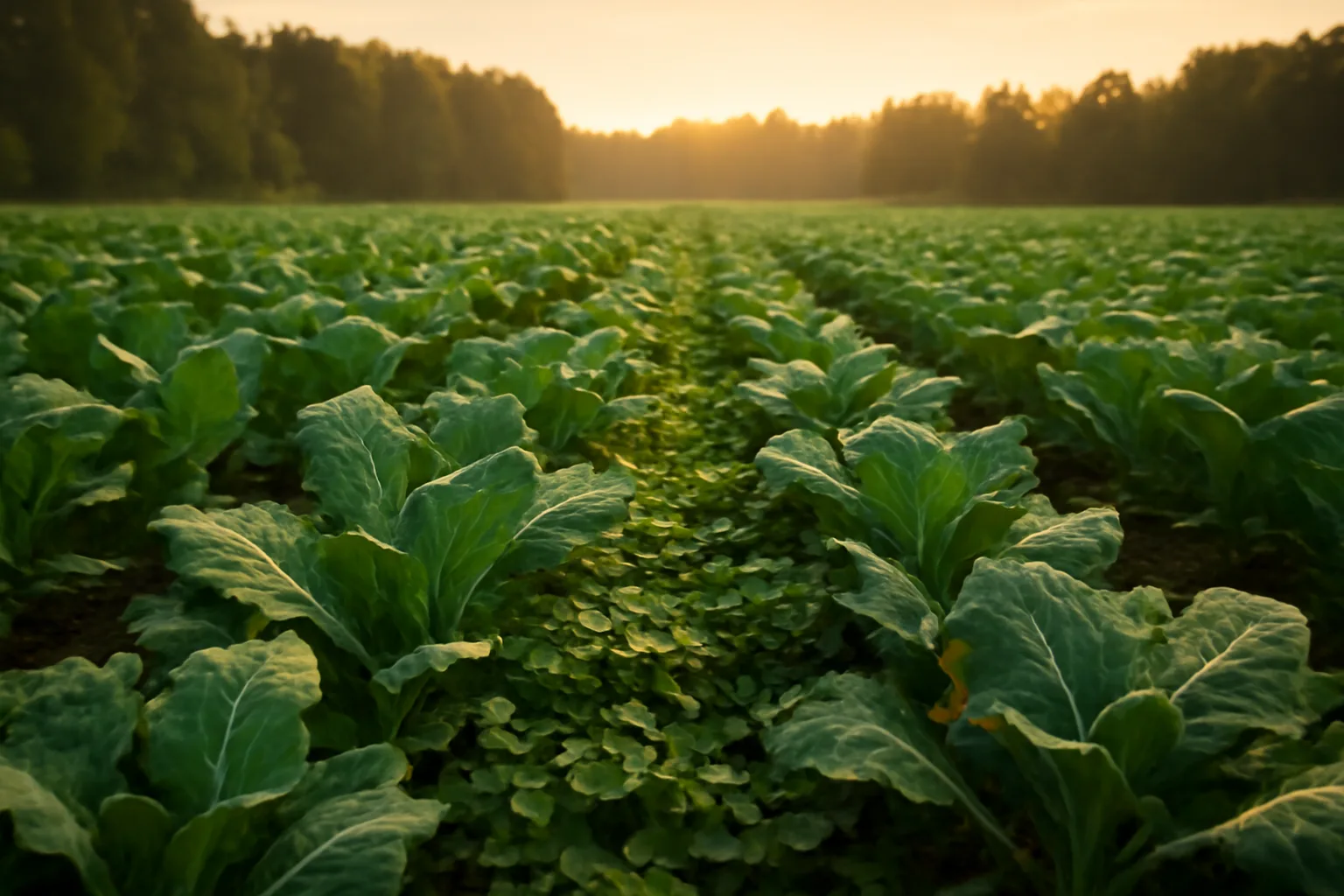
A food plot is a planted area, usually somewhere between a quarter acre and several acres, seeded with forage crops to attract, feed, and hold deer on a piece of ground. It's not a garden and it's not a lawn. The goal is nutrition and attraction, timed to line up with hunting season or with the deer herd's biological needs (antler growth, lactation, winter fat reserves). Most food plots fall into one of two buckets: annuals (planted fresh each year, like brassicas, cereal grains, and sorghum) or perennials (clover and chicory blends that can produce for 3-5 years with maintenance). Some hunters run both, a perennial clover plot for spring and summer plus an annual brassica or grain plot for fall and winter hunting. The term "green cover seed food plot" usually refers to a food plot planted with a green cover crop, meaning something that stays green and palatable late into the season, as opposed to a plot that browns out and goes dormant right when gun season opens. Brassicas (turnips, radishes, kale) and cereal grains (oats, wheat, rye) are the classic green cover choices because they hold up to frost and actually get sweeter after a hard freeze, when starches convert to sugars. A University of Tennessee Extension publication on wildlife food plots notes that successful plots depend on matching the right species to soil type, drainage, and shade conditions on the actual site, more than picking whatever bag looks good at the farm store [1]. That's the single biggest planning mistake: buying seed before testing soil or walking the field for sun exposure. If you want a plan built around your specific location and goals rather than general advice, that's the whole point of a food plot whitetail plan, and it's also why PlotSeason built the $99 Custom Food Plot Plan (see /plot-plan-builder). But you can absolutely build a solid plot without paying anyone, using the free extension resources cited throughout this article.
When should you plant food plots for deer?
| Deep South (Zone 8-9) | Sept-Nov or Feb-March | Aug-Sept | Sept-Nov | |
|---|---|---|---|---|
| Mid-South/Transition (Zone 7) | Mar-Apr or Aug-Sept | Jul-Aug | Aug-Sept | |
| Upper Midwest/Northeast (Zone 4-5) | Apr-May or Aug | Jul-Aug | Aug-early Sept | |
| Canada border states (Zone 3-4) | May | Jul | Aug | These are general windows, not guarantees. Your local extension office almost always has a more precise planting calendar for your county, and that source should override anything generic like this table. One planning note a lot of new plotters miss: cool-season annuals like brassicas and cereal grains are planted in mid to late summer for FALL and WINTER forage, not spring. That trips people up because it feels backwards to be planting in July for a plot you'll hunt over in November. |
Timing is tied to your first and last frost dates, not a calendar date that works everywhere. As a rule, perennial clover goes in during spring (April-May in the North, March-April in the South) or in late summer/early fall (August-September), while annual brassicas and cereal grains go in 60 to 90 days before your area's average first frost. The USDA's plant hardiness zone map and NOAA frost date data are the two tools worth bookmarking before you buy a single bag of seed. If your first frost historically lands around October 15, brassicas need to go in the ground by mid-to-late July or early August to bulb up and mature before the cold really sets in. Here's a rough framework by region: | Region | Perennial clover | Brassicas/turnips | Cereal grains (oats, wheat, rye) |
When to plant turnips for deer
Turnips need roughly 80 to 90 days from planting to full maturity, and they're frost-tolerant, so the standard advice is to plant them 90 days before your first expected fall frost [2]. In most of the whitetail's range that lands somewhere between mid-July and mid-August. Plant too early and the turnips bulb out and start going punky before deer season even opens. Plant too late and you get leafy growth but stunted or absent bulbs, since bulbing requires a real maturity window. Mississippi State University Extension recommends planting brassicas like turnips and rape from mid-July through early September depending on latitude, with earlier planting favored further north [2]. Deer typically hit the leafy tops first in early fall, then switch to digging up the bulbs after a few hard frosts convert starches to sugar. That's why a turnip plot often looks untouched in October and gets hammered in December and January, it's a late-season food source more than an early-season one. Soil pH matters more for brassicas than people expect. Turnips want a pH in the 6.0 to 6.5 range, and Extension soil testing is the only reliable way to know where you're starting. Lime takes months to fully adjust pH, so a fall test result often means you're correcting soil for next year's planting, not this one.
When to plant oats for deer
Oats are typically planted in late summer to early fall for deer food plots, generally 6 to 8 weeks before your first frost date, so they establish before cold weather but still provide green forage into winter. In the South that's often September, in northern states it can be as early as mid-August. Oats are a cool-season annual grain and one of the most palatable early-growth forages available, deer often prefer young oat shoots over almost anything else in a plot mix. The tradeoff is that oats aren't as frost-hardy as wheat or cereal rye. A hard freeze below roughly 20°F will usually kill oats outright, while winter wheat and cereal rye can survive and regrow into spring. That's why a lot of seed blends combine oats (for immediate fall palatability) with wheat or rye (for winter survival and a spring green-up). If you're only planting one grain and you want something that lasts through a hard winter, cereal rye is the more durable choice. If you want maximum attraction in October and November and don't care about spring regrowth, oats alone work fine. Spring oat plantings are possible too, mainly as a quick cover crop or a spring/summer supplemental plot, but they won't survive into the following winter in most climates.
Do deer eat clover, and do deer actually like it?
Yes, deer eat clover readily, and it's widely considered one of the most consistently preferred food plot forages available. White clover and red clover both show up in deer diet studies across the whitetail's range, and clover's high crude protein content, typically 25 to 30 percent in well-managed stands, makes it valuable during spring green-up, antler growth, and lactation [3]. The appeal of clover is less about deer preferring it over every other food and more about season-long availability. Clover greens up early in spring when almost nothing else is growing, stays productive through summer if it gets enough moisture, and can produce for multiple years off one planting if you keep weeds and pH in check. Purdue University's forage extension work on clover for wildlife notes that clover stands generally need soil pH of 6.0 or higher and benefit from mowing or clipping several times a season to keep growth in a tender, high-protein vegetative stage rather than letting it get woody and go to seed [4]. Neglected clover plots decline in both yield and palatability within two to three years without that maintenance. So yes, deer like clover, but a clover plot is a maintenance commitment, not a plant-it-and-forget-it project. If you want low-maintenance annual coverage instead, brassicas or cereal grains are more forgiving.
Do deer eat sorghum?
Deer will eat sorghum, particularly the grain heads and young leafy growth, but it's not typically planted as a primary deer forage crop the way clover or brassicas are. Sorghum shows up more often as a component in wildlife food plot blends aimed at both deer and upland birds, or as a screening/cover crop that also provides some late-season grain. Grain sorghum (milo) produces seed heads that deer, turkey, and other wildlife will feed on once the grain matures and drops or gets knocked down by weather, similar to how deer use corn. It's more drought-tolerant than corn, which is part of its appeal in drier regions, and it doesn't demand the same soil fertility that corn does. The practical issue with sorghum in a food plot mix is stand height and density. Grain sorghum can grow 4 to 7 feet tall in a thick stand, which is great for bedding cover or screening a plot from road view, but it can also make the plot harder to hunt over if you want open sightlines. Some hunters plant a sorghum or corn border around a clover or brassica plot specifically to create a screen and a secondary food source in the same footprint. If your goal is straightforward deer attraction and you're choosing between sorghum and a purpose-built deer blend, most deer food plot seed mixes built around clover, brassicas, or cereal grains will outperform sorghum for pure deer nutrition per acre. Sorghum earns its place when cover or bird habitat is part of the plan too.
What are deer's favorite foods, really?
There's no single universal answer, deer preference shifts by season, region, and what's naturally available on the landscape at the time. That said, research and field data point to a consistent pattern: acorns and other hard mast dominate fall diets when available, clover and other legumes rank high in spring and summer, and agricultural crops like soybeans and corn get heavy use whenever deer have access to them. A long-running whitetail diet study из Auburn University and similar work across Southeastern states consistently finds that deer diets shift opportunistically toward whatever high-energy or high-protein food is most available and least costly to obtain, rather than fixating on one species [5]. In a fall with a strong acorn crop, deer will often walk past a food plot to hit the timber, then come back to the plot hard once acorns run out. Among planted forages specifically, soybeans and clover consistently rank at or near the top for palatability and use, especially in spring and summer. In fall and winter, brassicas (after a frost sweetens them), cereal grains, and standing corn or soybeans left unharvested tend to draw the heaviest late-season use. So the honest answer to "what's a deer's favorite food" is: whatever is highest in protein or energy, easiest to digest, and most abundant nearby at that specific time of year. That's exactly why a lot of experienced plotters run multiple plot types on one property instead of betting everything on one species.
Do deer like honey?
This one needs a clarifying note, because "honey" isn't a food plot crop and deer don't seek out honey the way they seek out clover or acorns. There's no meaningful body of wildlife research on deer and honey consumption, because it's simply not a relevant food source in a natural or ag setting. What this question is probably actually pointing at is "honeysuckle," specifically Japanese honeysuckle (Lonicera japonica), which deer absolutely do browse and which shows up as a preferred natural browse species across much of the whitetail's range in the Southeast and mid-Atlantic. It's evergreen through much of winter in milder climates and provides real forage value when other browse is dormant. Japanese honeysuckle is also classified as an invasive species in numerous states, so it's not something wildlife managers typically recommend planting on purpose, even though deer use it heavily where it already exists [6]. If you've got established honeysuckle on your property, it's a legitimate winter browse resource. Planting more of it is a different conversation, and most state forestry and wildlife agencies actively discourage it given its ability to choke out native understory plants.
How do you pick species for your food plot?
Start with soil, not seed. A soil test tells you your existing pH and nutrient levels, and that result should drive every other decision, because the wrong pH can cut yield in half regardless of how good the seed is. Your soil test lab's recommendations are the authority here, not a generic online article, this piece and any plan built from it are general guidance, not site-specific agronomy advice. Most land-grant universities run inexpensive soil testing labs open to the public, often for $10 to $20 per sample, and Extension offices can walk you through the sampling process and result interpretation. Get results back before you buy seed, not after. Once you know your pH and rough fertility level, match species to sun and moisture. Clover wants at least 4 to 6 hours of direct sun and reasonable drainage. Brassicas tolerate a wider range of soil types but still want decent drainage, they hate standing water. Cereal grains are the most forgiving option across marginal soils, which is part of why they're a common "starter plot" recommendation. A simple, field-tested combination a lot of experienced plotters run: a perennial clover plot for spring/summer plus a rotating annual brassica-and-grain blend plot for fall/winter, on separate fields or in a rotation on the same field every few years. That gives you season-long coverage instead of one plot doing all the work. If you'd rather skip the trial and error, the $99 Custom Food Plot Plan (/plot-plan-builder) takes your soil test results, location, and goals and builds a species and timing plan around them. It's not required to run a good plot, plenty of hunters do this successfully with free extension resources alone, but it saves the guesswork if you'd rather not build the plan yourself.
What equipment do you actually need?
You don't need a tractor to plant a good food plot, though it helps on larger acreage. A lot of successful half-acre to one-acre plots get built with an ATV, a small disc or cultipacker, a broadcast spreader, and a lot of patience. The core sequence is the same regardless of equipment size: kill or till existing vegetation, test and amend soil, broadcast or drill seed at the right depth, then cultipack or drag to ensure seed-to-soil contact. Skipping that last step is one of the most common failure points, tiny seeds like clover and brassica seed that sit on top of dry soil without good contact often just don't germinate. For small plots, a hand-crank broadcast spreader, a pull-behind cultipacker, and a garden tiller or disc harrow can get the job done for well under $1,000 total in equipment, some of it rentable. Larger food plot operations on 3+ acre fields generally justify a tractor with a disc, cultipacker, and drill or no-till drill attachment. If you're mapping out gear needs against your acreage and species mix, that's a natural next read alongside a species guide like deer food plots or food plot seed selection guides.
Do you need to worry about baiting or feeding laws?
Yes, and this is one area where the rules genuinely vary a lot state to state, so don't assume what's legal in one state applies in the next. A planted food plot is almost universally legal to hunt over, since it's an agricultural planting rather than bait, but the line between "food plot" and "bait pile" gets legally specific in some states (harvested grain left in a pile, mineral licks, or supplemental feed placed on the ground can trigger baiting restrictions even on your own land). Some states restrict baiting statewide, some allow it with conditions, and some regulate it differently by wildlife management unit due to chronic wasting disease concerns. State wildlife agencies publish the specific definitions and distances (some states require food sources to be a certain distance from a hunting stand, or banned within CWD zones) . Check your state wildlife agency's current hunting regulations before assuming a growing plot or any supplemental feeding setup is legal, and recheck annually since these rules do change, especially around CWD management zones.
Frequently asked questions
What is a food plot?
A food plot is a planted field, usually a quarter acre to several acres, seeded with forage crops like clover, brassicas, or cereal grains to feed and attract deer on a property. Plots are either perennial (multi-year, like clover) or annual (replanted each year, like brassicas and grains), and species choice depends on soil, sunlight, and hunting goals.
When should you plant food plots for deer?
Perennial clover goes in during spring (April-May north, March-April south) or late summer (August-September). Annual brassicas and cereal grains go in 60 to 90 days before your area's first fall frost, generally mid-July through September depending on latitude. Check NOAA and USDA frost date data for your specific location rather than a generic calendar date.
When to plant turnips for deer?
Turnips need 80 to 90 days to mature, so plant them about 90 days before your area's first fall frost, usually mid-July through mid-August in most whitetail range. Deer often ignore the leafy tops until a frost sweetens the bulbs, so a turnip plot's heaviest use often comes in December and January, not October.
When to plant oats for deer?
Oats go in 6 to 8 weeks before your first fall frost, roughly mid-August in northern states and September further south. Oats aren't very frost-hardy (a hard freeze below about 20°F usually kills them), so many blends pair oats with winter wheat or cereal rye for longer season coverage into winter and spring.
Do deer eat sorghum?
Yes, deer eat sorghum grain heads and young growth, but it's more commonly used as a cover crop or screening plant paired with corn than as a primary deer forage. It's more drought-tolerant than corn and works well as a border planting around a clover or brassica plot for both food and visual screening.
Do deer eat clover, and do deer like it?
Yes, deer readily eat clover and it's one of the most consistently preferred food plot forages, with crude protein often in the 25 to 30 percent range in well-managed stands. Clover is especially valuable in spring and summer for antler growth and lactation, but it requires mowing and pH maintenance (6.0+) to stay productive for multiple years.
What are deer's favorite foods?
There's no single favorite; deer diet shifts by season and availability. Acorns and hard mast dominate fall diets when present, clover and legumes rank high in spring and summer, and soybeans, corn, and frost-sweetened brassicas get heavy use in fall and winter. Deer generally favor whatever's highest in energy or protein and easiest to reach nearby.
Do deer like honey?
Deer don't seek out honey; it isn't a natural or planted food source for whitetails. This question is likely confused with Japanese honeysuckle, a browse plant deer do eat heavily in the Southeast and mid-Atlantic, though it's classified as invasive in many states and isn't recommended for intentional planting.
How big should a food plot be?
Most hunting food plots range from a quarter acre to 2 acres for a hunting/kill plot, and 2 to 5+ acres for a larger destination or nutrition plot. Size depends on property size, herd density, and goals; small plots concentrate deer for hunting, larger plots support more of the herd's nutritional needs season-long.
What soil pH is best for a food plot?
Most food plot crops perform best between pH 6.0 and 7.0. Clover and alfalfa want pH 6.0 or higher, brassicas do well around 6.0 to 6.5, and cereal grains tolerate a slightly wider range. A soil test from your local extension office or a private lab is the only reliable way to know your actual starting pH.
Can you plant a food plot without a tractor?
Yes. Small plots (under an acre) are regularly built with an ATV, a pull-behind disc or cultipacker, and a broadcast spreader, often for under $1,000 in equipment. Larger plots (3+ acres) generally justify a tractor with disc, cultipacker, and drill attachments for efficiency.
Is it legal to hunt over a food plot?
In nearly all states, a planted food plot is legal to hunt over because it's classified as an agricultural planting, not bait. However, baiting and supplemental feeding rules vary significantly by state and sometimes by wildlife management unit, especially in chronic wasting disease zones, so check your state wildlife agency's current regulations before hunting.
What's the difference between annual and perennial food plots?
Annual plots (brassicas, cereal grains, sorghum) are replanted every year and typically targeted at a specific season, often fall/winter. Perennial plots (clover, chicory blends) can produce for 3 to 5 years off one planting but require ongoing mowing, weed control, and periodic fertilization to stay productive.
Sources
- University of Tennessee Extension, Wildlife Food Plots publication: Successful food plots depend on matching species to soil type, drainage, and sunlight conditions specific to the site
- Noble Research Institute, Clover for Wildlife Food Plots: Clover provides high crude protein forage important for spring and summer deer nutrition
- Purdue University Extension, Forage Field Guide: Clover stands need soil pH of 6.0 or higher and benefit from regular mowing to maintain vegetative, high-protein growth
- Auburn University, deer diet and forage research summaries: Deer diets shift opportunistically toward the most available, highest-energy food source rather than a fixed preference
- USDA Forest Service, Japanese Honeysuckle species profile: Japanese honeysuckle is browsed by deer and is classified as invasive in many states
- Example state wildlife agency baiting regulation reference (verify per-state): Baiting and feeding regulations for deer vary by state and by management zone, especially related to chronic wasting disease