Last updated 2026-07-26
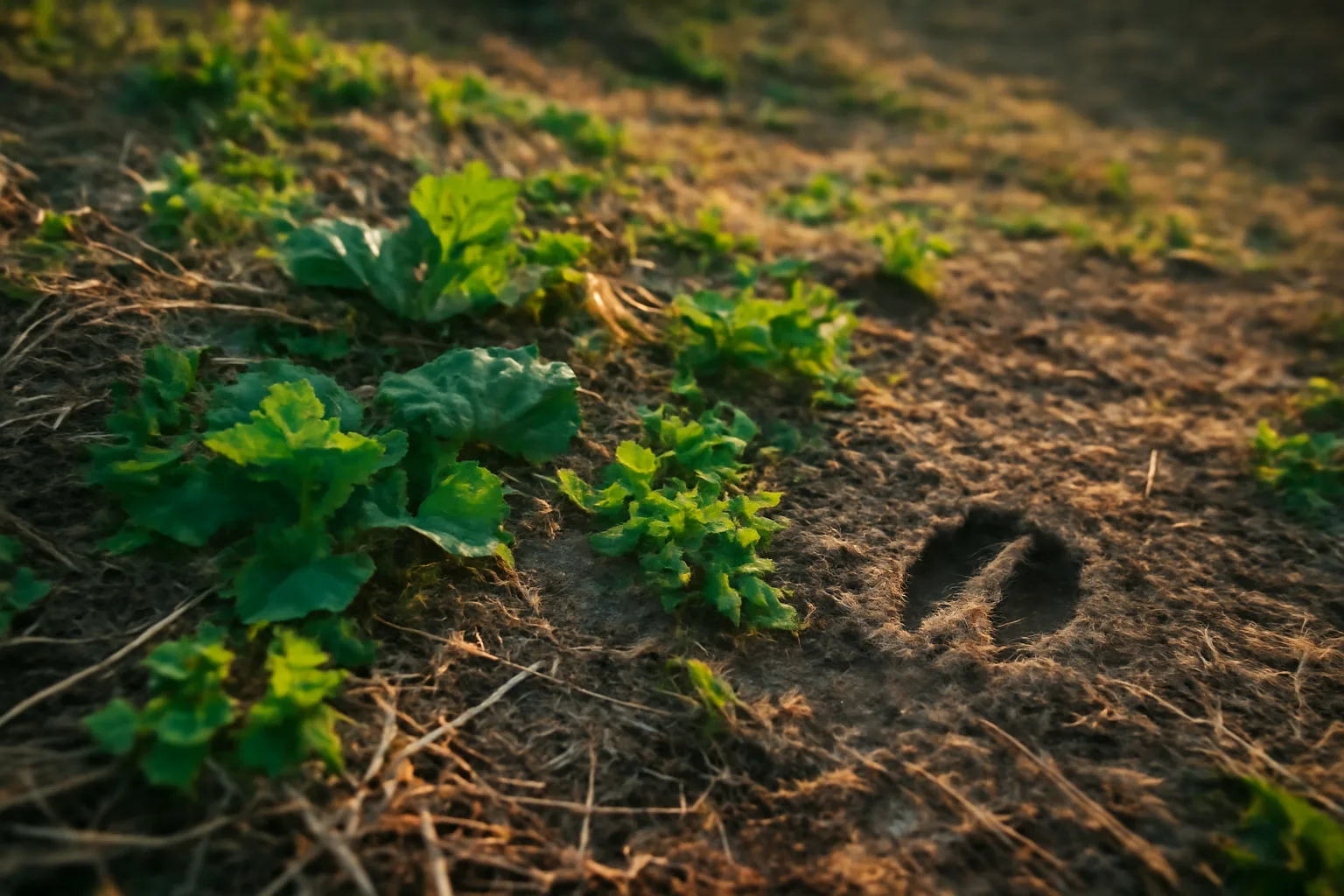
TL;DR
No-plow food plot seed means species and methods that establish without tillage, usually broadcast into existing sod or residue after herbicide burndown. Clover, oats, brassicas (turnips, radishes), and cereal grains work well no-till. Sorghum works but needs some soil-to-seed contact. Success depends more on killing competition and getting seed-to-soil contact than on owning a plow.
what is a food plot, and why skip the plow at all
A food plot is a planted area, usually somewhere between a quarter acre and several acres, established to feed deer and other wildlife and to give hunters a predictable spot to watch or hunt. Most state wildlife agencies and university extensions treat food plots as a wildlife habitat practice, not agriculture in the row-crop sense, though the same soil science applies [1]. Skipping the plow (no-till or "no-plow" planting) means you kill existing vegetation with herbicide or heavy mowing, then broadcast or drill seed directly into the dead residue instead of turning the soil over. The USDA Natural Resources Conservation Service has pushed no-till and reduced-till methods across row-crop agriculture for decades because tillage burns organic matter, increases erosion, and dries out topsoil right when you need moisture for germination [2]. For food plotters, the practical appeal is different: you don't need a tractor and disc. A four-wheeler with a drag harrow, a hand spreader, or even boots and a rake can get seed in the ground. That matters a lot if you're planting a small clearing, a ridge-top opening you can't get equipment into, or a lease where you don't want to buy a disc for two acres. The tradeoff: no-till plots depend entirely on killing what's already growing. Skip that step and your "food plot" is just a fertilized weed patch. Deer will still nibble it, but you won't get the stand or tonnage a properly killed and planted plot gives you.
does no-plow planting actually work for deer food plots
Yes, for the right species and with the right prep. No-till works because deer food plot seed at usual rates doesn't need deep, fluffy soil the way corn or soybeans grown for grain does. Small seeds like clover, brassicas, and cereal grains just need seed-to-soil contact, moisture, and light (or the right seeding depth), not inverted topsoil. The method most extension guides describe is "spray, mow, spread, drag": kill the existing sod or weeds with glyphosate, mow it down if it's tall, broadcast seed, then drag a section harrow, chain-link fence section, or ATV drag over it to work seed into the top quarter to half inch of soil. Some plotters skip the drag entirely and rely on rain to wash seed into the soil surface, which works fine for tiny seeds like clover and brassicas but is less reliable for anything you want at a specific depth, like cereal grains. Where no-till struggles: heavy clay that crusts hard, thick sod with a mat of thatch, and any spot with serious weed pressure that one herbicide pass won't knock down. In those cases, a single pass with a disc or tiller still beats fighting the ground for two seasons. There's no rule that says you have to go 100% no-till forever. Plenty of good plot managers till once to break up sod, then no-till every year after that once the seed bed is established.
which deer food plot seeds work best without tilling
| White/red clover | Excellent | Perennial, slow seed, light cover needed |
|---|---|---|
| Brassicas (turnips, radishes) | Excellent | Annual, cheap, bare ground preferred |
| Oats, wheat, rye | Good | Drag or cultipack improves stand |
| Grain/forage sorghum | Fair to poor | Needs firmer seedbed, drag recommended |
| Corn, soybeans (grain) | Poor | Wants tilled, loose seedbed and depth control |
Some species are basically made for no-till broadcast planting. Others need real soil prep to perform. Clover (white clover and red clover) is probably the single best no-till option. It's a small, slow seed that germinates well on the surface or barely covered, tolerates mowing instead of tillage for maintenance, and comes back year after year as a perennial, meaning you only do the hard prep once every 3 to 5 years [1]. Deer food plot seed blends built around clover are common for exactly this reason. Brassicas (turnips, radishes, rape) also broadcast well into a sprayed-down field. They're annuals, so you're starting over each year, but the seed is cheap and the germination rate on bare or lightly disturbed ground is good. Oats and other cereal grains (wheat, rye, triticale) do fine no-till too, though a light drag or cultipacking step improves stands noticeably versus just broadcasting and walking away. Sorghum is the outlier here. Grain sorghum and forage sorghum need decent seed-to-soil contact and reasonably loose surface soil to germinate reliably; broadcasting sorghum onto standing sod with no cultipacking or dragging gives spotty results at best. If sorghum is part of your plan, budget for at least one pass with a drag or light disc. | Species | No-till broadcast success | Notes |
do deer eat sorghum
Yes, deer eat sorghum, both the standing grain heads and the leaves, and it's a legitimate late-season food source in the Midwest and South. Sorghum (milo) is drought-tolerant and holds up standing through fall and winter better than corn in a lot of soils, which makes it attractive as a screening and late-season food plot in one planting [3]. That said, deer don't usually prefer sorghum over softer, higher-sugar foods early in the season. It tends to get hit hardest once other food sources thin out in late fall and winter, when the grain heads mature and other browse is gone. If you're planting sorghum specifically for deer, plan it as a fall/winter plot, not a summer attraction plot, and know that turkey, deer, and a long list of other wildlife will all use a good sorghum stand once it matures.
do deer eat clover, and do deer actually like it
Deer eat clover readily and it's consistently ranked among the most preferred, most digestible forages available to whitetails. University research on deer forage quality repeatedly shows clover has crude protein content in the 25 to 30 percent range during active growth, which is well above what most native browse offers [1]. Do deer like clover? Yes, and it's not close. Clover plots get hit hard from spring green-up through fall, and because it's a perennial, it's one of the few plot types deer will use consistently for months rather than in a short window. The catch is that clover needs decent soil pH (extension guides generally recommend 6.0 to 6.5) and won't tolerate standing water or deep shade, so a soil test really does matter here more than for most other plot species [1]. If your soil test comes back at 5.2, you can broadcast all the clover seed you want and get a weak stand until lime brings pH up. Mississippi State University Extension notes that white clover "is well adapted to Mississippi and is one of the most productive and persistent clovers grown" for wildlife food plots, and that liming to the recommended pH before planting is what makes or breaks a stand [1].
when to plant food plots for deer
| Deep South | March to April | September to October | |
|---|---|---|---|
| Mid-South / Transition | April to May | August to September | |
| Midwest / Mid-Atlantic | May | Mid-August to mid-September | |
| Upper Midwest / North | Late May to early June | Early to mid-August | These ranges are approximate. Your local extension office or state agency's frost date tables are the better source for your specific county. |
Timing depends on region and species, but there are two broad windows almost everyone works within: spring plots (roughly April through June depending on latitude) for warm-season annuals and perennials like clover, soybeans, and sorghum, and late-summer/fall plots (roughly August through early October) for cool-season annuals like brassicas, oats, wheat, and rye. The general rule of thumb from extension guides is to plant cool-season plots 4 to 8 weeks before your average first fall frost, so the plants have time to establish before growth slows. In the northern tier of the whitetail range (Wisconsin, Minnesota, northern Michigan), that often means planting fall plots by mid-to-late August. In the mid-South and southern states, you can push fall planting into September or even early October. Spring perennial plantings (clover, chicory, alfalfa) generally go in once soil temps are consistently above 50 degrees F and the risk of hard frost has passed, which again varies by zone from mid-April in the South to late May or early June in the far North. A rough national planting window guide looks like this: | Region | Spring/summer plot window | Fall plot window |
when to plant oats for deer
Oats go in as a cool-season fall planting, generally 45 to 60 days before your first killing frost, so plants have time to reach a few inches of growth and tiller out before winter dormancy or die-off. In most of the whitetail range that lands somewhere between mid-August and mid-September. Oats are a fast, cheap, high-tonnage option and deer hit young oat shoots hard, especially in early fall when they're one of the few tender green options around. They winterkill in the coldest parts of the country (generally below about 0 to 10 degrees F sustained), which is fine if you're using them as an attraction plot for archery season, but if you want green forage into late winter in the North, pair oats with a winter-hardy cereal like winter rye or winter wheat that survives colder temps. Oats also work as a nurse crop for clover, meaning you can broadcast them together in a fall planting; the oats come up fast and give the slower clover some cover and competition suppression while it establishes.
when to plant turnips for deer, and do deer actually eat them
Turnips are a fall brassica planted 60 to 90 days before the first hard frost, which in most whitetail country means late July through early September depending on latitude. That lead time matters because turnips need to bulb up and the leaves need to mature before a frost sweetens them; frost converts starches to sugars in brassicas, which is part of why deer often ignore turnip plots in September and hammer them in November and December. Deer do eat turnips, both the leaves early on and the roots/bulbs later in the season once frost has hit them a few times and the ground softens enough for deer to dig or the bulbs are pushed up. It's a genuinely good late-season plot species for exactly that reason: it holds tonnage in the ground through the coldest part of the season when a lot of other plots are picked clean. One caution worth repeating from extension guides: brassica-heavy diets should be introduced gradually where deer haven't had access to them before, similar to livestock rumen adjustment concerns, though this is more of a theoretical livestock-management carryover than something with strong deer-specific research behind it. In practice, most food plot managers don't worry about this because deer typically have other forage available alongside a brassica plot.
what are deer's favorite foods, and where does honey fit in
There's no single "favorite food" ranking that holds everywhere, because deer preference shifts by season, region, and what's locally available. That said, several themes show up consistently in deer forage research: clover and other legumes rank near the top for palatability and use through most of the growing season, acorns (especially white oak acorns, which are lower in tannins than red oak) are heavily preferred in fall when available, and soybeans and corn get hammered in agricultural areas [1] [3]. Do deer like honey? Deer are not meaningfully attracted to honey as a food source, and there's no wildlife research or extension guidance suggesting it as a food plot or attractant strategy. This one seems to come up because of confusion with mineral licks, salt blocks, or commercial deer attractant products that sometimes use molasses (a very different product with real sugar content deer do respond to). If you see "honey" mentioned around deer hunting, it's almost always either a brand name for a molasses-based attractant or an unrelated question, not an actual established deer feeding strategy. Where legal, molasses-based mineral or attractant products have some track record; straight honey does not.
how do you kill existing vegetation before a no-till planting
Glyphosate (Roundup and generic equivalents) is the standard burndown herbicide for no-till food plots, applied 1 to 2 weeks before planting to allow full kill of existing grass and broadleaf weeds. Application rates and timing vary by label and by what you're killing, so read the specific product label rather than going off a general rule; label rates are the legal application rate regardless of what a forum post says [2]. For established sod (fescue, orchardgrass, bermuda), one application often isn't enough. A lot of experienced plotters do two passes about 2 to 3 weeks apart, especially on perennial grasses with deep root systems, because a single spray knocks back top growth but leaves enough root reserve for regrowth. Mowing before spraying, on tall growth, helps herbicide contact the actual leaf surface rather than getting shaded out by old growth on top. Mow, wait a week or two for regrowth (herbicide works better on actively growing tissue than on stressed, freshly cut plants), then spray. If you're planting a Roundup Ready or glyphosate-tolerant seed blend, you get more flexibility on timing since you can spray again after planting without killing your crop. Standard clover, brassica, and cereal grain blends are not glyphosate tolerant, so your burndown window closes once you plant.
what equipment do you actually need for no-plow planting
Less than you'd think. A backpack or ATV-mounted sprayer for herbicide, a broadcast spreader (hand-crank or ATV tow-behind), and something to drag over the seed are the core three tools. For the drag step, people use everything from a real cultipacker to a chain-link fence section, a section of pallet, or even a heavy tire dragged behind an ATV. The goal is light soil disturbance and seed-to-soil contact, not deep tillage, so improvised equipment genuinely works here and you don't need to spend real money on it. A soil test kit (or a mail-in test through your state extension service) matters more than any piece of equipment. Extension soil tests typically cost somewhere in the $10 to $20 range per sample depending on the state and lab, and tell you your exact pH and nutrient needs rather than guessing [4]. Your soil test results and the lab's specific lime and fertilizer recommendations are the real authority on what your ground needs; general planting guides (including this one) can only give you typical ranges. If you're planning several plots or want species matched to your specific soil test numbers, sun exposure, and region, a service like PlotSeason's $99 one-time Custom Food Plot Plan builds out a planting plan from your inputs rather than you piecing one together from five different articles. It's general guidance built from your numbers, not a site visit or a guarantee of deer activity, but it saves the trial-and-error most first-timers go through.
what mistakes ruin no-till plots most often
Skipping or rushing the burndown is the single biggest one. If you spray and plant the same day, or spray once on tough perennial sod and call it done, weeds and grass come back through your new seedlings and choke them out within a few weeks. Planting too shallow or too deep is the second big one. Broadcast seed that never gets dragged or cultipacked at all has poor germination in dry years, since surface seed dries out fast without rain. On the flip side, dragging too aggressively buries small seed like clover too deep to emerge. As a rule, clover and brassica seed wants roughly an eighth to a quarter inch of soil cover; cereal grains want closer to half an inch to an inch. Ignoring the soil test is the third. No-till doesn't fix a pH problem. Broadcasting clover into 5.0 pH clay without lime gets you a thin, yellow, struggling stand no matter how well you time the planting. Extension soil test recommendations exist for exactly this reason, and your lab's specific lime and fertilizer numbers should drive what you buy, not a generic bag rate on the seed label. Finally, planting the wrong species for the light and moisture you actually have. Clover wants at least a half day of direct sun and decent drainage; a shaded, low, wet spot will struggle with clover no matter how well you prep it, and might be a better fit for something more shade-tolerant.
check your state's baiting and feeding rules before you plant
Food plots are broadly treated differently from bait piles under most state game laws, but the line between "food plot" and "baiting" varies by state and sometimes by whether you're hunting over standing crops versus piled feed. Some states restrict hunting over food plots planted or maintained a certain way, and baiting/feeding bans (common in states managing chronic wasting disease) sometimes have specific language about what counts as a plot versus a feeder. Check your state wildlife agency's current regulations before you plant, especially if you're near a CWD management zone, since those rules change more often than general hunting regulations and vary significantly state to state. As one example of how specific these rules get, Wisconsin's baiting and feeding law defines and restricts feeding within CWD-affected counties under Wis. Stat. 29.338, which spells out what materials and distances count as illegal feeding versus a standing crop [5]. A quick call or check of your state agency's hunting regulations page before planting season is worth the ten minutes.
Frequently asked questions
Do deer eat sorghum?
Yes. Deer eat both the grain heads and leaves of sorghum, and it holds up well as a late-season food source since it's drought-tolerant and stands through fall and winter better than corn in many soils. Deer typically use it more heavily once softer, high-sugar food sources thin out later in the season.
Do deer eat clover, and do deer like it?
Yes, clover is one of the most preferred and most digestible forages available to whitetails, often running 25 to 30 percent crude protein during active growth according to university extension research. Deer use clover plots consistently from spring through fall, which is unusual since most annual food plot species only get heavy use for a few weeks.
When should you plant food plots for deer?
Cool-season plots (brassicas, oats, wheat, rye) go in 4 to 8 weeks before your area's first fall frost, typically mid-August through September depending on latitude. Warm-season plots (clover, soybeans, sorghum) go in spring once soil consistently hits 50 degrees F, roughly April in the South to late May or June in the North.
When should you plant oats for deer?
Plant oats 45 to 60 days before your first killing frost, generally mid-August to mid-September across most of the whitetail range. Oats grow fast and deer hit the young shoots hard in early fall, but oats winterkill in cold climates, so pair with winter-hardy rye or wheat if you want forage lasting into deep winter.
When should you plant turnips for deer?
Plant turnips 60 to 90 days before your first hard frost, typically late July through early September depending on region. That lead time lets bulbs mature before frost sweetens them through starch-to-sugar conversion, which is why turnip plots often get ignored in September and hammered in November and December.
What is a food plot?
A food plot is a planted area, usually a quarter acre to several acres, established specifically to feed deer and other wildlife and give hunters a predictable place to hunt or observe animals. Most state agencies and university extensions treat it as a wildlife habitat practice using the same basic soil science as row-crop farming.
What are deer's favorite foods?
There's no universal ranking since preference shifts by season and region, but clover and other legumes rank consistently high for palatability, white oak acorns are heavily preferred in fall when available, and soybeans and corn get hit hard wherever they're locally available. No single food tops every list everywhere.
Do deer like honey?
No. There's no wildlife research or extension guidance supporting honey as a deer attractant or food plot component. This question usually comes from confusion with molasses-based commercial attractants or mineral products, which do have some real track record, or from mixing up unrelated topics. Straight honey isn't a real deer food strategy.
Can you really plant a food plot without a tiller or disc?
Yes, for clover, brassicas, and cereal grains, which establish fine with a herbicide burndown, broadcast seeding, and a light drag or cultipacking pass. Sorghum, corn, and soybeans generally want firmer seed-to-soil contact and a slightly worked seedbed, so no-till results with those species are less reliable.
What's the best no-till method for a small food plot?
Spray existing vegetation with glyphosate 1 to 2 weeks before planting, mow if growth is tall, broadcast your seed at the labeled rate, then drag a chain-link section, harrow, or heavy object over the area to work seed into the top quarter to half inch of soil. Rain does the rest.
Does a no-till food plot need lime and fertilizer?
Yes, just as much as a tilled plot does. Skipping tillage doesn't change your soil's pH or nutrient levels. A soil test (often $10 to $20 through a state extension lab) tells you exactly how much lime and fertilizer your specific ground needs before you plant anything.
Is it legal to hunt over a food plot?
In most states, standing food plots are treated differently from bait piles, but rules vary and some states restrict hunting practices near food plots inside chronic wasting disease management zones. Check your state wildlife agency's current regulations before planting, since baiting and feeding rules change more often than general season dates.
Sources
- Mississippi State University Extension, Establishing and Managing Wildlife Food Plots (Publication 2111): Food plots are a wildlife habitat management practice using standard soil science principles
- USDA Natural Resources Conservation Service, Conservation Practice Standard: Residue and Tillage Management, No Till (Code 329): No-till and reduced-till methods reduce erosion and preserve soil organic matter and moisture
- USDA NRCS Plant Guide, Sorghum (Sorghum bicolor): Sorghum drought tolerance and use as a standing winter food and cover source for wildlife
- University of Missouri Extension, Soil Testing for Lawns, Gardens, and Wildlife Food Plots (Guide G9111): Typical cost range for a standard extension soil test sample
- Wisconsin State Legislature, Wis. Stat. 29.338, Feeding of wild animals restrictions: State baiting and feeding restrictions tied to CWD management define what counts as illegal feeding versus a standing crop