Last updated 2026-07-25
TL;DR
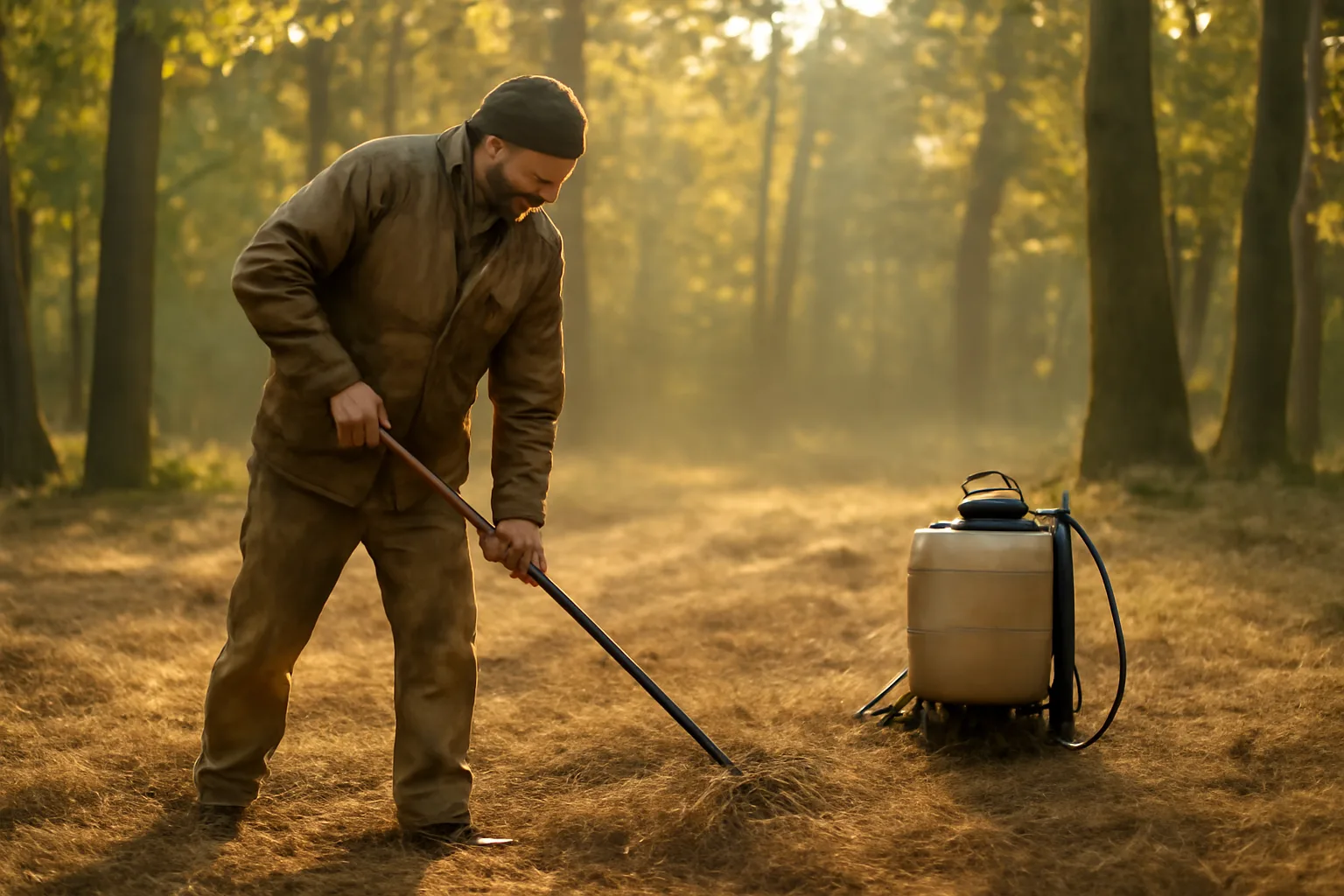
You can build a working food plot with a backpack sprayer, a hand seeder, a rake, and a roller (or a lawn roller, or your truck tires). Kill existing vegetation with glyphosate, broadcast seed into the dying thatch, then pack it down. Small plots (under an acre) and shade-tolerant species like clover, oats, and brassicas work best without machinery.
can you actually make a food plot without a tractor or disc
Yes. People did it for decades before ATV implements got cheap, and plenty of serious plotters still do it on purpose, especially on small hunting-pressure plots tucked into timber where you couldn't get equipment in anyway. The trade-off is scale and speed. Hand methods work great on plots from a few hundred square feet up to maybe half an acre. Past that, the labor gets brutal fast. The core process doesn't change whether you're running a 40 horsepower tractor or a garden rake. You need to kill or suppress the existing vegetation, get seed-to-soil contact, add lime and fertilizer if your soil test calls for it, and press the seed in so it doesn't just sit exposed on top of the dirt. Equipment just makes each step faster and lets you scale up. Skip it, and you lean harder on chemistry (herbicide) and timing (planting right before rain) to do the work a disc would normally do. If you want a legit shot at a plan tailored to your acreage and region without guessing at species mixes, that's exactly the kind of thing a food plot whitetail plan is built to answer, and PlotSeason's $99 Custom Food Plot Plan at /plot-plan-builder walks through species and timing for your specific spot. But even without that, the steps below get you a real, huntable plot.
what is a food plot, exactly
A food plot is a planted area, usually somewhere between a few hundred square feet and several acres, established specifically to attract and feed deer or other wildlife rather than to produce a harvestable crop for sale. State wildlife agencies generally treat food plots as a habitat management tool distinct from agricultural fields. Most cooperative extension guidance frames them the same way: a small-scale planting meant to supplement natural browse, concentrate deer activity for hunting or observation, and in some cases improve deer body condition and antler growth through better nutrition. Food plots aren't the same as bait piles. Most states draw a legal line between a planted, rooted crop (legal to hunt over almost everywhere) and piled or scattered feed like corn, apples, or minerals (restricted or banned in many states during hunting season). Rules vary a lot by state, so check your state wildlife agency's baiting and feeding regulations before you plant anything you're unsure about, especially if you're mixing in mineral licks or supplemental feed alongside the plot. The two broad categories most plotters use are annuals (planted every year, examples: oats, brassicas, sorghum, buckwheat) and perennials (planted once, lasting 3 to 5 years with maintenance, examples: clover, chicory, alfalfa). No-equipment plots lean toward annuals for the first year or two, because perennials need cleaner seedbeds to establish well, and clean seedbeds are exactly what's hardest to get without a disc.
what tools do you actually need instead of a tractor
You need less than most people think. Here's the realistic minimum kit for a plot under half an acre: a backpack sprayer (2 to 4 gallon, roughly $40 to $100) for glyphosate application, a hand-crank broadcast seeder or even a Solo bucket spreader ($15 to $40) for even seed distribution, a hard rake or a chain-link section dragged behind you for scratching in seed, some kind of roller or packer, and a soil test kit or mail-in test from your local extension office (usually $10 to $20) so you're not guessing on lime and fertilizer. The roller or packer is the part people skip and shouldn't. A lawn roller, a piece of plywood you walk across, or even driving your ATV or truck tires slowly over the seed all work fine. A string trimmer or brush cutter helps a lot if you're converting brushy ground rather than an existing field edge. For lime, if your test calls for more than a few hundred pounds per acre (common on acidic wooded soils), you'll be hauling bags by hand or wheelbarrow, which is real work but doable on small plots. Above half an acre, renting a small tiller or hiring someone with an ATV disc for one pass starts to make more sense financially than the hours you'll spend by hand.
how do you kill existing vegetation without tilling it under
Spray, don't till, is the mantra for no-equipment plotting. Glyphosate (the active ingredient in Roundup and generic equivalents) kills existing grass and weeds down to the root without disturbing soil structure, and the dying thatch actually helps hold moisture for your new seed. Spray when plants are actively growing, temperatures are above 50°F, and no rain is expected for at least 6 to 8 hours (check your product label, since rainfast windows vary by formulation). Give it 7 to 14 days to fully brown out before planting. For thick sod or heavy weeds, a second application 2 to 3 weeks later on any survivors saves you from a spotty plot. This is the step people rush, and it's the single biggest reason no-till, no-equipment plots fail. If you plant into green, living grass, your seed competes with an established root system and mostly loses. Extension research on no-till plot establishment consistently points to complete kill-down as the make-or-break variable, more than soil prep method.
how do you get seed-to-soil contact by hand
After the kill-down browns out, you don't need bare dirt, just broken-up thatch that lets seed reach soil. A hard garden rake, pulled hard enough to scratch the surface, works on small plots. Some people drag a section of chain-link fence or a bed frame behind an ATV or even by hand with a rope, which knocks down thatch and scuffs soil in one pass. Broadcast your seed by hand or with a cheap hand-crank spreader, then go back over it with the roller, plywood, or vehicle tires. Compaction sounds counterintuitive but it's exactly what a cultipacker does on big rigs: it presses seed into firm contact with soil so it doesn't dry out and die before germinating. Seed depth without a drill is a real limitation. Small seeds like clover and chicory should barely be covered, if at all, since they need light to germinate and can be broadcast right before a rain and left alone. Larger seeds like oats, wheat, soybeans, and cereal grains need more actual coverage (a half inch to an inch), so raking soil over them or spinning them in before you compact matters more. Brassicas (turnips, radishes) sit in between; light coverage or none at all still works fine if you time it right before rain.
when to plant food plots for deer
Timing splits into two windows almost everywhere in whitetail range: spring plots (late April through June, depending on latitude) for warm-season annuals and perennials, and late-summer plots (mid-July through early September) for fall annuals like brassicas, cereal grains, and clover overseeds. Your local frost dates drive everything. NOAA's climate normals and frost/freeze data are the most reliable free source, since a plot planted two weeks too early or late into a frost window can fail outright. As a rough national range: southern states (zones 7-9) can plant fall brassicas and cereal grains into early September, while northern states (zones 3-5) often need to be in the ground by mid-August to get enough growing days before frost. Spring/summer plantings: clover, chicory, soybeans, and sunn hemp go in after your last frost date, typically April in the South and late May to June in the North. Late summer plantings: brassicas (turnips, radishes, kale), oats, wheat, and clover overseeds go in 60 to 90 days before your first fall frost, which for most of the whitetail range lands between mid-July and early September.
when to plant oats for deer
Plant oats for deer 6 to 10 weeks before your area's average first fall frost date, which usually lands in the mid-August to mid-September window across most of whitetail country. Oats germinate fast (5 to 10 days in warm soil), grow quickly, and stay palatable and highly attractive to deer through several frosts before winterkill finally takes them out. Oats are one of the best no-equipment options because the seed is large enough to broadcast by hand and rake in without a drill, and it tolerates a rough seedbed better than fine-seeded species like clover. A seeding rate of 80 to 100 pounds per acre broadcast (versus 60 to 80 drilled) is typical, since broadcast seeding always needs a bump in rate to account for uneven coverage and seed sitting on the surface. Oats generally winterkill somewhere in the teens to single digits Fahrenheit, so in the Deep South they can persist into winter, while in the upper Midwest and Northeast they're usually done by December.
when to plant turnips for deer
Plant turnips for deer 80 to 100 days before your first expected fall frost, which for most of the whitetail range means a planting window from mid-July in the North to early September in the South. Turnips need that long runway to bulb up and reach peak palatability, since deer often ignore turnip tops early in the season and don't hit the bulbs hard until after a couple of frosts sweeten the starches into sugars. Seeding rate for turnips broadcast alone runs 4 to 6 pounds per acre. Most plotters mix them with radishes or a cereal grain like oats to get earlier-season attraction while the turnips mature. Turnip seed is tiny, so it barely needs covering. Broadcast it right before a rain, or rake very lightly and roll, and you're set. A common no-equipment mistake is planting turnips too early alongside spring clover. They're a fall species and won't handle summer heat well in most of the country.
do deer eat clover, and do deer like it
Yes, deer eat clover readily, and it's one of the most consistently preferred food plot forages across whitetail range. Extension forage trials and deer diet studies repeatedly rank clover among the top selected plot species, largely because it's high in protein (typically 25 to 30 percent crude protein in vegetative growth) and stays palatable through most of the growing season. White clover (Dutch white, ladino types) and red clover are the two most common food plot clovers. White clover is lower-growing, more shade-tolerant, and handles closer grazing pressure, which makes it a better fit for small, heavily-hunted plots where deer browse it down hard. Red clover grows taller, tolerates poorer drainage, and often out-competes weeds better in the first year. Clover is a perennial, meaning one planting can produce forage for 3 to 5 years with mowing and occasional overseeding, which makes it a strong pick for a no-equipment plot precisely because you're not re-doing the hard kill-down and seeding labor every single year. The catch: clover establishes best in a clean, firm seedbed, so your first-year kill-down and packing steps matter more here than with tougher annuals like oats or sorghum.
do deer eat sorghum, and is it worth planting
Yes, deer eat grain sorghum, both the standing seed heads and the young forage growth, though it's generally considered a secondary food plot species rather than a top attractant like clover or soybeans. Extension wildlife programs typically list sorghum as more valuable for its cover and as a component in a multi-species summer blend than as a standalone deer magnet. Sorghum's real strength for a no-equipment plotter is toughness. It handles poor soil, drought, and rough seedbeds better than almost anything else on this list, and the seed is large enough to broadcast and rake in with zero special handling. It's a reasonable choice for a first-year plot on rough ground where you're not confident your kill-down was perfect, since it'll still come up through some competition. Whitetails do sometimes hit standing sorghum hard in late fall and winter once other food sources thin out, and it doubles as excellent screening cover if you're using the plot for both nutrition and hunting concealment. It's not the plant to lean on if attraction is your only goal, though. Pair it with a legume or brassica if you want deer showing up consistently rather than just occasionally.
what are deer's favorite foods, and does honey belong in a plot
Deer preference studies and state wildlife agency browse surveys consistently rank a short list at the top: acorns (especially white oak family), soybeans, clover, and various fruits like apples and persimmons when in season. Preference shifts seasonally and regionally, and it's driven heavily by protein content, digestibility, and whatever's most abundant and easiest to reach at that moment, not a fixed universal ranking. Acorns are consistently cited as one of the single highest-preference natural foods because of their fat content, which matters enormously for pre-winter fat reserves. Among planted crops, soybeans (in the vegetative stage) and clover routinely top forage preference trials for crude protein and palatability. As for honey: there's no credible wildlife research supporting honey as a deer attractant, and it's not a food plot input at all. It's occasionally used as a mineral-lick or scent additive in some hunting products, but that's a different category of product entirely and isn't something you plant or spread on a plot. If you've seen it marketed as a deer attractant, that's a hunting-supply claim, not an extension-backed one, and several states restrict scent and bait products used over bait separately from food plot rules, so check your state's regulations before using any additive product near a stand.
what species work best for a no-equipment plot
| Clover (white/red) | Small, needs firm bed | Low, needs clean seedbed | Good, but only after solid kill-down | |
|---|---|---|---|---|
| Oats | Large, easy to rake in | High, tolerates rough beds | Excellent, top pick for beginners | |
| Brassicas (turnips/radish) | Tiny, needs light cover only | Moderate | Good, easy to broadcast | |
| Sorghum | Large, easy to handle | Very high, tolerates poor prep | Excellent for rough or new ground | |
| Soybeans | Large but needs real depth (1-1.5 in) | Low, wants true seed-to-soil contact | Hard without a drill, deer also hit seedlings hard | |
| Chicory | Very small | Low, similar to clover | Fine once established, tricky start | For a first no-equipment plot, oats or a sorghum-based summer blend are the most forgiving. Clover pays off longer term once you've proven you can get a clean kill-down, and it's the species most people wish they'd started with once they see how much labor a yearly annual replant takes by hand. |
Here's how the common food plot species stack up for hand-tool planting specifically, more than general popularity. | Species | Seed size (ease of hand broadcast) | Seedbed tolerance | Best no-equipment fit |
how big a plot can you realistically manage by hand
Most people doing this by hand top out productively somewhere between a quarter acre and half an acre. Below that, an afternoon or two of work with a sprayer, rake, and hand seeder gets you a legitimate plot. Push toward a full acre and you're looking at several full weekends, plus the physical toll of hauling lime and fertilizer bags without a spreader. A good compromise a lot of hand-planters land on: several small plots (a quarter acre each) scattered through timber, rather than one big field. Small plots tucked into cover are often more useful for bowhunting anyway, since they draw deer into range without requiring the deer to feel exposed in a big open field. This is also exactly the kind of layout question a tailored plan is built for, since species and plot size interact a lot with your terrain and hunting pressure; PlotSeason's deer food plot seed resources and the $99 Custom Food Plot Plan at /plot-plan-builder can help you size and place multiple small plots instead of guessing.
what soil prep can you actually skip without equipment
You can skip tilling entirely if your kill-down is thorough, and that's really the whole trick. What you can't skip is the soil test. Lime and fertilizer recommendations come from your test results, and your local extension office or a mail-in soil lab is the actual authority on how much of each your specific ground needs, not a general blog rule of thumb. Spreading lime and fertilizer by hand is genuinely more work than tilling, ironically, because you're broadcasting bagged product across the plot with a hand-crank spreader or by hand-tossing it, and it takes multiple passes to get even coverage. Budget real time for this on anything over a quarter acre. What you should not skip: pH correction if your test shows acidic soil (common under hardwoods, often in the 5.0 to 5.5 range), since most food plot species, especially clover and brassicas, perform poorly below pH 6.0 regardless of how well you seed and pack. No amount of hand labor on seeding technique fixes a pH problem; only lime does, and it takes months to fully react into the soil.
a realistic step-by-step timeline for a no-equipment plot
Step 1 (4 to 6 weeks before planting): Pull a soil sample, send it to your extension office or a private lab, and get your lime and fertilizer numbers back. Step 2 (2 to 3 weeks before planting): Spray the plot with glyphosate on a calm, dry day with plants actively growing. Wait 7 to 14 days, then spot-spray any survivors. Step 3 (planting day): Spread lime and fertilizer per your soil test. Rake or drag the dead thatch to scuff the surface. Broadcast your seed at the recommended rate (bump up 20 to 30 percent over drilled rates since broadcast coverage is less even). Roll or pack the seed in, ideally right before a forecasted rain. Step 4 (first 2 to 3 weeks after planting): Stay off the plot if you can. Watch for germination (5 to 10 days for oats and brassicas, a bit longer for clover). Spot-fix any bare patches with extra seed and a light rake pass. This whole process, spread across the actual calendar, takes 6 to 8 weeks from soil test to standing plot. Most of that is just waiting on herbicide to work and seed to germinate, not active labor. The hands-on hours themselves usually total somewhere between 6 and 15 hours for a quarter-acre plot, depending on how rough the starting ground is.
Frequently asked questions
Do deer eat sorghum?
Yes. Deer eat both the forage growth and mature seed heads of grain sorghum, though extension wildlife programs generally rank it below clover and soybeans as a primary attractant. It's most valuable as a tough, drought-tolerant component in a mixed summer blend, and it doubles well as screening cover.
Do deer eat clover?
Yes, and clover is consistently one of the top-ranked food plot forages in extension trials, largely due to crude protein levels around 25 to 30 percent in vegetative growth. Both white and red clover are widely planted, with white clover better suited to heavy browsing pressure on small plots.
Do deer like clover?
Deer show strong, consistent preference for clover across most regional forage studies, ranking it near the top alongside soybeans and acorns. It stays palatable through most of the growing season and regrows after grazing, which is part of why it's the most popular perennial food plot choice nationwide.
When should I plant food plots for deer?
Spring/summer annuals and perennials (clover, chicory, soybeans) go in after your last spring frost, typically April in the South and May to June in the North. Fall annuals (brassicas, oats, wheat) go in 60 to 90 days before your area's first fall frost, usually mid-July through early September.
When do you plant oats for deer?
Plant oats 6 to 10 weeks before your area's average first fall frost date, generally landing in the mid-August to mid-September window across most whitetail range. Oats germinate in 5 to 10 days and stay attractive through several early frosts before eventually winterkilling.
When do you plant turnips for deer?
Plant turnips 80 to 100 days before your expected first fall frost, roughly mid-July in northern states to early September in southern states. They need that runway to bulb up, and deer usually don't hit the bulbs hard until after a frost or two sweetens the starches.
What is a food plot?
A food plot is a planted area established specifically to feed and attract deer or other wildlife, distinct from a commercial agricultural field. Sizes range from a few hundred square feet to several acres, and they're generally treated by state agencies as a legal habitat management tool separate from bait piles.
What are deer's favorite foods?
Acorns (especially white oak family) rank at or near the top of most browse studies due to high fat content, followed closely by soybeans and clover among planted crops. Preference shifts by season and region, driven mostly by protein content and whatever food source is most abundant at the time.
Do deer like honey?
There's no credible wildlife research supporting honey as a deer food or attractant, and it's not a food plot input. It occasionally shows up in hunting-supply scent or mineral products, but that's a separate marketed category, not something backed by extension or agency research, and some states restrict additive products used near bait.
Can you really plant a food plot with no tractor or ATV at all?
Yes, for plots up to roughly a quarter to half acre. Use a backpack sprayer for kill-down, a hand-crank seeder for broadcasting, a rake or dragged chain-link section to scuff the surface, and a roller (or your vehicle's tires) to pack seed in. Labor scales up fast past half an acre, though.
What's the biggest mistake people make planting a food plot by hand?
Rushing the herbicide kill-down. Planting into still-green grass or weeds means new seed competes against an established root system and usually loses. Extension research on no-till establishment points to complete kill-down, not soil prep method, as the biggest factor separating successful plots from failed ones.
Do I still need a soil test if I'm not using equipment?
Yes, if anything it matters more. Lime and fertilizer still have to go down at correct rates for your species and pH, and hand-broadcasting them takes real effort. Skipping the test risks wasting labor on ground that's too acidic (often pH 5.0 to 5.5 under hardwoods) for clover or brassicas to perform well.
Is broadcasting seed by hand as good as using a seed drill?
It's less precise but works fine for most annual species if you compensate. Bump your seeding rate 20 to 30 percent over drilled recommendations, and follow broadcasting with a roller or packer pass so seed makes solid soil contact instead of sitting exposed on the surface.
Sources
- University of Missouri Extension, Food Plots for Wildlife: Definition and purpose of food plots as a wildlife habitat management tool distinct from commercial crops
- University of Missouri Extension, Herbicide Application Guidelines: Glyphosate application timing, temperature threshold, and rainfast window guidance
- NOAA National Centers for Environmental Information, U.S. Climate Normals: Regional frost date variation used to determine food plot planting windows
- Oklahoma State University Extension, Establishing Wildlife Food Plots (PSS-2120): Oat seeding rates for broadcast versus drilled planting and general fall planting windows
- University of Kentucky Cooperative Extension, Taking Soil Test Samples (AGR-16): Soil test authority on lime and fertilizer recommendations and typical acidic pH ranges under hardwood cover