Last updated 2026-07-25
TL;DR
A small food plot (a quarter acre to an acre) works if you test soil, clear competing weeds, plant the right seed for your zone (clover, brassicas, oats, or a blend), and time it to local rain and frost dates. Most failures trace back to skipped soil tests or planting into weed-choked, uncorrected dirt, not seed choice.
what is a food plot, exactly
A food plot is a planted patch of land, usually somewhere from a few thousand square feet to several acres, put in specifically to feed and hold deer (and often turkeys, rabbits, and other wildlife along the way). It's not a lawn and it's not a farm field, though it borrows techniques from both. Small plots, the kind most hunters with 20 to 200 acres actually plant, tend to run a quarter acre to one acre. That size is big enough to grow real tonnage of forage but small enough to work with a tractor, ATV, or even hand tools if you're patient. The USDA Natural Resources Conservation Service treats food plots as a wildlife habitat practice and cost-shares them in some states through programs like EQIP, which tells you the government considers this real habitat work, more than a hunting gimmick [1]. The two broad types are annual plots (replanted every year, like brassicas, oats, or sorghum) and perennial plots (clover or alfalfa, which you plant once and maintain for two to five years). Most small-property owners run a mix: a perennial clover plot for spring and summer, and an annual brassica or grain plot for fall and winter. For a broader look at how these fit together, see food plot whitetail.
how big should a small food plot be
For most hunters, a quarter acre to one acre is the sweet spot. Anything smaller than a quarter acre gets hammered down to dirt fast if you have any real deer density, and anything over an acre starts needing bigger equipment and more seed money than a first-time plotter usually wants to spend. A good rule from wildlife extension programs: aim for total food plot acreage equal to roughly 1 to 5 percent of your property, split across several small plots rather than one big field [2]. Three quarter-acre plots tucked into different cover types beat one three-acre plot in the middle of nowhere, both for deer movement and for hunting access. Shape matters too. Long, narrow plots (say 30 to 50 yards wide) give you more edge, which deer prefer, and they're easier to hunt with the wind than a perfect square.
when to plant food plots for deer
Timing depends entirely on what you're planting and where you live, but the two windows that matter most are late spring (for perennials and summer annuals) and late summer to early fall (for cool-season annuals like brassicas, oats, and cereal grains). As a rough national guide: clover and other perennials go in either early spring (April to May in the North, March in the South) or late summer (August). Brassicas like turnips and radishes want 45 to 60 days of growing time before your first hard frost. Cereal grains like oats and wheat go in 6 to 8 weeks before your average first frost date, which lines up with late August in the upper Midwest and mid-September to October farther south. Check your local NOAA or state extension frost date charts before you commit. Planting two weeks too early or too late can be the difference between a lush plot and a moldy mess of seed.
when to plant clover for deer
Clover goes in either early spring or late summer, and both windows work; late summer (roughly mid-August to early September) tends to give you less weed pressure because summer annual weeds are done germinating by then. Spring plantings (April into May, once soil hits about 50°F) work well too, especially in northern states where fall windows are tight [3]. Do deer like clover? Yes, and it's one of the most reliable answers in the whole food plot world. White clover and red clover show up constantly in deer diet studies as high-preference, high-protein forage, often tested above 25 percent crude protein in good growing conditions [4]. It's also one of the few plots that keeps producing from spring through fall once established, which is why so many small-acreage hunters plant one clover plot and build everything else around it. Clover is a perennial, meaning a well-maintained stand can last three to five years with mowing and a little nitrogen-free fertilizer touch-up, versus replanting an annual plot every single year. That's real savings in both seed cost and diesel.
when to plant oats for deer
Oats are a fall annual for most of the whitetail range. Plant them 60 to 75 days before your first killing frost, which for a lot of the Midwest and mid-South lands somewhere between mid-August and mid-September. Oats germinate fast, sometimes in 5 to 7 days with decent moisture, and they green up quick, which makes them a good nurse crop mixed with clover or brassicas. Oats don't handle hard winters well in the far North; they'll often winterkill once temperatures drop into the low teens for extended stretches. That's actually a feature for a lot of hunters, since deer hit oats hardest in the weeks right after a frost, when the plant converts starches to sugars and gets sweeter. If you're in a zone with mild winters, oats can hang on into December or later, giving you a longer feeding window. Oats also work as a spring planting in the northern tier, but most hunters skip that because clover and brassicas do a better job filling the spring and summer slot.
when to plant turnips for deer
Turnips need 45 to 90 days to mature bulbs, so back-time your planting from your first expected frost. In most of the whitetail's range that means planting turnips sometime between late July and late August, depending on latitude. Turnips are a two-stage food source. Deer eat the leafy tops first, often starting within a few weeks of germination, then switch to the bulbs later in the season once a few hard frosts sweeten the starches into sugars. That's why turnip plots often look untouched in October and get devastated in December, once cold weather flips the plant's chemistry. A common mix is turnips with radishes and a cereal grain, since the grain gives early-season grazing while the brassica bulbs mature for late season. Extension trial data out of programs like Mississippi State's deer nutrition work generally shows brassica forage quality (protein and digestibility) holding up well into winter compared to many warm-season options [5].
do deer eat sorghum
Yes, deer eat sorghum, both the leaves and the grain heads, though it's more commonly planted as a summer annual for cover and forage than as a primary attractant crop. Grain sorghum and forage sorghum both show up in wildlife food plot mixes, especially in the South and parts of the Midwest where summer heat and drought stress out other summer annuals like soybeans or cowpeas. Sorghum's real strength for small plot owners is drought tolerance. It handles dry summers better than corn and needs less nitrogen to produce a decent stand, which matters if you're working with thin soil or don't want to run a heavy fertilizer program. It's not usually the top choice if you have room to plant something deer prefer more, like soybeans or cowpeas, but on marginal ground or in a dry year, sorghum will still put out tonnage when other options fail. One caution: sorghum and sudangrass can develop prussic acid (cyanide compounds) in young, stressed, or frost-damaged growth, a known risk in livestock forage that extension livestock programs warn about regularly. It's mostly a concern for grazing livestock rather than deer browsing lightly, but it's worth knowing if you're mixing species or grazing cattle on the same ground.
what are deer's favorite foods
There's no single universal answer because it shifts by season, region, and what's locally available, but across most whitetail research, a short list keeps showing up: acorns, soybeans, clover, and standing corn rank among the highest-preference foods where they're available. Acorns are the wildcard. In a heavy mast year, deer will walk past a lush clover plot to hammer white oak acorns, because acorns pack more fat and carbs per bite. That's not a food plot failure, that's just deer being efficient. Soybeans, when deer pressure is low enough to let them mature, produce both high-protein foliage in summer and a bean pod crop in fall that rivals acorns for fat content. Among planted forages specifically, clover consistently tests as one of the most preferred and most nutritious options, which is a big reason it anchors so many small plot plans. Brassicas, cereal grains, and legumes like cowpeas and lablab round out a rotation that covers spring through winter.
do deer like honey (locust) and other odd food questions
If the question is about honey locust trees, yes, deer readily eat the seed pods that drop from honey locust trees in fall, and some food plot and habitat programs plant or preserve honey locust specifically as a mast source alongside oaks. If the question is about honey itself (the bee product), there's no real research or extension guidance suggesting deer seek out honey as a food source, and it's not something anyone plants or bait-feeds with in a food plot context. Most of the honey confusion online traces back to honey locust, crabapple, and other soft/hard mast trees that genuinely matter for deer nutrition and that experienced land managers plant deliberately around plot edges. If you're trying to decide between planting a food plot or planting mast trees, the honest answer is do both if you can; trees take years to produce but last decades, while plots produce fast but need replanting. One practical note: several states regulate or restrict feeding and baiting deer, separate from food plot planting, and the rules vary a lot by state (some ban baiting outright, some allow it with restrictions, some allow it only outside hunting season). Check your state wildlife agency's current regulations before putting out any supplemental feed, mineral, or bait product.
how do you test and prep the soil for a small plot
Start with a real soil test, not a guess. Most state extension services offer soil testing for somewhere between $6 and $20 per sample, and results come back with your exact pH and recommended lime and fertilizer rates . Whitetail forages like clover and brassicas want a soil pH in the 6.0 to 7.0 range; most untested wildlife food plot ground comes in more acidic than that, often in the 5.0 to 5.5 range, which cuts nutrient uptake even if you dump fertilizer on it. Your soil test lab is the real authority here, not a blanket internet rule. Lime takes months to fully react in the soil, so if your test calls for 1 to 2 tons per acre (a common recommendation on acidic wildlife ground), get it down as early as you can, ideally the fall before you plant, or at minimum a few weeks ahead. After the test, kill or till under existing vegetation. For a small plot, that means either a glyphosate spray 2 to 3 weeks ahead of planting, or repeated disking to expose bare dirt and knock back weed competition. Skipping this step is probably the single most common reason small food plots fail; new seedlings can't out-compete an established stand of fescue, ragweed, or briars.
what equipment do you actually need for a small plot
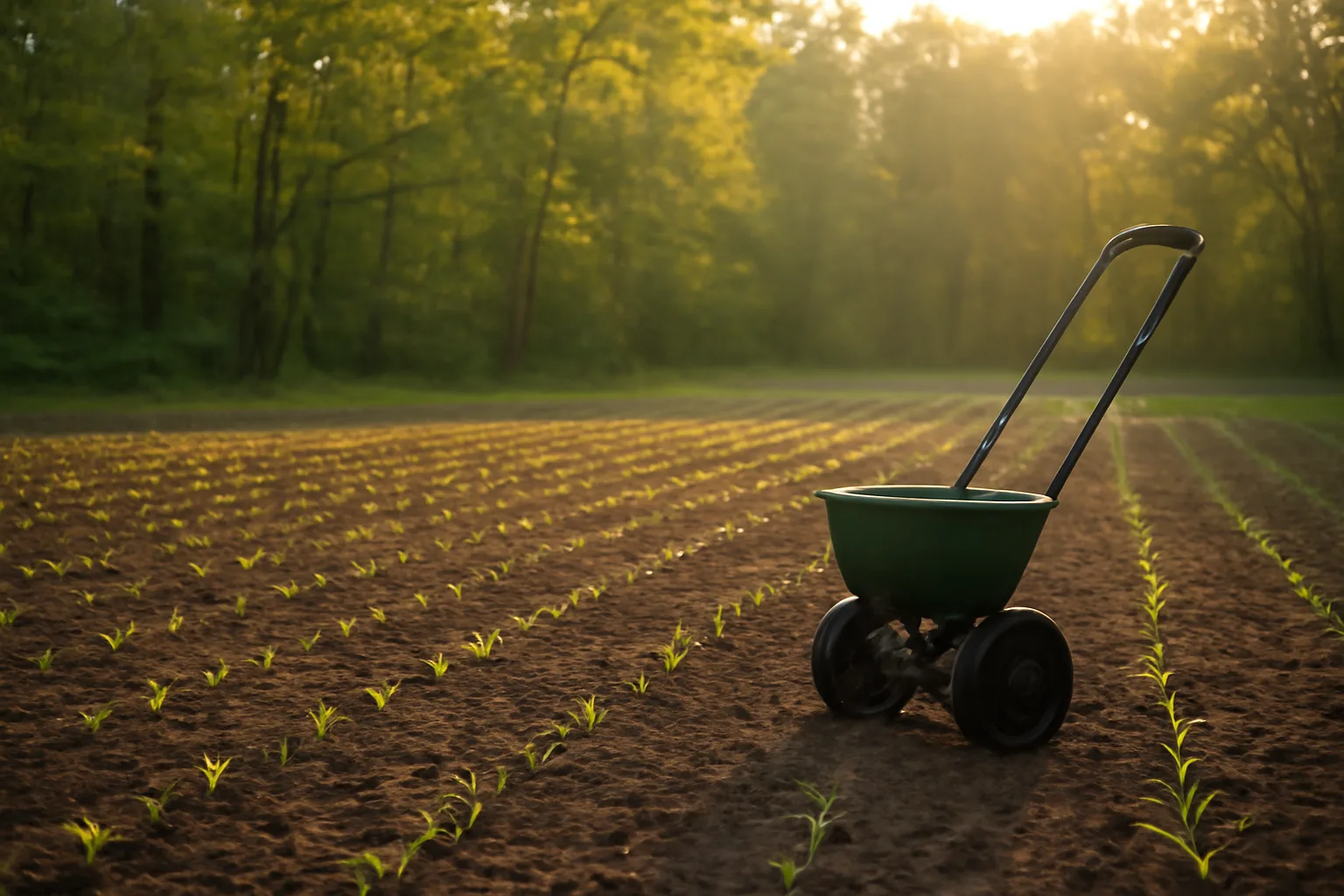
For a quarter-acre to one-acre plot, you don't need a farm. An ATV or UTV with a small disk, drag harrow, and pull-behind broadcast spreader covers most of what a small plot needs. A lot of hunters get by with a hand-crank broadcast spreader, a rake, and a rented or borrowed disk for the initial ground-breaking. A basic small-plot kit looks like this: soil test kit or mailer, glyphosate (or a tiller) for initial vegetation control, lime and fertilizer per your soil test results, a disk or tiller to work the seedbed, a broadcast spreader for seed and fertilizer, and a cultipacker or drag to firm the seed into the soil after broadcasting. Small-seeded species like clover and brassicas need very shallow planting depth, often a quarter inch or less, so a cultipacker pass (or just driving over it with an ATV tire) matters more than people expect. If you're planting a larger annual like corn or soybeans, a drill or planter helps with depth control, but for clover, brassica, and cereal grain blends, broadcasting followed by a light drag works fine and is what most small-property extension guides recommend for those seed types . For deeper equipment and method comparisons, see deer food plot seed and food plot seed.
what should you plant in a small plot, species by species
| Species | Type | Plant Window (general US) | Days to Maturity | Best For | |
|---|---|---|---|---|---|
| White/red clover | Perennial | Spring (Apr-May) or late summer (Aug) | 60-90 to establish | Spring-fall protein, multi-year plot | |
| Brassicas (turnips, radish) | Annual | Late July-Aug | 45-90 | Late-season bulbs and greens | |
| Oats | Annual | 60-75 days before frost | 50-70 | Fast fall greenup, nurse crop | |
| Winter wheat/rye | Annual | Late Aug-Oct | Overwinters | Late fall through spring grazing | |
| Soybeans | Annual (warm) | Late spring (May-June) | 90-120 | Summer protein, fall pods | |
| Sorghum | Annual (warm) | Late spring-early summer | 90-120 | Drought-tolerant summer forage/cover | This is a starting menu, not a rulebook. Your actual planting dates shift by two to four weeks depending on your USDA plant hardiness zone and local frost dates, so check your state extension's planting calendar before locking in a date. For a single small plot, a lot of experienced land managers run one of two simple plans: a clover-only perennial plot for season-long feeding, or a fall annual blend (oats plus brassica plus a cereal grain) replanted every August. Both work. The clover plot costs more upfront (clover seed and lime run higher than a basic oat planting) but saves money over years two through four since you're not re-tilling and reseeding annually. |
how much does a small food plot cost to plant
Rough budget for a quarter-acre plot: seed runs $15 to $60 depending on species (clover and brassica blends cost more per pound than cereal grains, but you use less per acre for small seeds). Lime, if your soil test calls for it, runs roughly $30 to $60 per ton delivered in bulk in a lot of rural areas, and a quarter-acre plot at a 1-ton-per-acre rate needs about a quarter ton. Fertilizer, again based on your soil test, typically adds another $20 to $50. All in, a first-year quarter-acre plot usually lands somewhere between $75 and $200 once you count seed, lime, and fertilizer, not counting fuel or equipment rental. Perennial clover plots cost more the first year but less in years two and three since you skip re-tilling and re-buying seed. If you'd rather skip the guesswork on species mix, seeding rates, and timing for your specific property and soil test results, PlotSeason's $99 one-time Custom Food Plot Plan builds a planting plan around your zone, plot size, and soil numbers. It's general guidance built from your inputs, not a site visit or a guarantee of deer activity. Your soil test lab is still the final word on exact lime and fertilizer rates.
common mistakes that ruin small food plots
Planting into standing weeds without killing them first is the number one mistake. Clover and brassica seedlings can't out-compete established grass and weeds, so a 2-to-3-week herbicide window (or aggressive tilling) before planting matters more than seed brand or blend choice. Skipping the soil test is a close second. Planting into soil at pH 5.2 with no lime applied can cut forage yield dramatically even with perfect seed and fertilizer, because acidic soil locks up nutrients the plant can't use . A $10 to $20 soil test is the cheapest insurance in the whole process. Other recurring problems: planting too deep (most food plot seed, especially clover and brassica, wants a quarter inch of soil coverage or less), planting the wrong window for the species (see the timing sections above), and picking a plot size or shape that gets pounded flat by opening week because there's no other food source nearby. For a broader strategy view across plot types, check deer food plots and deer for food.
Frequently asked questions
Do deer eat sorghum?
Yes. Deer browse both the leaves and grain heads of forage and grain sorghum. It's most useful as a drought-tolerant summer annual on marginal soils, though most deer prefer soybeans or cowpeas when both are available and growing conditions allow either option.
Do deer eat clover?
Yes, clover is one of the most consistently preferred food plot forages across whitetail research, often testing above 25 percent crude protein in good conditions. White and red clover anchor many small food plot plans because they produce from spring through fall once established.
Do deer like clover more than other plants?
Clover ranks high in most preference studies, but acorns and standing soybeans often outrank it when available, since both pack more fat and carbohydrates per bite. Clover's advantage is consistency: it produces protein-rich forage for months, more than during a mast or harvest window.
When should you plant food plots for deer?
Timing depends on species. Perennials like clover go in during early spring or late summer. Fall annuals (brassicas, oats, cereal grains) go in 45 to 75 days before your area's first hard frost, generally mid-July through September depending on latitude. Check your state extension's frost date chart.
When should you plant oats for deer?
Plant oats 60 to 75 days before your first expected fall frost, which lands roughly mid-August through mid-September across most of the whitetail range. Oats germinate fast and green up quick, making them a good nurse crop mixed with clover or brassica seed.
When should you plant turnips for deer?
Turnips need 45 to 90 days to mature bulbs, so plant them between late July and late August in most regions, back-timed from your first frost. Deer eat the leafy tops early in the season and switch to the sweetened bulbs after a few hard frosts.
What is a food plot?
A food plot is a planted area, usually a quarter acre to several acres, seeded specifically to provide forage for deer and other wildlife. It uses farming techniques (soil testing, tilling, fertilizing, planting) but its goal is feeding and holding game, not commercial crop production.
What are deer's favorite foods?
Across most whitetail food studies, acorns, soybeans, clover, and standing corn rank as top-preference foods. Preference shifts by season and region; acorns often outrank planted forages in heavy mast years because of their higher fat content.
Do deer like honey?
There's no real evidence deer seek out honey (the bee product) as food. The confusion usually comes from honey locust trees, whose seed pods deer readily eat each fall. Honey locust and other mast trees are worth managing alongside food plots, but honey itself isn't a deer attractant.
How big should a small deer food plot be?
A quarter acre to one acre works well for most properties and equipment levels. Several small plots spread across different cover types generally outperform one large plot, both for deer use and for hunting access with the wind.
Do you need a soil test before planting a small plot?
Yes. Most state extension services run soil tests for $6 to $20 per sample and return exact lime and fertilizer recommendations. Skipping this step is one of the most common reasons small plots underperform, since uncorrected acidic soil locks up nutrients even with good seed and fertilizer.
What equipment do you need for a small food plot?
A basic kit covers most quarter-acre to one-acre plots: glyphosate or a tiller for vegetation control, lime and fertilizer per soil test results, a disk or tiller, a broadcast spreader, and a cultipacker or drag to firm small seed into the soil. An ATV or UTV can pull all of this.
Is it legal to plant a food plot to attract deer?
Planting a food plot is legal in every state and is different from baiting or supplemental feeding, which some states restrict or ban outright, especially close to hunting season. Rules vary widely, so check your state wildlife agency's current baiting and feeding regulations before combining plots with any bait or mineral product.
Sources
- USDA NRCS, Wildlife Habitat Practices (EQIP): USDA cost-shares wildlife habitat practices, including food plot related work, through EQIP
- University of Tennessee Extension, Establishing Wildlife Food Plots: Clover planting windows in spring and late summer and soil temperature thresholds
- USDA Natural Resources Conservation Service, Plant Guide: White Clover: Clover forage quality and crude protein characteristics
- University of Missouri Extension, Soil Testing for Food Plots: Soil test cost range and pH targets for food plot forages
- Iowa State University Extension, Establishing Food Plots for Wildlife: Broadcast seeding and cultipacking recommendations for small-seeded food plot species