Last updated 2026-07-25
TL;DR
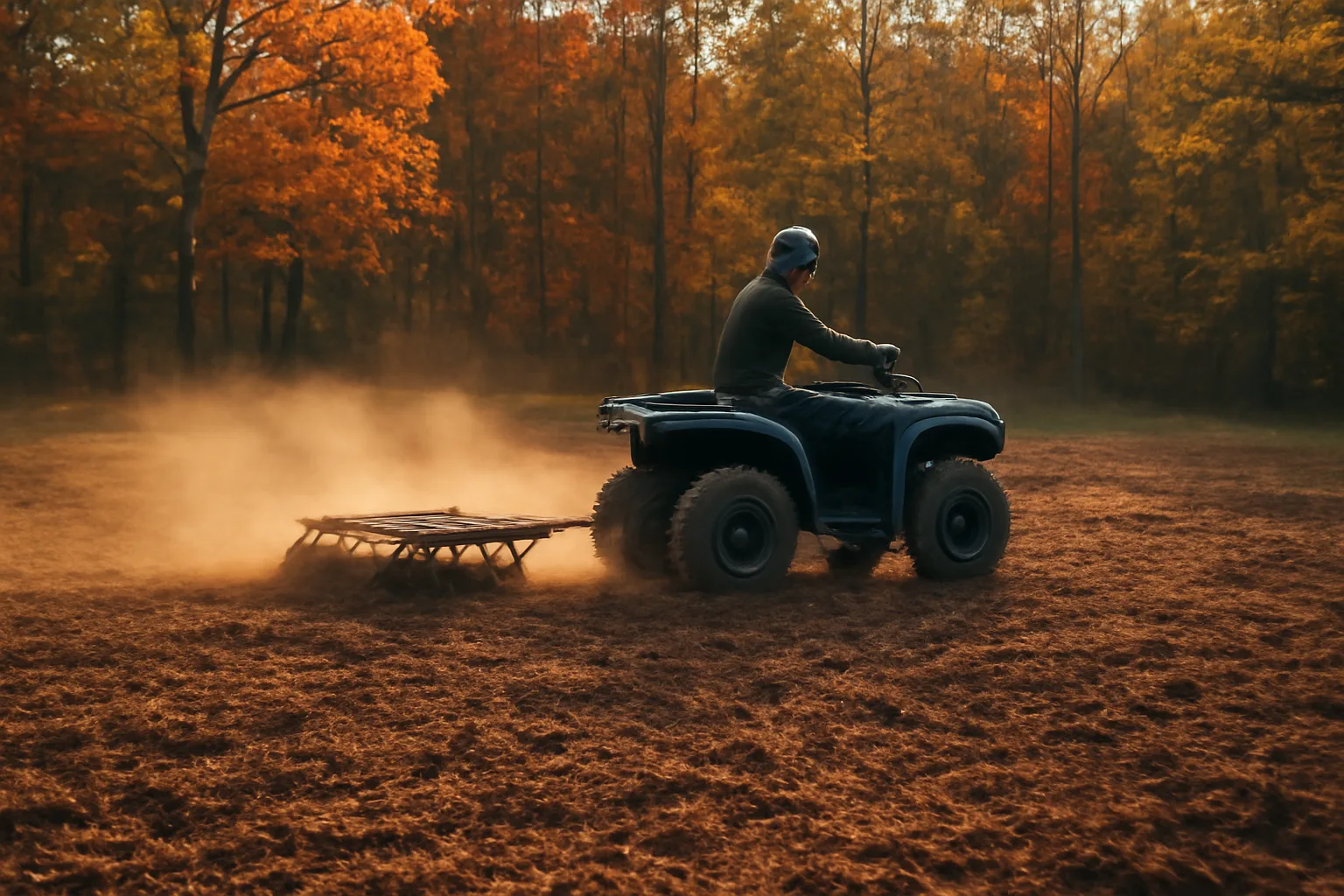
Yes, you can build a solid food plot with just an ATV and pull-behind implements. Kill existing growth, break the soil with a disc or harrow, test and adjust pH, broadcast seed at the right depth, then cultipack or drag. Budget $300 to $800 for basic implements and plan on 2 to 4 passes per plot depending on ground condition.
what is a food plot, and can an atv really build one?
A food plot is a planted opening on hunting land, usually a half acre to a few acres, seeded with forage that draws and holds deer while also giving them better nutrition than what they find in the surrounding woods. Most plots run clover, brassicas, cereal grains, or a blend of those, and most private-land plots in the whitetail belt are 1 acre or smaller according to general habitat management guidance from state wildlife agencies. An ATV with the right pull-behind tools can do almost everything a tractor does. Just slower and on a smaller scale. You need something to kill or clear existing vegetation, something to break and level soil, a way to spread seed, and a way to press seed into the dirt. A 400cc to 700cc ATV or side by side has enough pull for a 4 to 6 foot disc or drag harrow in most soil types, though heavy clay or root-choked ground will slow you down and may stall a smaller machine. What an ATV struggles with is turning heavy sod in one pass or working ground with a lot of rock and root mass. If your plot site was never cleared or was pasture for decades, you may need to spray it out with glyphosate first and let it die back rather than trying to tear it up mechanically in one session. That single step saves more headaches than any piece of equipment you can buy. For a full breakdown of plot sizing, shape, and placement relative to bedding and travel corridors, see food plot whitetail and deer food plots.
what equipment do you actually need for an atv food plot?
| ATV disc harrow (4-5 ft) | $300 to $700 | Breaks sod, mixes in lime/fertilizer | |
|---|---|---|---|
| Drag harrow or chain drag | $100 to $250 | Smooths and levels after discing | |
| Cultipacker (ATV-size) | $400 to $900 | Firms soil for seed-to-soil contact | |
| Broadcast spreader (tow-behind) | $150 to $400 | Spreads seed and dry fertilizer | |
| Boom or boomless sprayer (15-25 gal) | $150 to $500 | Herbicide application before planting | A disc and a drag can substitute for a cultipacker in a pinch (drag twice, once each direction), but you'll get less consistent seed depth, especially with small-seeded species like clover or brassicas that need to sit near the surface. If you're planting a mix that includes small seeds and larger grain seeds in the same plot, consider two passes: broadcast and cultipack the small seed shallow, then drill or press the larger seed a bit deeper. For seed selection matched to your soil and region, deer food plot seed and food plot seed break down species by climate zone. |
The core kit is a disc harrow or tiller, a cultipacker or drag, a broadcast spreader, and a sprayer for herbicide. You do not need all of it new, and used implements at farm auctions or from local classifieds often run half of retail. Here is a realistic cost range for a basic setup: | Implement | Typical cost (new) | Purpose |
how do you prepare the ground before planting?
Start with a soil test, not a guess. Most land-grant universities run soil tests for $10 to $20 per sample through their extension soil labs, and results typically come back with pH, phosphorus, potassium, and lime/fertilizer recommendations specific to the crop you tell them you're planting [1]. Your soil test lab is the authority on how much lime and fertilizer your specific dirt needs; a general article can only give you ranges. Most food plot species do best in a pH range of 6.0 to 7.0, and many established plots in the eastern half of the country run acidic without lime, sometimes below 5.5. If lime is needed, get it down and worked in as early in the season as you can, since agricultural lime can take 3 to 6 months to fully react with the soil, according to Penn State Extension guidance on liming. Kill existing vegetation first if it's sod, weeds, or old plot residue. Glyphosate applied 7 to 14 days before working the ground gives it time to translocate into root systems and actually kill the plant instead of just knocking back the top growth. Then disc the plot 2 to 3 times, going different directions each pass, breaking clods down to a manageable texture. Heavy clay will need more passes than sandy loam. Drag or cultipack after discing to level the seedbed. This step gets skipped more than any other and it's the reason so many DIY plots come up patchy. A rough, cloddy seedbed lets seed fall into gaps too deep to germinate or leaves it exposed on top where birds and wind take it.
when to plant food plots for deer?
Timing depends entirely on what you're planting and your region. Spring plots (clover, chicory, soybeans, sunn hemp) generally go in after your last frost date, often April through May in the North and March through April in the South. Fall plots (brassicas, cereal grains, oats, wheat) usually go in 6 to 10 weeks before your average first fall frost, so the target planting window often falls between mid-August and mid-September in northern states and September into early October in the transition zone and South [2]. Your local extension office publishes frost date tables and planting windows specific to your county, and those are worth checking rather than relying on general zone maps [2]. A hard frost date 100 miles north or south of you can shift your ideal planting window by 2 to 3 weeks. If you're planting a fall annual and miss the window by more than 2 weeks, plants often don't reach maturity before killing frost, and you end up with thin, stunted growth that deer barely touch. It's better to wait for next year's better window than force a late planting that fails.
when to plant oats for deer?
Oats go in the ground in late summer to early fall for most whitetail regions, typically 60 to 90 days before your first killing frost so they have time to establish before cold weather slows growth. In the upper Midwest and Northeast, that often means planting oats in August. In the mid-South and lower Midwest, early to mid-September works, and in the deep South, late September into October is common. Oats germinate fast, often in 5 to 7 days under good moisture and soil temperatures around 50 to 85°F, which makes them a good nurse crop mixed with slower-establishing brassicas or clover. They're also one of the more shade-tolerant cereal grains, so a plot with partial canopy cover can still produce a decent oat stand where wheat or rye might struggle. Oats will winterkill in most of the northern half of the whitetail range once temperatures drop into the teens for extended periods. That's actually fine for a fall attraction plot since you want tender green growth through hunting season, not a plant that's trying to survive winter.
when to plant turnips for deer?
Turnips and other brassicas go in 60 to 90 days before your first fall frost, which usually lands in the July to early September window depending on latitude. Northern states (Minnesota, Wisconsin, Michigan, upper New York) often plant in late July to early August. The transition zone (Kentucky, Tennessee, southern Missouri) usually plants mid-August to early September, and the deep South can push into late September. Brassicas need that long runway because they're building both leaf mass and a bulb or taproot, and a hard frost actually improves palatability by converting starches to sugars, which is part of why deer often ignore brassica plots in October and hammer them in December and January. If you plant too late, the plants never bulb out and you get thin leaf growth with none of that late-season sugar conversion. Seed depth matters more with turnips than most food plotters realize. Turnip seed is tiny and should go no deeper than 1/4 to 1/2 inch. Broadcasting onto a firm, prepared seedbed and then cultipacking to press seed into the top layer of soil works better than trying to drag seed in, which buries it too deep in most conditions.
do deer eat sorghum, clover, and other common plot species?
Deer do eat grain sorghum, but it's not a preferred forage species. It's more commonly planted as a screening or standing-crop option, or as a component in a wildlife blend rather than a primary attractant, because whitetails generally rank it below soybeans, corn, and cereal grains in preference studies and field observation. If your goal is pure draw, sorghum is a secondary choice at best. If your goal is cover and some incidental feeding, it works. Clover is a different story. Deer like clover, and it's one of the most consistently used food plot species across the whitetail range. White clover varieties (Ladino, Durana, and others) provide 25 to 30% crude protein in vegetative growth stages according to forage testing summarized by university extension forage programs, and clover is used by deer from spring green-up through fall in most climates because it's perennial and keeps producing new growth after grazing [3]. Beyond clover, deer's most consistently preferred food plot species include soybeans, cowpeas, chicory, and brassicas in fall, plus acorns and native browse in the surrounding woods, which usually outcompete any plot for a few weeks each fall when the mast drop hits. No plot beats a heavy acorn year for pulling deer off a food source, and that's worth knowing before you assume a quiet plot means a failed plot. For blend options built around clover as a base, domain food plot seed covers common commercial mixes.
do deer like honey, and is that a real food source?
No, honey isn't a natural or practical deer food, and it's not something you'd plant or use in a food plot context. Deer are herbivores that browse plants, forbs, mast, and agricultural crops; they have no meaningful dietary relationship with honey. This question shows up in search likely from confusion with 'honey locust,' a tree whose seed pods deer do actually eat readily in fall, or from unrelated wildlife feeding questions that have nothing to do with food plots. If you're trying to figure out what actually pulls deer onto your property, stick to real forage data: soybeans, clover, brassicas, cereal grains, and natural mast are what the research and field observation actually support, not sweeteners or bait products, which in many states fall under baiting regulations anyway (more on that below).
how do you check state baiting and feeding rules before planting?
Food plots are legal to hunt over in every state, but baiting (placing loose grain, minerals, or feed to attract deer) is a separate legal category in most states and is banned or restricted in a lot of them. The distinction usually comes down to whether the food is grown in place (a plot) versus hauled in and dumped (bait). Rules vary a lot, and they're tied increasingly to chronic wasting disease management. Some states ban baiting statewide. Others restrict it only in specific counties where CWD has been detected in deer or elk. Always check your specific state wildlife agency's current regulations before assuming a plot, mineral site, or supplemental feed setup is legal, since these rules change year to year and often mid-season as CWD zones expand. Wisconsin's administrative code, for example, sets baiting and feeding restrictions county by county tied to disease surveillance, under NR 12.10, and those county lists get updated as new CWD detections happen [4]. A properly planted, rooted food plot is almost universally treated differently than a bait pile, but the definitions of 'food plot' versus 'bait' do vary by state, particularly around things like mineral licks and protein supplement stations, which some states classify as baiting even though they're not grain.
how big should an atv-built food plot be?
Most ATV-accessible plots run from a quarter acre up to 2 or 3 acres, mainly because that's the practical limit of how much ground you can disc, drag, and cultipack in a reasonable timeframe with a single ATV pass width of 4 to 6 feet. A 1 acre plot with a 5 foot disc means roughly 8 to 9 passes lengthwise just to cover the ground once, and you'll do that 2 to 3 times minimum through the prep process. Smaller plots (quarter acre to half acre) tucked into timber openings are often better bedding-adjacent food sources and are easier to fully work with ATV equipment in a single day. Larger plots (2 to 5 acres) usually make more sense with a tractor and 3-point implements, though a determined ATV owner with a weekend to spare can still get there. Don't oversize your first plot. A well-prepared half acre plot with good soil chemistry and clean seed-to-soil contact will outperform a rough, under-prepared 3 acre plot every time.
what's the step-by-step process from bare ground to planted plot?
Here's the order that actually works, in the sequence most food plot programs at land-grant extensions and state agencies recommend: 1. Soil test 2 to 3 months before planting, so lime has time to react if needed [1]. 2. Spray existing vegetation with glyphosate, wait 7 to 14 days for die-back. 3. Disc or till the plot 2 to 3 passes, breaking up clods and dead vegetation. 4. Apply lime and fertilizer per your soil test recommendations, work into top few inches. 5. Drag or harrow to level and firm the seedbed. 6. Broadcast seed at the rate listed on the bag, adjusting for your spreader's actual output (calibrate on a tarp first). 7. Cultipack or drag lightly to press seed into soil, especially for small seeds like clover and brassicas. 8. Water isn't usually feasible on food plots, so time planting ahead of expected rain if you can. Each step matters, but steps 3 and 7 are where most DIY plots fail. Skipping a firm seedbed after discing leaves too much air pocket space around the seed, and germination rates drop hard in dry stretches. If you want a plan built around your specific soil test numbers, region, and plot size rather than general ranges, a Custom Food Plot Plan for $99 gives you a one-time, tailored planting and fertility schedule instead of guessing from generic advice. It's not a substitute for your soil lab's specific lime and fertilizer recommendation, but it turns those numbers into an actual planting plan.
what mistakes do first-time atv food plotters make most often?
Skipping the soil test is the biggest one. Guessing at lime and fertilizer rates means you might spend money on fertilizer your soil doesn't need while still running short on lime, which is usually the actual limiting factor in acidic ground. Planting too deep is second. Small seeds like clover and brassica need to sit near the surface, no deeper than 1/4 inch, and burying them with an aggressive drag pass kills germination before it starts. Third is not killing existing sod or weeds before planting. New seed can't compete with established grass and weed root systems for water and nutrients, and a plot planted into unkilled sod usually looks thin and weedy by midsummer regardless of what species you planted. Fourth is oversizing the first plot relative to available time and equipment. A rushed 2 acre plot with one disc pass and no cultipacking will underperform a properly prepared half acre every season. For a broader look at species selection matched to soil type and shade tolerance, deer for food covers plant-by-plant comparisons.
Frequently asked questions
do deer eat sorghum?
Yes, but it's a lower preference species compared to soybeans, clover, or brassicas. Deer will browse grain sorghum, especially when better food sources aren't available, but most food plotters use it as a screening crop or blend component rather than a primary attractant.
do deer eat clover, and is it worth planting?
Yes, clover is one of the most consistently used food plot species across the whitetail range. White clover runs 25 to 30% crude protein in vegetative stages per university forage testing, and it's perennial, meaning it keeps producing forage from spring through fall for 3 to 5 years before needing to be re-established.
when to plant deer food plots?
Spring plots (clover, soybeans, chicory) go in after your last frost, typically March through May depending on latitude. Fall plots (brassicas, oats, wheat) go in 60 to 90 days before your first fall frost, usually mid-August through early October depending on region. Check your county's frost dates through your local extension office.
do deer like clover more than other food plot species?
Clover ranks among the top preferred species in most field observation and forage studies, often alongside soybeans and cowpeas during growing season. Preference shifts seasonally though; deer often favor brassicas and cereal grains once frost hits and clover growth slows.
when to plant oats for deer food plots?
Plant oats 60 to 90 days before your area's first fall frost. That's typically August in the northern whitetail range, early to mid-September in the transition zone, and late September into October in the deep South. Oats germinate quickly, often within 5 to 7 days given adequate soil moisture.
when to plant food plots for deer in general?
It depends on species. Spring annuals and perennials go in after last frost. Fall annuals go in 6 to 10 weeks before first frost. There's no single date; check your state extension's frost date tables for your specific county rather than relying on a general calendar.
when to plant turnips for deer?
Plant turnips 60 to 90 days before first fall frost, generally late July to early August in northern states and mid-August to September farther south. Turnips need that runway to build leaf mass and bulb before frost, which also improves palatability by converting starches to sugars.
what is a food plot exactly?
A food plot is a planted opening, usually a quarter acre to a few acres, seeded specifically to attract deer and other wildlife and to supplement their natural diet with higher-quality forage than typical woodland browse provides. Common species include clover, brassicas, cereal grains, and soybeans.
what are deer's favorite foods overall?
Acorns and other hard mast typically top the list when available, often pulling deer off food plots entirely during a heavy drop. Among planted forages, soybeans, clover, cowpeas, and brassicas (post-frost) are consistently high-preference species across most whitetail research and field observation.
do deer like honey?
No, honey has no real role in deer diet or food plot planning. Deer are browsing herbivores and don't seek out honey. This question likely stems from confusion with honey locust pods, which deer do eat, or unrelated feeding questions.
can you really build a food plot with just an atv, no tractor?
Yes, for plots under 2 to 3 acres, an ATV with a pull-behind disc, drag, cultipacker, and spreader can handle the full process from ground-breaking to planting. Larger plots or heavy sod ground get harder to manage without a tractor's added horsepower and wider implements.
how much does it cost to set up atv food plot equipment?
A basic setup (tow-behind disc, drag harrow, cultipacker, broadcast spreader, small sprayer) typically runs $1,100 to $2,750 new, though used implements from farm auctions or classifieds often cut that by 40 to 50%. Many food plotters build the kit over a couple seasons rather than buying it all at once.
is baiting deer with feed the same as planting a food plot legally?
No, in most states there's a legal distinction between a rooted, planted food plot and hauled-in bait like loose grain or minerals. Rules vary widely by state and even by county due to CWD management zones, so check your state wildlife agency's current regulations before hunting over any supplemental feed.
Sources
- University of Missouri Extension, Soil Testing for Lawns, Gardens and Crops: soil testing cost range and standard practice of testing before applying lime/fertilizer
- USDA National Agricultural Statistics Service, Field Crops Usual Planting and Harvesting Dates (Handbook 628): regional planting date guidance and typical planting windows by crop and location
- University of Georgia Extension, Forages: Clover Production: crude protein content of white clover in vegetative growth stages
- Michigan Department of Natural Resources, Wildlife Conservation Order, Baiting and Feeding of Deer: Michigan baiting restrictions tied to CWD-affected counties versus statewide food plot legality
- Wisconsin Department of Natural Resources, NR 10.13 and NR 12.10, Baiting and Feeding Rules: county-by-county baiting and feeding bans tied to CWD management zones