Last updated 2026-07-25
TL;DR
Food plots in woods work best in openings that get at least 4 to 6 hours of direct sun, usually a half-acre or smaller. Cereal rye, oats, and clover tolerate partial shade far better than brassicas or soybeans. Soil pH and fertility matter even more in the woods, since timber soils are often acidic and low in phosphorus.
What is a food plot, and why plant one in the woods instead of a field?
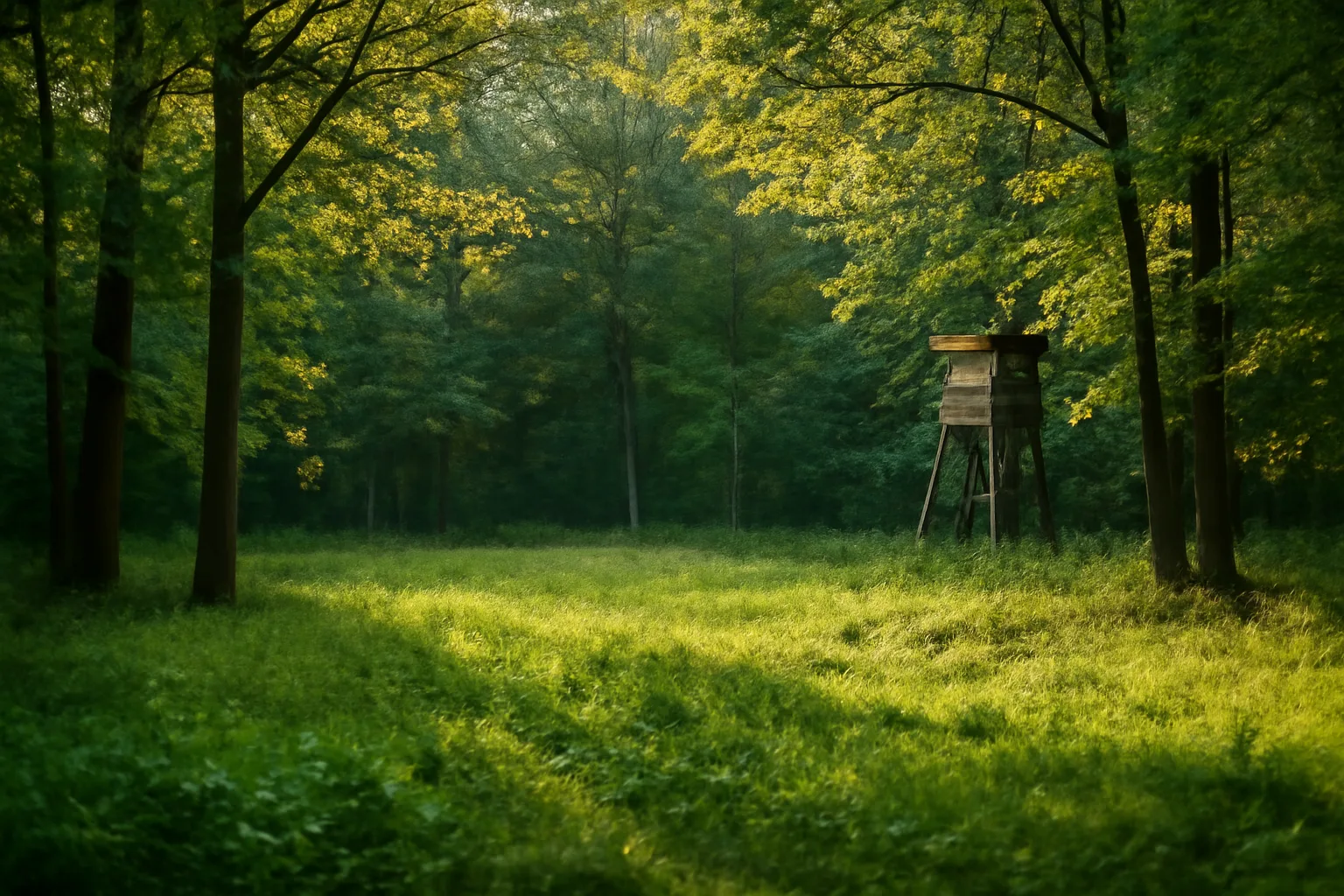
A food plot is a planted patch of forage, grain, or legumes managed specifically to feed and hold wildlife, most often whitetail deer. Most food plot advice online assumes you have open ag ground or a cleared field to work with. A lot of hunters don't. They've got 40 to 200 acres of hardwoods or mixed timber with a few natural openings, an old logging deck, a power line cut, or a spot where a few big oaks fell in a storm. Planting in the woods isn't a lesser version of a field plot. It's a different tool. A quarter-acre kill plot tucked into timber does something a 5-acre field plot can't: it puts deer inside bow range with cover on three sides and a controlled approach for you. The tradeoff is sunlight. Trees compete with your plants for light, water, and nutrients, and that changes which species will actually grow. Sunlight reaching the plot floor is the single biggest variable separating a productive woods plot from a wasted bag of seed. Less than 4 hours of direct sun a day and most food plot species, brassicas and soybeans especially, struggle or fail outright. If you're planning your first interior plot, it helps to also read up on general food plot whitetail strategy before you commit to a timber location, since some of the same fertility and seed-selection rules carry over.
How much sunlight does a food plot in the woods actually need?
Most food plot species need a minimum of 4 to 6 hours of direct sunlight a day to produce usable forage, and full-sun species like soybeans and brassicas do best with 6 or more hours. Anything under 4 hours is a long shot no matter what you plant. Before you clear a single tree, walk the spot at different times of day, ideally in spring or early summer when leaf canopy is full, and track how the light moves. A gap that looks bright at noon in March can be solid shade by June once the canopy leafs out. This is the mistake most first-time woods-plotters make: they scout in late winter, see sun on the ground, and plant a spot that's 90% shaded by July. A hinge-cut opening or a small clearcut of a half-acre to an acre, oriented so the long axis runs east-west, captures more midday sun than a narrow north-south slot. If you're working with an existing logging deck or a natural gap from a windthrow, that's often your best starting point because the canopy is already open and the soil hasn't been compacted by heavy equipment recently. Partial shade reduces both germination rates and total forage yield compared to full-sun plots of the same species. Budget for lower yield per square foot in timber, and plant a bit more acreage than you think you need if tonnage matters to you.
What are deer's favorite foods, and does that change in the woods?
Deer preference doesn't change because a plot is in the woods, but availability does. Whitetail diet studies consistently show acorns, soft mast, and high-protein browse rank among the most preferred natural foods, with agricultural crops like soybeans and corn ranking highest when available. In terms of planted forages, deer generally favor soybeans, clover, and standing corn over brassicas and cereal grains, though preference shifts hard by season, with brassicas becoming far more attractive after the first frost sweetens the leaves. In a woods setting, you're usually not going to get a soybean field to survive on 4 hours of light. So the practical answer is: plant what deer will actually eat that will also grow in your light conditions. Clover and cereal grains (oats, wheat, rye) top that list. They're shade-tolerant relative to full-sun row crops, and deer readily eat both. One thing worth remembering: your woods plot is competing with acorns most falls. In a heavy mast year, deer will often ignore a plot entirely in favor of white oak acorns on the ground. That's not a plot failure, that's just deer being deer. Plots in timber work best as a supplement to natural browse and mast, not a replacement for it.
Do deer eat clover, and is it a good choice for shaded plots?
Yes, deer eat clover readily, and it's one of the better choices for a shaded woods plot because it tolerates partial shade better than most other food plot species. White clover (Ladino types) and red clover both hold up under 4 to 6 hours of dappled light where brassicas or soybeans would thin out. Clover is a perennial, so once established it comes back for 3 to 5 years with proper mowing and fertility maintenance, which matters in the woods where re-tilling and re-seeding a shaded plot every year is more work than it's worth. Clover plots should be mowed periodically through the growing season to keep growth vegetative and palatable, and to knock back weed competition, which tends to be worse in wooded plots due to leaf litter and lower light discouraging thick clover canopy closure. The tradeoff is that clover needs decent soil pH, generally 6.0 to 6.5, to perform well, and a lot of timber soil runs more acidic than that naturally due to leaf litter decomposition and lower base saturation. This is exactly why a soil test matters more in the woods than in a field. If your test comes back at 5.2, you can plant all the clover you want and it will limp along until you correct pH with lime. For variety and shade tolerance side by side, it's worth comparing clover against other perennial options through deer food plots resources before you commit a whole shaded acre to one species.
When to plant oats for deer in a wooded plot
Oats are typically planted in late summer to early fall for a fall food plot, generally 60 to 90 days before your first expected hard frost, though exact windows depend heavily on your USDA Plant Hardiness Zone and region. In much of the whitetail's range that means a planting window somewhere between mid-August and mid-September for fall plots, and oats can also be planted in early spring in some regions as a quick, cool-season cover. Oats germinate fast, often within a week under good moisture, and they tolerate cooler soil temps and partial shade better than warm-season legumes like soybeans. That makes them a solid choice for a woods plot where you want quick green-up and coverage before bow season opens. The downside is oats are an annual and a frost-sensitive one at that; hard freezes in the teens will kill oats outright, so in northern zones they're really more of an early-to-mid-season fall attractant than a food source that lasts through late winter. Many hunters blend oats with cereal rye or winter wheat specifically because rye is far more cold-hardy and will carry the plot's green forage into late fall and winter after the oats die back. That blend approach shows up often in food plot seed mixes built for exactly this kind of layered fall planting.
When to plant turnips for deer, and will they grow in shade?
Turnips and other brassicas are generally planted in mid to late summer, roughly 80 to 100 days before your average first frost date, so the bulbs and leaves have time to mature before deer start hitting them hard after frost sweetens the sugars in the plant. In most of the Midwest and Southeast that lands somewhere between late July and early August; in the Deep South it can push into September. Here's the honest limitation for woods plots: brassicas, turnips included, are full-sun crops. They want 6 or more hours of direct light to bulb properly and produce real tonnage. In a shaded timber opening getting 4 hours of dappled sun, you'll get thin, leggy turnip plants with small or no bulbs. They're not a great pick for a tight interior woods plot unless you've got a genuinely open gap, like a powerline right-of-way or a clearcut, running through the timber. If your woods opening does get solid afternoon sun, turnips paired with cereal rye can still work well and give you a two-stage food source, green leafy forage early and a starchy bulb food source after a few hard frosts convert the starches to sugar. Just don't expect brassica performance in a plot buried under closed hardwood canopy.
Do deer eat sorghum, and does it fit a woods plot?
Deer will eat sorghum, particularly the grain heads once mature, and it's sometimes planted as a summer annual for both forage and as a standing grain source into fall and winter. Sorghum is a warm-season, full-sun crop, closely related to grain sorghum grown for livestock and wildlife feed programs, and it needs strong sun exposure and warm soil to establish. For a shaded woods plot, sorghum is a poor fit for the same reason turnips are: it's not shade tolerant and it needs a longer warm growing season to head out grain. It's much better suited to open ag fields or the sunniest cuts and clearings you've got, not a tight timber opening under canopy. If you have a genuinely open logging deck or a wide powerline cut inside your timber with 6-plus hours of sun, sorghum can work as a summer/fall standing grain plot, and it does double duty as escape cover once it grows tall. But for the classic small, shaded kill plot tucked into hardwoods, skip it and put your effort into clover, oats, or winter rye instead.
Do deer like honey, and is it worth using in a food plot?
Deer don't eat honey in any meaningful wild-foraging sense, and honey isn't a planted food plot input or attractant with any real agronomic role. This question shows up in search because of general "what do deer eat" curiosity, not because honey has a place in plot planning. Deer are herbivores that browse on woody stems, forbs, mast, and agricultural crops; they're not drawn to honey the way, say, bears are. If you're looking for a genuine sugar-based attractant angle, that's really a mineral/attractant scent question, not a food plot question, and it's also worth checking your state's baiting and feeding regulations before using any concentrated attractant, since many states regulate or outright ban baiting deer for hunting purposes and the rules vary significantly by state. Some states allow feeding outside of hunting season but ban it during season; others ban baiting for deer entirely. Check your state wildlife agency's regulations before assuming anything is legal, because a food plot itself is legal almost everywhere but supplemental feeding and baiting rules are a separate, often stricter, category.
When to plant food plots for deer: a general timing guide
| Northern (Zones 3-4) | Late May to mid-June | Late July to mid-August | Mid-July to early August | |
|---|---|---|---|---|
| Mid-latitude (Zones 5-6) | Early May to early June | Mid-August to mid-September | Late July to mid-August | |
| Southern (Zones 7-8) | April to May | Mid-September to mid-October | Late August to September | Woods plots don't change these dates much, but the shade does mean you should lean toward the earlier end of any window when possible, giving cool-season plants extra time to establish canopy and root mass before light competition from overhead trees becomes an issue as neighboring foliage fills back in the following spring. |
Food plot timing splits into two broad windows: spring/summer plantings for warm-season annuals and fall plantings for cool-season annuals and perennials, and the right window depends on your species choice and your USDA Hardiness Zone. There's no single national date because a hunter in Zone 4 (northern Minnesota, Maine) and a hunter in Zone 8 (south Georgia, north Florida) are working with frost dates months apart. As a rough national framework: spring plantings of soybeans, clover, or sorghum generally happen after your last frost date, often April through June depending on zone. Fall plantings of oats, wheat, rye, brassicas, and turnips generally happen 60 to 100 days before your first fall frost, often July through September depending on species and zone. Here's a simplified planting window table by broad region. These are general ranges; your local extension office has the actual frost data for your county. | Region (rough zone) | Spring annuals (soybeans, sorghum) | Fall cereal grains (oats, rye, wheat) | Brassicas/turnips |
How do you actually prep and plant a food plot in the woods?
Start with a soil test. This matters more in timber than in a field because wooded soils are frequently more acidic (often pH 5.0 to 5.5) due to years of leaf litter decomposition, and they're often lower in phosphorus and calcium than adjacent ag ground. Your soil test lab is the real authority here, not a blog post; they'll tell you exactly how much lime and what fertilizer blend your specific dirt needs. A general guideline can get you close, but the lab report is site-specific and it's worth following it over generic advice. Once you've got your test results, here's the general sequence for a woods plot: 1. Clear the opening. Cut back overhanging limbs, remove or hinge-cut competing understory trees, and get as much direct sun onto the plot floor as you can, ideally 4-plus hours. 2. Test soil pH and nutrients, then apply lime and fertilizer per your lab's recommendation. Because wooded soil pH correction is slow, spreading lime a season ahead of planting, if you can manage it, gives it time to work into the root zone. 3. Clear leaf litter and debris, then till or disc lightly. In tight spots without equipment access, a hand-push tiller or even a rake-and-hand-broadcast approach works on small plots under an acre. 4. Broadcast seed at the recommended rate for your species, then drag or cultipack to get seed-to-soil contact. Seed sitting on top of leaf litter with no soil contact often just doesn't germinate. 5. Fence or protect a portion if you're worried about deer browsing seedlings into the ground before they establish, a real risk in a small, isolated plot with a resident deer population. Equipment access is often the real bottleneck in wooded plots. If you can't get a tractor back to a remote opening, look at compact or walk-behind options; a lot of woods-plotters run ATV-mounted or hand-push equipment specifically because of tight trail access. Equipment and methods style planning matters as much as species choice for these interior plots.
Small kill plots vs. destination plots: which one fits your timber?
Woods plots generally fall into two categories: small kill plots (quarter-acre to half-acre, tucked tight against a stand for bow range) and larger destination or transition plots (half-acre to a few acres, meant to pull deer off neighboring land and hold them through more of the season). Which one fits your property depends on the size of your openings and your hunting pressure tolerance. A kill plot works best planted with something deer will hit in low light near dusk, like clover or a brassica/cereal blend, and it should be small enough that a single deer's browsing pressure doesn't wipe it out before season. Because these plots are so small, over-browsing is a real risk; a half-dozen deer working a quarter-acre plot can hammer it down fast, especially early in establishment. A larger destination plot in a bigger clearing or powerline cut can support more diverse plantings, including some full-sun options if the light is there, and it's more forgiving of browse pressure just due to sheer plant volume. If you're choosing between the two for a given piece of ground, match the plot size and species list to the actual canopy opening you have, not the plot design you saw on a hunting show filmed on an open Midwest field.
Getting a plan built for your specific woods opening
Every wooded property is different: canopy density, soil type, slope, deer density, and hunting pressure all vary block to block, and a lot of generic seed bag instructions just don't account for a half-acre opening surrounded by oak canopy. If you'd rather not guess at species and timing on your own, PlotSeason's $99 one-time Custom Food Plot Plan (/plot-plan-builder) walks through your specific location, soil test results, and equipment on hand to build a planting plan suited to your ground. It's general guidance built around your inputs, not site-specific agronomy from a certified agronomist, and your soil lab's recommendations still take priority on lime and fertilizer rates. Whether you build a plan yourself or use a tool to help, the fundamentals don't change: measure your actual sunlight, test your soil, pick species that match both, and time the planting to your zone's frost dates, not a generic national calendar.
Frequently asked questions
Do deer eat sorghum in food plots?
Yes, deer eat sorghum, especially the mature grain heads, and it's used in some standing grain food plots. It's a full-sun, warm-season crop, though, so it's a poor fit for shaded woods openings and works best in open fields or wide clearings with 6 or more hours of direct sunlight.
Do deer eat clover, and how much shade can it handle?
Deer readily eat clover, and it's one of the more shade-tolerant food plot species available, handling 4 to 6 hours of dappled light better than brassicas or soybeans. It needs soil pH around 6.0 to 6.5 to thrive, so a soil test is worth doing before planting, especially in acidic timber soil.
When should you plant deer food plots?
Timing depends on species and your USDA Hardiness Zone. Warm-season plants like soybeans go in after last frost, roughly April through June. Cool-season plants like oats, rye, and brassicas go in 60 to 100 days before first fall frost, generally July through September depending on region.
Do deer like clover better than other food plot options?
Deer generally rank clover highly, often just behind soybeans and standing corn in preference studies, and well ahead of straight cereal grains. Its shade tolerance and multi-year perennial growth make it a favorite specifically for wooded plots, where full-sun options like soybeans and brassicas underperform.
When should you plant oats for deer?
Oats are typically planted 60 to 90 days before your area's first hard frost, often mid-August through mid-September in much of the whitetail range. They germinate quickly and tolerate partial shade well, but a hard freeze in the teens will kill them, so pair with cereal rye for late-season coverage.
When should you plant food plots for deer in general?
Spring annuals like soybeans go in after your last frost date. Fall annuals like oats, wheat, rye, and brassicas go in 60 to 100 days before your first fall frost. Exact dates shift by USDA zone, so check your local cooperative extension office's frost date charts for your county.
When should you plant turnips for deer?
Turnips are generally planted 80 to 100 days before first frost, often late July through early August in much of the Midwest and Southeast. They need 6-plus hours of direct sun to bulb properly, making them a weak choice for tightly shaded woods plots unless the opening gets strong afternoon light.
What is a food plot?
A food plot is a planted patch of forage, grain, or legumes managed to feed and attract wildlife, most commonly whitetail deer. Plots range from quarter-acre bow-range plots tucked into timber to multi-acre agricultural-style fields, and species selection depends heavily on sunlight, soil fertility, and regional climate.
What are deer's favorite foods?
Whitetail diet research shows deer favor acorns and soft mast among natural foods, and soybeans, clover, and standing corn among planted crops, with strong seasonal shifts, brassicas become far more attractive after a hard frost sweetens the leaves. Preference also depends heavily on what's locally available and abundant.
Do deer like honey?
No, honey isn't part of a deer's natural diet or a real food plot input. Deer are herbivores focused on browse, mast, forbs, and crops. If you're considering sugar-based attractants, check your state wildlife agency's baiting and feeding regulations first, since rules on that vary a lot by state.
How much sunlight does a woods food plot need to succeed?
Most food plot species need at least 4 to 6 hours of direct sunlight daily, with full-sun crops like soybeans and brassicas wanting 6-plus hours. Scout your opening in late spring or summer when the canopy has fully leafed out, not late winter, since light levels change drastically once trees leaf out.
Can you plant a food plot without heavy equipment in tight timber?
Yes. Small woods plots under an acre can be prepped with hand tools, a rake, and a push tiller or ATV-mounted disc if trail access allows. Broadcast seed by hand and drag a section of chain-link fence or cultipacker over it to get seed-to-soil contact for germination.
Sources
- Fox et al., 'Whitetail deer diet composition and seasonal forage selection,' via National Library of Medicine, PMID 24955840: Whitetail deer diet composition shifts seasonally between mast, browse, and agricultural forage
- USDA Natural Resources Conservation Service, Plant Guide for White Clover (Trifolium repens): White clover performs best in soil pH generally in the 6.0 to 6.5 range and tolerates partial shade better than full-sun legumes
- USDA Natural Resources Conservation Service, Plant Guide for Turnip (Brassica rapa): Brassicas including turnips are generally planted roughly 80 to 100 days before first frost and need strong sun exposure
- USDA Natural Resources Conservation Service, Plant Guide for Oat (Avena sativa): Oats germinate quickly and tolerate cooler soil temperatures and partial shade better than warm-season legumes
- USDA Natural Resources Conservation Service, Plant Guide for Sorghum (Sorghum bicolor): Sorghum is a warm-season, full-sun crop requiring warm soil temperatures to establish