Last updated 2026-07-26
TL;DR
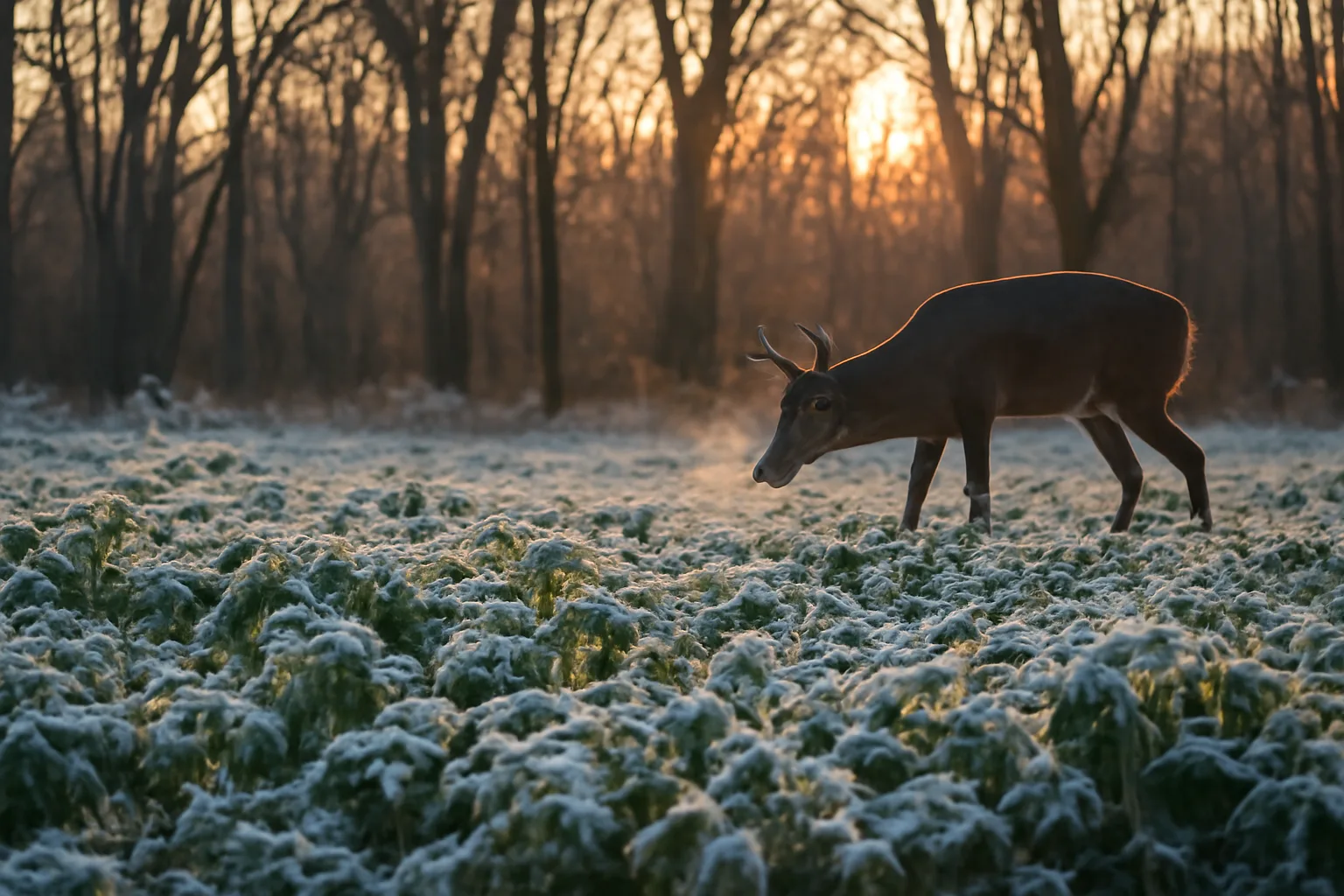
The best winter food plots combine brassicas (turnips, radishes) with cereal grains (oats, wheat) and a perennial clover base. Brassicas need frost to convert starches to sugars, cereal grains stay green under snow, and clover regrows each spring. Plant 60 to 90 days before your first hard frost, matched to your USDA zone.
what is a food plot, exactly
A food plot is a planted patch of forage on hunting land meant to feed deer and other wildlife, usually somewhere between a quarter acre and a few acres, though plenty of guys plant smaller kill plots tucked into thick cover. It's not a garden and it's not a lawn. The goal is tonnage of digestible protein or carbohydrate at the right time of year, planted in a spot deer will actually use and that you can hunt without blowing them out. Most state wildlife agencies treat food plots differently from bait piles or feeders. Planted, standing crops are legal in nearly every state because the deer are foraging naturally off a growing plant, not eating from a pile you dumped. But the line between a food plot and baiting gets fuzzy in a few states, and rules on feeders and mineral sites vary a lot by state. Check your state wildlife agency's regulations before you plant anything you're unsure about, especially if you're near a state with strict baiting bans like Michigan, which prohibits baiting and feeding of deer under Michigan Department of Natural Resources rules [1]. A winter food plot specifically is planted to still be producing food, or at least still standing and palatable, once the ground freezes and native browse disappears. That's a different job than a summer plot, which is mostly about antler growth and lactation nutrition. Winter plots are about calories and survival, plus late-season hunting opportunity.
what makes a food plot good for winter specifically
A good winter plot has to do two things a summer plot doesn't: survive a hard freeze and still be attractive after repeated frosts have hit it. That rules out a lot of warm-season stuff like soybeans and cowpeas, which get hammered by the first freeze and turn to mush or drop their leaves. The plants that hold up best fall into three groups. Brassicas (turnips, radishes, kale, rape) actually get sweeter after a hard frost because the plant converts starches to sugars as a cold-tolerance response, which is why deer often ignore a brassica plot in October and hammer it in December. Cereal grains (winter wheat, winter rye, oats) stay green and grazable under snow in a lot of climates, with cereal rye being the most cold-hardy of the bunch. Perennial clovers go dormant but green back up fast in late winter and early spring, giving you a plot that's still producing when everything else is gone. The honest answer to "what is a good winter food plot for deer" isn't one species. It's a blend that layers these together so you've got tonnage in October, sweetness in December, and green groceries in February. A lot of hunters over-index on picking the one perfect seed. Timing and soil fertility matter more than the seed tag.
do deer eat sorghum
Yes, deer will eat grain sorghum, but it's a lower priority forage for most whitetail plots compared to brassicas or cereal grains. Sorghum is more commonly planted as a screening or bedding cover crop, or as a late-season standing grain source in states where corn struggles or costs too much to plant per acre. Deer will browse young sorghum plants and eat the grain heads once they mature and dry down, and turkey and other wildlife use it heavily too. But sorghum isn't as cold-hardy as cereal rye or wheat, and it doesn't have the sugar-conversion trick that brassicas have. If you're specifically building a winter plot for whitetail, sorghum is a supporting player at best, mostly useful for cover and screening between plots rather than as your primary winter forage. Grain sorghum tolerates drought well, per USDA Natural Resources Conservation Service plant guides, which is why it shows up more in dry Western and Southern Plains plantings than in Midwest winter deer plots [2].
do deer eat clover, and do deer like clover
Deer eat clover readily and it's one of the most consistent forages across the whitetail's range. Clover is a perennial legume, meaning a single planting can produce forage for three to five years if you maintain it, and it's high in crude protein, often tested in the 25 to 30 percent range during active growth according to forage analyses cited by university extension programs. Do deer like clover? Yes, it's consistently one of the top-ranked forages in preference studies and it's a staple of most food plot programs for a reason. It's palatable nearly year-round in mild climates, it fixes its own nitrogen so it needs less fertilizer than grasses, and it recovers from grazing pressure better than almost anything else you can plant. The catch for winter specifically: clover goes dormant in cold climates and stops producing new growth once hard frosts hit. It's not a true winter powerhouse forage the way brassicas or cereal grains are, but it's an excellent shoulder-season plot that bridges late fall into the first hard freezes, and it greens back up earlier than almost anything else in late winter and early spring. For a winter-specific plot, clover works best as part of a blend or as a perennial base plot planted alongside an annual brassica or grain plot, not as your sole winter offering in the North.
when to plant food plots for deer, by region
| Zone 3-4 (northern Midwest, upper Great Lakes) | Late July to mid-August | |
|---|---|---|
| Zone 5-6 (central Midwest, mid-Atlantic) | Mid-August to mid-September | |
| Zone 7-8 (southern Appalachians, mid-South) | Early September to early October | |
| Zone 9 (deep South, Gulf Coast) | Late September to November | These windows come from typical first-frost dates by zone; check your specific county's average frost date through your state's cooperative extension office rather than relying on the zone alone, since local microclimates shift things by two or three weeks in either direction. A food plot whitetail plan built around your actual zip code beats a generic calendar every time. |
Timing depends entirely on your frost dates, and this is the single most common mistake hunters make: planting winter annuals too late. Brassicas and cereal grains need real growing time before a hard frost to bulk up, and if you plant three weeks before frost instead of ten, you'll get a thin, disappointing plot. As a general rule from state extension guidance, plant fall/winter brassica and cereal grain plots 60 to 90 days before your area's average first hard frost date [3]. That gives brassicas time to bulb out and cereal grains time to establish a root system before winter dormancy. | Region (USDA zone) | Typical planting window for fall/winter annuals |
when to plant oats for deer
Plant oats for deer 60 to 90 days before your first expected hard frost, the same general window as other cereal grains. Oats germinate fast, often within 7 to 10 days in warm soil, and put on a lot of leafy growth quickly, which makes them a favorite for quick fall attraction plots. The tradeoff: oats are the least cold-hardy of the common cereal grains. They'll typically die back once temperatures drop into the low teens or single digits, unlike winter wheat and cereal rye, which can survive much harder freezes and keep growing into winter and again in spring. If you're in a zone with brutal winters (zone 4 and colder), oats are better treated as an early fall attraction crop or a nurse crop mixed with clover, not your main late-winter forage. Farther south, where hard freezes are milder or less frequent, oats can hold on and provide grazing well into winter. A common and effective approach: mix oats with cereal rye or winter wheat. The oats give you fast early growth and attraction, and the rye or wheat carries the plot through the coldest months after the oats have died back.
when to plant turnips for deer
Plant turnips for deer 60 to 90 days ahead of your first hard frost, generally from late July through early September depending on your zone. Turnips need that lead time to bulb up; planted too late, you'll get leafy tops but small or no bulbs, and the bulb is a big part of the winter calorie payoff. Turnip tops are palatable to deer from the moment they emerge, so you'll often see grazing pressure on the leaves through fall. The bulbs themselves usually don't become attractive until after one or two hard frosts convert their starches to sugars, which is why a turnip plot can look completely untouched in November and get devastated in late December and January. This delayed-attraction pattern is well documented in university food plot research and is one of the most useful things to understand if you're timing a late-season hunt over a brassica plot [4]. Seeding rate matters here more than people think. Broadcasting turnips too heavy gives you a thick canopy of tops and small, spindly bulbs. Extension guidance generally recommends drilling turnips at around 4 to 6 pounds per acre or broadcasting slightly heavier, and soil testing to correct pH and phosphorus, since brassicas are heavy feeders and perform poorly in acidic soil below about pH 6.0.
what are deer's favorite food, and how does that change in winter
There's no single answer to what deer's favorite food is, because preference shifts hard by season and by what's available. In spring and summer, deer favor high-protein browse, forbs, soybeans, and clover. In fall, acorns often beat almost anything you can plant, when they're available in volume, deer will leave a soybean field to hammer a white oak flat. In winter, once acorns are gone and native browse is stripped down, preference shifts to whatever still has sugar and digestible energy: frosted brassica bulbs and tops, standing corn or grain sorghum, and the leftover green growth on cereal grains and clover. Research on white-tailed deer diet composition, including long-running work summarized by university wildlife programs, consistently shows deer are opportunistic browsers whose diet tracks seasonal availability rather than a fixed hierarchy of favorites [5]. That's the honest answer: deer eat what's calorie-rich and available right now, and a well-planned food plot program tries to have something in that category in every season, more than one great fall plot. If you're picking one plot to plant and can only do one, a brassica and cereal grain blend covers more of the late-season calendar than a pure clover plot or a pure corn plot would.
do deer like honey (crops, not the food)
This question usually comes from confusion with "honey hole," a hunting term for a hotspot, not an actual food. Deer don't eat honey and it has no place in a food plot program. If you've heard "honey" mentioned around food plots, it's probably someone talking about a honey locust tree, which does produce pods that deer eat readily in fall, or they're describing a plot as their "honey hole," meaning their best spot. Honey locust pods are a legitimate natural deer food where the trees exist, high in sugar content, and deer will travel to hit a producing tree hard in October and November. But you can't plant a honey locust and expect food plot results, it's a slow-growing tree, not an annual forage crop, so it's not really in the same conversation as turnips or clover for winter plot planning.
how do I build a winter plot blend that actually works
Start with soil, not seed. A soil test is the cheapest insurance you can buy for a food plot, typically $10 to $20 through your state's land-grant university soil lab, and it tells you your actual pH and nutrient levels instead of guessing . Brassicas and clover both perform poorly below pH 6.0, and a lot of "the deer didn't touch my plot" complaints trace back to soil that never got limed. Your soil test lab is the authority on how much lime and fertilizer your specific field needs; a general plan can point you toward species and timing, but it can't replace a lab result from your dirt. A solid winter blend for most of the whitetail's range: 40 percent brassica (turnips and radish mixed), 40 percent cereal grain (oats and winter rye or wheat mixed), 20 percent clover for perenniality. Drill or broadcast at rates matched to the label, cultipack or drag if you broadcast, and get it in the ground on the early end of your window rather than the late end. If you're not sure how to weight that blend for your specific soil and zone, that's exactly the kind of thing a $99 one-time Custom Food Plot Plan is built to sort out, matching species and seeding rates to your zip code and soil test instead of a one-size-fits-all bag mix. Don't skip potash and phosphorus. Brassicas in particular are heavy feeders, and a soil test will usually call for more phosphorus and potassium than a typical no-till drill operator assumes.
what about perennial options for a winter-heavy program
If you want less annual replanting, a clover and chicory perennial base plot paired with a smaller annual brassica or grain plot covers more of the calendar with less yearly labor. Clover and chicory stands can run three to five years before needing renovation, according to extension forage management guides, as long as you're mowing to control weeds and maintaining fertility with an annual soil test. The tradeoff is winter performance. Perennials go dormant in real cold and don't have the frost-sweetened bulb trick brassicas have, so in zone 5 and colder, a pure perennial plot won't carry you through January the way a brassica plot will. The best programs I've seen split acreage: perennial clover for spring, summer, and early fall, with a dedicated annual brassica and grain plot for the December through February window. If acreage is tight, that annual winter plot is the one to prioritize, since a hungry deer in February has fewer other options than a deer in June. Check out deer food plot seed options if you're comparing blends, and food plot seed for a broader rundown on species selection before you buy.
Frequently asked questions
Do deer eat sorghum in food plots?
Yes, but it's a secondary choice. Deer browse young sorghum and eat the mature grain heads, and it's useful for screening cover and drought-prone soils, but it lacks the cold-hardiness of cereal rye or the frost-sweetening trick of brassicas, so it's rarely the main species in a dedicated winter plot.
Do deer like clover, and will they eat it all winter?
Deer like clover a lot and it's often one of the highest-preference forages tested, running 25 to 30 percent crude protein when actively growing. It goes dormant in cold climates though, so it's better as a spring-through-fall staple paired with brassicas or cereal grains for true winter coverage.
When should I plant food plots for deer?
For fall and winter annuals, plant 60 to 90 days before your area's average first hard frost date, generally late July through early September in the Midwest and upper South, and into October in the deep South. Check your county's average frost date through your state cooperative extension office rather than guessing.
When do I plant oats for deer?
Plant oats 60 to 90 days before your first hard frost, same general window as other cereal grains. Oats germinate fast and grow leafy quickly but die back in hard cold, so in zone 4 and colder they work best mixed with more cold-hardy rye or wheat.
When should turnips be planted for deer?
Plant turnips 60 to 90 days before your first hard frost, usually late July through early September depending on your zone. They need that lead time to bulb up properly, and the bulbs don't become highly attractive until after one or two hard frosts convert starches to sugar.
What exactly is a food plot?
A food plot is a planted area of forage, usually a quarter acre to a few acres, established specifically to feed deer or other wildlife and often to create a hunting opportunity. It differs from bait piles or feeders because deer are grazing a standing, growing crop rather than eating from a dumped food source.
What is a deer's favorite food?
There's no fixed favorite. Deer preference shifts by season: acorns and soft mast dominate in fall when available, clover and forbs lead in spring and summer, and frosted brassica bulbs, cereal grains, and standing corn become top picks once winter strips away native browse.
Do deer like honey?
Deer don't eat honey. The confusion usually comes from "honey locust," a tree whose sugar-rich pods deer do eat in fall, or from hunters calling a great spot their "honey hole." Neither is relevant to planting an actual winter food plot.
What's the best single species for a winter food plot?
There isn't one best species. A blend of brassicas (turnips, radish) for frost-sweetened bulbs, cereal grains (oats, wheat, rye) for cold-hardy standing forage, and clover for perennial spring green-up covers more of the winter calendar than any single crop planted alone.
How late is too late to plant a winter food plot?
If you're inside 30 days of your first hard frost, brassicas won't have time to bulb properly and cereal grains will be thin going into winter. You can still plant for some late fall grazing value, but don't expect the tonnage or frost-sweetened attraction a properly timed plot delivers.
Is a food plot the same as baiting deer?
No, in most states a planted, standing crop is legal where bait piles or feeders may not be, since deer forage it naturally as it grows. Rules vary by state though, and some states, like Michigan, restrict baiting and feeding broadly, so check your state wildlife agency's current regulations before planting or hunting over a plot you're unsure about.
Do I need a soil test before planting a winter plot?
You don't strictly need one, but skipping it is the most common reason winter plots underperform. A soil test costs roughly $10 to $20 through most state land-grant labs and tells you the actual lime and fertilizer needs for your field, since brassicas and clover both struggle below pH 6.0.
Sources
- Michigan DNR, Baiting and Feeding Regulations: Michigan prohibits baiting and feeding of deer under state DNR rules
- USDA NRCS, Plant Guide: Grain Sorghum: Grain sorghum tolerates drought well and is commonly used in dry Western and Southern Plains plantings
- University of Tennessee Extension, Brassicas for Deer: Brassica bulbs become more palatable to deer after repeated hard frosts convert starches to sugars
- University of Georgia, Warnell School Deer Nutrition and Diet Research: White-tailed deer diet composition tracks seasonal forage availability rather than a fixed food hierarchy
- University of Missouri Extension, Soil Testing for Lawns, Gardens and Food Plots: Typical cost range for a standard soil test through a university soil lab